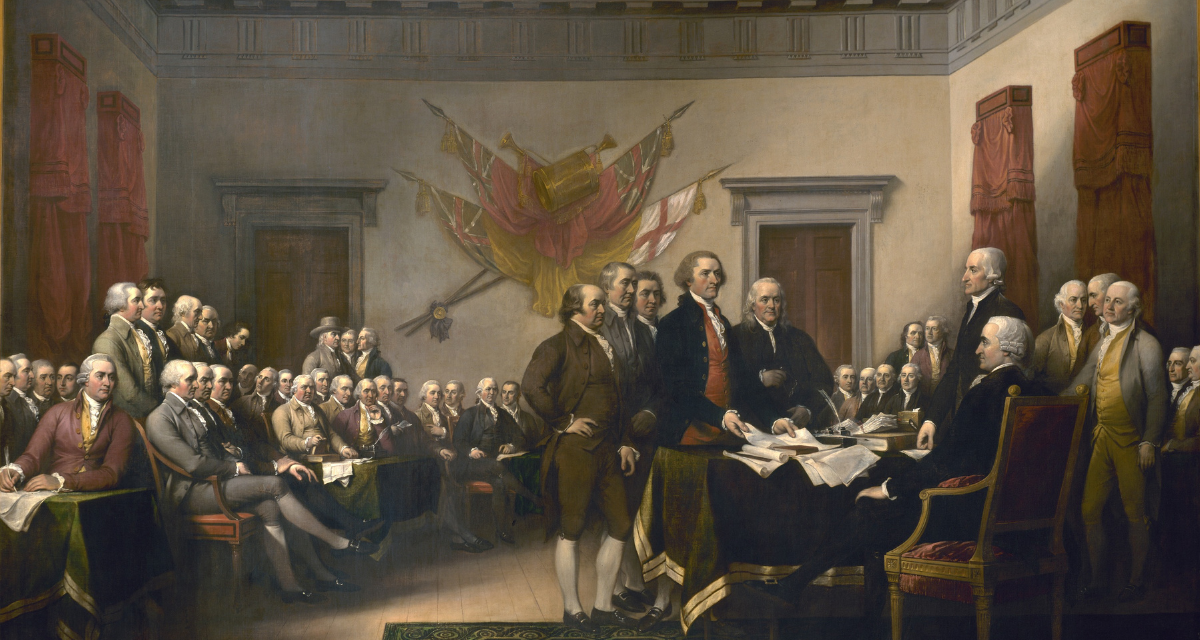
On July 4, the United States of America will celebrate its 250th birthday. Called the “semiquincentennial,” the day will commemorate 250 years since the Declaration of Independence was signed.
Of course, English was spoken by colonial Americans, and they had a distinctive accent that was unique to the newly formed country.
Surprisingly, they did not sound British. That’s because by the time of the Revolutionary War, two new generations had been born on American soil, according to JSTOR.
British English and American English began to develop separately. An English tourist commented on the colonial American dialect in 1770:
“The colonists are composed of adventurers, not only from every district of Great Britain and Ireland, but from almost every other European government…Is it not therefore reasonable to suppose that the English language must be greatly corrupted by such a strange admixture of various nations? The reverse is however true. The language of the immediate descendants of such promiscuous ancestry is perfectly uniform, and unadulterated; nor has it borrowed any provincial, or national accent from its British or foreign parentage.”
9 interesting colonial American words
Many words from colonial America have faded from the modern-day lexicon. But a book from 1785 titled The Vulgar Tongue by author Francis Grose documented slang used during colonial times. The book was reprinted over the years, including an updated version titled 1811 Dictionary of the Vulgar Tongue.
The word “vulgar” had a different meaning than it does today. “Vulgar” meant “common” or “ordinary,” according to Merriam-Webster.
Here are nine fascinating colonial-era words to add to your lexicon:
Adam’s ale
This is another word for water. According to Merriam-Webster, its origins are “after the biblical Adam; from its being provided by nature and thus presumably being the only drink in the Garden of Eden.” The term’s first known use was in 1643.
Altitudes
This is another word for drunk. According to the 1811 Dictionary of the Vulgar Tongue, it means “the man is in his altitudes, i.e. he is drunk.”
Arsy yarsey
According to the 1811 Dictionary of the Vulgar Tongue, it means “to fall arsy varsey, i.e. head over heels.”
Merriam-Webster defines it as “backside forward; head over heels; topsy-turvy.” It goes on to add that the word is “a non-reduplicative (yet still very cheeky) equivalent of arsy-varsy would be the expression ass over teakettle. However, arsy-varsy may be used as both adverb (modifying an action, as in the first example below) or an adjective (modifying a noun, as in the second) meaning ‘topsy-turvy’ or ‘disordered.’”
Calibogus
Surprisingly, this is the name of a colonial drink. According to the 1811 Dictionary of the Vulgar Tongue, it means “rum and spruce beer, American beverage.” It may also have been sweetened with molasses, according to Merriam-Webster.
Carroty-pated
This is another word for a redhead. According to the Collins Dictionary, “carroty” means “a reddish or yellowish-orange colour; having red hair.” The word “pated” means “having a (specified kind of) pate, or head.”
Caudge-pawed
This is another word for left-handed, according to the 1811 Dictionary of the Vulgar Tongue.
Flam
According to the 1811 Dictionary of the Vulgar Tongue, it means “a lie, or sham story: also a single stroke on a drum. To flam; to hum, to amuse, to deceive. Flim flams; idle stories.”
While it was used in colonial times, its history dates further back. Merriam-Webster explains:
“‘Flimflam’ first entered English as a noun meaning ‘deceptive nonsense’ in the second half of the 16th century. A sense meaning ‘deception’ or ‘fraud’ soon developed. The verb use didn’t show up until well into the next century. In addition to general deceiving or tricking, the verb ‘flimflam’ is often used specifically to refer to swindling someone out of money. The ultimate origin of ‘flimflam’ is uncertain, but the word is probably of Scandinavian origin and may be related to the Old Norse flim, meaning ‘mockery’.”
Huzza
This celebratory word was chanted during colonial times. According to the 1811 Dictionary of the Vulgar Tongue, it means “said to have been originally the cry of the huzzars or Hungarian light horse; but now the national shout of the English, both civil and military, in the sea phrase termed a cheer; to give three cheers being to huzza thrice.”
American colonists also adopted the word. According to Dr. Tyler Putman at the Museum of the American Revolution, it also had a surprising pronunciation: hu-ZAY (like “hooray”), not hu-ZAH (like “hoorah”).
Oyster
This word had a second meaning besides the shellfish. According to the 1811 Dictionary of the Vulgar Tongue, it means “a gob of thick phlegm, spit by a consumptive man; in law Latin, UNUM [one] VIRIDUM [green] GOBBUM [lump or mass].”