Woman who gave her baby up for adoption gets a wonderful surprise from the new family
"You know, you can't have too many people loving you, right?”

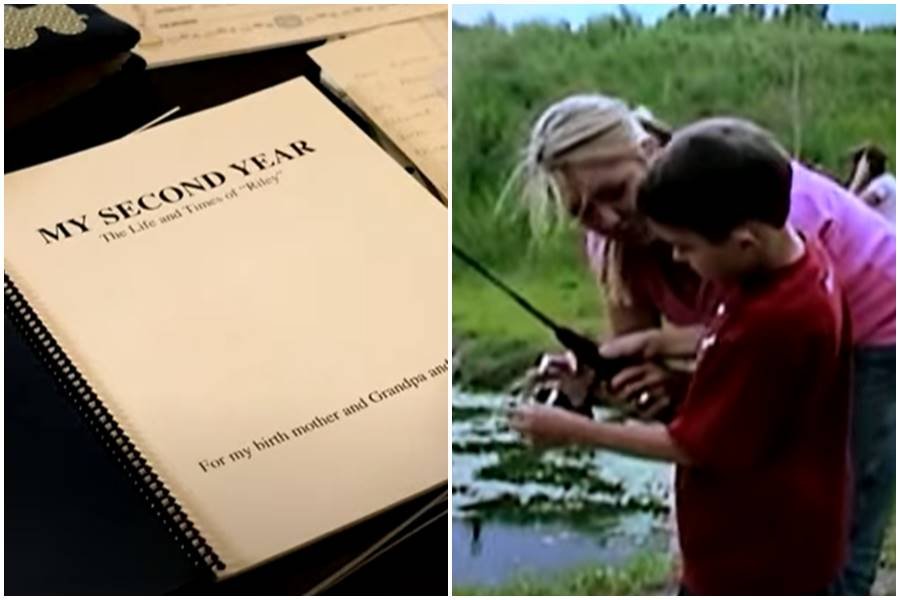
A journal detailing Steven Schoebinger's young life.
At Upworthy, we love sharing the “best of humanity” with our audience, and this story out of Utah, originally reported by CBS News’ Steve Hartman, shows the power of love to break down barriers.
When Schauna Austin, 48, was 20 years old, she got pregnant and knew she wasn’t ready to raise a child, so she made the difficult decision to give the baby up for adoption. She gave birth to a son she named Riley and only had three days to spend with him before surrendering him to his new family.
So, she held him tight for 72 hours straight.
"It was perfect," Austin said about those three emotionally-charged days. "I knew I would have him for a short time, so I made every minute count of it. I didn't sleep for three days." It must have been tough for Austin to give up her son because the grieving process of surrender and adoption can be incredibly difficult.
Riley, renamed Steven, was given to Chris and Jennifer Schoebinger in a closed adoption, where Austin was not to be informed about the adoptive family. In Utah, closed adoptions are a rarity these days, with about 95% allowing some exchange of information between the birth and adoptive parents.
However, about a week later, the Schoebingers had a change of heart.
The Schoebingers decided Austin should be involved in Steven’s life. "It was like, 'OK, this is the way it should be. She was part of our family,'" Jennifer told CBS News. "You know, you can't have too many people loving you, right? Why couldn't he be both of ours?" Chris added.
Every year, the Schoebingers sent Austin pictures and bound journals showing Steven's journey in deep detail. They even had lists of all the new words he learned each year. The books were titled “The Life and Times of ‘Riley,’” paying homage to Steven’s original name.
The hope was that one day when the biological mother and son were ready, they could pick up where they left off. That moment came when Steven was seven years old and Austin taught him to fish.
He’s heeere!!! 🥹 Our first grandchild. Welcome, Riley. You don’t know me yet, but our home will always be your home. No matter what life throws your way, you will be loved and accepted and we’ll eat pie! And ice cream. And you’ll wonder if that’s the only thing grandpa eats? 🤣 pic.twitter.com/7ac8A0GVKI
— Chris Schoebinger (@PUBGUY) August 19, 2022
The unique arrangement has been fantastic for both Austin and her biological son. "I was blessed beyond words," Austin said. "I kind of got the best of both worlds, for sure," Steven agreed. It may seem like relationships between children and those who gave them up for adoption would be complicated, but studies show that 84% of adoptees reported high levels of satisfaction when maintaining ongoing contact with their birth parents.
Steven is now 27 and in August 2022, he and his wife, Kayla, had their first child, a boy they named Riley. Austin is now a grandmother.
The remarkable story of Austin and the Schoebinger family proves that when we put walls between ourselves and others, we are often blocking everyone off from more love and support. "I think the lesson we learned is that sometimes we create barriers where barriers don't need to be. And when we pull down those barriers, we really find love on the other side," Chris said.
This article originally appeared last year.

- 'She just needed somebody to help her'—principal adopts student after she's suspended ›
- A dying woman left a heartwarming note to her cat’s future owner. ›
- A woman who grew up in foster care explains why the 'adoption not abortion' argument doesn't fly. ›
- Adoptive mom's secret letters to biological mother for 17 years - Upworthy ›
- Doctor who adopted and raised a teen boy teared up when he discovered the kid's true identity - Upworthy ›


Student smiling in a classroom, working on a laptop.
Students focused and ready to learn in the classroom.
Fish find shelter for spawning in the nooks and crannies of wood.
Many of these streams are now unreachable by road, which is why helicopters are used.
Tribal leaders gathered by the Little Naches River for a ceremony and prayer.

Communications expert shares the perfect way to gracefully shut down rude comments
Taking the high ground never felt so good.
A woman is insulted at her job.
It came out of nowhere. A coworker made a rude comment that caught you off guard. The hair on the back of your neck stands up, and you want to put them in their place, but you have to stay tactful because you're in a professional setting. Plus, you don't want to stoop to their level.
In situations like these, it helps to have a comeback ready so you can stand up for yourself while making making sure they don't disrespect you again.
Vince Xu, who goes by Lawyer Vince on TikTok, is a personal injury attorney based in Torrance, California, where he shares the communication tips he's learned with his followers. Xu says there are three questions you can ask someone who is being rude that will put them in their place and give you the high ground:
Question 1: "Sorry, can you say that again?"
"This will either make them have to awkwardly say the disrespectful remark one more time, or it'll actually help them clarify what they said and retract their statement," Xu shares.
Question 2: "Did you mean that to be hurtful?"
The next step is to determine if they will repeat the disrespectful comment. "This calls out their disrespect and allows you to learn whether they're trying to be disrespectful or if there's a misunderstanding," Xu continues.
Question 3: "Are you okay?"
"What this does, is actually put you on higher ground, and it's showing empathy for the other person," Xu adds. "It's showing that you care about them genuinely, and this is gonna diffuse any type of disrespect or negative energy coming from them."
The interesting thing about Xu's three-step strategy is that by gracefully handling the situation, it puts you in a better position than before the insult. The rude coworker is likely to feel diminished after owning up to what they said, and you get to show them confidence and strength, as well as empathy. This will go a lot further than insulting them back and making the situation even worse.
Xu's technique is similar to that of Amy Gallo, a Harvard University communications expert. She says that you should call out what they just said, but make sure it comes out of their mouth. "You might even ask the person to simply repeat what they said, which may prompt them to think through what they meant and how their words might sound to others," she writes in the Harvard Business Review.
More of Gallo's suggested comebacks:
“Did I hear you correctly? I think you said…”
“What was your intention when you said…?”
“What specifically did you mean by that? I'm not sure I understood.”
“Could you say more about what you mean by that?”
Ultimately, Xu and Gallo's advice is invaluable because it allows you to overcome a negative comment without stooping to the other person's level. Instead, it elevates you above them without having to resort to name-calling or admitting they got on your nerves. That's the mark of someone confident and composed, even when others are trying to take them down.