Imagine you’re walking deep in the woods when some kind of potentially aggressive wildlife appears. Ask yourself: Would you run? Would you freeze? So many of us have seen online videos where a bear, wolf, or cougar shows up in someone’s path and they have to think super quickly to avoid trouble—or even worse!
A viral video shared by Wilderness Escape Adventures and CBS News shows a bone-chillingly terrifying close encounter. A woman is walking with her large black dog on a leash in Alberta, Canada, when a grizzly spots them and starts toward them.
Guttural growls
Her survival instinct worked. While it seems she didn’t have a gun or bear spray, she did a lot of things correctly in their absence. She didn’t run or turn her back, which could have proven disastrous. Instead, she, in a sense, became an animal, choosing guttural growls and yelps to show aggression, but not fear.
As the bear continues coming toward her, it occasionally gets on its hind legs, which could be seen as an escalation. She loudly growls words like “stop,” “enough,” “go away,” and “No!” Even when it looks like the bear might be retreating, she never lets up with the growls and screams until she gets safely to a car.
The comment section, and there are thousands of comments, is roaring with opinions. Many point out that she’s filming and how that could have distracted her, giving her one less hand for the situation. Others responded that the camera didn’t seem handheld: “Looks more like a hat- or chest-mounted cam to me.” Another commenter asserted that having a cell phone handy is very important should she need to attempt to call for help.
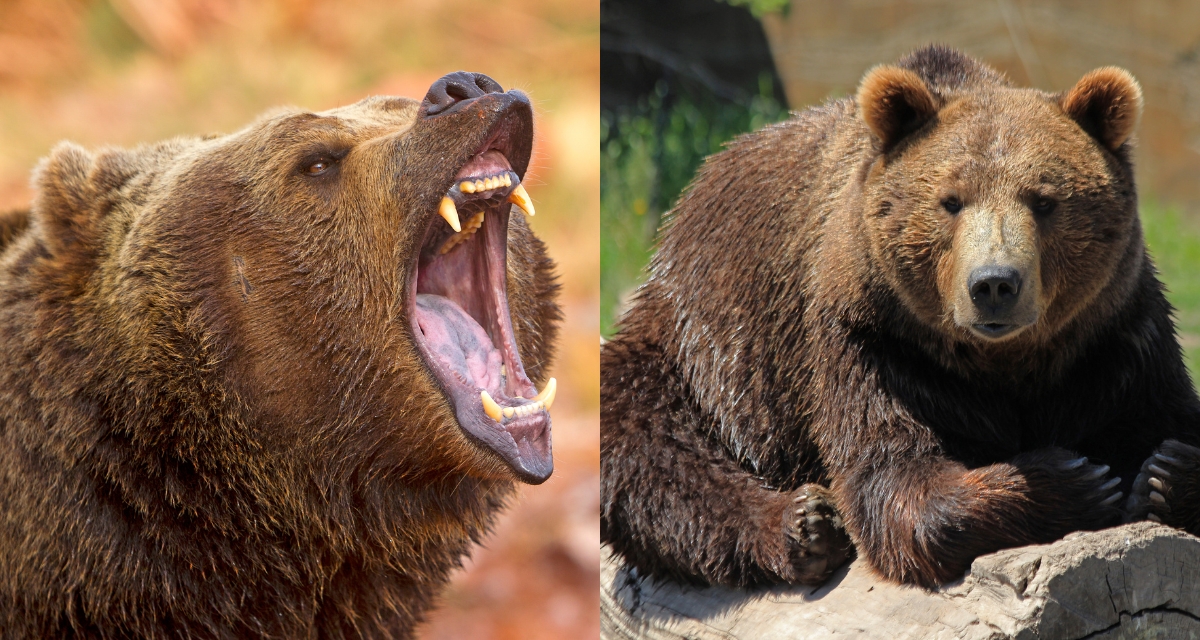
Grizzly vs. brown bear
One Instagrammer, defending her actions, wrote, in part:
“To everyone coming in here with your ‘she should’ve done this and that’ advice and ‘my dog would’ve scared it off!’ or ‘she should’ve had her handgun on her!’—This is in Canada. This is a GRIZZLY bear. This is NOT a black bear. It’s an apex predator that is EXTREMELY aggressive, with massive claws. (Look up the difference between grizzly claws and black bear claws).”
They emphasize the gravity of the situation:
“It is one of the most dangerous and violent animals on the planet. Her making noise and talking down at the bear while walking away slowly is EXACTLY what you’re supposed to do in this situation.”
In a segment on Fox Weather, Caleb and Jerry Jacques of Alaska Grizzly Safaris say that while it’s usually encouraged to stay quiet and calm, there are definitely instances when that’s not the case: “It’s advisable to put your hands above your head, be loud, and stand your ground.”
Some experts say ‘stay calm’
The official National Park Service site offers advice on what to do should someone have a bear encounter. Some of it is quite contrary to what the woman did in the video:
“Identify yourself by talking calmly so the bear knows you are a human and not a prey animal. Remain still; stand your ground but slowly wave your arms. Help the bear recognize you as a human. It may come closer or stand on its hind legs to get a better look or smell. A standing bear is usually curious, not threatening.
Stay calm and remember that most bears do not want to attack you; they usually just want to be left alone. Bears may bluff their way out of an encounter by charging and then turning away at the last second. Bears may also react defensively by woofing, yawning, salivating, growling, snapping their jaws, and laying their ears back. Continue to talk to the bear in low tones; this will help you stay calmer, and it won’t be threatening to the bear. A scream or sudden movement may trigger an attack. Never imitate bear sounds or make a high-pitched squeal.”
In fact, their suggestion is not to make loud noises at all:
“Do not make any loud noises or screams—the bear may think it’s the sound of a prey animal. Slowly wave your arms above your head and tell the bear to back off. Do NOT run or make any sudden movements. Do not make any loud noises or screams—the bear may think it’s the sound of a prey animal.”
That said, it’s easier said than done. Perhaps upon spotting the bear, a quiet, composed manner is best. But once the bear begins to approach, it’s likely that her protective nature simply took over. Whether this reaction is advised by experts or not, it worked. And we’re so glad she, her dog (and even the bear), all made it away safely.