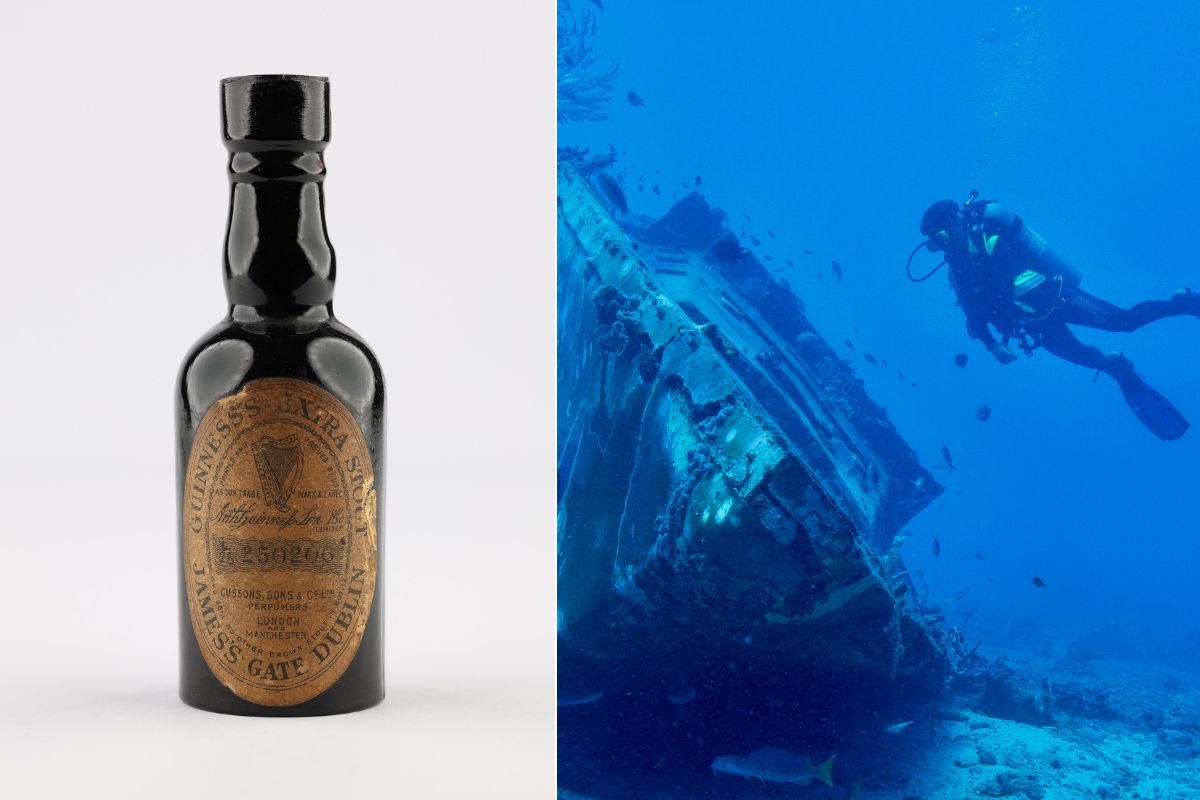
Humans have only explored a small percentage of the ocean floor. While all of it has been mapped by satellite data, less than 30% has been revealed in detail by high-resolution sonar mapping.
Because they’ve remained largely untouched, Earth’s oceans and seas hold plenty of untold secrets. Some are yet to be discovered, like fascinating new life forms, while others have been found buried in ancient shipwrecks. One such artifact, it turns out, is some very old, very choice beer.
Diver finds old Guinness bottle intact on the sea floor
A Belgian photographer named Stefan Panis was recently exploring the English Channel when he came across a shipwreck off the coast of Dover.
While exploring the wreckage of the ship called The Mindoro, he came across a pretty remarkable find: a sealed bottle featuring the Guinness logo.
It was no ordinary bottle of beer, though. Panis’ find actually dates back to 1864, making the bottle 162 years old. The Mindoro was a cargo ship from London headed to Vancouver Island with a heavy load before it collided with another vessel and sank.
Most interestingly, the beer remained quite well sealed and preserved.
Today, Guinness is around 267 years old, which would make the bottle Panis found a somewhat early brew in the company’s history.
It’s nothing short of a miracle that the bottle has remained in tact for so long.
Brewing historian Edward Bourke told Panis and his dive team that bottles found upside down survive submersion in the ocean while upright bottles do not.
Apparently “upside-down bottles stayed perfect because the trapped air bubble creates a pressurized barrier blocking seawater” from leeching in through the cork or bottle opening.
The miraculous bottle is of legitimate scientific interest
Panis and his colleagues immediately contacted “a microbiologist specialising in beer at KU Leuven University in Belgium,” according to the BBC. There, the researchers took quick interest in the bottle.
Why?
Breweries keep logs and hand down old recipes, so it’s not a complete mystery how Guinness was made nearly 200 years ago. However, the specific strains of yeast (that may now be extinct) used in this bottle, the exact makeup and quality of the water, the grains incorporated in the recipe, and the microbial environment inside the bottle offer researchers a treasure trove of information about the time period.
It can also serve as a landmark to help better understand even older brews and recipes, and round out our mapping of yeast DNA from different time periods.
The beer inside that bottle is like a living, biological record of the Victorian and Civil War Era that scientists are eager to better understand.
This is not the oldest sealed beer bottle ever recovered
Shipwrecks, it turns out, are incredible places to recover old recipes and brews like this one.
A beer from the late 1700s was recovered off the coast of Tasmania recently, and yeast samples from inside the bottle are now being used to brew a new beer: one that has modern characteristics but still reflects the time period it came from. This is largely known as the world’s oldest bottle of beer, though the 162-year-old Guinness isn’t far behind.
For a beer with such a rich history, it only seems fitting this one would take a place in the record books—even if it’s not quite first place.
Researchers hope they can recreate the exact recipe and specifications of the recovered bottle, so we can taste for ourselves what it was like to drink a Guinness in the 1800s.
The shipwrecked bottle is not just a novelty, nor is it only a science experiment. Recovered recipes and samples of old food and drink connect us to the past in a way that history books never can. They tell us what it was like to live, survive, and even relax during historically epic and turbulent times. It’s amazing to think of the journey that beer went on, from being bottled in London, sinking in the English Channel, and waiting over a century for someone to pull it from the wreckage.
Panis believes the shipwreck of The Mindoro contains a full case of beer bottles that may still be well-preserved, and Guinness experts told him much of it may still be drinkable.
So…bottoms up?