When we think of legendary television creators, few names carry the profound aura of Rod Serling. As the mastermind behind The Twilight Zone, he transported millions of viewers into dimension after dimension of imagination, shock, and surprise.
He scripted beloved episodes like “Time Enough at Last,” which finds Burgess Meredith’s character pining for time to read, only to survive a nuclear blast because he was inside the bank vault at work—and then break his only pair of glasses. Then there’s “The Monsters Are Due on Maple Street,” one of the most searing allegories of mob mentality ever broadcast.
With such startling tales often set in everyday suburbia, it’s easy to think of a singular storyteller like Serling as operating on a different frequency than the rest of us, as though he somehow tapped into an exclusive, mystical reservoir of cosmic inspiration yet to be explored onscreen.
When asked about his own creative engine, Serling spoke with surprisingly down-to-earth clarity. His perspective reveals both his practical discipline and his poetic view of the human experience.
‘Ideas are in the air. Like ozone.’
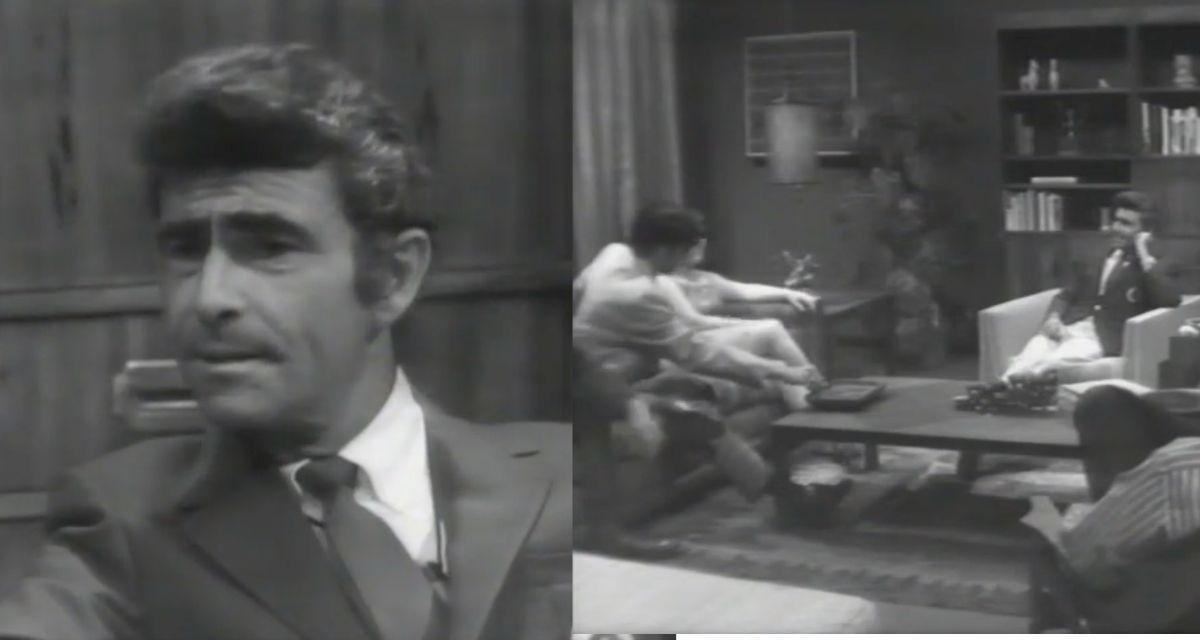
During a rarely seen local interview, Serling tackled all sorts of practical issues for writers. One of his most profound answers came in response to this question: Where do your ideas actually come from?
It’s a question many fiction writers get asked. And if you’ve ever watched his iconic intros to The Twilight Zone, you might picture Serling getting philosophical with his answer. Maybe something about solitary genius or flashes of lightning. Instead, he explained that ideas are built from everything you witness, feel, hear, and touch every day. Inspiration is tangible. Serling beautifully summarized this view of creativity: “Ideas are in the air. Like ozone.”
To Serling, inspiration wasn’t a scarce resource. Interesting and provocative stories that could challenge and engage audiences were everywhere. However, finding that great idea is only the first act. The real battle happens once you sit down and try to write it out. Serling didn’t sugarcoat the grueling nature of the creative process: “The easiest thing on Earth is to come up with an idea. The hardest thing on Earth is to put it down.”
It’s a reassuring reminder for anyone struggling to bring an idea to life. Even the king of speculative fiction acknowledged that wrestling an idea from the mind onto the page was often an uphill climb.
Storytelling anchored in the immediate future
What made Serling’s imagination so compelling wasn’t just his ability to dream up far-off worlds. He found ways to ground the fantastic in our everyday reality, weaving in a healthy dose of social commentary.
In a separate interview with science fiction author James E. Gunn, Serling homed in on what drew him to speculative fiction in the first place. He enjoyed reading stories about space travel or galactic empires but didn’t feel qualified to write them. Instead, Serling preferred to craft tales that hit closer to home: “When it comes to stories, I’d like to know what happens next Thursday—not the next century.”
That single line encapsulates the enduring magic of The Twilight Zone. The show never cared about high-tech gadgetry for its own sake. It delved into the complexities of human nature, morality, paranoia, and difficult choices. By focusing on “next Thursday,” Serling kept his stories urgently relevant to everyday people. His sci-fi and fantasy tales often mirrored our ever-present fears and hopes.
It’s wildly refreshing to hear such a prolific writer talk about creativity in such accessible terms. Serling reminded us that the key to a great story is paying attention to the world right in front of us.