Timeboxing: The science-backed productivity method that can double your output

Science says to do lists actually make you less productive. Here’s what works instead.

calendars, productivity, planning, timeboxing, lists
Welcome to the world of timeboxing. Photo credit: Canva

Have you ever heard of timeboxing?

Probably not. It’s a powerful productivity method used by some of the world’s most successful people, but many of us are completely unaware of its existence. That’s our loss: in a survey of 100 productivity techniques, timeboxing was ranked the most useful.

This article dives into timeboxing, and why it’s such an effective technique—and why it remains underused by the general public. By the end, you will have the tools to incorporate timeboxing into your daily routine.

What is timeboxing?

It’s simple. Timeboxing is a time management technique in which you set a specific, fixed time limit for a single task. You then commit to focusing on it exclusively during that period. It’s like setting up a personal one-on-one with your to-do list. When the allocated time is up, you stop and move on to the next scheduled task. What if you’re not done? Too bad. You move on to the next task, regardless of whether the previous one is fully finished.

Think of it as setting healthy boundaries for yourself and your work. By enforcing this strict, self-imposed deadline, you naturally eliminate distractions and sharpen your focus. You channel all your energy into completing the task within that set timeframe. It turns a vague goal like “work on the report” into a specific action like “spend the next 45 minutes writing the introduction to the report.” Genius. 

Why does it work?

The secret to timeboxing lies in its simplicity. By allocating a fixed period to a specific task, you avoid open-ended to-do lists. No vague goals to “get it done today.” You’re left with clear, defined work.

The method was popularized by Marc Zao-Sanders in his December 2018 article in the Harvard Business Review, “How Timeboxing Works and Why It Will Make You More Effective,” and has since changed how millions of people organize their days.

Where timeboxing comes from

The origins of timeboxing date back to the mid-1900s. In November 1955, British naval historian Cyril Northcote Parkinson published a satirical essay in The Economist with a now-famous observation: “Work expands so as to fill the time available for its completion.” The illustration that accompanied it was a drawing of a woman focused on a single task—sending a postcard—who spent the entire day doing it.

timeboxing, productivity, time, management, science
Parkinson’s Law gives us a sharp, accurate insight into human behavior. Photo credit: Canva

This concept, known as Parkinson’s Law, is a sharp, accurate insight into human behavior. Give a task with no clear deadline, and it will expand to fill all available time.

The concept of timeboxing first took formal shape in the 1980s, emerging as a practical solution to the problem Parkinson observed. The term “timebox” was first documented in 1988 as a central component of Scott Schultz’s Rapid Iterative Production Prototyping method. Just a few years later, in 1991, IT consultant James Martin championed this idea in his influential book, Rapid Application Development.

This structured approach to time management soon became a core element of Agile software development methods like Scrum. Instead of letting projects drag on indefinitely, developers began using fixed-length “sprints”—in essence, timeboxes—to complete specific chunks of work. This shift brought predictability and focus to what was often a chaotic process.

While timeboxing originated in software engineering, its power wasn’t limited to coding. The practice has since been widely adopted for personal productivity, and it’s supported by fascinating science that explains why it works so well across so many tasks.

What the research says

A significant 2021 meta-analysis published in PLOS ONE examined 158 studies involving 53,957 participants to determine whether structured time management is effective. The results even caught the researchers off guard.

They found that time management increased life satisfaction by 72%, whereas job satisfaction rose by only 19%. Researchers also discovered that “time management may primarily enhance wellbeing rather than boost performance.” What does that mean? Essentially, the main advantage of managing your time well is not just higher productivity, but a more fulfilling and meaningful life.

The psychological reasoning behind timeboxing is even more important. Research by psychologist Roy Baumeister shows that decision-making is a limited resource that gets used up. Every moment you spend wondering “what should I work on next?” uses up the same mental energy you need for your most important work. Timeboxing removes those small, repetitive decisions completely. Your past self, during the planning stage, decides for you, so your current self can just focus on doing the work.

Then there’s the cost of distraction. Gloria Mark’s research at the University of California, Irvine, found that it takes an average of 23 minutes and 15 seconds to fully regain focus after being interrupted. Timeboxing creates protected windows where interruptions are explicitly blocked, preserving the deep focus that makes real progress possible.

How timeboxing flips the traditional approach

Most people organize their work—and life—around to-do lists. The issue with these lists, as Zao-Sanders points out in his HBR article, is that they lack a system for when tasks should be done or how long they should take. Tasks often remain on lists forever, growing and shrinking, getting delayed, mainly because there’s no sensible limit.
timeboxing, calendar, scheduling, time, management
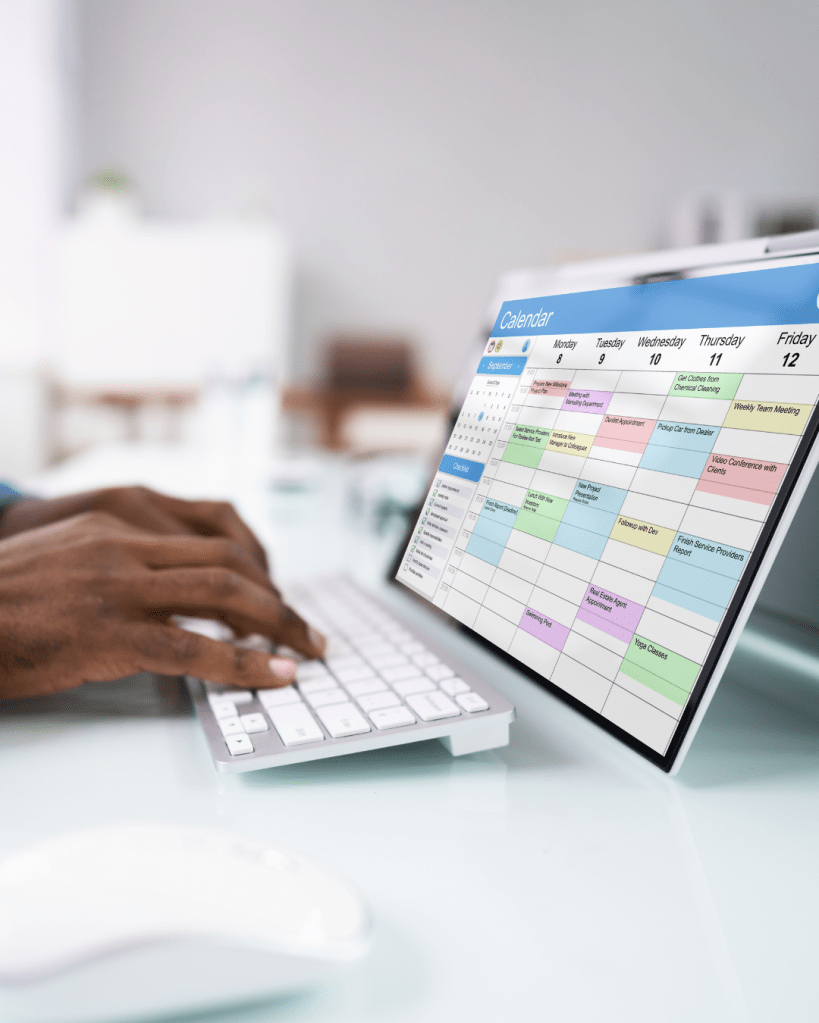
Timeboxing moves tasks from a list to your calendar. Photo credit: Canva

Timeboxing moves tasks from the list to your calendar. Each task is assigned a specific start time, an end time, and a clear goal. Your calendar becomes more than just a schedule: it offers a full view of how your time is really used. It becomes a record of what you’ve achieved and a tool for understanding how long things truly take.

This shift matters beyond just personal productivity. When your timeboxed calendar is visible to colleagues, it becomes a tool for coordination. Teams can plan around each other’s focus periods. Shared visibility decreases the constant flow of “quick questions” that disrupt the workday.

The people who already live by it

Some of the most demanding schedules in the world operate on timeboxing principles. Both Bill Gates and Elon Musk reportedly divide their days into five-minute blocks: a hyper-detailed version of the same core practice. Jack Dorsey, former CEO of Twitter and Square, used a broader approach called “day theming,” dedicating each day of the week entirely to a specific business function. Author Cal Newport has estimated that “a 40-hour time-blocked work week produces the same amount of output as a 60+ hour work week pursued without structure.”

These are not coincidences. Each of these approaches follows the same basic idea: when something has a place, attention goes there.

How to get started

You don’t need a sophisticated app or a complete calendar overhaul to start timeboxing. The core method has seven steps:

  1. List your tasks. Write down everything that needs to be done—big projects, small administrative items, emails, and all of it.
  2. Set clear goals for each task. Specify what “done” looks like. “Work on the report” is too vague. “Complete the executive summary section” gives you a clear target.
  3. Estimate the time, then add a buffer. Most people consistently underestimate how long tasks take (psychologists call this the planning fallacy). Add a 25–50% buffer to your initial estimates.
  4. Schedule blocks of time on your calendar. Assign particular start and end times to each task. Think of these blocks as scheduled meetings.
  5. Work without interruptions. When a timebox starts, close unrelated tabs, mute notifications, and focus solely on the task at hand.
  6. Stop when the time is up. This discipline keeps the system working. If a task isn’t finished, evaluate how many more timeboxes you’ll need and reschedule — don’t let it spill over into the next block.
  7. Review and adjust. At day’s end, evaluate how your estimates aligned with reality. This data sharpens your future planning.

One practical tip: keep your blocks under 90 minutes. Research on cognitive rhythms shows that sustained, high-quality focus has a natural limit. For larger tasks, schedule multiple 60–90-minute sessions throughout the day or week instead of a single marathon session.

Start small, then build

The biggest mistake people make when adopting timeboxing is going all-in right away. Timeboxing your entire week from the start often feels overwhelming—and people give up before it proves useful. Begin with two or three timeboxed tasks each day. Allow yourself a couple of weeks to fine-tune your estimates and develop the habit of focused work before expanding the system.
calendar, timeboxing, time, scheduling, productivity
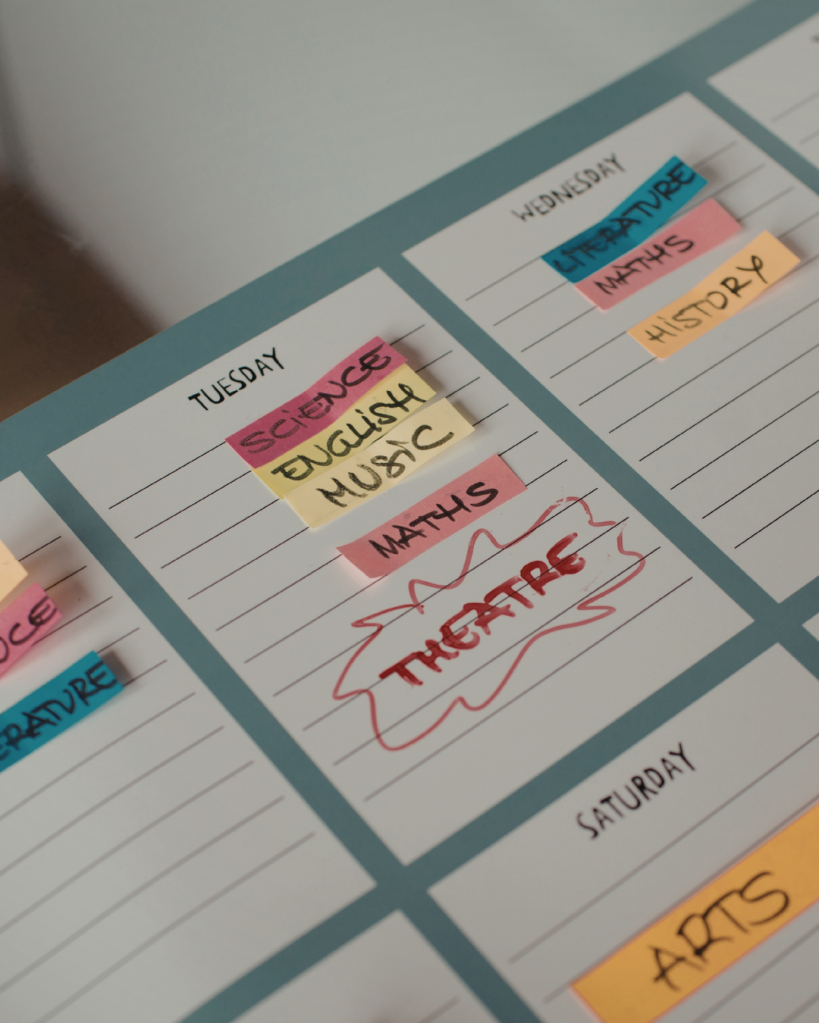
The key to effective timeboxing is not overwhelming yourself. Photo credit: Canva

If you’re unsure where to start, try this: select your top three tasks for tomorrow, estimate how long each will take, add a buffer, and schedule them on your calendar tonight. That’s all. One week of this practice will reveal more about how you work than months of vague intentions.

The 2021 meta-analysis found that the effects of time management on well-being persisted even when performance improvements were small. That means even imperfect timeboxing—estimations that are off, occasional overruns, days that don’t go as planned—still make a difference in life satisfaction. The structure itself has value, regardless of whether you carry it out perfectly.

Your calendar awaits

Parkinson’s Law has been shaping your schedule for years, whether you realize it or not. Tasks grow, focus scatters, and days slip away between intention and action.

Timeboxing gives that time shape: a start, an end, and a purpose. The research clearly shows that the practice provides benefits beyond the office: reducing stress, increasing life satisfaction, and giving a sense of control over how your days unfold.

Your to-do list will always have more on it than any single day can hold. What timeboxing offers is a way to stop fighting that reality and start working with it, one focused, bounded block at a time.


  • Pediatric neurologist shares 3 easy and effective journaling techniques to fix mental clutter
    Journaling is a powerful tool for calming the brain.Photo credit: Canva

    Do you feel like your brain is constantly juggling a million things? Like your mind is on overload and you cannot focus? Between the effects of scrolling social media, navigating the 24/7 news cycle, and managing work and family life, your brain can easily feel overwhelmed.

    Even when you have quiet moments of calm, your mind might still feel too cluttered to get your thoughts in order. However, according to pediatric neurologist Dr. Arif Khan, there is an old-school solution to that problem with modern science to back it up: journaling. Khan goes a step further by sharing three specific techniques and the neuroscience behind why they help.

    “In brain scans, something remarkable happens when people write about their feelings,” Khan says in a YouTube video. “The regions for motion and the regions for reasoning begin to synchronize, as if the brain is learning to talk to itself. That is the hidden power of journaling. It’s not just reflection. It’s neurological repair.”

    Khan explains that when you write, your prefrontal cortex—the brain area that helps with planning and analysis—begins to communicate with your amygdala, the brain’s emotional reaction center. He cites a 2021 Stanford University study, which demonstrated that expressive writing can help your brain recover from stress.

    “The mid-cingulate cortex, which usually fires under emotional pressure, becomes calmer and more coordinated,” says Khan. “And when you put emotions into words, the ventrolateral prefrontal cortex turns on, helping to quiet the amygdala. This process is called affect labeling; it allows you to feel without drowning in the feeling.”

    Writing by hand matters, Khan adds.

    A 2023 study in Frontiers in Psychology showed that handwriting activates more areas of the brain than typing,” he says. “When your hand moves with your thoughts, that is, the mind slows down just enough to make sense of itself.”

    Here are three journaling techniques Khan recommends to reduce brain clutter:

    Technique #1: Expressive writing

    Expressive writing, a technique developed by psychologist James Pennebaker, involves writing about something you feel strongly about.

    “Think about something you still carry—a disappointment, a loss, a moment that lingers longer than it should,” Khan says. Then write about it for 15 to 20 minutes.

    “Don’t worry about grammar,” he adds. “Don’t edit. Don’t write for anyone else. Write until you run out of words.”

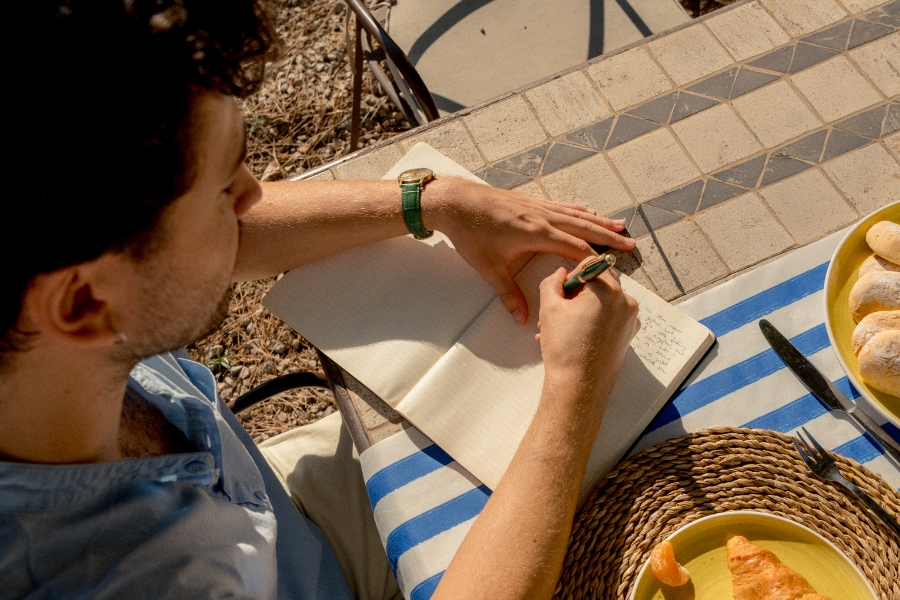
    A man sits at an outdoor table writing in a journal.
    Expressive writing helps the brain process emotions. Photo credit: Canva

    Khan says this technique is effective because the brain treats emotional suppression as “unfinished work.”

    “Studies show that after expressive writing, the brain’s emotional centers quiet down while cognitive control increases,” he explains. “Your body feels lighter because your mind has stopped trying to contain what it has finally released. You might cry. You might feel tired. You might want to stop halfway. That’s okay. Healing requires a small amount of discomfort before calm returns.”

    Technique #2: Gratitude journaling

    Gratitude journals aren’t new, but Khan explains how and why they work from a neurological point of view.

    Instead of writing about what’s troubling you, write down two or three things you’re grateful for. It could be anything, but stay specific. (Khan gives examples like “the smell of rain,” “a message from a friend that came at just the right time,” or “a meal that made you feel safe.”)

    “Gratitude journaling doesn’t force positivity,” says Khan. “It retrains your attention. Neuroscientists have found that practicing gratitude activates the ventral striatum and the medial prefrontal cortex regions that regulate mood and motivation. When you do this daily, you teach your brain to look for what is stable instead of what is threatening.”

    Khan says gratitude journaling “tunes your nervous system towards balance.” Rather than erasing struggle, it helps you see beyond it.

    Technique #3: Reflective reframing

    Reflective reframing journaling focuses on a specific incident and helps you work through it. Khan says to think of a challenge you’ve had and write about it plainly. No judgment, just write what happened. Then write down:

    1. What it meant.
    2. What it revealed.
    3. What it taught you.
    4. One small action you can take the next time something like that happens.

    “This pattern strengthens the prefrontal regions that regulate emotional reactivity,” Khan says. “It builds the ability to pause and reinterpret before reacting. You learn to step back—not to detach, but to understand. Over time, this practice reshapes resilience itself. You begin to see difficulties not as failures, but as data points for growth. That subtle shift changes how your brain responds to future stress.”

    Journaling rewires the brain over time

    Khan says you don’t have to use all three journaling techniques every day.

    “Think of journaling as mental cross training,” he says. “Use expressive writing when emotions feel heavy. Use gratitude journaling when you feel numb or distant. Use reflective reframing when life feels confusing. Each practice strengthens a different circuit of awareness.”

    Khan says that journaling isn’t just self-expression but self-construction. While it can help in the moment, the real power is the change that happens over weeks or months. “You pause longer before reacting. You remember more clearly. You recover more quickly,” says Khan.

    People in the comments of Khan’s video shared their own experiences with how journaling has impacted their lives:

    “I’ve done all these. I’m 68 now, and I’ve been journaling since I was 13. I have all of these journals. It is all very true and tried out. Today, people ask me how do I live my life so well. This is one of the secrets…..”

    “This is fascinating. When I was about 12, I had a teacher who made us keep journals, and we would write about a given promt for 10 minutes at the start of each class. On the days when we wrote about something negative/stressful, she always told us to just keep writing until every single word we had about the topic had drained out. Sounds like we were actually doing technique #1!”

    “I recently went thru a 12 year relationship breakup. I felt so bad , like no pain I had ever experienced before. After two weeks of this agony I started a journal and wrote whatever came into my mind including my diet. Now, a month and a half later I have stopped daily entries and my anxiety has dropped from 100 pc every day for a month to almost zero. I write as I feel the need. What an amazing insight this video has given me.”

    A girl sits in a window wrapped in a blanket, writing in a journal
    People testify to the old-school power of journaling. Photo credit: Canva

    “I have survived and thrived by doing this kind of journaling since 1996 when my husband left me with our three wonderful children (thank God for them!). I highly recommend writing as often as you can on both good and bad days.”

    “I’m 27. I’ve been journaling since 16/17. I can honestly say it’s gotten me out some pretty dark places. All types a writing, expressing, pain, gratitude, to God, to my future self, it all helps. Writing and journaling are a lost art. I hope more people get in tune with themselves a little more and open up to writing and journaling. It’s a beautiful experience.”

    “I started to write about my life at 75, mainly for my children, grandchildren and future generations. I have to say that getting all the hurt, upset, sorrows and jubilation has given me peace at last.”

    You can follow Dr. Khan’s The Brain Project channel on YouTube for more neuroscience info.

  • Movers share what to pack in a ‘first night box’ when moving into a new home
    Keep your first-night essentials separate from the rest.Photo credit: Canva

    While moving into a new place is exciting, for most people, the actual process is exhausting. Even with the help of movers, boxing up all your belongings and getting them into your new home can take a lot out of a person. At the end of move-in day, most folks just want to relax, unwind, and refresh after a long day before unpacking everything in the morning. But then the question hits: “Wait, which box has the toothbrushes?”

    This common occurrence is why moving companies and folks on Reddit recommend packing a separate “first night box” among all your other belongings. A first night box is a box of items you and your family will need to ensure a comfortable first night in your new home. This way, you won’t have to open various boxes to find essentials when everyone is tired and needs to recharge after the move.

    The concept isn’t too dissimilar to a go bag for emergencies. Each person packs essentials such as toiletries, phone chargers and snacks, into a box. Depending on the size of your family, each of you may have to pack your own first night box.

    Moving companies have a suggested list of items to put in everyone’s first night box:

    • Toiletries (soap, shampoo, toilet paper, toothpaste, toothbrushes, etc.)
    • Bedding (sleeping bag, linens, pillows, etc.)
    • Comfortable clothes (clean underwear, pajamas, sweatpants, etc.)
    • Snacks
    • Drinks (such as bottled water)
    • Chargers for phones, laptops, etc.
    • Towels
    • Cosmetics
    • Medications

    Depending on your family, you might want to have an additional first night box for your baby. Include things they’ll need like bottles, diapers, and their favorite toy.

    If you own a pet, you may want to pack a separate box with pet food, bedding, and toys, among other items. This can help with your pet’s transition to the new place. You don’t want to hunt for the dog’s leash if your pup needs to go outside.

    Make another box for tools

    Folks also recommend having a separate toolbox with items you’ll want to have at the ready to hang up pictures, assemble bookcases, and the like. They also recommend packing cleaning supplies in the box to quickly clean up any move-in messes.

    Some items recommended for this box include:

    • Power drill with charger, battery, and drill bits
    • Screwdriver
    • Fasteners (nails, screws, etc.)
    • Flashlights
    • Spare light bulbs
    • Paper towels
    • Cleaning solutions
    • Dish soap
    • Trash bags
    • Hammer
    • Box cutter

    For all of these boxes, make sure they are the last items added to the moving truck so you can easily access them. This can also allow you to unpack just those boxes and leave the rest in the vehicle until the morning.

    Moving can be a pain, but preparation like this can make it less stressful. It also allows everyone to get what they need to recharge as you make your new place truly home.

  • People share the ’10 second decisions’ that meaningfully improved their lives forever
    A woman at a fork in the road.Photo credit: Canva

    The average adult makes upwards of 35,000 decisions a day. These can include the bigger, more existential questions that require reflection to weigh the pros and cons. But the vast majority of decisions seem insignificant: What will I wear today? Order takeout or make food at home? Podcast or playlist? Still, these fleeting impulse choices can play just as big a role in our lives as the more thought-out ones. 

    Prime examples of this were recently made on Reddit, when people were asked to share a “decision you made in under 10 seconds that changed your life forever.” These seemingly insignificant choices changed fates in profound ways. 

    “Decided to go to Subway instead of Dairy Queen. They were across the street from each other and I was passing through town during lunchtime. Ended up hitting it off with the woman making my sandwich. Next week is our 11 year anniversary.”

    “My best friend said she wanted to move 2000+ miles across the country back to her home state and asked me if I wanted to come. I didn’t think, said ‘Yup, I’ll go.” We moved, less than a year afterwards I met my now wife. Couldn’t be happier.”

    reddit, ask reddit, decisions, decision making, gut instinct, intuition
    A van travels down the road. Photo credit: Canva

    “Said yes to adopting a stray dog that followed me home. 10-second ‘sure why not’ moment—now he’s my best buddy for 8 years.”

    Others were able to uncover new passions they never imagined.

    “I flipped a coin to decide if I was going to quit my job. Heads. I quit. A friend saw my lights on that night and stopped by to see what I was doing. I told him what happened, and he told me it was great timing. They let someone go at his job that day. He set me up with an interview for the next day, and I was hired. There were only three people who worked there. I eventually became the plant manager and have been working in management ever since!”

    “Saw a random advert advertising scuba diving certification. I signed up thinking ‘why not?’ I’m now an aspiring diving instructor!”

    “Early 20s and my sister asked me to drive her to the music shop to buy a guitar. I point one out and say ‘that black and gold one is gorgeous. Get that one.’ She tries it out and says ‘ehhh, I dunno if I really feel this one.’ I tell her that if she doesn’t buy it, I will, and she says ‘you don’t even play guitar! What are you gonna do with it?’ Walked out of the store with it on a complete whim, spent 3 months learning before I started doing open mics, making friends at the music shop, joining a band, and having the time of my life throughout my 20s.”

    reddit, ask reddit, decisions, decision making, gut instinct, intuition
    A person plays the guitar. Photo credit: Canva
    For some, a 10-second decision ended up with an unexpected windfall.

    “Decided not to get into an elevator with my ex and her new boyfriend, so I took the stairs instead. On the third flight, I found a discarded scratch-off ticket that ended up being worth $50,000. It’s the only time in my life where being socially awkward actually paid off my mortgage.”

    “A family in my marina announced that they are moving away the following week. They were going to turn their sailboat over to a broker to sell it for them. I mentioned that I was contemplating a larger boat with a smaller engine and would be interested in theirs. I asked what price would they consider? He said, $10k. I said, okay, and we shook on it. The boat was worth over $24k. I got a wheelbarrow from the marina corral and removed stuff from my smaller boat, walked it over to their dock, and loaded it onboard. That was ten years ago, and I still live on it six months out of the year. Sweet.”

    Sometimes, these kinds of life-altering changes are simply fresh new outlooks on life. 

    “I was going through old text messages with my then girlfriend and realized I had become a very negative person. I decided right there to always look for the bright side of things. It takes some effort but that was 12 years ago and I’m much happier. It becomes second nature after a while.”

    reddit, ask reddit, decisions, decision making, gut instinct, intuition
    A man smiles. Photo credit: Canva
    In many instances,  a 10-second decision prevented tragedy for themselves or others. 

    “Most of these answers are super happy and mine really isn’t but fits the question. Mine would be double checking on my wife before bed. She suffers from PTSD, depression and anxiety and had just been ‘off’ all day. I checked with her a couple times and she said everything was alright each time. It might sound weird but she was too happy and calm but kind of sad at the same time. It just didn’t sit right with me. She said she was going to bed and we kissed and I asked again she chucked and said to stop worrying. She went upstairs and I waited a few seconds and went up to say I think something is wrong. I stopped her from committing suicide that night. Normally I would take her for her word but that decision was 12 years ago and we are having the best version of our lives because I listened to my gut and went and checked.”

    “One night I drove home from working evening shift (like 2 miles) and when I glanced in the rear view I had chills when I saw the headlights behind me at a red light. I got to my house and was about to park but then heard a voice in my head tell me to keep driving, so I did… and they continued to follow me. Called my dad to stay on the phone as I drove to a police station. Car stopped following when a cop car pulled up behind us (coincidentally). Next morning read about an armed carjacking in the area about an hour later.”

    “In middle school my best friend invited me to Knott’s Berry Farm with another group of kids he was friends with…I got to my friend’s house after running some errands with my mom. There were 5 kids aged 14-15 there. I asked my friend how we were getting [to Knott’s Berry]  and he said he was driving his dad’s car (he was underage and had no license). I was nervous but I wanted to look cool so, I said ok. Right before we got into the car, I had the worst feeling come over me. In approximately 5 seconds, I felt a drop in my stomach to a bottomless pit, a hot flash followed by chills, and intense nausea. I literally left without making a sound, running to a nearby Starbucks and using a stranger’s phone and asking my mother to pick me up. I felt so embarrassed. I knew I was going to get shit all month from my friend…A few hours later, they were on their way home on the freeway and lost control of the vehicle. All 5 died.”

    reddit, ask reddit, decisions, decision making, gut instinct, intuition
    A damaged vehicle sits on the side of a road. Photo credit: Canva
    What about when you can’t decide?

    And yet, for some (make that many) of us, knowing that every decision is uniquely important can be a major source of anxiety, causing us to freeze via “analysis paralysis” and not choose at all—which, in itself, is a choice (they’re inescapable!). In fact, our brains tend to struggle more with less risky decisions

    Interestingly, experts seem to suggest combating this ambivalence with tools that force a quick deadline. You can either toss a coin or set a time limit, which would arguably incite one of these potentially life-changing 10-second decisions. 

    Life will inevitably call on us to make both long, thought-out decisions and to go with our gut. But hopefully, this reminds us that even our whims can lead to something truly pivotal without making us lose our minds.

  • Frugal people share 30 things they stopped buying completely to save money
    Frugal people open up about how they save money.Photo credit: Image via Canva

    Saving money is never a bad thing. And for those looking for economical solutions for how to cut back on spending, a smart place to start is taking an inventory of your spending habits and what you buy.

    In an online forum of frugal people, member TS1664 posed the question to fellow savvy financial members: “What’s something you stopped buying completely and don’t miss at all?”

    They continued, “For me it’s paper towels. Switched to rags and microfiber cloths a year ago and haven’t looked back. I used to go through a roll a week without thinking, now I just toss the cloths in with regular laundry. Saves money and space.”

    And they ended the post with some more insight. “It made me realize how many things I was buying out of habit, not need. What things others have cut out completely that turned out to be no big deal or even better without. Could use some inspiration!”

    The callout garnered some excellent real-life advice from frugal people. These are 30 things that thrifty people shared they stopped buying completely that helped save them money.

    save money, saving money, money habits, money advice, saving
    Make It Rain Money GIF by A Little Late With Lilly Singh Giphy

    “Dryer sheets.” Super-Examination594

    “Starbucks – bought an espresso machine, took some time to learn how to dial it in and pull a proper shot. It’s been 4+ Years and don’t miss it one bit.” Fox_137

    “Makeup! Used to wear it every day and buy tons of it to try new products and such. Now I only wear it for special occasions. It works great — even just a little bit of makeup really pops when you hardly ever wear any.” VerschwendeMeineZeit

    “Soda. Too expensive now. Pre-pandemic, sometimes Kroger would have a sale (4) 12-packs for $10.” NotJimIrsay

    “Cigarettes .” rickety_picket

    bottled water, bottled waters, water, plastic water bottle, water
    martial arts water GIF Giphy

    “Bottled water.” WorriedPermission872

    “Most fast food but especially McDonald’s and bk. When I paid $20 for two adults’ meals, it stopped making sense, and I’ll cook better burgers and better sides fries at home for less.” diegothengineer

    “Cable tv subscription.” nombreusuario

    “Pizza delivery service. Frozen meals are just as unhealthy, but much cheaper.” The_Keri2

    “We started our pizza making journey by buying dough (under $2) at trader joe’s. it really lowered the barrier to entry. once we kind of perfected the bake etc, we started playing with dough recipes until we found one we loved. it sounds painful but it was a good learning experience and fun to do together.” suddenlymary

    candles, candle, scented candle, buying candles, glass candle
    christmas sniffs GIF by Target Giphy

    “I stopped buying scented candles. I used to grab them all the time on impulse, but they’re expensive, don’t last that long, and honestly gave me headaches half the time. Now I just open a window or boil some citrus peels with cloves if I want the place to smell nice.” HollisWhitten

    “Cigarettes and nicotine pouches! Been smoke free since august 2021 and pouch free since July 2024 :).” HueLord3000

    “Amazon Prime. We stopped paying for the privilege of shopping and making money for Bozo. Now, we just put stuff in the cart until there is enough for free shipping. I don’t miss Prime, I never found anything on Prime video I wanted to watch once that wasn’t a rental. We live in a rural village, so online is cheaper than driving 25 to 50 miles to a store.” cwsjr2323

    lottery, lotto, lottery ticket, scratch off, scratch offs
    Animation Scratch Off GIF Giphy

    “Lottery tickets.” evissamnoisis

    “Hair color. I’ve embraced the gray!” phishinfordory

    “I’ll add sandwich bread. I started making my own. It costs just over $1 for me to make a small loaf that’s just enough for the 2 of us for a week. Plus no additives or preservatives.” BeerWench13TheOrig

    “Books. I go to the library.” Significant-Emu1855

    library, library card, library book, books, reading
    Dog Glasses GIF by County of Los Angeles Giphy

    “Broth. Have an ongoing ‘broth bag’ going in the freezer. Once I run out of frozen broth cubes, I make another round.” Colorfulplaid123

    “New clothes from shops! I’m now a charity shop and Vinted gal, my clothes are so much better quality and I spend less.” CorinaPhoto

    “Bidet toilet seat is cheap, easy to install, much easier and faster to use, and most importantly will keep you far cleaner while not wasting any toilet paper.” hopopo

    “Menstrual products. Bought a menstrual cup back in 2016 and have not looked back.” simply-misc

    “Chip clips. I buy cheap old wooden clothespins! Works great and if they break, no biggie. It’s $2 for 24. I also use clear shower caps for dishes I have no lids for or it’s something that can’t have a lid, like deviled eggs. I use the shower caps. Much cheaper than those bowl covers they sell 8-12 in a pack for $1.25. Those bowl covers are kind of pricey and you get 1 large and 2 mediums and a bunch of tiny ones!!” Florida1974

    alcohol, quit alcohol, drinks, pour out, drinking
    Pour One Out Malt Liquor GIF Giphy

    “Alcohol.” Fit_Artichoke_523

    “Baked beans in the can, I literally keep everything on hand to make it so it was an excess purchase. Instant rice packs, I make regular rice, 20 minutes is not that long We keep getting gifted napkins but we don’t purchase them.” Miss_Pouncealot

    “Soap in a pump bottle. Switched to bars (Costco). So much value, less trash and plastic, and a better experience. Why did we invent pump bottle soap??” thebiglebowskiisfine

  • How often should you wash your sheets? Experts settle the debate once and for all.
    How often do you change your sheets?Photo credit: Kampus Production/Canva

    If you were to ask a random group of people, “How often do you wash your sheets?” you’d likely get drastically different answers. There are the “Every single Sunday without fail” folks, the “Who on Earth washes their sheets weekly?!?” people and everyone in between.

    According to a survey of 1,000 Americans conducted by Mattress Advisor, the average time between sheet changings or washings in the U.S. is 24 days—or every 3 1/2 weeks, approximately. The same survey revealed that 35 days is the average interval at which unwashed sheets are “gross.”

    Some of you are cringing at those stats while others are thinking, “That sounds about right.” But how often should you wash your sheets, according to experts?

    Hint: It’s a lot more frequent than 24 days.

    While there is no definitive number of days or weeks, most experts recommend swapping out used sheets for clean ones every week or two.

    Dermatologist Alok Vij, MD told Cleveland Clinic that people should wash their sheets at least every two weeks, but probably more often if you have pets, live in a hot climate, sweat a lot, are recovering from illness, have allergies or asthma or if you sleep naked.

    We shed dead skin all the time, and friction helps those dead skin cells slough off, so imagine what’s happening every time you roll over and your skin rubs on the sheets. It’s normal to sweat in your sleep, too, so that’s also getting on your sheets. And then there’s dander and dust mites and dirt that we carry around on us just from living in the world, all combining to make for pretty dirty sheets in a fairly short period of time, even if they look “clean.”

    Maybe if you shower before bed and always wear clean pajamas you could get by with a two-week sheet swap cycle, but weekly sheet cleaning seems to be the general consensus among the experts. The New York Times consulted five books about laundry and cleaning habits, and once a week was what they all recommend.

    Sorry, once-a-monthers. You may want to step up your sheet game a bit.

    What about the rest of your bedding? Blankets and comforters and whatnot?

    Sleep.com recommends washing your duvet cover once a week, but this depends on whether you use a top sheet. Somewhere between the Gen X and Millennial eras, young folks stopped being about the top sheet life, just using their duvet with no top sheet. If that’s you, wash that baby once a week. If you do use a top sheet, you can go a couple weeks longer on the duvet cover.

    For blankets and comforters and duvet inserts, Sleep.com says every 3 months. And for decorative blankets and quilts that you don’t really use, once a year washing will suffice.

    What about pillows? Pillowcases should go in with the weekly sheet washing, but pillows themselves should be washed every 3 to 6 months. Washing pillows can be a pain, and if you don’t do it right, you can end up with a lumpy pillow, but it’s a good idea because between your sweat, saliva and skin cells, pillows can start harboring bacteria.

    Finally, how about the mattress itself? Home influencers on TikTok can often be seen stripping their beds, sprinkling their mattress with baking soda, brushing it into the mattress fibers and then vacuuming it all out. Architectural Digest says the longer you leave baking soda on the mattress, the better—at least a few hours, but preferably overnight. Some people add a few drops of essential oil to the baking soda for some extra yummy smell.

    If that all sounds like way too much work, maybe just start with the sheets. Pick a day of the week and make it your sheet washing day. You might find that climbing into a clean, fresh set of sheets more often is a nice way to feel pampered without a whole lot of effort.

    This article originally appeared last year.

Wholesome

7-year-old boy obsessed with UPS asks for a themed birthday party, and his mom delivers big time

Wholesome

21-year-old woman asks for ‘random, specific advice.’ Here are the 22 best answers.

Generations

Gen X is stunned to learn just how old the actors on their favorite shows actually were back then

Family

Dad shares how he raises his 2-year-old daughter while working on a cruise ship