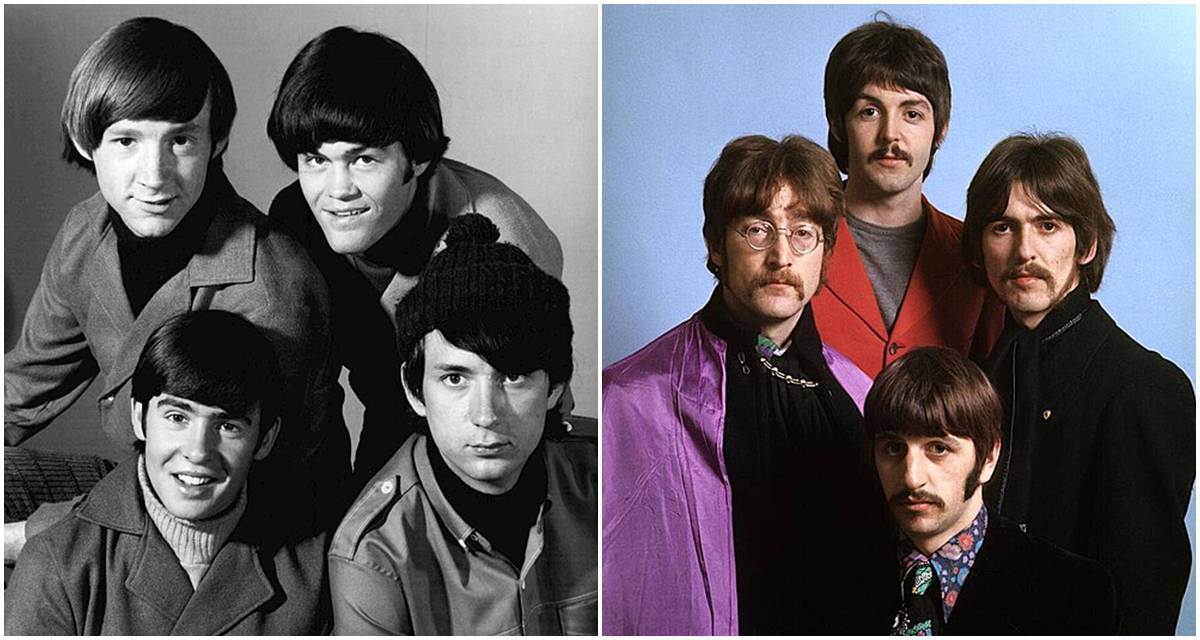
It’s no secret that The Monkees were put together to capitalize on The Beatles’ success. Four good-looking and funny guys, two of whom had actual musical chops, were thrown together by executives to sing music derivative of the Fab Four in a show that looked like a colorized version of The Beatles’ A Hard Day’s Night film.
Before the TV show debuted, the made-for-TV band had a stroke of luck: their first single, “Last Train to Clarksville,” was climbing the charts when the show debuted on September 12, 1966. It would hit number 1 on the Billboard Hot 100 on the chart dated November 5, 1966.
‘Last Train to Clarksville’ was based on a misheard lyric
Songwriters Tommy Boyce and Bobby Hart were tasked with writing the band’s debut single, and they set out to write one that sounded like some of The Beatles’ big rock hits at the time, namely “Paperback Writer,” “Day Tripper,” and “I Feel Fine.” While listening to “Paperback Writer,” written by Paul McCartney, Hart thought the song included the line “take the last train,” which he found compelling and urgent. But when he realized he misheard the lyric, he wrote a song around the idea.
Hart added intrigue with the lyric, “I don’t know if I’m ever coming home,” nodding to American soldiers drafted into the Vietnam War. He originally meant Clarksville in Arizona, but there’s also a Clarksville near Fort Campbell in Tennessee, which gave some added punch to the song’s anti-war message.
Monkees drummer Mickey Dolenz was the only member of the group to appear on the song and sing lead vocals; the backing band was Hart’s outfit, the Candy Store Prophets. If there was any doubt the song was a Beatles rip-off, the main guitar riff sounds like George Harrison himself played it. But Micky Dolenz’s laid-back, weary voice gave the song enough character to stand on its own and introduce The Monkees to the world.
‘Clarksville’ wasn’t the only hit based on a misheard Beatles lyric
“Judy in Disguise (with Glasses)” by John Fred and the Playboys was written after singer Fred heard the song “Lucy in the Sky with Diamonds” on The Beatles’ Sergeant Pepper’s Lonely Hearts Club Band album and thought the band was singing “Lucy in Disguise,” instead of “Lucy in the sky.” The song took the form of a mild parody of The Beatles’ song, with obtuse lyrics about “Lemonade pie with a brand new car” that mirror John Lennon’s “tangerine trees” and “newspaper taxis” in “Lucy.”
Although the song was at The Beatles’ expense, Fred said Lennon loved the track. “When I met John Lennon, that’s the first thing he asked me. He thought it was great. He said the first thing he was going to do when he got home was write a song called ‘Froggy in a Pond with Spectacles,”” Fred said, according to Songfacts.
The stories of “Last Train to Clarksville” and “Judy in Disguise” are proof that inspiration can come from anywhere, even from a mistake or, to put it positively, a happy accident. Creativity isn’t necessarily a talent, but a process. Great creators know there are many wells to draw from, and sometimes even a misunderstanding can be spun into gold. Or, even better, a gold record.