
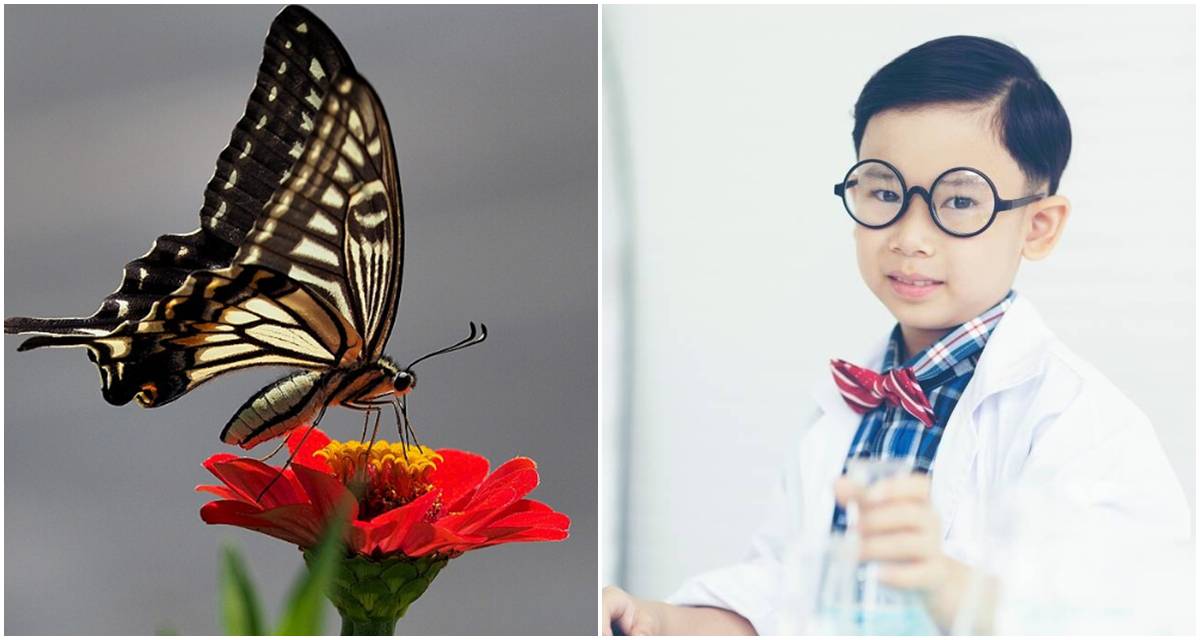
The typical elementary-aged child in Japan spends their free time playing baseball, collecting Pokémon cards, and reading all the manga they can get their hands on. For Jo Nagai of Kobe, Japan, however, his spare time was filled with a more eclectic pursuit. He started hand-raising swallowtail butterflies.
Asian swallowtails are identified by the bright dots that outline their wings. They’re also fantastic pollinators for local plants and flowers. As Jo cared for his insect companions, he noticed a particularly heartwarming behavior. Once he released them into the wild, the butterflies would linger for a bit, then fly right back to him. This observation sparked a curious question in the young boy’s mind: Did his butterflies actually remember him?
Reaching out to an unexpected pen pal
Determined to find an answer, Jo started looking online for scientific studies that might correlate to his question. The answer came in the form of Dr. Martha Weiss, a renowned entomologist at Georgetown University who had previously studied whether moths could retain memories from their caterpillar days. In a recent Radiolab podcast, Dr. Weiss recounts how the then second-grader Jo penned a detailed four-page letter to her. Nagai asked if she knew the best way to expand Weiss’ moth experiment to his butterflies. Delighted by the boy’s precocious curiosity, she wrote back.
What followed was a cross-continental scientific mentorship. Together, the university professor and the elementary school student collaborated to adapt complex laboratory methods into a brilliant, child-friendly experiment conducted from within Jo’s home.
Going… going… “goo”? What survives the metamorphosis stage?
Time for a little Butterfly 101. To transform into a butterfly, a caterpillar goes through a process called metamorphosis. The caterpillar walls itself off inside a chrysalis as its body completely breaks down and rebuilds itself. This is sometimes referred to as the “goo phase.”
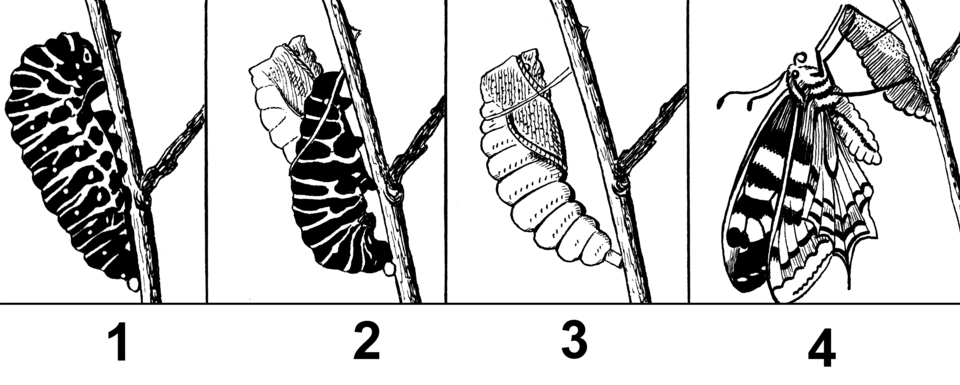
(Media Credit: Pearson Scott Foresman / Wikimedia Commons)
So, the question became, what memory could Jo create for his caterpillars that might carry forward as they became butterflies? Jo designed a clever experiment using simple household materials. Starting with a mild electronic pulse from a muscle therapy device, Jo trained a small group of his caterpillars to associate the scent of aromatic lavender oil with the vibrating stimulus.
The result? The swallowtails didn’t particularly enjoy being near the smell, but they were never harmed by it. He left a control group completely untrained. Now that Jo had one trusty group of caterpillars that he knew disliked the smell of lavender, it was on to the next phase. Would their memories of trying to avoid lavender survive the radical, total-body meltdown of metamorphosis?
Once the insects emerged as beautiful butterflies, Jo tested them using a Y-shaped tube maze. One side contained the initial lavender smell while the other side was scent-free. The control group of butterflies split evenly, flying into the two arms of the Y; meanwhile, the trained butterflies overwhelmingly avoided the lavender scent! Against all odds, Jo proved that sense memories can survive the total reorganization of the body and brain during metamorphosis.
Generational learning discovered by a grade-school scientist
You would understand if Jo stopped there, but his curiosity was piqued. Could these memories travel even further down generations? After breeding his trained butterflies, he tested their offspring—and eventually, their grandchildren. Remarkably, without ever receiving any vibration-training themselves, the subsequent generations naturally avoided the scent of lavender. Jo had uncovered definitive evidence of transgenerational memory inheritance in swallowtail butterflies.
The young boy’s meticulous 33-page research report shocked the scientific community. Jo eventually presented his findings at the International Congress of Entomology in Kobe, Japan, in 2024. Dr. Weiss even flew out to meet Jo there while briefing global experts, including the Crown Prince of Japan.
Georgetown’s Dr. Martha Weiss also spoke about Jo’s future goals on the Signal Hill podcast. “He told me he doesn’t actually want to be an entomologist when he grows up. He wants to be a veterinarian.” His desire to learn more about animals has only made Jo care even more about them. No doubt he will make a wonderful vet someday.






.png)