
In March of 2025, the Scottish government took action to codify the Community Wealth Building Bill (CWB), a first-of-its-kind law that would transform how money is distributed throughout the country.
The proposed framework would legally require public institutions to make spending, investment, and development decisions that prioritize the betterment of the local community, rather than growth alone, to create a fairer, more resilient economy.
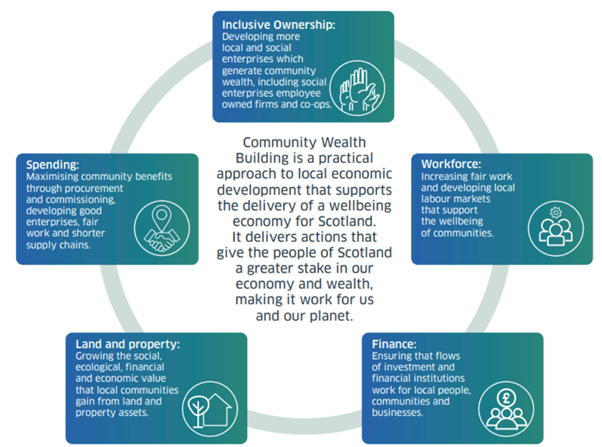
The CWB would operate on the Five Pillars below:
- Inclusive Ownership: Priority will go to developing local businesses, including employee-owned firms and co-ops
- Spending on Community Benefits: Public spending first goes to support the local economy, rather than large corporations.
- Fair Employment: this includes fair pay and work that supports wellbeing.
- Socially Productive Land/Assets: Ensuring land and property serve community benefit.
- Fair Financial Power: Again, money circulates into local areas.
The goal is simple: shift wealth towards local communities rather than shareholders. And it’s not necessarily a new concept. Other places have experimented with similar programs, like Preston in England, Arrasate/Mondragón in Spain, and Emilia-Romagna in Italy, along with USA cities like Cleveland, Richmond, Detroit, and Albuquerque, and found success.
What makes Scotland’s CWB different, however, is that it would be permanent law, not a temporary policy change, marking a bigger, more fundamental paradigm shift in how prosperity is defined.
“Incoming legislation will solidify gains and ensure that activity is not done in isolation, but comprehensively, helping Scotland go further in creating a dynamic economy, where more wealth can be generated, circulated, and retained for the benefit of all Scots,” wrote The Democracy Collaborative’s Neil McInroy, who helped develop the CWB.
The CWB comes as a potential solution to Scotland’s hugely uneven wealth distribution. According to a report from the Resolution Foundation, the top 10% own 200 times more wealth than the bottom 10%, with 25% of Scottish people having less than $500 of net savings, and 7% of those with zero savings are in debt.
Compare that to the US, where Federal Reserve data shows that the richest 10% of American households now own over two-thirds of the nation’s total wealth. The top 1% holds 31.0% of total wealth, equaling to only slightly less than the entire bottom 90% of U.S. households. According to Inequality.org, the United States has a wider wealth disparity between rich and poor than any other major developed nation in the world.
Whether or not we can all agree that the CWB specifically is the best move to take, most of us can concur that some collective legislative action is needed to bridge this growing gap. If the CWB does what it sets out to do, it could mean that a mutually beneficial solution is not only possible, but already here.
The CWB is currently moving through Stage 2 of parliamentary scrutiny, with further stages following throughout 2026.