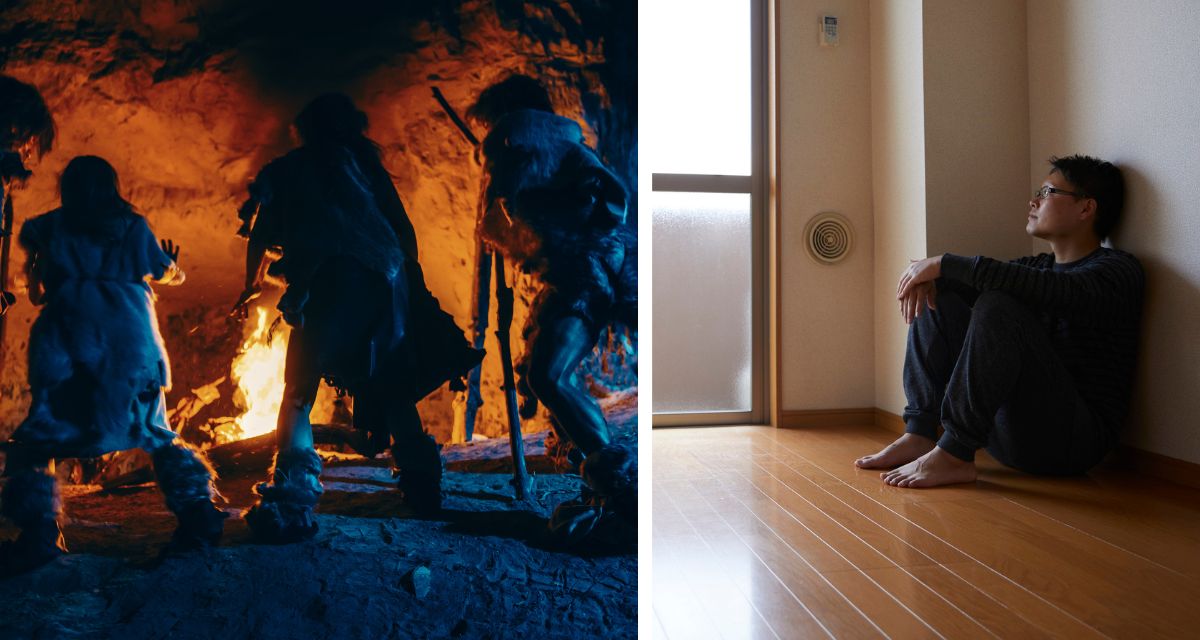
Privacy is both an essential and a luxury. Most of us, regardless of socioeconomic status, are separated from our neighbors by walls. Sometimes you might hear those neighbors through the walls, but the separation is still there. It’s pretty much a baseline requirement of life. The richer you get, though, the more privacy you might be able to afford via gates, shrubs, hell, a moat, if you fancy.
Yet privacy, at least privacy in any sort of architectural form, is an incredibly new human invention. And whether this invention is entirely beneficial is up for debate when you really look at the big picture.
Primitive privacy
For centuries, our ancestors ate, slept, breastfed, bathed, and lived virtually every waking and sleeping moment together with the other members of their clan. As anthropologists like David Samson have discovered, when an individual or couple did require some, ahem, alone time, this was communicated nonverbally. If one or two members moved away from the group fire at night into the darkness, it was understood to be their private moment.
Of course, in some groups, even this activity wasn’t always done under the cloak of secrecy.
Then came agriculture, which reshaped our collective psyche in countless ways, including our concept of separation.
For the first time in history, humans built structures with walls—aka houses—that separated them from one another. Interestingly, this first marker of individualism correlated with a rise in interpersonal violence, according to the findings of archaeologist Ian Hodder. With the concept of privacy came the concept of private property, something that could be taken away by others if not defended.
Still, many more centuries would pass during which families shared a room, while wealthy elites and select religious monks enjoyed solitude. It wasn’t until the 1920s that private bedrooms became a middle- and lower-class staple. A mere fraction of a fraction of our entire timeline.
Does more privacy mean more isolation?
It’s common knowledge that we are in what experts call a “global public health crisis” of loneliness. Granted, you can’t necessarily place the sole blame on physical privacy. After all, many individualist countries, like Denmark and Switzerland, consistently report lower levels of loneliness. Conversely, densely populated or family-centric countries like Turkey and India frequently rank among the loneliest globally. But it’s worth noting that, unlike the latter, Denmark and Switzerland have a generous work-life balance, built-in opportunities to make friends through hobbies, and strong financial safety nets.
The big takeaway here: when it comes to loneliness, privacy might not be the biggest culprit, but rather a lack of communal living and support.
A return to shared spaces
And we’re seeing more people make a shift back toward this lifestyle. Friends sharing single-family homes, co-working spaces, and rural ecovillages all aim to bring back a sense of shared resources and reduce isolation.
Privacy in the digital age
Then again, the concept of privacy has evolved from a purely physical one to a digital one. Some of us break down intangible walls by posting candid videos about our everyday lives. Others opt to pay a little extra to avoid having their behavior tracked for ad targeting. Those who can afford it, anyway—another example of privacy being an indulgence, not a right.
While privacy remains deeply valued, its role in human life has never been static. From communal fires to private bedrooms to online data protections, the boundaries between individual space and shared experience continue to evolve alongside the societies that create them.