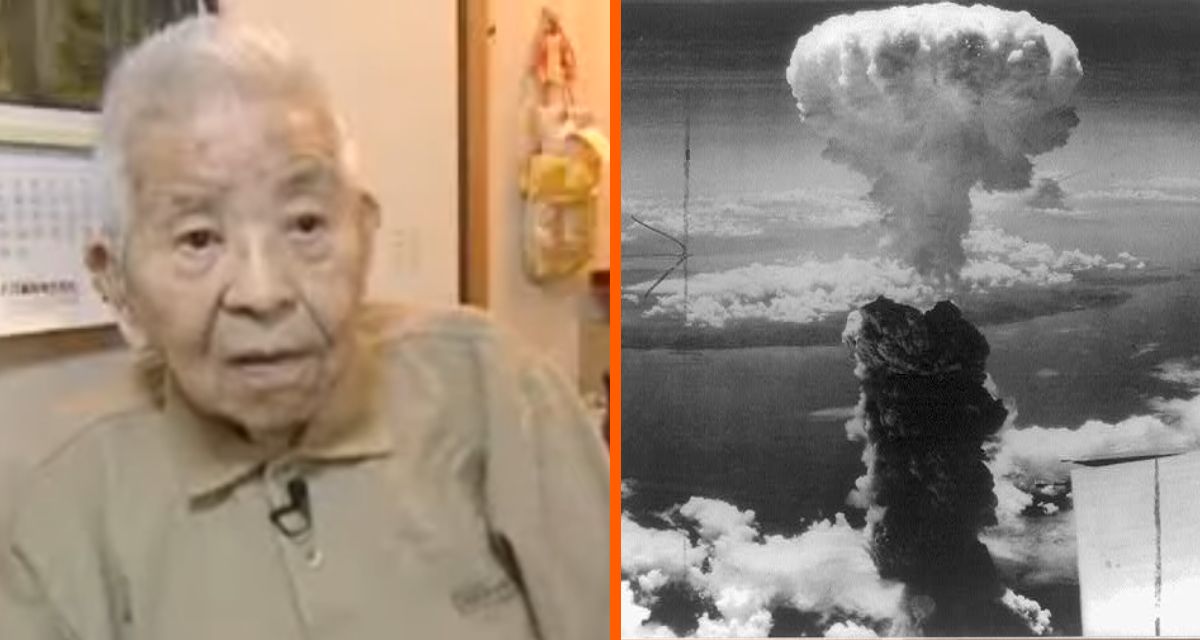
The atomic bombs that were dropped in the Japanese cities of Hiroshima (on Aug. 6, 1945) and Nagasaki (on Aug. 9, 1945) directly resulted in the deaths of at least 100,000 Japanese people, according to the National Archives. Additionally, a minimum of 100,000 more Japanese lost their lives in the aftermath.
While the exact death toll remains unknown, there is only one man who managed to both witness and survive the two attacks: Tsutomu Yamaguchi.
Yamaguchi was just 29 years old at the time, and is the only verified survivor (hibakusha) of both atomic bombings. He passed in 2010 at 93-years-old, and spent his life after the war as a nuclear disarmament advocate who wrote powerful tanka poetry to heal and process the trauma he had been through.
Who is Tsutomu Yamaguchi?
Yamaguchi was originally from Nagasaki, and worked as an engineer for Mitsubishi Heavy Industries. On Aug. 6, 1945, he was in Hiroshima for work when the first atomic bomb was dropped.
In a 2009 interview with The Independent, Yamaguchi shared that he had just stepped of a tram when the bomb exploded; he was less than two miles from the epicenter.
He suffered terrible injuries: besides being temporarily blinded, his left eardrum was destroyed and the top half of his body was badly burned. To get back home to Nagasaki by train, he had to endure more radiation exposure in central Hiroshima.
Just three days later back home in Nagasaki, he was talking to his boss about what he had experienced in Hiroshima when the second atomic bomb was dropped. Yamaguchi was again two miles away from where the bomb went off.
“I thought the mushroom cloud had followed me from Hiroshima,” he told The Independent.
Life after the atomic bombings
Yamaguchi struggled to heal. His daughter Toshiko told the outlet, “Until I was about 12, he was wrapped in bandages for his skin wounds, and he went completely bald. My mother was also soaked in black rain [the famously radioactive rain that fell after both bombings] and was poisoned. We think she passed on that poison to us.”
However, his body eventually healed and he considered himself healthy compared to other survivors. His daughter shared that he went back to work as a ship engineer and chose not to discuss his atomic bomb experiences.
“Afterwards he was fine—we hardly noticed he was a survivor,” she added.
It wasn’t until later in his life that he decided to become an advocate for nuclear disarmament. At 90, he spoke at the United Nations about his experience and the horrors he experienced due to the bombings of Hiroshima and Nagasaki.
Yamaguchi’s tanka poetry
Tanka poetry is traditional Japanese style of poetry that originated in the 7th century and is defined by the Academy of American Poets as “a thirty-one-syllable poem, traditionally written in a single unbroken line. A form of waka, Japanese song or verse, tanka translates as ‘short song,’ and is better known in its five-line, 5/7/5/7/7 syllable count form.”
Yamaguchi’s tanka poetry was translated by Chad Diehl, a Columbia University doctoral candidate, in the book And the River Flowed as a Raft of Corpses: The Poetry of Yamaguchi Tsutomu, Survivor of Both Hiroshima and Nagasaki.
Diehl lived with Yamaguchi and his daughter’s family during the summer of 2009. He explained, “Tanka provided Yamaguchi with a framework that helped suture together a fragmented—but not incomplete—memory of the bombings…For Yamaguchi, composing tanka became a way to tidy up the past, so to speak, to ‘normalize’ daily life to the extent possible so that he could live. A trauma never disappears; it is simply managed.”
Below is one of Yamaguchi’s haunting tankas:
They [corpses] are piled atop one another high.
And the ground will never dry.
It is soaked with the fat of all the people
who burned and died.