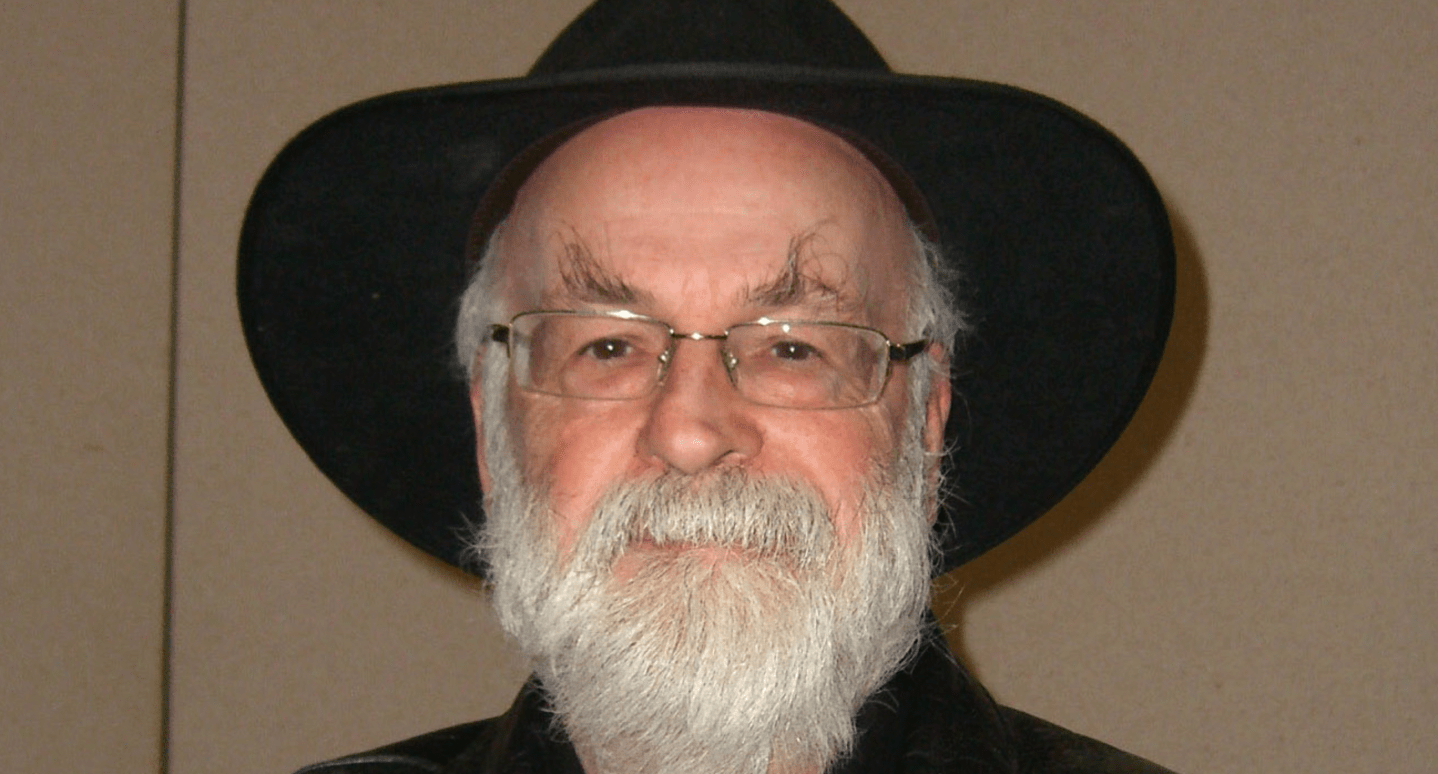
In December 2007, author Terry Pratchett posted a note on his illustrator’s website under the heading “AN EMBUGGERANCE.” He had been diagnosed with a very rare form of early onset Alzheimer’s, he wrote, and it was what had actually been behind the phantom stroke he’d had earlier that year. Pratchett was 59. He asked people to keep things cheerful and added a postscript clarifying that the announcement should be read as “I am not dead.”
He was right about that for another seven years. In that time he published seven more books, gave the Richard Dimbleby Lecture, donated heavily to research and became the most visible person in Britain living openly with dementia. He died in 2015 at age 66.
A study published in the journal Brain Sciences, however, argues that if you had the right software, you could have seen it coming in 1998.
Clues in his writing
Researchers at Cardiff University, Loughborough University and Oxford ran 33 of the 41 Discworld novels through lexical analysis, excluding the eight that were very short or written for younger readers. They were measuring lexical diversity, which is how varied a writer’s word choices are relative to the total number of words. The specific metric is type-token ratio. If a book uses 5,000 distinct adjectives across 200,000 words, that’s a different ratio than 3,000 distinct adjectives across the same 200,000.
What they found was that both noun and adjective diversity dropped significantly in the later books, with adjectives falling below a defined threshold starting with The Last Continent, the 22nd book in the series. Published in 1998, the book came out nine and a half years before the diagnosis.
This is the part almost every write-up of the study garbled. To be clear, Pratchett did not start using fewer adjectives. His books got longer over this stretch, which means he started reusing the same ones.
Objections to the research
Melody Pattison, the Cardiff lecturer who is first author on the paper, addressed the obvious objection about book length directly. Longer texts naturally show lower lexical diversity, she said, but “even after controlling for text length our findings were still significant.” She described the change as gradual and subtle rather than anything a reader would pick up on.
Thom Wilcockson at Loughborough, who led the study, framed the point of the exercise in terms of what dementia does before it announces itself. “Research indicates that memory problems may not be the first symptom of dementia,” he said. Early intervention works better than late intervention, and there is currently no cure. So, anything that moves detection earlier is worth investigating.
Then Marc Burrows, who wrote a biography of Pratchett, took the study apart on Facebook.
His first objection was chronological. The supposed decline begins immediately before the strongest decade of Pratchett’s career, a run that includes Night Watch and Nation. Arguing that his writing was already deteriorating before those books, Burrows wrote, doesn’t hold up.
His second was that a simpler explanation exists. Pratchett was working at enormous speed in this period and his prose was getting cleaner and more controlled. He was learning not to let vocabulary crowd out character and story. “That’s mastery, not decline,” Burrows wrote, adding that the alternative reading requires you to believe Alzheimer’s improved his writing.
His third objection was medical. Pratchett had posterior cortical atrophy (PCA), which attacks visual and spatial processing first and often leaves memory and vocabulary intact for years. It isn’t a language-led illness. When language problems do appear in PCA, they tend to arrive through the visual system as difficulty reading and scanning text. Pratchett took some pride in being able to reel off long word lists during testing while being unable to copy a simple drawing. Rob Wilkins, his assistant, has said the eventual difficulty was about holding the shape of a story and keeping character voices distinct, not about finding words.
Burrows’ complaint was that the coverage citing this research never mentioned PCA at all.
Nuance in the condition
This is accurate about the coverage and not about the study. Writing on her blog Skepchick, Rebecca Watson read the paper and found that the researchers had gotten there first on nearly every count. The discussion section states that age-related changes in writing style are expected and that some of what they observed could be “natural stylistic evolution rather than disease-related decline.”
They cite research on PCA specifically. They note that PCA can cause severe reading impairment and pure alexia, which would disrupt a writer’s ability to scan his own drafts. Thus, that writer could no longer reliably reread his own text and may not catch when he’s repeating himself. That mechanism would produce exactly the pattern they measured without requiring Pratchett’s vocabulary to have shrunk at all.
Reservations
The authors also concede that they could only date the books by publication with no way to know when any of them was actually written. And, unlike an earlier study of Iris Murdoch and Agatha Christie, they had no control author.
Watson’s own reservation is different and harder to answer. Vocabulary narrowing doesn’t point to Alzheimer’s. It points to cognitive change, which can come from Huntington’s, Parkinson’s, Lewy body dementia, depression, concussion, or medication. An algorithm flagging your writing would tell you something is happening without telling you what, which is a difficult thing to hand someone in the absence of a treatment.
The study is a case study added to a small pile of case studies. It is published in an MDPI journal, a publisher some researchers regard skeptically on peer review, and it stops well short of what the headlines about it claimed.
Pratchett himself thought he had noticed something in the year before his diagnosis. He also had a lot to say about how people treated him afterward. “It seems that when you have cancer you are a brave battler against the disease, but when you have Alzheimer’s you are an old fart,” he said. “That’s how people see you. It makes you feel quite alone.”