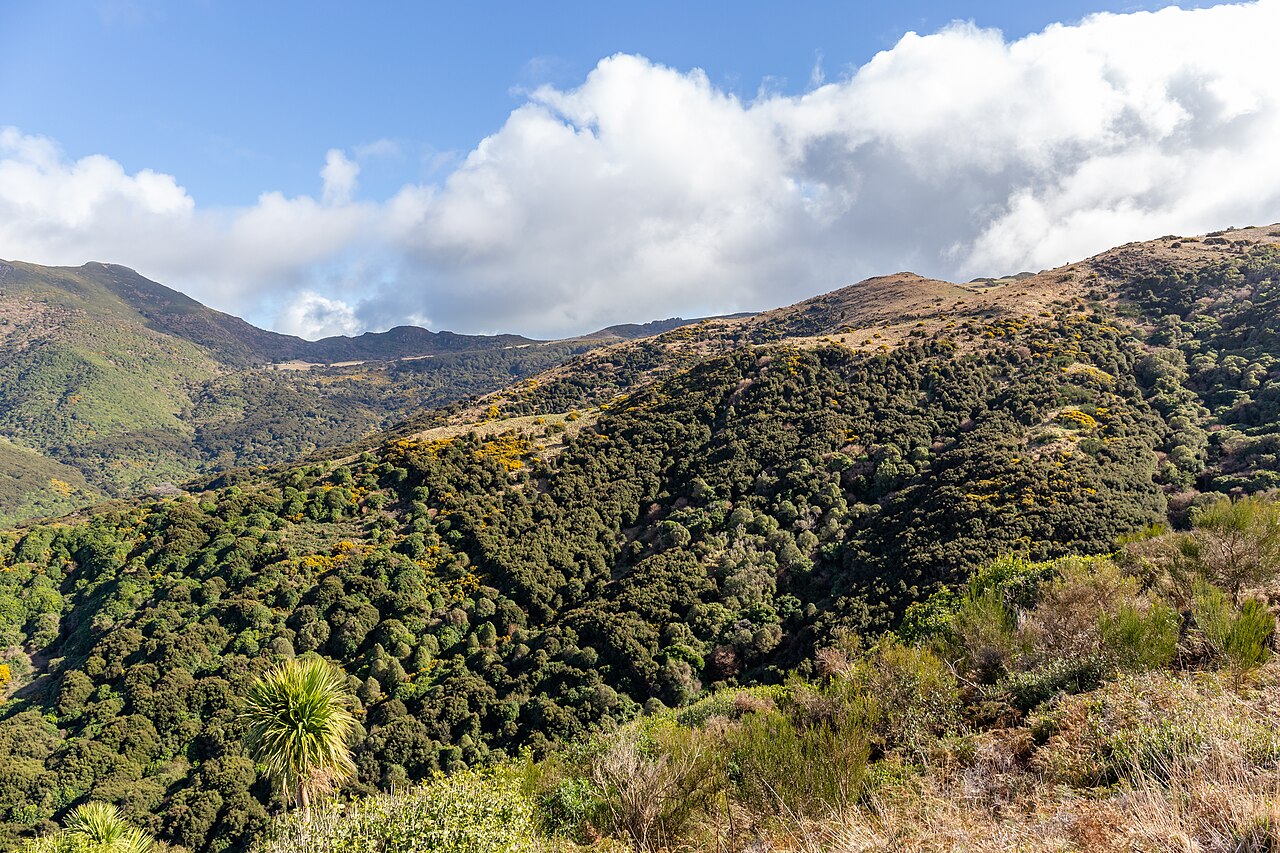
In 1987, a botanist named Hugh Wilson looked at 109 hectares of exhausted hill country on New Zealand’s Banks Peninsula. Most of its old-growth forest had long since been cleared for grazing, and much of what remained was buried under gorse. He proposed doing essentially nothing about it.
Gorse is a spiny European shrub with yellow flowers that New Zealand farmers have spent generations trying to eradicate. They burned it, sprayed it, bulldozed it—and it kept coming back. Wilson’s plan was to stop. Leave it. Let it grow.
The reaction was not warm. As Earth Island Journal recounted, one Banks Peninsula farmer wrote to the local newspaper in the late 1980s that he was “all for preserving the little bits of bush that are here, but as for letting gorse go and turning it into native forest, that’s fools and dreamers stuff.”
The phrase stuck. Three decades later, it became the title of Fools & Dreamers: Regenerating a Native Forest, a 30-minute documentary released by Happen Films in 2019 that is free to watch.
Wilson’s reasoning was that gorse isn’t really the enemy. It’s a nurse crop. Its thorns keep browsing animals away from whatever grows beneath it, its canopy holds moisture and shelters seedlings, and the ground beneath it provides exactly the environment that native species like māhoe, wineberry, five-finger, and lemonwood prefer. Left alone, native seedlings germinate under the gorse and grow up through it.
Then the mechanism completes itself. Native trees keep growing and eventually overtop the gorse, forming a canopy above it. Gorse cannot tolerate shade. Having sheltered the forest into existence, it is shaded out by the trees it protected and dies. The nurse crop eliminates itself on schedule, without anybody spraying anything.
What Wilson and the Maurice White Native Forest Trust actually did was subtractive. They removed the grazing animals—goats, sheep, cattle, and possums. They stopped the burning and spraying. They pulled out the genuinely destructive invasive species: vines and exotic trees that suppress regeneration rather than assist it. Then they left the hillside to do the work.
“The key was to leave it well alone, take away the things that stopped the regeneration process and let nature do the hard work,” Wilson told RNZ.
The skepticism didn’t last, partly because of a drought. In 1988, Banks Peninsula had one of the worst dry summers on record, and neighboring farmers watched their cattle starve. Wilson let one of them—a man who had been among the loudest voices calling him crazy—graze his herd on the reserve. There was still enough grass at that stage that reducing it actually helped native regeneration. The farmer became a supporter for life.
Hinewai Reserve is now roughly 1,500 hectares, the largest private reserve in New Zealand, stretching unbroken from summit to sea across two bays. It has 47 permanently flowing waterfalls and native bird species that had vanished from the district. Neighbors watched tomtits, small insect-eating native birds, spread outward from the center of the reserve year by year until they reached farms that hadn’t seen one in living memory. The land now earns more in carbon credits than it ever did as pasture.
Wilson predicted much of this. In a 1994 paper in the New Zealand Journal of Botany, he projected that 50 years later, assuming fire could be kept out, the reserve would be 95% second-growth native forest, 4% old growth, and 1% tussock and scrub clinging to the bluffs. The reserve has tracked closely with that prediction.
The fire caveat was not theoretical. In 2011, a lightning strike set part of Hinewai alight, burning through a section of the regenerating bush—still Wilson’s greatest fear.
Wilson is now in his eighties and still there, cycling to work, keeping the tracks open to the public for free, and hand-writing and illustrating the reserve’s quarterly newsletter. He doesn’t drive. His assessment of the scale of the problem is neither especially cheerful nor especially defeated.
“The problems are immense,” he says in the documentary, “but the solutions are immense too.”