Tags
More for You
-
The next generation of female leaders has arrived. Here’s how they’re making sure they (and every girl) get a chance to learn.
Malala Fund and their local partners, with support from Pura, help girls find their voice. The result: greater access to education and a better world.
Music, community and joy drive real change
In a small village in Pwani, a district on Tanzania’s coast, a massive dance party is coming to a close. For the past two hours, locals have paraded through the village streets, singing and beating ngombe drums; now, in a large clearing, a woman named Sheilla motions for everyone to sit facing a large projector screen. A film premiere is about to begin.
It’s an unusual way to kick off a film about gender bias, inequality, early marriage, and other barriers that prevent girls from accessing education in Tanzania. But in Pwani and beyond, local organizations supported by Malala Fund and funded by Pura are finding creative, culturally relevant ways like this one to capture people’s interest.
The film ends and Sheilla, the Communications and Partnership Lead for Media for Development and Advocacy (MEDEA), stands in front of the crowd once again, asking the audience to reflect: What did you think about the film? How did it relate to your own experience? What can we learn?
Sheilla explains that, once the community sees the film, “It brings out conversations within themselves, reflective conversations.” The resonance and immediate action create a ripple effect of change.

MEDEA Screening Audience in Tanzania. Captured by James Roh for Pura Across Tanzania, gender-based violence often forces adolescent girls out of the classroom. This and other barriers — including child marriage, poverty, conflict, and discrimination — prevent girls from completing their education around the world.
Sheilla and her team are using film and radio programs to address the challenges girls face in their communities. MEDEA’s ultimate goal is to affirm education as a fundamental right for everyone, and to ensure that every member of a community understands how girls’ education contributes to a stronger whole and how to be an ally for their sisters, daughters, granddaughters, friends, nieces, and girlfriends.
Sheilla’s story is one of many that inspired Heart on Fire, a new fragrance from the Pura x Malala Fund Collection that blends the warm, earthy spices of Tanzania with a playful, joyful twist. Here’s how Pura is using scent as a tool to connect the world and inspire action.
A partnership focused on local impact, on a global mission
Pura, a fragrance company that recognizes education as both freedom and a human right, has partnered with Malala Fund since 2022. In order to defend every girl’s right to access and complete 12 years of education, Malala Fund partners with local organizations in countries where the educational barriers are the greatest. They invest in locally-led solutions because they know that those who are closest to the problems are best equipped to solve and build durable solutions, like MEDEA, which works with communities to challenge discrimination against girls and change beliefs about their education.
But local initiatives can thrive and scale more powerfully with global support, which is why Pura is using their own superpower, the power of scent, to connect people around the world with the women and girls in these local communities.
The Pura x Malala Fund Collection incorporates ingredients naturally found in Tanzania, Nigeria, Pakistan, and Brazil: countries where Malala Fund operates to address systemic education barriers. Eight percent of net revenue from the Pura x Malala Fund Collection will be donated to Malala Fund directly, but beyond financial support, the Collection is also a love letter to each unique community, blending notes like lemon, jasmine, cedarwood, and clove to transport people, ignite their senses, and help them draw inspiration and hope from the global movement for girls’ education. Through scent, people can connect to the courage, joy, and tenacity of girls and local leaders, all while uniting in a shared commitment to education: the belief that supporting girls’ rights in one community benefits all of us, everywhere.
You’ve already met Sheilla. Now see how Naiara and Mama Habiba are building unique solutions to ensure every girl can learn freely and dare to dream.
Naiara Leite is reimagining what’s possible in Brazil
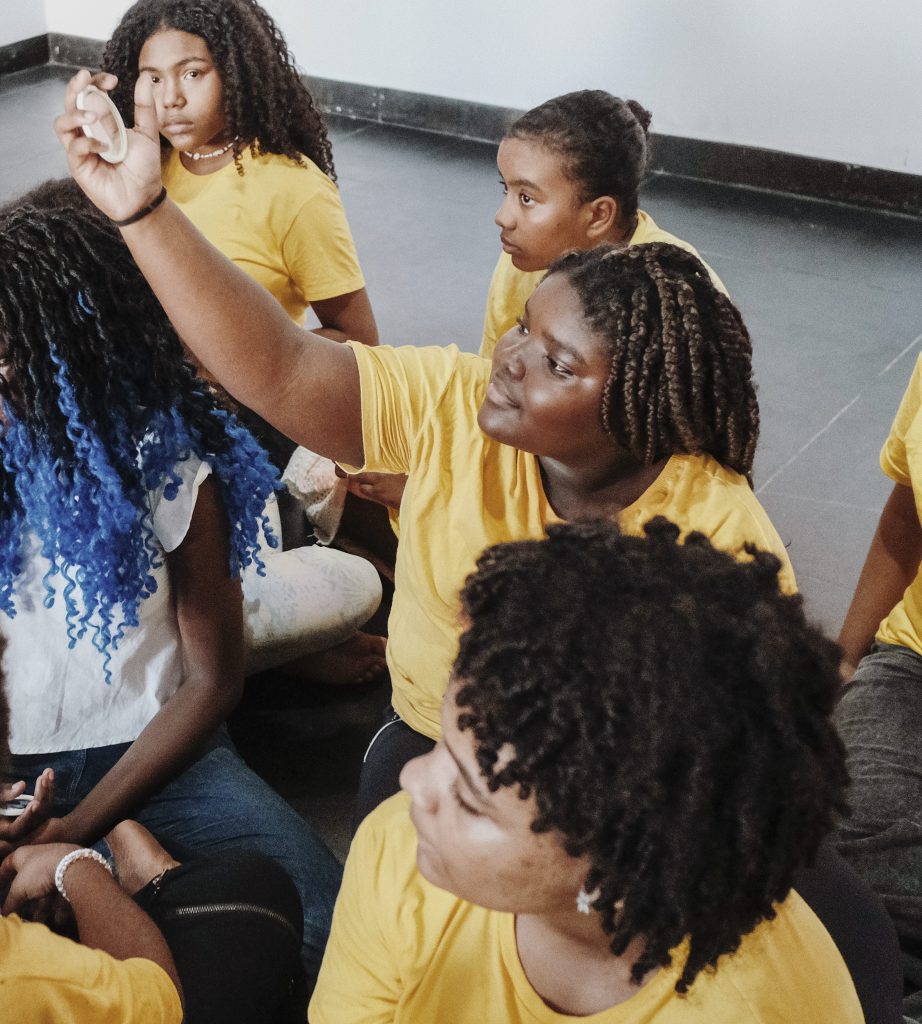
Julia with Odara in Brazil. Captured by Luisa Dorr for Pura In Brazil, where pear trees and coconut plantations cover the Northeastern Coast, girls like ten-year-old Julia experience a different kind of educational barrier than girls in Tanzania. Too often, racial discrimination contributes to high dropout rates among Black, quilombola and Indigenous girls in the country.
“In the logic of Brazilian society, Black people don’t need to study,” says Naiara Leite, Executive Coordinator of Odara, a women-led organization and Malala Fund partner. Bahia, the state where Odara is based, was once one of the largest slave-receiving territories in the Americas, and because of that history, deeply-ingrained, anti-Black prejudice is still widespread. “Our role and the image constructed around us is one of manual labor,” Naiara says.
But education can change that. In 2020, with assistance from a Malala Fund grant, Odara launched its first initiative for improving school completion rates among Black, quilombola, and Indigenous girls: “Ayomidê Odara”. The young girls mentored under the program, including Julia, are known as the Ayomidês. And like the Pura x Malala Fund Collection’s Brazil: Breath of Courage scent, the Ayomidês are fierce, determined, and bursting with energy.
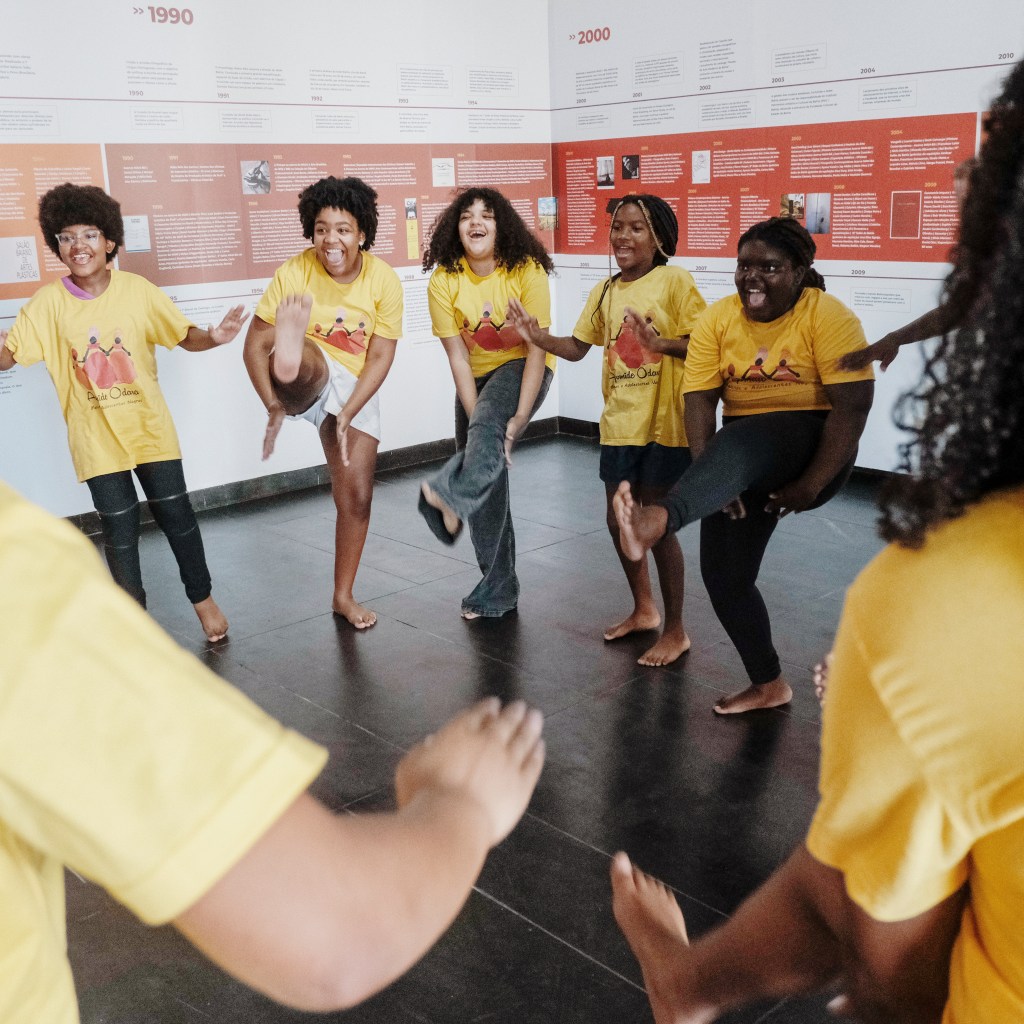
Ayomidês with Odara in Brazil. Captured by Luisa Dorr for Pura Ayomidês take part in weekly educational sessions where they explore subjects like education and ethnic-racial relations. The girls are encouraged to find their own voices by producing Instagram lives, social media videos, and by participating in public panels. Already, the Ayomidês are rewriting the narrative on what’s possible for Afro-Brazilian girls to achieve. One of the earliest Ayomidês, a young woman named Debora, is now a communications intern. Another former Ayomidê, Francine, works at UNICEF, helping train the next generation of adolescent leaders. And Julia has already set her sights on becoming a math teacher or a model.
“These are generations of Black women who did not have access to a school,” Naiara says. “These are generations of Black women robbed daily of their dreams. And we’re telling them that they could be the generation in their family to write a new story.”
Mama Habiba is reframing the conversation in Nigeria
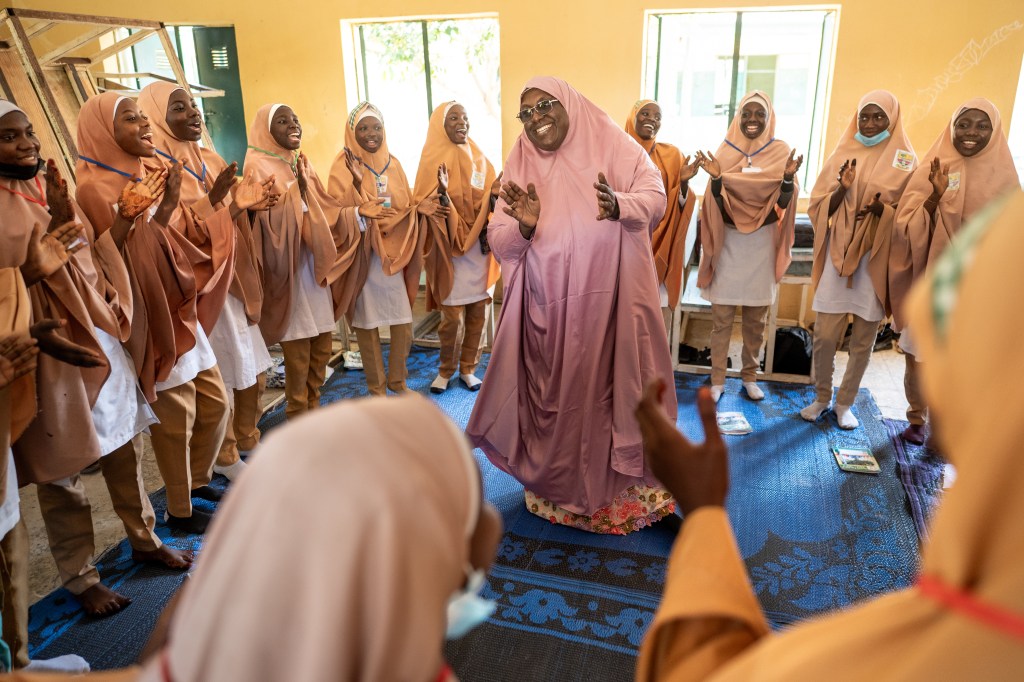
Centre for Girls' Education, Nigeria. Captured by James Roh for Pura In Mama Habiba’s home country of Nigeria, the scents of starfruit, ylang ylang and pineapple, all incorporated into the Pura x Malala Collection’s “Nigeria: Hope for Tomorrow,” can be found throughout the vibrant markets. Like these native scents, Mama Habiba says that the Nigerian girls are also bright and passionate, but too often they are forced to leave school long before their potential fully blooms.
“Some of these schools are very far, and there is an issue of quality, too,” Mama Habiba says. “Most parents find out when their children are in school, the girls are not learning. So why allow them to continue?”
When girls drop out of secondary school, marriage is often the alternative. In Nigeria, one in three girls is married before the age of 18. When this happens, girls are unable to fulfill their potential, and their families and communities lose out on the social, health and economic benefits.
Completing secondary school delays marriage, and according to UNESCO, educated girls become women who raise healthier children, lift their families out of poverty and contribute to more peaceful, resilient communities.

Centre for Girls’ Education, Nigeria. Captured by James Roh for Pura To encourage young girls to stay in school, the Centre for Girls’ Education, a nonprofit in Nigeria founded by Mama Habiba and supported by Malala Fund and Pura, has pioneered an initiative that’s similar to the Ayomidê workshops in Brazil: safe spaces. Here, girls meet regularly to learn literacy, numeracy, and other issues like reproductive health. These safe spaces also provide an opportunity for the girls to role-play and learn to advocate for themselves, develop their self-image, and practice conversations with others about their values, education being one of them. In safe spaces, Mama Habiba says, girls start to understand “who she is, and that she is a girl who has value. She has the right to negotiate with her parents on what she really feels or wants.”
“When girls are educated, they can unlock so many opportunities,” Mama Habiba says. “It will help the economy of the country. It will boost so many opportunities for the country. If they are given the opportunity, I think the sky is not the limit. It is the starting point for every girl.”
From parades, film screenings to safe spaces and educational programs, girls and local leaders are working hard to strengthen the quality, safety and accessibility of education and overcome systemic challenges. They are encouraging courageous behavior and reminding us all that education is freedom.
Experience the Pura x Malala Fund Collection here, and connect with the stories of real girls leading change across the globe.
-
‘The one who’s in love always wins’: Ethan Hawke’s poetic advice on unrequited love touches millions
A red carpet moment that resonated with so many.
During a red carpet interview leading up to the 2026 Oscars ceremony, actor Ethan Hawke was asked to speak about unrequited love, as Blue Moon, the film that earned him a Best Supporting Actor nomination, centers heavily on the theme.
As Hawke often does, he left viewers stunned and inspired with his thoughtful, poetic answer in a now-viral clip.
According to Hawke, one needn’t feel as though they’ve lost anything when romantic feelings aren’t returned, because the act of feeling itself is the true gift of being alive.
Hawke’s thoughts on unrequited love
“The one who’s in love always wins,” the Dead Poets Society star explained. “It doesn’t matter if you get your heart broken; you’re living. When you’re feeling, you’re alive.”
He added, “The sun doesn’t care whether the grass appreciates its rays, right? It just keeps on shining. That’s you.”
And to top it all off, when the interviewer, Amelia Dimoldenberg, said “I love you” in response to Hawke’s inspiring words, the actor didn’t skip a beat, replying, “I love you too,” with genuine affection.
Reactions
The message, now seen more than 13 million times, left many marveling at how Hawke was able to deliver such “insanely beautiful” and “absolutely brilliant” words off the cuff.
“That was just off the dome??”
“He freestyled that???? no script, nothing…. such heavenly Shakespearean poetic words off the top of his head?? Wow.”
“This man is always spitting pure poetry.”
“Ethan Hawke is my fave modern philosopher.”
Others couldn’t help but share that it instantly changed their mindset for the better.
“This switched something in my brain like a full factory reset.”
“It’s the most profound thing I’ve literally ever heard.”

Two hands exchanging a paper heart Photo credit: Canva It’s not hard to see why the clip resonated so deeply
Unrequited love is often framed in pop culture as something embarrassing or tragic. But here, Hawke reframed it as something beautiful and life-affirming. Loving someone, even without those feelings being reciprocated, becomes proof of openness, courage, and emotional vitality. Not a failure.
That perspective can feel especially radical, since we are often taught to measure success by what we receive in return, whether through affection, validation, or monetary gain. But Hawke’s words gently push against that idea, suggesting that the experience of loving itself holds inherent value, regardless of the result. His take echoes a quote by C.S. Lewis that many referenced in the comments: “Love is never wasted, for its value is not based on reciprocity.”
Moments like this are part of why Hawke has built a reputation not just as an actor, but as a thoughtful observer of the human experience. Whether through interviews, writing, or performances, he often taps into something both deeply personal and universally relatable.
If the reaction online is any indication, this brief red carpet exchange did more than promote a film. It offered millions of viewers a small but meaningful shift in perspective, reminding them that feeling deeply is not a weakness, but a sign of being fully alive. And isn’t that, in a way, the point of it all?
-
Dad shares list of 10 things he tells his kids ‘100 times’ for emotional resilience
His powerful phrases inspired other dads to share their own.
Present dads have an overwhelmingly positive impact on their kids’ lives—and the data supports it.
A 2026 study published in Early Childhood Research Quarterly found that father involvement is “closely and positively linked to children’s social-emotional development, playing a crucial role in fostering emotional well-being, social competence, and emotion regulation in early childhood.”
The study goes on to explain that this happens through direct engagement and interaction between dads and their kids, including play, teaching, and shared experiences. Even the smallest moments together can have a big impact, and one dad shared how he fosters that development through language.
A dad explains his role in developing emotional resilience
Reddit user Medium-Put-4976 opened up to fellow fathers on the platform about how he’s helping build his kids’ emotional resilience. He says he has a short list of impactful phrases he hopes to instill in them.
He writes, “10 things to say to your kids at least 100 times before a time/event when they’ll need to hear it. (And mean it. Clearly saying it, but not living it, is counterproductive).”
The post continues, explaining why repetition matters.
“I’d like to think in the right moment I’d say the right thing, but on the fairly decent chance I don’t, I will make sure my kids have heard these things enough before the time they really need it,” he adds.
He also shares the impact he hopes it will have on his kids.
“For the same reasons that routines make kids feel safe, being a predictable parent is a stabilizer,” he writes. “Start now to develop your own mouth-muscle-memory.”
He concludes the post with wisdom about his role as a father and about being someone his kids can feel secure with.
“When this stuff falls out of my mouth easily, and frequently, I’m more likely to get it right when it matters most,” he writes. “And if not, they’ll at least know where I stand, not just in a crisis.”
10 things to tell kids “100 times”
Here are the phrases he shared with fellow dads, which he hopes will inspire them in their fatherhood journey:
- “I’m so glad you told me.”
- “I love you.” and “I love you, no matter what.”
- “I’m sorry.”
- “I was wrong. How can I make it right?”
- “I don’t know. Let’s figure it out together.”
- “I’m ready to listen.”
- “Do you want me to help, or just listen?”
- “You can always come home.”
- “I have your back.”
- “The world needs your __. (Reference a specific attribute and be prepared to back it up with examples of how your kid has it. Eg: ideas, enthusiasm, energy, art, voice, grit, style, friendship, kindness.. whatever fits)”
Fellow dads share more impactful phrases
The inspirational post ends with a callout to dads to share the important parenting phrases they say to their kids. Here are six fathers and their go-to phrases:
Dad #1:
“I recently saw a video that had some good ones. Pasting details below:
Your feelings make sense.
I was wrong.
I love watching you figure things out.
Tell me more about that.
That took courage.
You can change your mind.” – GrrATeam81Dad #2:
“I have so much fun hanging out with you.
I’m grateful for the person you are and the young man you’re growing up to be.
I’m proud of you for doing the right thing even though it was difficult.
Everyone makes mistakes, has accidents, and makes bad decisions. Learn from the consequences; we’ll get through it.
What do you think about _?Also, I’ve always told my son ‘I promise that you’ll never regret telling me about anything.’ My parents said I could talk to them but they’d get mad or hold it against me later. When my son tells me about something he did wrong upfront, I thank him for being honest and tell him that taking responsibility voluntarily and knowing when to ask for help shows maturity and good judgment.” – CertainMedicine757
Dad #3:
“This is a great list. I learned two other ones recently: ‘I’m so glad you’re here’ (i.e. their presence is worthwhile) and ‘I love watching you figure things out'(the process is what I love, not results).” – Friendly-Land-1873
Dad #4:
“‘We are problem solvers’ is something I’ve tried to engrain in my kids.” – slidingscrapes
Dad #5:
“I run a slightly more Star Wars flavor on 2B. ‘I love you more than anything you could ever do wrong.’” – jeconti
Dad #6:
“I got this from a video, I wrote it in my notes and say it to my kid often when dropping her off at school. She loves it and even responds adding to it lol.
It’s okay to not know it all.
It’s okay to make mistakes.
It’s okay to be yourself.
It’s okay to ask for help.
It’s okay to start over.
It’s okay to say no.
It’s okay to cry.
It’s okay to feel upset.And recently added this to my notes and have started saying this to her when she’s working on something unfamiliar (‘difficult’):
This feeling means your brain is growing.
It’s okay that this is hard, hard is how we all learn.
Stay with it. I believe in you and I’m right here.” – factsonlynomisinfo -
Mom stopped taking teen’s phone as punishment and switched to something more helpful
“I started using consequences that actually match what I’m trying to correct.”
When it comes to disciplining teens, every generation and every parent has their own style. Back in the Gen X days, when someone got grounded, we often heard things like, “No TV for two weeks!”
Of course, cell phones didn’t exist back then, so removing them wasn’t an option.
Many Gen X parents now choose to take away cell phones as punishment. But one mom, Carol, has gone viral on Instagram for declaring that she doesn’t agree with that approach. In fact, she believes it can make matters worse.
Over a video of kids playing in a park, a chyron reads, “I’m not taking away my teen’s phone anymore as a fast consequence.”
A new approach
“You know when your teen messes up and your first instinct is to go straight for the phone?” Carol asked. “Yeah… that used to be me. Disrespectful tone? Phone. Didn’t follow a rule? Phone. Endless fighting with siblings? Phone. And yes… it ‘worked’ fast. They’d stop right away.”
“But it didn’t sit right with me,” she wrote. “Because the behavior stopped but the conversation stopped too. They shut down, got defensive, and I ended up feeling like the worst mom in the world.”
At some point, she realized that a phone can be a source of support and connection for some teenagers:
“What slowly changed things for me was realizing this: for teens, their phone isn’t just a distraction. It’s where their friends are. Where they vent. Where they feel connected.
So, when I took the phone away in the heat of the moment, I wasn’t just taking away a privilege… I was cutting them off from their world right when emotions were high. Another thing: the consequence wasn’t even connected to what they did. So it didn’t really correct the behavior. It just felt unfair to them and built resentment.”
Instead, she tried to make the punishment fit the crime:
“So I tried a small shift. I started using consequences that actually match what I’m trying to correct.
If the tone is disrespectful?
I don’t raise my voice. I hold the line and say we’ll talk when they can speak to me respectfully.
If siblings can’t agree?
The thing they’re fighting over is paused until they work it out (like both wanting the TV at the same time, they have to agree on turns and who goes first).
And when I do believe phone access needs to be limited, I say it ahead of time, explain the boundaries, so next time it’s not a surprise.
And the energy in our house changed. Less shutting down and resentment. More real conversations.”
Many relate
The post clearly resonated with parents. It has more than 72,000 likes and hundreds of comments, many in agreement and others vehemently disagreeing, sparking an interesting discussion.
One Instagrammer, a teenager, waded into the conversation. Not surprisingly, they agreed with the assessment:
“As a teenager, I would love to have parents who understand that taking away a phone will ‘fix’ things quickly but never in the long run and that these methods are soooo much better.”
Another commenter disagreed:
“What’s the consequence for disrespect? You actually don’t have one. The phone often is the cause of disrespect for my kid, and I am sure others, as she has spent too much time on it. When she is away from devices, she is a calmer and happier person, so yes, I will take it away and put limits on it. Kids need parents that will actually have boundaries and backbones.”
Expert opinions
Upworthy spoke with a few experts on teens. Cindy Shuster, who holds a master’s degree in elementary education and is the founder of Partner in Parenting, said, in part:
“Teens do need to be accountable for their behavior and choices, but I see too many parents relying on the phone, and it becomes a constant battle of a back-and-forth. Nothing ever changes. Parents need to work with their teens to problem-solve through bad decisions and mistakes.”
Shuster noted, however, that if the issue is the phone, it should be taken away:
“Sometimes, the phone comes into play because it is the phone that may have been used to break a rule, or its use may have led to poor grades. In this case, the conversation centers around how the phone led to the outcome, and therefore there will be new rules around the phone. However, if a child did not do well in school and it is unrelated to the phone, it does not make sense to use the phone as a punishment. Instead, it is best to sit down with the child and try to understand what broke down. Help them discover what caused them to not do their best and what they could do differently moving forward.”
Jeanette Lorandini, founder and clinical director at Suffolk DBT, had a different approach:
“I don’t think the question is simply whether taking away a phone is ‘good’ or ‘bad.’ In DBT [Dialectical Behavior Therapy], we take a dialectical approach, looking for the middle path.
On the one hand, a teen’s phone can be an important way for them to cope, connect, and regulate. On the other hand, limits and boundaries are still necessary. The goal isn’t to choose between connection and limits. It’s to create both. Before taking a phone away, it can help to ask what role it’s playing. Is it about connection, coping, or avoiding something painful? Punishment alone doesn’t teach skills. Teens need to learn what to do instead.
A middle-path approach might look like setting limits on certain apps or times while still allowing connection and support. When parents are clear, consistent, and collaborative, teens are more likely to stay connected to expectations and to the relationship.”
Many parents and teen therapists believe children and young adults have too much access to their phones in the first place.
Brooke Sundin, a licensed marriage and family therapist, shared:
“It’s important for families to remember that a phone is a privilege, not a right. As a mental health therapist, I encourage the parents I work with to empathize with their teen’s experience while confidently stepping into their parental authority when limits are needed.
While many teens view their phone as a primary source of social connection, it is important to recognize the highly engaging and addictive nature of this technology. Constant screen-based connectivity can have real negative consequences for sleep, mood, and overall well-being. Real-life interactions are not the same as screen-based interactions, and screen-based communication can take away valuable opportunities to practice in-person communication.”
-
United’s new ‘Relax Row’ will allow coach passengers to stretch out and sleep with their families
It’s the airline version of a fold-out bed.
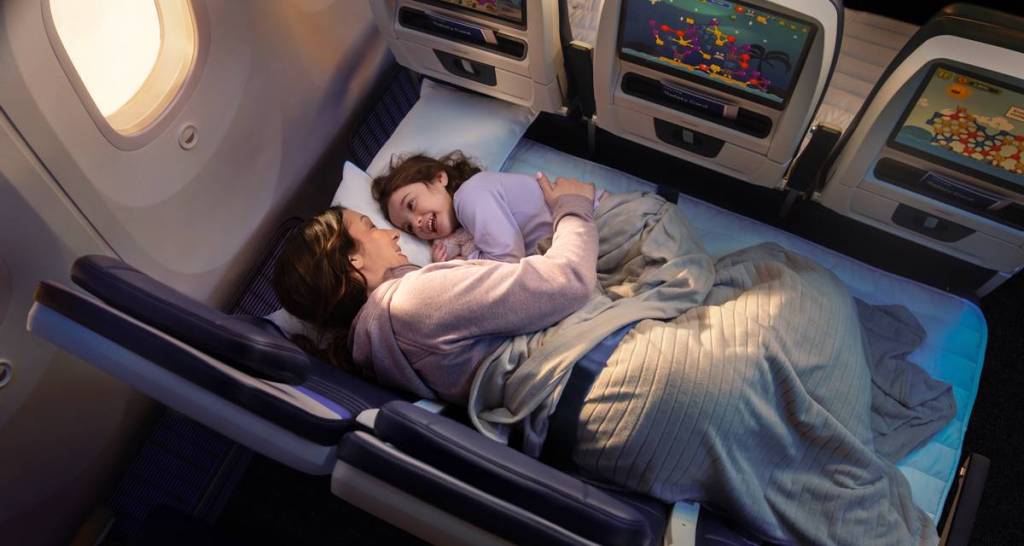
Have you ever dreamed of buying an entire row of seats on an airplane so you could either enjoy the flight without being squeezed next to a stranger or lie down as if in a bed? Now, United Airlines is making that dream a reality with its new “Relax Row” seating, where your row of seats folds into a lie-flat, mattress-like space after takeoff.
If you’re flying alone, it may be a bit expensive to buy an entire row, but if you’re sharing it with a partner or traveling with kids and were planning to buy three seats anyway, it’s a more comfortable way to fly. In addition to the bed-like layout, customers receive a custom-fitted mattress pad, a specially sized plush blanket, two additional pillows, a plush toy, and a children’s travel kit for families.
Relax Row seating
For years, people who sit in first class have been able to lie down and sleep almost as they would at home. This will be the first time that bed-like seats have been available in coach on an American airline. A similar type of seating is currently available on Air New Zealand, All Nippon Airways, and Lufthansa.
“As a leading premium airline, we’re committed to delivering new, industry-leading experiences for all of our customers–and the United Relax Row is the perfect example of that,” Andrew Nocella, United’s executive vice president and chief commercial officer, said in a statement. “Customers traveling in United Economy on long-haul flights deserve an option for more space and comfort, and this is one way we can deliver that for them. United is the only North American airline offering a product like the United Relax Row and is one of the many reasons why we’re continuing to win brand loyal customers.”
When it will be available
The new seating arrangement will launch in 2027. It will be available on more than 200 Boeing 787 and Boeing 777 aircrafts by 2030, with up to 12 United Relax Row sections per plane. United Airlines currently has more than 1,000 planes in its fleet.
The airline hasn’t shared any details on how much the Relax Row will cost compared with three regular seats on a flight, saying only that it’s intended for those who “want the value of United Economy but with a little extra comfort.”
It also appears that, in the event of turbulence, passengers won’t have to pack the bed away, as they are secured by safety belts that go across their bodies.
It’s becoming harder for families to sit together on commercial airlines
The new seating arrangement is perfect for families with small children, allowing them to lie down, relax, and hopefully get some sleep during a flight.
The announcement comes at a time when it’s becoming harder for families to sit together. On many budget airlines, families who book tickets aren’t guaranteed seats together unless they pay an additional fee to select them.
-
NY superintendent flies to Guatemala to give diploma to graduate detained by ICE
The student, who self-deported, was supposed to graduate in May.
Roosevelt Schools Superintendent Dr. Shawn Wightman set out on an unusual journey to give his student, Alvaro Castro Velasquez, the graduation he earned.
The senior was looking forward to walking across the stage with his friends at Roosevelt High School this May. But just weeks before graduation, Immigration and Customs Enforcement (ICE) detained him during a random encounter. Soon after, ICE transferred Castro Velasquez to a facility in Texas. When school officials found out, it sparked a response that brought the immigration crackdown right to their doorstep.

Students in their caps and gowns. Photo credit: Canva “He wasn’t a hardened criminal or anything like that. Didn’t have any type of record. That was the moment everybody realized that this is a real thing,” Wightman told ABC 7 New York.
Wightman didn’t give up on the senior. The superintendent boarded a flight to Texas with his regalia and Castro Velasquez’s diploma in hand. It was then that he realized the task wouldn’t be so simple. He was denied a meeting with the student who had reportedly come to the United States alone when he was 16. The flight, paid for out of his own pocket, turned out to be an expensive dead end.
A man on a plane. Photo credit: Canva “It’s very difficult as a superintendent, a father, to think about if something like that were to have happened to any of my kids,” Wightman told ABC 7 New York.
But where a seed of determination is planted, setbacks can sometimes act as water, leading to a bloom. After Wightman’s unsuccessful attempt to deliver the teen his diploma, Castro Velasquez opted for self-deportation to Guatemala. Navigating the immigration system alone as a teen is likely overwhelming, which may have contributed to the senior’s decision to leave.
Wightman, however, became more determined than ever to ensure the teen received the diploma he earned. The educator took two flights and drove five and a half hours through the foothills of Guatemala to reach his former student. The pair reunited after Wightman’s long journey to the Central American country.
The unwavering superintendent didn’t just arrive with a diploma in hand. He brought his own graduation robe and hood, along with the student’s cap and gown. In doing so, Wightman brought the graduation ceremony to Castro Velasquez.

An airplane. Photo credit: Canva “This is amazing for me. He helped me. And he supported me, for all this time,” Castro Velasquez told ABC 7 New York. “I’m not feeling I’m alone. I know I have him and my family.”
The TV station shared the video on Instagram, and people can’t get over the lengths the superintendent went to to mark the special occasion for his student.
One person said, “Thank you sir, for demonstrating humanity.”
Another wrote, “On his own dime. He should sleep peacefully at night knowing he did something extraordinarily kind!!”
Someone else shared, “My heart is so moved by the sheer humanity and compassion of this man. He is a true educator! I pray that this young man will be inspired to keep fighting for his dreams. I pray that he be protected so that one day he can pay it forward.”
For those wondering why he went to such lengths at his own expense, Wightman’s answer is simple: “You don’t abandon people who you care about.”
-
Father and son to cycle 9,600 miles to visit all 30 MLB parks and raise $1M for a children’s hospital
“This is well beyond us. It’s about everybody. Especially those young kids.”
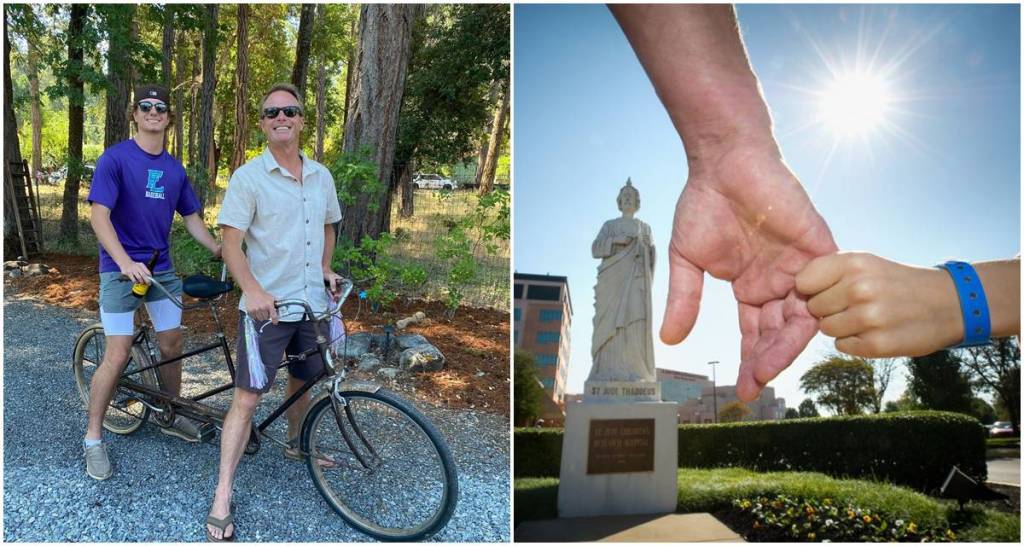
Thirty-two years ago, Scott Pesch and a group of track-and-field friends from college took on a crazy challenge: cycling across the United States to visit every Major League Baseball stadium. They came up eight stadiums short due to a player strike, but still raised $15,000 for their local Boys & Girls Club.
On March 26, Scott and his son Ethan, a recent graduate of the University of Arizona, will recreate the ride, this time visiting all 30 MLB stadiums with a loftier goal: raising $1 million for St. Jude Children’s Research Hospital.
On the Bike 2 Ballparks ride, the Pesches will be joined by friends and cyclists across the country who wish to take part. The journey begins in Seattle, Washington, for a Mariners–Cleveland Guardians matchup and ends on September 26 in Miami, Florida, with a Marlins–Atlanta Braves game.
Finding a beneficiary for the ride was an emotional experience
The Peschs’ decision to ride for the children’s hospital came after experiencing its work firsthand when Scott’s beloved professor at Cal Poly Humboldt, Dr. Richard Stull, lost his 12-year-old daughter to cancer. “It’s such a memorable ride, you have to do it for something. St Jude Children’s Research Hospital, that’s who we chose,” Scott said in a statement. “And I’m so glad we did. Because, man, that team over there is so fantastic.”
The Pesch family visited the hospital, and the experience humbled them. “The campus is very impressive,” Scott told Upworthy. “The fact that the scientists and doctors are there, looking to cure cancer and treat cancer. And then you walk into the children’s hospital. That’s the most sobering spot. It just stands you up. It’s crazy.”

The Peschs’ journey to all 30 ballparks. Photo credit: Bike 2 Ballparks Ethan has been training for more than two months to get in shape for the ride of a lifetime. “I’ve been cycling four or five times a week, probably since January, just trying to get into physical shape,” he told Upworthy.
“Physiologically, you’re sore. Your butt’s going to hurt. You know, you just have to get used to these things,” Scott added. “But psychologically, you just have to mentally prepare for what we’re doing.”
The Pesches have some added motivation to get them through the toughest parts of their trip: the children at the hospital. “It kind of puts things in perspective,” Scott said. “If you’re having a bad day, just think about the kids of St. Jude who are the beneficiaries.”
One place they’ll need all the encouragement they can get is en route to Coors Field. “The biggest elevation gain is going to be going up to Denver, Colorado, when you have to climb the Continental Divide,” Scott said.
The duo is most excited about games in San Francisco and Chicago
The father-and-son team can’t wait for their third game in San Francisco, where they’ve been invited to throw out the first pitch at Oracle Park. “That is something that is like a dream come true. I grew up a Giants fan,” Ethan said.
Scott is excited to relive one of his favorite moments from the ’94 ride. “I think the part that I’m looking forward to is being at Wrigley Field on the Fourth of July,” he said. “Oh, wow. Because we had that same schedule back in ‘94. We were in Chicago. We watched the Cubs play the St. Louis Cardinals on the Fourth of July.”

The Pesch family. Photo credit: The Pesch family (used with permission) They also can’t forget about the food. Given how many calories they’ll be burning on the road, they’re free to eat and drink whatever they like at the ballpark. “I’m looking forward to going to San Diego, and they have these carne asada fries,” Ethan said. “I lived in San Diego for a little bit, and every time I went to a game, that’s all I was getting because it’s good.”
Ultimately, the 9,600-mile trip is all about supporting children and their families in the fight of their lives. “We have even more purpose to get this thing done because of those young kids who have cancer. And it just breaks your heart. It just does,” Scott said. “But it really wakes you up. And there’s more out there than just us. This is well beyond us. It’s about everybody. Especially those young kids.”
The Peschs’ ride is open to anyone who wants to join and support St. Jude Children’s Research Hospital. You can track their progress across the country at Bike 2 Ballparks and follow the ride on Instagram. If you’d prefer to donate, you can do so here.
-
Dad remakes AC/DC’s ‘Thunderstruck’ using only a year’s worth of baby’s recorded sounds
Prepare to be thunderstruck.
Few things bring as much joy to a parent’s heart as the adorable sounds their babies make. But back in 2024, when a dad with a vision, a camera and a year’s worth of footage used those sounds to recreate one of the most iconic rock songs ever…let’s just say joy alone doesn’t quite cover it.
In one of the most epically adorable and adorably epic song renditions ever, dad and video editor Matt MacMillan spliced together tiny snippets of his baby’s sounds to make AC/DC’s “Thunderstruck.” And it’s one of those things you just have to see to believe.
Below, enjoy little Ryan singing a jaw-droppingly awesome babyfied version of “Thunderstruck.” Nothing but awe and respect for a guy who takes a whole year to get just the right sounds at the right pitches and figures out to put them together to create this masterpiece:
Making a sneeze into a cymbal? Are you kidding me?
People have been understandably impressed, with the video getting over 11 million views.
“Ryan becomes the vocalist of AB/CD.”
“I need a cover in 17 years whenever he is an adult singing over the instrumentals lol”
“‘I recorded my son for a full year. I edited for the next 5′”
“The fact that he genuinely found clips that fit every note he need instead of just pitch shifting like most videos like this do really makes this stand out. Good job he’s adorable.”
“This dude had a kid just so he could make this song. What a Legend.”
“Other parents: ‘I want my child to create masterpieces.’ This guy: ‘my child IS the masterpiece.’”
“I’m a residential plumber and I’ve had an absolutely horrible day on a work shift that’s lasted 13 hours and even after crawling through human poop all day this made me smile laugh and giggle like a small baby.”
Believe it or not, it’s not autotuned or pitch-shifted. Those notes are all baby.
The real question is: How did he do it? This isn’t just some autotune trick. MacMillan really did it all manually, going through each video clip of Baby Ryan, organizing them by pitch and figuring out what notes they were.
Perhaps most impressively, he didn’t even know the notes of “Thunderstruck” to begin with and doesn’t really read music. He had to pluck the song out on the piano and then match those notes with his baby’s sounds.
As he wrote, “It took forever.” But he shared an inside look at how he did it here:
Seriously, doesn’t seeing how he did it make it even more impressive? Pure human creativity and perseverance on display. What a delightful gift Ryan will have for the rest of his life. Much better than a standard baby book.
Baby Ryan’s “Thunderstruck” was not MacMillan’s first foray into baby covers, either. He previously created a rendition of “Carol of the Bells” using Baby Ella’s sounds, and it is just as impressive (and adorable) as Baby Ryan’s. Here’s one to add to your holiday playlist:
Here’s to the humans who wow us with their ambitious, innovative projects that exist purely to bring a smile to people’s faces.
You can follow Matt MacMillan on YouTube.
This article originally appeared last year.
-
Dad shares the unique 7-point checklist his kids must finish before they get screen time
A psychiatrist and father of seven went viral for sharing the typed checklist his kids must complete before they’re allowed anywhere near a phone or tablet, and even plenty of adults are saying they need someone to do this for them.
We know too much screen time is not good for us. We also know that younger folks are particularly susceptible to screen addiction. Crucially, teachers and psychologists have been sounding the alarm about the effects of too much screen time on young people for years now. Reports flood in every year that more and more people in schools struggle to do anything without ChatGPT’s help, that they’re way behind in learning fundamental skills, that they’re disrespectful and lazy.
Every generation has been “concerned” about the one that comes directly after them, bemoaning that they don’t have the same values or that their brains are being rotted by Elvis, rock and roll, radio, or television. So some of the doom and gloom is probably overstated, but there’s truthfully never been anything quite like iPhones loaded up with TikTok and other forms of hyper-dopamine-fueled social media.
Still, it’s unlikely that a young person, or any person, really, can exist in modern society without some level of access to screens. So parents need to effectively help teens and tweens manage the habit and offset the dangers as much as humanly possible.

A young girl plays on the monkey bars. Photo credit: Canva Psychiatrist, author, and dad of seven Richard Wadsworth recently went viral after showing his own personal strategy for getting his kids to do something other than scrolling.
It could be the perfect solution for parents to not only break screen addiction, but instill some other healthy ritual as well.
In the clip, we first see Wadsworth’s tween son doing deltoid exercises with dumbbells. Which he apparently got up at 6:30 am to do. What could possibly incentivize practically anyone, let alone a preteen to wake up at the crack of dawn to lift weights? Was his dad forcing him to exercise?
No. Wadsworth went on to show a typed out list of various tasks that must be performed before his kids even think about setting eyes on a phone or tablet. The list included a short workout in the form of one mile on the treadmill or 20 minutes of another exercise.
Wadsworth explained that rather than enforcing strict rules, this method provides necessary structure without taking away choice.
“I’m not forcing my son to exercise every day, but I am setting rules and boundaries around his screen time,” he said. “He decided he wanted to have more time after school to play with his friend. And so in order to do that, he realized that he’d need to wake up a little bit earlier and exercise in the morning.”
In addition to exercise, the list included domestic chores like cleaning the bedroom and shared areas, finishing homework, doing laundry, preparing for the next day…and, perhaps most importantly…making sure the toilet is flushed. (Not cleaned, just flushed. Parents everywhere can relate.)
“We have all of their screens locked away. And if they want access to any of them, they need to come ask us and we’ll go through the list together. And they’re not getting their screens until the list is done,” Wadsworth continued.
He also drew a comparison between screen time and sugary sweets, noting how most parents probably wouldn’t routinely allow kids to eat dessert before a nutritious meal, but instead allow it to be a treat.

Two young women look at a cell phone. Photo credit: Canva “Just as you would hopefully have your kids eat dinner before they had their dessert, you should probably be having them do something positive…before they get on their screens.” Hence why he tries to get his kids to complete their list before going to the phone.
And in case you’re wondering how Wadsworth’s son feels about all this, he reported having “so much energy for school” feeling “so much better” since his dad introduced the to-do list.
Bottom line: kids need guidance from their parents. And Wadsworth recommends clear cut boundaries to help them develop good habits, “because if you don’t do it, nobody else is.”
Wadsworth’s parenting hack was well received, with quite a few grown adults saying they could benefit from this type of boundary-setting in their own life.
“Even I’m addicted to this screen. I have to tell myself to put it down all the time and I’m a grown adult. Kids definitely need this!” one user wrote.
Another added, “I need someone to do this for me (I’m 28).” To which Wadsworth replied, “we all need parents sometimes.”
“We implemented a similar plan, and I was surprised at how easy they took to it. It’s almost like kids need structure. What a concept!” another user remarked.
While the inclusion of exercise on the To-Do List might be controversial, the facts don’t lie. Most kids and teens aren’t getting enough daily physical activity. Kids don’t play outside or walk to school anymore, either. So if they’re not exercising, they’re probably not moving much at all. And that’s just as dangerous as too much TikTok.
Even with ongoing uncertainty around TikTok, social media isn’t going anywhere. The sooner parents can implement guidelines like these, the better equipped their kids will be at balancing tech savviness with tech dependence.
This article originally appeared last year. It has been updated.








‘The one who’s in love always wins’: Ethan Hawke’s poetic advice on unrequited love touches millions



United’s new ‘Relax Row’ will allow coach passengers to stretch out and sleep with their families

Get stories worth sharing delivered to your inbox.
Advertisement