Tags
More for You
-
The next generation of female leaders has arrived. Here’s how they’re making sure they (and every girl) get a chance to learn.
Malala Fund and their local partners, with support from Pura, help girls find their voice. The result: greater access to education and a better world.
Music, community and joy drive real change
In a small village in Pwani, a district on Tanzania’s coast, a massive dance party is coming to a close. For the past two hours, locals have paraded through the village streets, singing and beating ngombe drums; now, in a large clearing, a woman named Sheilla motions for everyone to sit facing a large projector screen. A film premiere is about to begin.
It’s an unusual way to kick off a film about gender bias, inequality, early marriage, and other barriers that prevent girls from accessing education in Tanzania. But in Pwani and beyond, local organizations supported by Malala Fund and funded by Pura are finding creative, culturally relevant ways like this one to capture people’s interest.
The film ends and Sheilla, the Communications and Partnership Lead for Media for Development and Advocacy (MEDEA), stands in front of the crowd once again, asking the audience to reflect: What did you think about the film? How did it relate to your own experience? What can we learn?
Sheilla explains that, once the community sees the film, “It brings out conversations within themselves, reflective conversations.” The resonance and immediate action create a ripple effect of change.

MEDEA Screening Audience in Tanzania. Captured by James Roh for Pura Across Tanzania, gender-based violence often forces adolescent girls out of the classroom. This and other barriers — including child marriage, poverty, conflict, and discrimination — prevent girls from completing their education around the world.
Sheilla and her team are using film and radio programs to address the challenges girls face in their communities. MEDEA’s ultimate goal is to affirm education as a fundamental right for everyone, and to ensure that every member of a community understands how girls’ education contributes to a stronger whole and how to be an ally for their sisters, daughters, granddaughters, friends, nieces, and girlfriends.
Sheilla’s story is one of many that inspired Heart on Fire, a new fragrance from the Pura x Malala Fund Collection that blends the warm, earthy spices of Tanzania with a playful, joyful twist. Here’s how Pura is using scent as a tool to connect the world and inspire action.
A partnership focused on local impact, on a global mission
Pura, a fragrance company that recognizes education as both freedom and a human right, has partnered with Malala Fund since 2022. In order to defend every girl’s right to access and complete 12 years of education, Malala Fund partners with local organizations in countries where the educational barriers are the greatest. They invest in locally-led solutions because they know that those who are closest to the problems are best equipped to solve and build durable solutions, like MEDEA, which works with communities to challenge discrimination against girls and change beliefs about their education.
But local initiatives can thrive and scale more powerfully with global support, which is why Pura is using their own superpower, the power of scent, to connect people around the world with the women and girls in these local communities.
The Pura x Malala Fund Collection incorporates ingredients naturally found in Tanzania, Nigeria, Pakistan, and Brazil: countries where Malala Fund operates to address systemic education barriers. Eight percent of net revenue from the Pura x Malala Fund Collection will be donated to Malala Fund directly, but beyond financial support, the Collection is also a love letter to each unique community, blending notes like lemon, jasmine, cedarwood, and clove to transport people, ignite their senses, and help them draw inspiration and hope from the global movement for girls’ education. Through scent, people can connect to the courage, joy, and tenacity of girls and local leaders, all while uniting in a shared commitment to education: the belief that supporting girls’ rights in one community benefits all of us, everywhere.
You’ve already met Sheilla. Now see how Naiara and Mama Habiba are building unique solutions to ensure every girl can learn freely and dare to dream.
Naiara Leite is reimagining what’s possible in Brazil
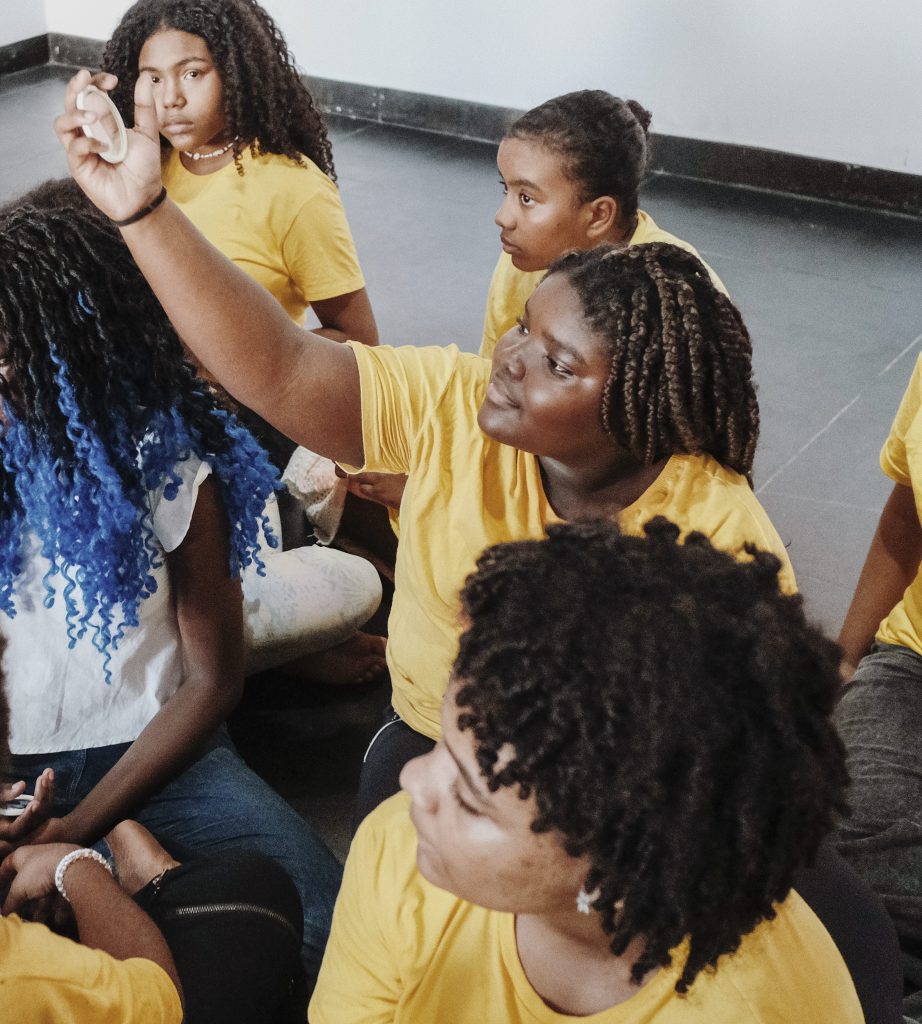
Julia with Odara in Brazil. Captured by Luisa Dorr for Pura In Brazil, where pear trees and coconut plantations cover the Northeastern Coast, girls like ten-year-old Julia experience a different kind of educational barrier than girls in Tanzania. Too often, racial discrimination contributes to high dropout rates among Black, quilombola and Indigenous girls in the country.
“In the logic of Brazilian society, Black people don’t need to study,” says Naiara Leite, Executive Coordinator of Odara, a women-led organization and Malala Fund partner. Bahia, the state where Odara is based, was once one of the largest slave-receiving territories in the Americas, and because of that history, deeply-ingrained, anti-Black prejudice is still widespread. “Our role and the image constructed around us is one of manual labor,” Naiara says.
But education can change that. In 2020, with assistance from a Malala Fund grant, Odara launched its first initiative for improving school completion rates among Black, quilombola, and Indigenous girls: “Ayomidê Odara”. The young girls mentored under the program, including Julia, are known as the Ayomidês. And like the Pura x Malala Fund Collection’s Brazil: Breath of Courage scent, the Ayomidês are fierce, determined, and bursting with energy.
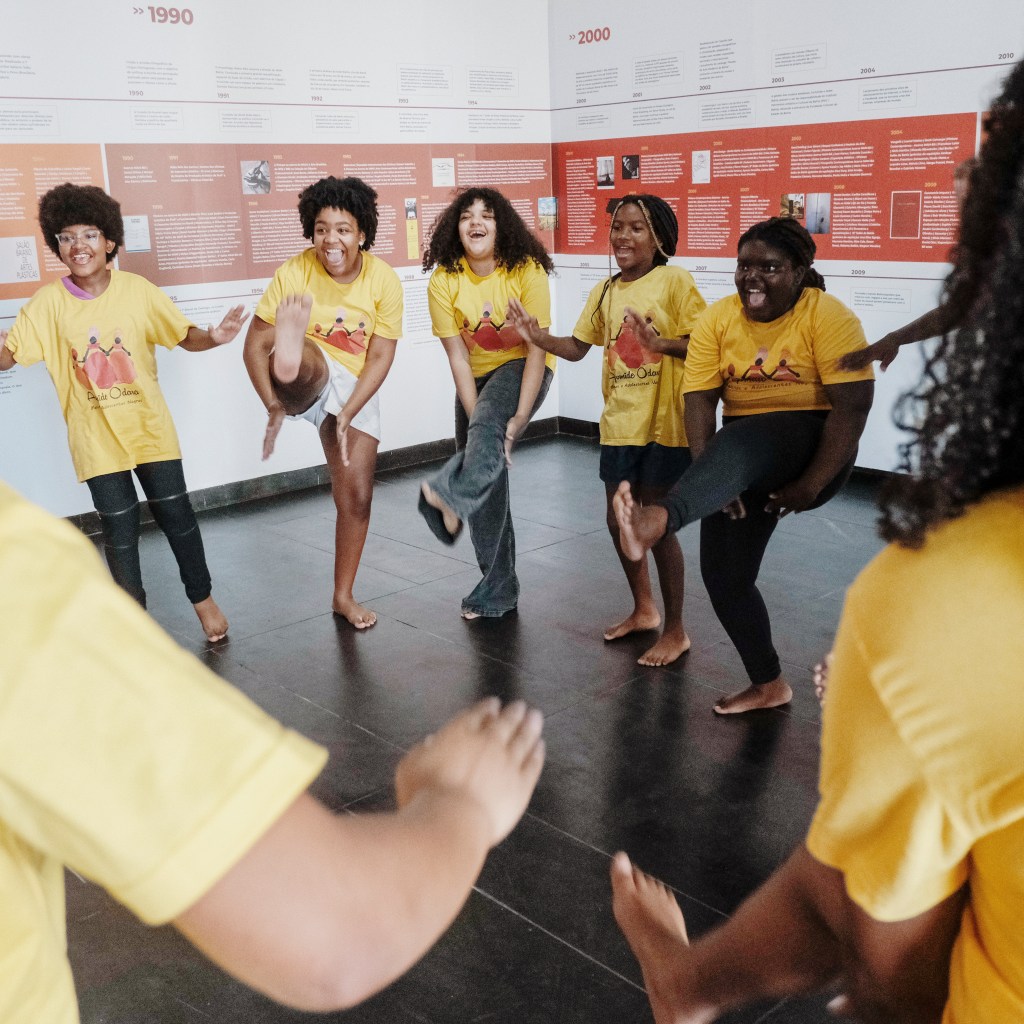
Ayomidês with Odara in Brazil. Captured by Luisa Dorr for Pura Ayomidês take part in weekly educational sessions where they explore subjects like education and ethnic-racial relations. The girls are encouraged to find their own voices by producing Instagram lives, social media videos, and by participating in public panels. Already, the Ayomidês are rewriting the narrative on what’s possible for Afro-Brazilian girls to achieve. One of the earliest Ayomidês, a young woman named Debora, is now a communications intern. Another former Ayomidê, Francine, works at UNICEF, helping train the next generation of adolescent leaders. And Julia has already set her sights on becoming a math teacher or a model.
“These are generations of Black women who did not have access to a school,” Naiara says. “These are generations of Black women robbed daily of their dreams. And we’re telling them that they could be the generation in their family to write a new story.”
Mama Habiba is reframing the conversation in Nigeria
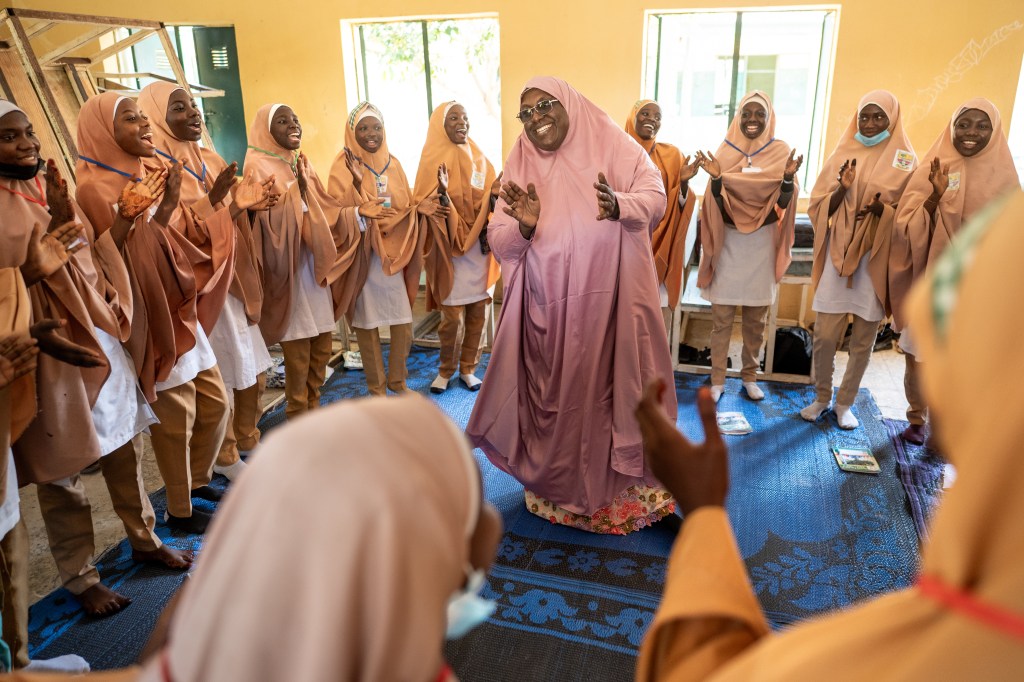
Centre for Girls' Education, Nigeria. Captured by James Roh for Pura In Mama Habiba’s home country of Nigeria, the scents of starfruit, ylang ylang and pineapple, all incorporated into the Pura x Malala Collection’s “Nigeria: Hope for Tomorrow,” can be found throughout the vibrant markets. Like these native scents, Mama Habiba says that the Nigerian girls are also bright and passionate, but too often they are forced to leave school long before their potential fully blooms.
“Some of these schools are very far, and there is an issue of quality, too,” Mama Habiba says. “Most parents find out when their children are in school, the girls are not learning. So why allow them to continue?”
When girls drop out of secondary school, marriage is often the alternative. In Nigeria, one in three girls is married before the age of 18. When this happens, girls are unable to fulfill their potential, and their families and communities lose out on the social, health and economic benefits.
Completing secondary school delays marriage, and according to UNESCO, educated girls become women who raise healthier children, lift their families out of poverty and contribute to more peaceful, resilient communities.
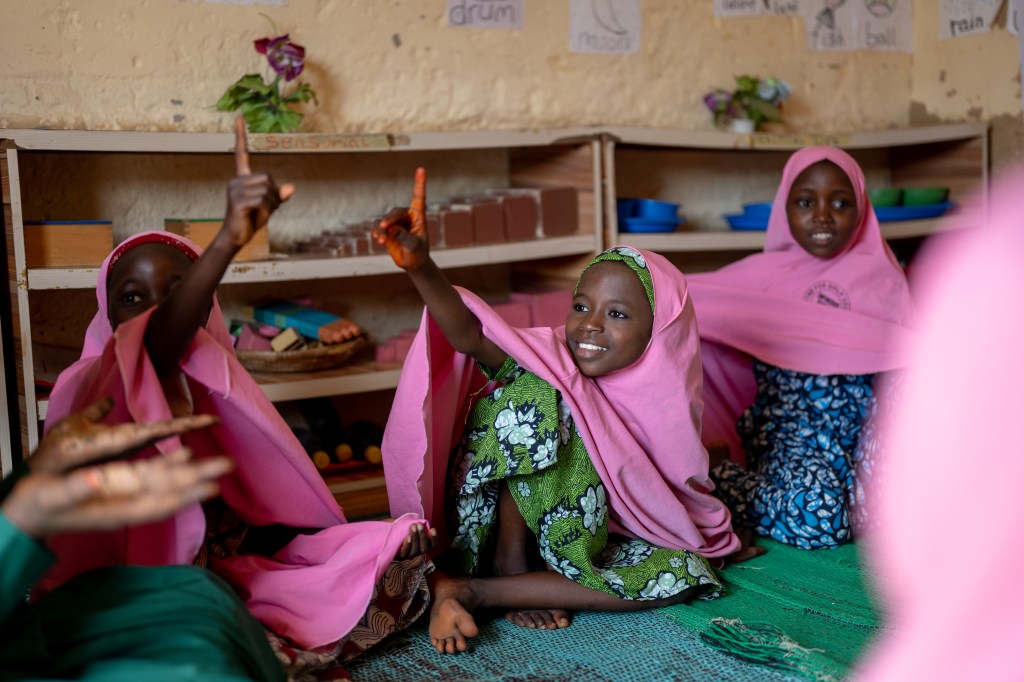
Centre for Girls’ Education, Nigeria. Captured by James Roh for Pura To encourage young girls to stay in school, the Centre for Girls’ Education, a nonprofit in Nigeria founded by Mama Habiba and supported by Malala Fund and Pura, has pioneered an initiative that’s similar to the Ayomidê workshops in Brazil: safe spaces. Here, girls meet regularly to learn literacy, numeracy, and other issues like reproductive health. These safe spaces also provide an opportunity for the girls to role-play and learn to advocate for themselves, develop their self-image, and practice conversations with others about their values, education being one of them. In safe spaces, Mama Habiba says, girls start to understand “who she is, and that she is a girl who has value. She has the right to negotiate with her parents on what she really feels or wants.”
“When girls are educated, they can unlock so many opportunities,” Mama Habiba says. “It will help the economy of the country. It will boost so many opportunities for the country. If they are given the opportunity, I think the sky is not the limit. It is the starting point for every girl.”
From parades, film screenings to safe spaces and educational programs, girls and local leaders are working hard to strengthen the quality, safety and accessibility of education and overcome systemic challenges. They are encouraging courageous behavior and reminding us all that education is freedom.
Experience the Pura x Malala Fund Collection here, and connect with the stories of real girls leading change across the globe.
-
Happiness expert shares simple ’20-Second Rule’ to make bad habits harder and good ones easier
Small changes can lead to life-changing gains.
Life can be full of roadblocks, but what if there were little things we could do to make it a little easier? While nothing is guaranteed, what if those small changes only took a handful of seconds?
According to happiness expert Shawn Achor, the “20-Second Rule” might be all you need to make a big difference.
In his New York Times bestselling book, The Happiness Advantage: The Seven Principles of Positive Psychology that Fuel Success and Performance at Work, Achor explains that we often get stuck in everyday patterns. To “unstick” ourselves, we need to make it easier to build the habits we want and harder to maintain the ones we don’t.
Here’s how to do it
In the book, Achor gives the example of wanting to learn to play the guitar. But because he had spent so much of his life not playing, it was hard to break that cycle: “The guitar was sitting in the closet, a mere 20 seconds away, but I couldn’t make myself take it out and play. What had gone wrong?”
To make learning even possible, he simply had to take 20 seconds to remove the guitar from the closet and place it nearby. The result? He practiced 21 days in a row. He also brought in a bit of science: “In physics, activation energy is the initial spark needed to catalyze a reaction. The same energy, both physical and mental, is needed for people to overcome inertia and kick-start a positive habit.”
Works for negative habits
Those same 20 seconds can just as easily be used to take away the temptation of bad habits. Achor offered this example: If someone wants to watch less television, they can spend 20 seconds removing the batteries from the remote control, making the experience just a bit more difficult.
“The next few nights when I got home from work, I plopped down on the couch and pressed the ‘on’ button on the remote – usually repeatedly – forgetting that I had moved the batteries,” Achor wrote. “Then, frustrated, I thought to myself, ‘I hate that I do these experiments.’ But sure enough, the energy and effort required to retrieve the batteries – or even to walk across the room and turn the TV on manually – was enough to do the trick.”
The rule is this: “You need to decrease the activation energy you need to do positive habits and increase it to do negative habits.”
It’s that simple.
Many swear by it
On a Reddit thread, an OP shared that the 20-Second Rule “transformed” their life:
“I recently stumbled upon a simple but incredibly effective life hack that has made a profound difference in my daily routine. I wanted to share it with you all in the hopes that it might help someone else too. It’s called the 20-Second Rule.”
They continued, explaining how it works:
“I noticed that I often procrastinated on tasks that I knew were good for me but required a bit of effort. Whether it was working out, practicing a musical instrument, or reading, I’d always find excuses not to start. Then, I learned about the 20-Second Rule, a concept from author Shawn Achor. The idea is to make good habits 20 seconds easier to start and bad habits 20 seconds harder. For example, I placed my guitar right next to my couch, so all I have to do is reach over and start playing. I put my running shoes by the door, making it convenient to go for a jog.
It might seem insignificant, but it eliminates the initial friction that keeps you from starting a task. Once you begin, it’s often easier to keep going.”
The spark before motivation
The post received quite a few upvotes from people who seemed to like the idea.
One user shared, “If you can get outside of your head and stop relying on motivation, you can basically accomplish anything. People tend to rely on motivation to get started, but motivation comes once you have started.”
Another Redditor described the spark needed to get started: “If there’s something I really don’t want to do but really need to do, I promise myself all I have to do today is five minutes. You’ll be amazed that before you know it, an hour has gone by and you got over the initial hurdle of starting.”
-
‘Windfall time’: Why unexpected free time feels so much better than the kind we plan
A new study reveals why we value surprise downtime.
Most of us are familiar with the sudden rush of relief that comes when a work meeting gets canceled. Even if you’re only getting 60 minutes of your time back, it can feel like a huge chunk of the day is suddenly uncharted territory. That feeling is liberating—a rare moment when your schedule loosens its grip, reminding you that not every second of your time is spoken for.
It turns out there’s a scientific explanation for this wave of euphoria, and it has everything to do with our (very subjective) sense of time.
A Rutgers University study, published in the Journal of the Association for Consumer Research, found that when people unexpectedly gain free time, they perceive it as longer than time that was already designated as free. The researchers call this phenomenon “windfall time.”
“An hour gained feels longer than 60 minutes, and that deviation from expectation creates a unique sense of opportunity,” said Gabriela Tonietto, an associate professor of marketing at the Rutgers Business School and lead author of the study.

Computer, clock, and letters spelling “TIME.” Photo credit: Canva Tonietto’s past work has explored various aspects of time management and perception, including “time famine” (the persistent feeling of not having enough time) and the benefits of having nothing to do. Her research often highlights how our relationship with time is shaped less by the clock and more by context, expectation, and emotion.
After conducting seven surveys involving more than 2,300 participants, the team found that windfall time results from the “contrast effect.”
That surprise hour is inherently judged against the initial expectation of having no free time at all, and thus feels perceptually expanded. In other words, a canceled one-hour meeting gives you 60 more free minutes than you expected to have. That mental comparison alone is what makes the time feel richer, fuller, and more valuable.
In terms of productivity, the study also found that people were just as likely to use windfall time for work (often longer tasks) as they were for breaks or personal errands. Tonietto cautioned against employers trying to engineer these surprises, especially at the last minute, as it could backfire and create frustration rather than relief.
Instead, Tonietto suggests that whenever this windfall comes, we should simply “take the gift and make the most of it.”

A man stretching at his desk. Photo credit: Canva And really, this discovery hits a little broader than just the workplace.
Parents, for example, might never know a sweeter bliss than the 45 minutes of free time gained when their child takes a nap. A delayed appointment, an early dismissal, or even a plan that falls through can become an unexpected pocket of possibility. That might mean being productive, or doing nothing at all, without guilt.
For example, some people find it helpful to use windfall time to start a task that normally feels too big to begin. Because the time feels more expansive, it can lower the mental barrier to getting started, even if only a small portion gets done. Others might choose something genuinely restorative, like stepping outside, taking a short walk, or simply sitting in silence without distractions.

A woman walking, refreshed. Photo credit: Canva It can also help to pause before automatically filling the time. Resisting the urge to default to scrolling or busywork, even briefly, allows you to decide what would actually feel good or useful in that moment. Keeping a loose mental list of things you enjoy or have been meaning to do can make these unexpected pockets of time feel even more rewarding.
Perhaps the biggest takeaway is to start seeing more of our time as “windfall time,” so we can make the most of it—or at least appreciate it more. Because sometimes it’s not about having more time, but about recognizing the moments when it unexpectedly appears.
-
10 uncommon words that perfectly capture feelings that feel impossible to explain
When we have words for a feeling, it becomes easier to understand.
Sometimes, explaining exactly how you feel can be hard. Sure, basic emotions like happy, sad, or angry are easy to name. But pinpointing the exact word for certain complex human emotions can be difficult. (And often, there isn’t an English word to convey those feelings.)
But those with an expanded vocabulary (or access to a dictionary) can often procure uncommon words for these emotions, helping them feel more emotionally intelligent.
On Reddit, people shared 10 of their favorite rare words that describe hard-to-explain feelings.
Sonder
“‘Sonder’ meaning the sudden realization that every random stranger you pass has a life as complex and messy as your own.” – ownaword
Merriam-Webster defines sonder as “the realization and understanding that all other people have lives as complex as one’s own.”
Sonder also has an interesting origin story. “The word was introduced by American author John Koenig in The Dictionary of Obscure Sorrows, a collection of words coined to describe feelings, emotional states, etc., for which the English language seems to lack a current word,” Merriam-Webster notes. “The dictionary was initiated as a website in 2009 and became a printed book in 2021.”
Ennui
“Ennui’s pretty well known, but not to everyone I guess. Ennui (pronounced ahn-WEE) is a noun defining a deep feeling of weariness, dissatisfaction, or listlessness caused by boredom or a lack of interest. It is more profound than simple boredom, often carrying an existential, ‘world-weary’ tone. Common synonyms include tedium, languor, apathy, and melancholy.” – nworbleinad
Merriam-Webster defines ennui as a “feeling of weariness and dissatisfaction; boredom.”
Eudaimonia
“Eudaimonia – much deeper than the usually given surface definition of happiness or well-being, philosophically speaking it means the deep and persistent feeling of flourishing because you are living in accord with the true nature of your being, or that you are in alignment with your true purpose.” – TurangaLeela80
Merriam-Webster defines eudaimonia as “well-being; happiness. Aristotelianism: a life of activity governed by reason.”
Encyclopaedia Britannica expands on eudaimonia in reference to philosopher Aristotle, who wrote two ethical treatises (Nicomachean Ethics and Eudemian Ethics) that explore the concept: “For Aristotle, eudaimonia is the highest human good, the only human good that is desirable for its own sake (as an end in itself) rather than for the sake of something else (as a means toward some other end).”
Frisson
“I wasn’t aware of the term ‘frisson’ until very recently, but now it comes to mind all the time when I have the experience. It refers to the aesthetic chills one can get from some external stimuli that’s deeply stirring and pleasurable. I most often experience it during masterful solo musical performances.” – common_grounder
Merriam-Webster defines frisson as “a sudden strong feeling or emotion.”
Piquancy
“Piquancy – the quality of being pleasantly stimulating or exciting.” – Putrid_Rock5526
Merriam-Webster defines piquancy (the quality or state of being piquant) as “agreeably stimulating to the taste, especially: having a pleasantly pungent, sharp, or spicy taste; engagingly provocative or stimulating, having a lively and often mischievous charm.”
Weltschmerz
“Weltschmerz (Welt = world + Schmerz = pain) — the sadness and discouragement you feel when you look at the state of the world and it falls painfully short of how you wish it was.” – canarialdisease
Merriam-Webster defines weltschmerz as “mental depression or apathy caused by comparison of the actual state of the world with an ideal state; a mood of sentimental sadness.”
Weltschmerz first appeared in 1827. “The word weltschmerz initially came into being as a by-product of the European Romanticism movement of the late 18th and early 19th centuries,” Merriam-Webster explains. “A combining of the German words for ‘world’ (Welt) and ‘pain’ (Schmerz), weltschmerz aptly captures the melancholy and pessimism that often characterized the artistic expressions of the era.”
Anhedonia
“Anhedonia: The inability to experience pleasure or a loss of interest or satisfaction in previously enjoyable activities.” – adulting4kids
Merriam-Webster defines anhedonia as “a psychological condition characterized by inability to experience pleasure in normally pleasurable acts.”
Numinous
“Numinous: Describing an experience that is both awe-inspiring and spiritual.” – adulting4kids
Merriam-Webster defines numinous as “supernatural, mysterious; filled with a sense of the presence of divinity; appealing to the higher emotions or to the aesthetic sense.”
Torpor
“Torpor: A state of physical or mental inactivity, lethargy, or apathy.” – adulting4kids
Merriam-Webster defines torpor as “a state of mental and motor inactivity with partial or total insensibility; a state of lowered physiological activity typically characterized by reduced metabolism, heart rate, respiration, and body temperature that occurs in varying degrees especially in hibernating and estivating animals. Apathy, dullness.”
Lachrymose
“Lachrymose: Inclined to weep or cry easily, often describing a melancholic or tearful mood.” – adulting4kids
Merriam-Webster defines lachrymose as “given to tears or weeping, tearful; tending to cause tears, mournful.”
-
People share inconveniences from back in the day that would ‘break’ us in 10 minutes now
It’s amazing how far we’ve come.
It’s perfectly normal to forget how much the world changes month by month. It can feel like we blinked, and suddenly there are self-driving cars, delivery robots, and home 3D printers. But not long ago, what was once considered “the way it was” would drive people batty today.
A user going by the name u/CharlesUFarley81 took to the r/AskReddit subreddit to pose this question: “What ‘back then’ inconvenience would break people today in 10 minutes?” The post received 6,200 upvotes and more than 4,000 responses, offering some surprising reminders of how different things once were.
One commenter described what an ordeal going to the bank used to be: “No online banking. I remember being a kid, and it seemed like my parents were constantly going to the bank.”
Another followed up with, “More than that, no ATMs. If you want to spend any money on the weekend, you’d better withdraw it before 5 p.m. on Friday.”
This Redditor reminded us that before trusty computers, we had only typewriters: “Projects for class had to be typed. Mistakes were corrected with white-out. If you decided there’s a better way to say something, you’d have to retype the whole thing.”
Had to work for it
Oh, and never forget there was a time before remote controls. “Having to stand up and walk across the room to change the TV to one of the three channels,” one user wrote.
Speaking of media, there was no Spotify in years past, so the music we wanted to hear wasn’t always at our fingertips. One Redditor shared the memory: “Having to wait to hear your favorite song on the radio and try to record it onto a cassette tape without the DJ talking.”
A little personal fun fact: I was a DJ on the KZLA morning show in Los Angeles, and we were taught to talk over the beginnings (and sometimes the ends) of songs. It was called “talking up the ramp” (or “hitting the post”), and it was annoying to time perfectly. So, this wasn’t just difficult for the listener.
24/7 access
One Redditor took it a step further, noting how available many of us are expected to be 24/7:
“Nobody was expected to be reachable at all times. You needed to say something to a relative? You called them, and if nobody answered the phone, tough luck, you called them again a few hours later. And automatic answering machines were a later invention.
I don’t know about other countries, but in mine (Argentina), phone lines were some kind of luxury until roughly 30-35 years ago, to the point that homes were sold for more if they had a landline. And because not everybody had a landline, some people used a neighbor’s number as a reference. So, people would call that number, the owner would answer, and then notify the person in question. Or, a neighbor would notify you about an incoming call they were expecting around that time, and they would wait (sometimes for like half an hour) next to the phone. Inside your house, obviously.”
That comment alone received nearly 5,000 upvotes, with one person (of many) responding, “That sounds so peaceful. That’s one of the things I truly dislike about the modern age: you’re expected to instantly reply to people. It gets exhausting.”
Missing being present
Similarly, the information you were given on any given day was all you had. One user wrote:
“You agree to meet up with a friend at a particular time and place. You’re there on time, but your friend still isn’t. Did they forget? Did they get in an accident on the way, or are they just late? Once they’ve left their home, there’s no way of calling them to find out. You will only find out what happened after they finally show up, or, if you wait around forever and they don’t show, then you go back home and try calling them at home.”
Scary phones
Speaking of calls, the panic of not knowing who was calling with each ring wouldn’t be tolerated today. As one person pointed out, “Not knowing who was calling you; you had to answer the phone to find out. Caller ID and *69 were like magic that only the rich could afford at first.”
And don’t forget: before Google or Apple, navigation meant paper maps. Not only did we have to use them for directions, but as one Redditor pointed out, it was all about “having to FOLD them.”
-
What it means to look at the ground while walking, according to psychology
The answer is surprisingly complex.
So much about a person’s inner world can be revealed without them having to say a single word. Even the smallest gestures can offer clues to their deeper emotions, coping mechanisms, and how they navigate the world.
For instance, you may have noticed people who keep their eyes on the ground while walking. You might even be one of them yourself. Experts suggest that even this tells a psychological story—but not necessarily the one you might be thinking.
Walking with one’s eyes down is commonly associated with shyness, depression, social anxiety, and low self-esteem. There does appear to be some science to support this.
For example, researchers have found that people experiencing social anxiety are more likely to avert others’ gaze, often looking toward the ground rather than making eye contact. Some studies suggest this behavior may stem from a fear of being judged or negatively evaluated, making eye contact feel uncomfortable or even threatening.
At the same time, psychologists caution against making quick assumptions. Human behavior is rarely driven by a single cause, and the same outward action can reflect very different internal states. In fact, looking down while walking can serve multiple purposes, many of which have little to do with anxiety or emotional distress.
Cultural context, for instance, is another important factor. In some cultures, lowering one’s gaze is considered a sign of respect, humility, or politeness, especially when encountering elders or authority figures. What might be interpreted as insecurity in one setting could actually be a learned social norm in another.
There is also a cognitive explanation. Many people use walking as a time to think, process, or problem-solve. Looking down can reduce visual distractions, allowing the brain to focus more fully on internal thoughts. This kind of inward attention may be especially common among creative thinkers or those working through complex ideas.
Another factor is more practical and straightforward: balance and navigation. Researchers at the University of Rochester found that people instinctively spend more time looking at the ground when it’s uneven in an effort to avoid tripping. This behavior is particularly noticeable in unfamiliar environments or places with obstacles where visual attention shifts downward to maintain stability and prevent falls.
Expanding on this, age can also play a role. Older adults, for example, may be more likely to watch their steps carefully to reduce the risk of injury. Similarly, people recovering from injuries or dealing with mobility challenges might rely more on visual cues from the ground.
Lastly, we live in a smartphone-dominated world. Many, if not most, of us regularly look down at our devices while walking. Over time, this habit can carry over even when a phone is not in hand. The posture becomes automatic, shaped by repetition rather than emotion.
Taken together, these perspectives suggest that a downward gaze is not a one-size-fits-all signal. It can reflect anxiety, yes, but it can also point to cultural norms, deep thought, environmental awareness, or simple habit. Like many aspects of human behavior, its meaning depends heavily on context.
-
A dad said he takes his young daughter to the women’s restroom. Then women chimed in.
“I would rather feel awkward or uncomfortable than having my daughter feel uncomfortable.”
It’s one of the all-time classic “girl dad” problems: you’re out with your young daughter and she needs to “go potty.” Do you take her into the men’s room or the women’s room?
Most guys would go to the men’s room without a second thought. But one dad has people wondering if there might be a better way.
Alex Vigilante coaches high-achieving men to “live a more aligned life, be more present, [and be] more whole.” He also shares content about fatherhood and his own life as a dad.
Question goes viral
Recently, Vigilante posed a question to fellow girl dads on Instagram: “When you’re out in public and your daughter has to go to the bathroom, which restroom do you take her to if there’s not a gender-neutral restroom?”
He took his viewers by surprise with his answer: “Today, I took her into the women’s restroom. … I think that is the better route than taking her to the male restroom.”
In the caption to his post, Vigilante outlined his reasoning. One point in particular was especially thought-provoking.
“I would rather feel awkward or uncomfortable than having my daughter feel uncomfortable,” he wrote, adding that he didn’t feel it was appropriate to have his young daughter around grown men using the facilities. Vigilante also noted that he prefers to go in when no women are inside and will openly announce himself so as not to startle anyone.
The now-viral Reel drew more than six million views, and needless to say, a passionate discussion ensued.
Men react
First came the dads who vehemently disagreed and said they would never set foot inside a women’s restroom, even with a toddler girl in tow.
“Men’s restroom, respectfully. Handicap stall. Clorox wipes and Lysol travel size spray in hand. The potential for a misunderstanding isn’t one I’m willing to entertain.”
“Imagine two or three dads in the women’s restroom…no bro, just use the dudes’ and go in the stall with her if she’s a little one, if she’s older, find a better solution. Don’t go in the girls restroom.”
“The world doesn’t revolve around me or my daughter, & it’s not fair for an innocent adult female to walk into me in her safe place.”

Urinals in a men’s bathroom. Photo credit: Canva Women react
Then moms and women at large began to chime in. Their collective response was surprising and heartwarming.
Though not a monolith, of course, a majority of women who responded to Vigilante’s video were strongly in favor of dads bringing their daughters into the women’s room. Many recalled being young and feeling intimidated by the presence of grown men in the men’s room, even with their fathers there.
“Please use the women’s restroom we really don’t mind. We were once little girls who needed protected too.”
“As a woman I support dads bringing their daughters to the woman’s room.”
“Absolutely! I have been in places before and if I see a man bringing his daughter towards the restroom I always offer to announce it in the bathroom and I stand at the entry door and keep everyone informed that comes in until they are finished. It takes a village!”
“I’d rather feel a little uncomfortable and know a child is safe in the women’s restroom than have a little girl in the men’s room where there’s urinals and what not.”
Honest discussion changed the minds of at least a few dads
Several admitted they always “hated” bringing their daughters into the men’s room but didn’t see another way. After the warm response from moms, they were inspired to give it a try.
“I’ve literally never considered this. Dude, thank you for bringing up. My first reaction was that I would never want to make other women afraid or uncomfortable if I was in there with my baby girl. And then I read the comments. WOW. Women are incredible. Sad that we have to even worry about this, but grateful to know my daughter has other women who freely have her back without even knowing her.”
However, the opposing view is also valid, making this a complex issue. It could even become a legal one. While it’s not generally considered illegal for a man to enter a women’s restroom, the situation can become murky if someone feels threatened and raises a complaint.
For his part, Vigilante said he’s never had an issue taking his daughter to the women’s room, but would happily leave if he made anyone uncomfortable.
A better solution?
It seems there should be a better solution by now, and fortunately, there has been incremental progress in this area.
For starters, more men’s rooms have changing tables than in years past. This not only allows dads with babies to avoid going into the women’s room to change them, but also helps rebalance the distribution of childcare labor, which has historically been skewed toward moms.
There’s also a push to “ditch the gap” in public restroom stalls, offering greater privacy for all.
There’s even been a steep rise in the availability of family or gender-neutral bathrooms in public spaces, which helps everyone. In some places, they’re required by law.
There are other solutions as well. For girls old enough to go in alone, many dads choose to stand outside the bathroom, sometimes with the door propped open so they can hear what’s going on and talk to their daughter for comfort.
In the end, it’s an individual choice that requires dads to be mindful of others, as well as their daughter’s comfort level.
“My daughter’s safety comes first…so I feel empowered to keep doing this,” Vigilante wrote in the comments. “I respect the opinion of parent who think otherwise, as they just want their kids to be safe as well.”
-
Madrid art student sews a gorgeous, wearable dress out of hand-picked leaves
It took 40 hours to sew the dress by hand.
Making quality dresses takes an enormous amount of skill. It’s not just about sewing and tailoring, but also about design—knowing which fabrics and colors pop and draw the eye. At their best, dresses bring art and beauty to fashion. But for a fine arts student living in Spain, making a dress incorporated all of those skills, along with a touch of nature.
Artist Amanda Meyer successfully sewed a beautiful dress from a variety of hand-picked autumn leaves in vibrant shades of orange, red, and yellow. She then soaked the leaves in glycerin to help preserve them. After drying them with an iron, the leaves became sturdier and easier to manipulate. Meyer cut and sewed the leaves together into a gorgeous patchwork mini dress.
“I wanted to see if it was possible to create a fully organic garment without using the usual materials such as cotton or linen,” Meyer told My Modern Met. “As a young person deeply committed to the environment, my practice focuses on using only recycled and natural resources. I specialize in textile art, creating sculptures and sculpt-like garments.”
Natural fibers of a different kind
It took Meyer around 100 meters of thread and 40 hours of hand sewing to create her leaf dress. While the dress remains fragile and is intended for exhibition, it is also a wearable and successful clothing experiment. However, it was never meant to last.
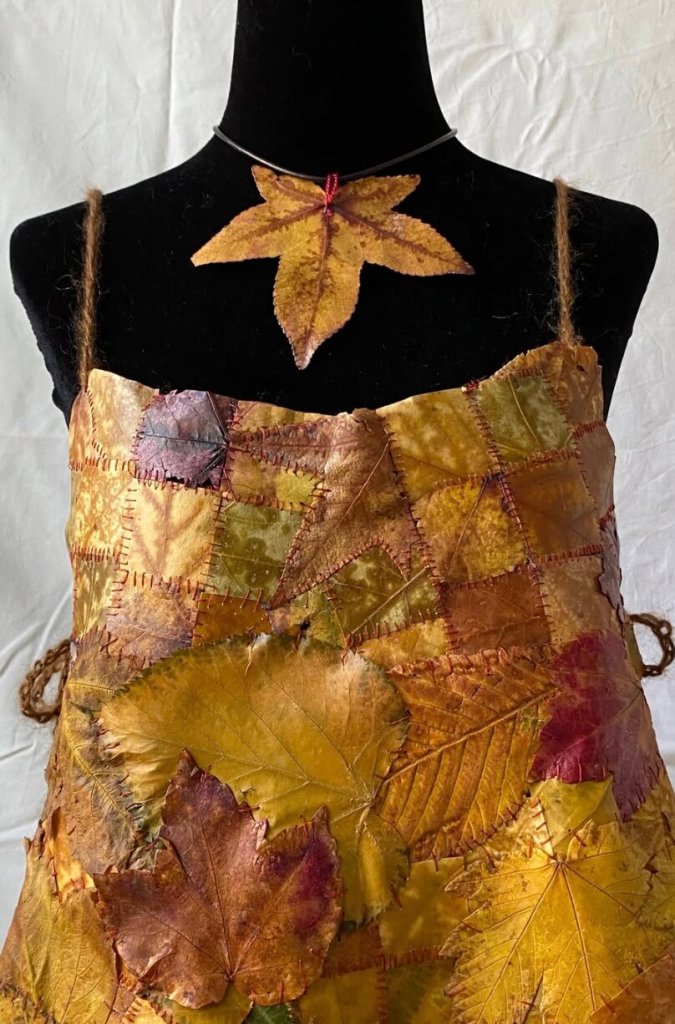
Screenshot “Many people have asked me if I intend to preserve it,” said Meyer. “The answer is no, I want to see how it passes the test of time. Clothes aren’t meant to last forever.”
The environmental problem of modern fashion
The mixed-media artist draws attention to the troubling fast-fashion industry. Fast fashion offers convenience and style, but it also contributes to environmental issues. According to Boston University, the United States throws out 34 billion pounds of used textiles each year. The lion’s share of them are made from synthetic fibers, which take much longer to decompose than natural ones like cotton.
Fast fashion production also generates more carbon emissions than international flights, according to Business Insider. In the end, it contributes to piles of long-lasting clothing in landfills and increasing levels of air pollution.
Meyer’s artwork and similar movements show how the life cycles of items can be repurposed, whether for creative expression or practical use. An old garment can be transformed into crafts, toys, rugs, or even cleaning rags. If leaves can be used to create beautiful art, a discarded T-shirt can become something more, too.
-
Philosophy expert reveals the character trait that shows someone is highly intelligent
“An intelligent person tries to be a realist.”
Julian de Medeiros, a philosophy expert who’s popular on TikTok and Substack, has built a reputation for sharing some of the world’s most important philosophical ideas about life, love, ethics, and intelligence. Recently, he shared wisdom from Bertrand Russell on the character trait that highly intelligent people tend to have: they see the world as it really is, not as they want it to be.
Russell, a British philosopher and founding figure of the analytic movement in philosophy, won the Nobel Prize in Literature in 1950. His work in logic, epistemology, and mathematics made him one of the most important minds of the 20th century. As they say, it takes one to know one, and if Russell says someone is intelligent, chances are he’s right.
What’s a sign someone is highly intelligent?
“Here’s how you know that someone is intelligent, and this goes back to the philosopher Bertrand Russell, who wrote, ‘You see the world as it is, not as you would like it to be, is the beginning of all wisdom,’” de Medeiros shared on TikTok.
To put it simply, an intelligent person wants to get things right, while an unintelligent person wants to be right. Smart people look at the facts and form their opinions based on reality. Those who aren’t as bright tend to be more dogmatic, trying to see the world in ways that align with their beliefs.
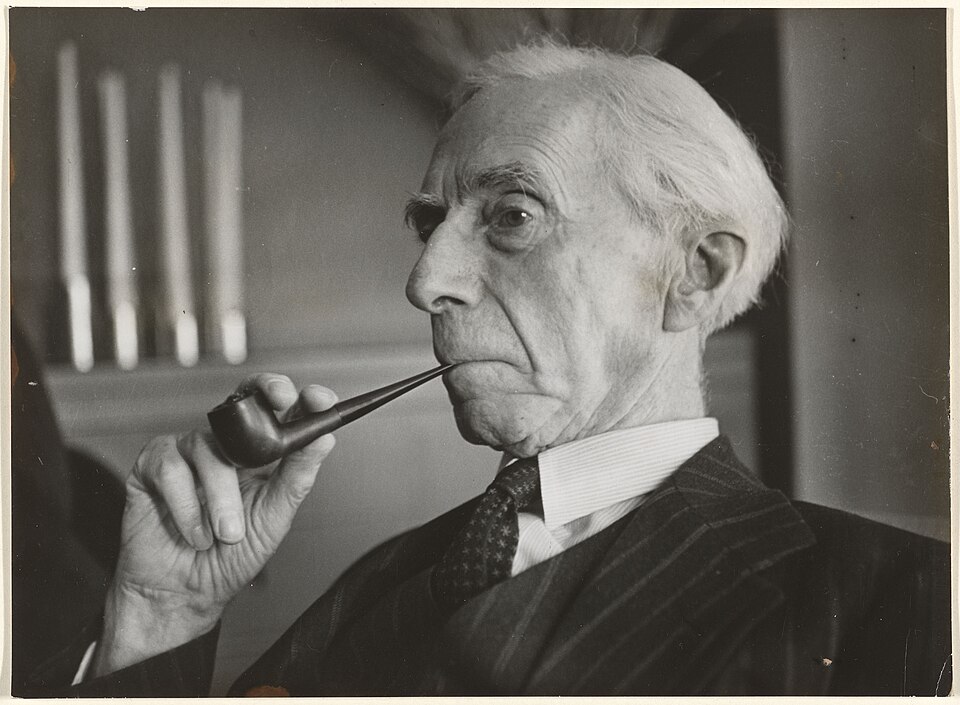
Bertrand Russell. Photo credit: Rijksmuseum/Wikimedia Commons “What [Russell] meant is that an intelligent person tries to be a realist,” de Medeiros continued. “Like, they try to measure, examine, and test their own belief systems against reality. But an unintelligent person tends to be dogmatic. Like they don’t change their mind when confronted with the facts. In fact, you could show them the evidence, and they would simply double down.”
What is the “backfire effect”?
What de Medeiros is referring to is what’s known as the “backfire effect.” It’s a psychological phenomenon in which, when people are presented with credible facts that challenge their beliefs, they may hold on to those beliefs even more strongly than before.
“Once something is added to your collection of beliefs, you protect it from harm,” author David McRaney wrote in You Are Not So Smart. “You do this instinctively and unconsciously when confronted with attitude-inconsistent information. Just as confirmation bias shields you when you actively seek information, the backfire effect defends you when the information seeks you, when it blindsides you.”

Politicians debating. Photo credit: Canva It can sting to change your mind, because it can feel like you’ve invalidated a big part of your sense of self. However, it becomes much easier if you begin to change how you see yourself. Instead of identifying with a specific worldview, you can think of yourself as someone who embraces the truth, no matter how difficult that may be.
“Bertrand Russell believed that true intelligence was when you were open to the possibility that you might be wrong,” de Medeiros said. “When you sought to test your own belief systems and when you had a rational and inquisitive mindset, that is true intelligence. When the facts change, you change.”








Happiness expert shares simple ’20-Second Rule’ to make bad habits harder and good ones easier

‘Windfall time’: Why unexpected free time feels so much better than the kind we plan



Get stories worth sharing delivered to your inbox.
Advertisement