People share what it was really like being raised by parents of the ‘Greatest Generation’

“Very hardworking. Very stoic.”

Array
ArrayPhoto credit: Images via Canva

Every generation is influenced by their parents. From Baby Boomers (who were largely raised by the Silent Generation) to Gen X (the majority of which were raised by Baby Boomers) to Millennials (raised older Gen X and younger Boomers), their parents left an impact that defined each one. For those raised by the Greatest Generation (those born between 1901 and 1927), their unique upbringings are filled with experiences that are still cherished generations later.

Over on Reddit in a subforum of people born before 1980, member gameboy90 posed the question: “What was it like having a parent who was part of the Greatest Generation (born 1901-1927)?”

Many people raised with parents (and some grandparents) from the Greatest Generation shared their childhood experiences. These are 15 amazing stories from people raised by parents of the Greatest Generation.

greatest generation, the greatest generation, black and white film, greatest generation gif, classic movies
black and white kiss GIF Giphy

“My folks were born in the late teens/mid-twenties. They met and married during WWII. As a kid growing up in the 1970s, I joked that I was the last kid to be raised in the 1950s, because that’s the decade where my parents were really adults and absorbed a lot of their ideas. Neither of them liked to talk much about the past, there wasn’t any talk of the depression or the war, but I was told how easy I had it on a fairly regular basis. I was taught to be grateful and how lucky I was. They were fairly distant parents — I was cared for, but not hovered over in any way. I was regularly kicked out of the house to go entertain myself until the streetlights came on.” —localgyro

“One of my parents was part of this cohort and the other parent was just a couple of months too young to technically belong to the Greatest Generation. I heard endless stories about what childhood was like during The Great Depression and the notion of not wasting things was pounded into me. I was taught to not trust the stock market and to not count your chickens before they are hatched. Do people even use that expression anymore?! Both of my parents felt it was important to look one’s best in public at all times. I remember my mother wore girdles long after it was fashionable to do so and my father wore undershirts in the hottest of weather.” —Woodinvillian
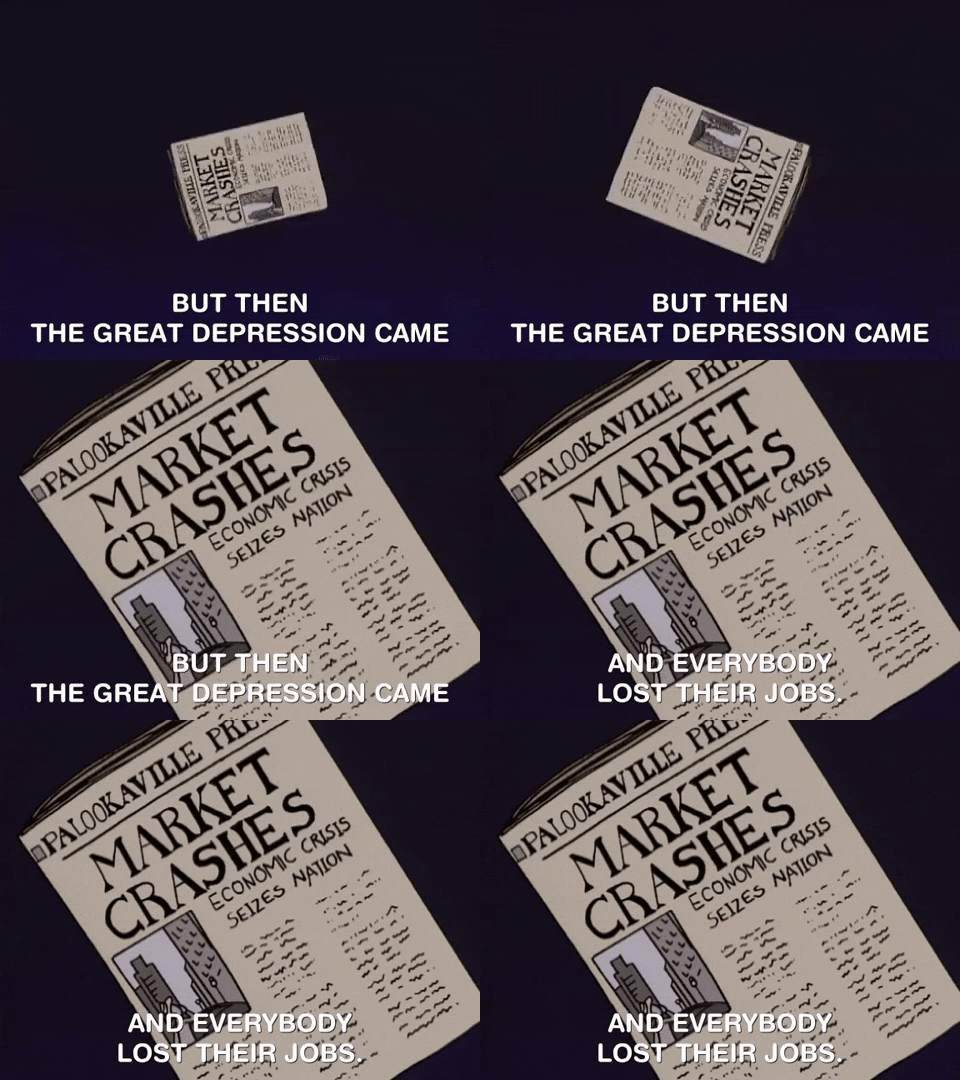
great depression, the great depression, great depression gif, 1930s, 1930s gif
hey arnold nicksplat GIF Giphy

“My grandparents were greatest generation. Very hardworking. Very stoic. Super secretive. While they weren’t racist, they were prone to using slang like Wop (gpa was Italian) etc. My gma left school in 8th grade to help on the family farm. Gpa made it thru High School and didn’t go to war due to helping the family ice business. Back in the day, they cut ice from the ponds w huge saws and packed it away in sawdust or straw. His brothers went to war though.” —apurrfectplace

“I’m not sure you can generalize about a cohort that includes so many millions of people. My parents were born in 24 and 26 and I was born in 52. My father spent WWII In Europe and never would talk much about his experience. My father was a teacher, high school principal and then a college professor. My mother stayed home and raised my brother and I. My parents were hardworking, honest, decent people. They were also progressive, liberal and intellectual and participated in the civil rights marches of the 1960s and later supported my brother and I in our opposition to the Vietnam war.” —valisglans

“Both parents were born in the time frame you gave. We are American, and my grandparents were immigrants from Eastern Europe. My father was a WWII infantryman and Purple Heart recipient. He almost never talked about the war, although he did recount his experiences to another family member who was doing a living history project. My Dad apparently lived through some awful times when he served overseas during the war. My mother came from a well to do family, and she never mentioned weathering much hardship during the Great Depression… During these days of Covid-19, I am reminded of my late father’s frugality (which he learned during the Great Depression). I am reminding myself how he never let anything go to waste, and how he would repurpose items around the house, rather than get rid of them if they were at all useful. My parents weren’t hoarders or anything like that (quite the opposite), but they did use items up until they could be used no more. I used to roll my eyes at my dear Dad over that at times, but now of course I see the wisdom in it. My grandparents were all born in the last quarter of the 1800s, and lived through the 1918 pandemic. I wish they were still able to answer my questions about how they survived it, or at least I wish my parents were able to answer my questions regarding my grandparents’ recollections of it.” —Hey_Laaady

world war 2, world war II, world war II gif, world war 2 gif, 1940s
World War Ii Vintage GIF by US National Archives Giphy

“My parents were born in the teens of 1900’s. Both to poor, but educated families. Music, art, that sort of thing, that generally pays poorly in good times. But during the depression? Not much at all. Like others in this thread, we were taught to use up everything, don’t waste anything. Food was made into leftovers. Clothing was repaired, and passed down from child to child. If we wanted to get rid of something, give it to someone who could use it. Don’t leave the lights on. Don’t waste water. We also had a vegetable garden, and we kids helped weed it. We snapped and froze beans from it for the winter. We played outside all day in the summer, and came in for supper. Had to be home when the street lights came on. Dad had war stories about WWII which he told often, but never about fighting, but rather about his commanding officer, or something weird that happened. I’m pretty sure he had PTSD, but you bucked up and got on with life. My parents were both really good people. My mother raised us, and my dad ‘brought home the bacon’.” —sanna43

“Awesome. They loved each other deeply. They loved their siblings, parents, aunts and uncles who we all regularly visited. Mom and Dad were good parents who provided us with love and a good home. Maddening. They were soooooo much older than my friend’s parents, still clung to Depression-era frugality, wanted us kids to be independent but NOT IN TROUBLE.” —Sunkitteh

“They were the finest people I’ve ever met: selfless, loving, devoted to family. There will never be another generation like them.” —Offthepoint

love, romance, 1940s, 1940s couple, greatest generation
classic film hug GIF Giphy

“Dad worked a blue collar job and mom was a homemaker. There was always dinner at the dining room table every night. My dad made $85 a week and that was enough to keep a roof over our head and our tummies full. Mom (born 1922) stretched the ground round by putting grated potatoes in it. I don’t really remember going without very often. I only remember a pair of shoes I really wanted in the early 70’s that we couldn’t afford…My dad was born in 1921 and was the strong silent type. Never spoke much nor showed much affection but we knew he loved us. They never fought. I never remember them fighting or hearing them yelling at each other. If there was anything they didn’t want us to know they would talk to each other in Spanish. They never taught us girls because we ‘didn’t need to speak it’. I sure wish they had taught us. Back then it was more about assimilation.” —AuntChilada

“Since my folks grew up during the depression, the thriftiness they learned was passed on to us kids. Even in the city, we had a vegetable garden in the 1960s, as well as several fruit bearing trees…We were raised with more discipline than some of our classmates, but less than others. We took responsibility for our actions at early ages and were seen as trouble makers because we didn’t deny it when caught red handed.” —Swiggy1957

“Lots of great war stories. Lots of lies. Lots of racist beliefs (how come people never mention how racist old people can be?). Generous but highly critical. Intelligent and accomplished. High expectations with little guidance or input. Dad was born in 1913.” —aiandi

world war 2, world war II, world war II gif, world war 2 gif, war gif
Landing World War 2 GIF by US National Archives Giphy

“My dad (born 1905 in Buffalo, NY) and my mom (born 1909 in St. Louis, MO) were both children of Polish immigrant parents. My mom graduated from elementary school, but my dad was pulled out of school during his last half of 8th grade so he could go to work at Kutchens Furniture Co. in St. Louis as a woodworker so he could support the family (his dad had died a year earlier). My mom got a job as a seamstress at a clothing company where she worked until she got married. in 1925 my dad obtained employment at Robertson Aircraft Co. at the airport as a mechanic for the air mail airplanes. He became good friends with Charles Lindbergh when Lindbergh was still an air mail pilot. In 1926 he started building his own airplane in his backyard. In 1929, when the stock marked crashed, his airplane was nearly complete. But he had to put a hold on it in order to work crazy hours at Robertson to continue his employment. He and his mother, brother and sister all lived in one house and they raised chickens, rabbits and a vegetable garden in the back yard. Home brewed beer was made along with a concoction of straight grain alcohol colored with tea that they called ‘Old Skunk’. The airplane was flown in 1930 but the depression went on, and on and on. Nothing was thrown away since there was always another use for everything. My mom and dad finally met and got married in 1937. A year later I was born and now there were 6 people living in a small 2 bedroom 1 bath house. In 1941 the United States entered the war. My dad was too young for the first world war and too old for the second world war, so he obtained employment with Curtiss-Wright Aircraft Corp. as a loftsman for the wing of the C-46 ‘Commando’ transport aircraft. He remained at Curtiss-Wright until the end of the war. Once married, my mom became the traditional housewife. During my early years we lived like it was still the depression and it was pounded into me on a daily basis. The only good thing that happened during the war years was dad got extra gas ration stamps because he was working in the defense industry. My mom had a foot operated Singer sewing machine that she used for the rest of her life. My dad didn’t buy a powered lawn mower – he made one using the motor from a junked motor scooter he found in the junk yard. At dinner time you ate everything on your plate – period! To this day it has been engrained in me – take what you want, but eat what you take. Yes, the Greatest Generation raised a whole different breed of children. When I was growing up, if I needed a whack on my butt I got a whack on my butt. Maybe two whacks! And my teachers could do it too. If the teachers did that today it would be on the 5 o’clock news.” —55pilot

“My parents were born in the 1920’s. My father was drafted in 1944. He waited out the war in the Philippines. He didn’t say much about it. Only that he saw awful things and war is really, really bad. After the war he worked for USPS and met my mother. They moved to NJ and raised 6 kids on a working class salary. My parents were both strict Catholics. It wasn’t a very demonstrative relationship. They put a roof over our heads and fed us so we needed to STFU and clean our rooms. My mother was kinder; my father was distant and withdrawn. There was a huge generation gap. They adored clean-cut American entertainment: broadway musicals, Johnny Mathis, Perry Como, etc. Meanwhile, us 60’s and 70’s kids were all about Black Sabbath and Led Zeppelin. It caused tension. Once we became teens, us boys all grew our hair long. The folks HATED it, but they allowed it because we made a big deal over it and it was the trend at the time. My parents never drank and never used foul language. Cursing was forbidden in the house. Even ‘damn’ was retconned to ‘darn’. Period. No exceptions. Discussions about sex (or indulging in any measure of explicit material) was also utterly forbidden.” —CitizenTed
johnny mathis, johnny mathis gif, johnny mathis music, greatest generation, music gif
johnny mathis GIF by Henry Mancini Giphy

“My father was born in 26. My mother is a bit too young to meet this criteria. But they were both frugal people. My mother was a bit more sympathetic about it. ‘Do you need it, or do you just want it?’ My father was more dismissive, in a half joking, half mocking manner: ‘you need that like you need a hole in the head’, ‘I wouldn’t kick a dead dog for a truckload of (whatever it was I wanted)’, alternatively he ‘wouldn’t sign his name for a boatload’. If I wanted to see a movie or a concert, he ‘wouldn’t walk from here to the corner (to see them, even) if they paid him.’ At least he was amusing. Last week, he told me about something that would ‘hare lip Santa Claus’, and I still don’t know what that means…My father grew up on a farm. As a boy, he plowed with a mule, and used a carved cypress knee to make holes for the seeds. The old plow was still in storage when I was growing up, and was always more fun for me to climb on and play than the old tractors were. My father says that at school, instead of each kid bringing their own lunch, each person would bring something to add to a pot of soup. I don’t know if that was everyday, though. My grandmother had a large garden and also did home baking and canning to sell at the farmer’s market. The better stuff always got sold. One of my aunts said they never got any cookies that hadn’t burnt. My father served at the tail end of WW2, in the Pacific.” —MetalSeagull

“My parents married after the second world war. My mother had been engaged and her fiancé was killed overseas. They were pretty old for their generation to be getting married. Born in 1919 and 1918 they married in 1950. Being good Catholics they then started having babies. My mother lost four of the pregnancies late term and had four babies eventually. I was born when she was 40 and my younger brother when she was 47 because of the pregnancies and recovery from them. My mother became a teacher and my dad was a draftsman. They never had a mortgage, paid cash for their cars and ALWAYS had a ton of tinned food. If I wanted a ham and cheese sandwich my mother would say no because that was two meals. Ham sandwich and a cheese sandwich. I don’t think either of them ever missed a day of work for anything less than a heart attack. Seriously. They just got up every morning and did what the rules said they should do. My dad was an enormously talented man with an incredible intellect and my mother was artistic and romantic. I feel that with the war, service and losses they never got the chance to experience self expression like they may have wanted to. Duty to God and family. They both died young at 61 and 67.” —Rosiebelleann


  • 8 fascinating ways parenting norms in other countries differ from the U.S.
    Other countries approach parenting very differently than we do in the U.S.Photo credit: Canva
    ,

    8 fascinating ways parenting norms in other countries differ from the U.S.

    Motivational speaker Jim Rohn is credited with the idea that each of us is the average of the five people we spend the most time with. The same could be said about the way we raise our kids. Each family has its own values, traditions and way of doing things, but we can’t help adopting…

    Motivational speaker Jim Rohn is credited with the idea that each of us is the average of the five people we spend the most time with. The same could be said about the way we raise our kids. Each family has its own values, traditions and way of doing things, but we can’t help adopting certain norms from our neighbors and the culture that surrounds us.

    That’s why it’s so fascinating to compare parenting in the United States with parenting in other countries around the world. Here are a few things American parents might be surprised to learn that parents and societies around the globe do differently:

    1. No kids menus

    Most American restaurants feature an altered menu for children, usually with simple foods like grilled cheese, chicken nuggets, or cheeseburgers.

    In many—perhaps even most—other countries, children are expected to eat smaller portions of what the adults are eating, even if it’s spicy or complex. In countries like Germany, many restaurants offer a menu item called a “robber’s plate,” an empty plate that allows kids to steal bites from their parents.

    america, asia, europe, africa, cultural differences, parenting, kids, dads, moms, children, parenting strategies
    A plate of dinosaur chicken nuggets and ketchup. Photo credit: Canva

    2. Homeschooling is rare

    According to Pew Research, about 3.4% of American children are homeschooled. That’s a relatively small percentage, but accounts for millions of kids. American parents are keen on homeschooling for many reasons, including distrust of the moral instruction in public schools or worries about the “school environment.”

    American parents who move abroad are often surprised to find that homeschooling is extremely rare or even illegal in most other countries. Its popularity is growing in the United Kingdom, but even there, only about 100,000 children are currently homeschooled. In places like Germany and the Netherlands, children are required by law to attend school.

    3. Some kids are allowed to drink alcohol

    The legal drinking age of 21 is strictly enforced in America, with little to no exceptions. What goes on in people’s private homes is anyone’s guess, but legally speaking, the rules are pretty black and white.

    In many countries around the world—including Australia, France, Canada, and Ireland—the legal drinking age is 18, and the overall approach to alcohol is far more casual. However, there are numerous exceptions in several of these places. In the U.K., for example, 15-year-olds can have a beer or glass of wine with dinner at a restaurant as long as they’re supervised by an adult. At home, almost anything goes, with the minimum legal drinking age on private premises in the U.K. being five—although doctors strongly advise against this.

    4. Postpartum care

    In America, it’s common for mothers to leave the hospital about 48 to 96 hours after giving birth, depending on the delivery method and any complications. In the past, new moms would get a single postpartum checkup about six weeks later, although standards have recently changed to encourage earlier support.

    Giving birth in other countries around the world can be drastically different. In the U.K., new mothers can be discharged from the hospital as soon as six hours after an uncomplicated birth, which is one of the fastest turnarounds in the world.

    In China, however, it’s common for new moms to “sit the month” and take 30 to 40 days of confined rest at home or in a “birth hotel.” South Korea, meanwhile, sends about 85% of new mothers to a joriwon, a specialized postpartum care facility, for about two weeks.

    5. Independent kids

    In the U.S., kids are spending less time outside. Some estimates say only about 6% of children regularly play outside unsupervised, and around 11% walk or bike to school alone, a number that has fallen dramatically over time.

    This is a stark difference from many other cultures around the world, where kids frequently exercise more day-to-day independence. In most European countries, at least 40% of kids walk or bike to school. Japan is famous for children as young as six taking the subway and running errands independently, thanks to high levels of social trust.

    “We don’t hover and helicopter kids here like American parents,” a U.S. parent living in Switzerland wrote on Reddit. “Kids walk to school on their own in elementary. They can take public transportation on their own, and parents don’t worry.”

    6. Bedtime differences

    Americans march to the beat of their own drum in the evening, with kids, on average, going to bed early—and almost always in their own beds.

    About 90% of American kids under 10 are in bed by 9 p.m. Bedtimes around the world, however, vary greatly, with countries in Southern Europe like Italy and Spain allowing kids to stay up past 10 or 11 p.m. for late dinners and socializing. In other places, bedtime is much more rigorous. Kids in Germany and New Zealand have some of the earliest bedtimes around.

    Co-sleeping is also a major difference. Sharing a bed with your infant is on the rise in America, but it’s still recommended against by the American Academy of Pediatrics. However, the U.S. doesn’t hold a candle to countries in Asia, Africa and Latin America, where more than 70% of young children share a bed with their parents.

    7. Bilingual kids

    About 20% of kids in the U.S. speak more than one language, usually because someone at home speaks it regularly. In many other countries around the world, learning multiple languages is far more common.

    According to Quartz, “Almost every country in Europe requires students as young as six to learn a foreign language, usually English. Even more impressive, over 20 European countries (including France) require students to learn two foreign languages in school for at least one school year.”

    America is far from the most monolingual country, however. Places like Hungary, Japan, South Korea, and Brazil place little importance on kids learning English or any other foreign language.

    8. Greeting and talking to adults

    It’s common in America for kids to be shy around adults or to have their interactions guided and supervised by a parent. In many other countries, kids are taught from a young age to formally greet adults as a show of respect.

    “Greeting and talking to adults is taught early on,” wrote one U.S. parent who raised their children in Spain. “My boys always note how awkward some of their US peers are when talking to adults or public speaking. Looking into someone’s eyes when speaking is another thing they noted.”

    It’s fascinating to consider alternative approaches to parenting that would seem completely inappropriate in America but tend to work just fine in many other parts of the world. American parents would probably have a hard time letting their six-year-old walk to school independently without drawing suspicion from neighbors or law enforcement. It just goes to show that not every interesting idea can be implemented everywhere, and that our unique cultures shape the way we raise our kids, for better or worse.

  • Dad turns his 3-year-old’s whimsical stories into song lyrics and people are hooked
    A young girl with messy hands and a man playing the guitar. Photo credit: Canva
    ,

    Dad turns his 3-year-old’s whimsical stories into song lyrics and people are hooked

    When Stephen Spencer got his PhD in music theory and composition, he likely never imagined how he’d one day use that training to propel himself to viral fame. The composer and songwriter has always enjoyed turning everyday things into little musical ditties, or even full songs. But when he became a dad to a precocious…

    When Stephen Spencer got his PhD in music theory and composition, he likely never imagined how he’d one day use that training to propel himself to viral fame.

    The composer and songwriter has always enjoyed turning everyday things into little musical ditties, or even full songs. But when he became a dad to a precocious and creative daughter, he suddenly found himself with more inspiration than he knew what to do with.

    Spencer began paying close attention when his daughter’s stories became longer and more elaborate. “She started giving me these stories—real narratives that had a beginning, middle and end combined with toddler logic and grammar—they just sounded like songs to me,” he tells Muse.

    At first, he thought he’d record a few as a fun experiment to share with friends and family—sort of a musical photo album. But almost as soon as he began posting the songs on Instagram, they went far more viral than he ever could have imagined.

    Spencer currently has more than 300,000 followers, even though his first “toddler songs” clip was uploaded only a few months ago.

    kids, parenting, family, dads, fatherhood, fathers, singers, songwriters, funny songs, viral instagram
    The effortless creativity of toddlers is a joy to experience. Photo credit: Canva

    The first song goes like this:

    “There was a little woman/Who liked wigglin’ so much (she liked wigglin’, she just really liked wigglin’)/Her mom said/Her mommy said ‘you can’t’/So she goed to her room/And she wiggled again…”

    Cute, right? Yes, it’s all very adorable—until you actually take the time to listen to Spencer’s song. Then you’ll be blown away.

    His voice. The production value. The arrangement. It’s all top-notch. Frankly, the songs—which commenters have dubbed “toddler yacht rock” or “tot rock”—are far better than they have any right to be.

    Check out “Wigglin’ Woman” here:

    It’s no wonder that the very first clip received nearly three million views on Instagram

    And just a week or so later, Spencer was back with another banger:

    “There was a purple bear princess/She was a grown up dog/She was a grown up purple bear princess dog/(What was her name?)/Uh ‘Blossom’/ (That’s a nice name)/Actually it’s ‘Crudda’”

    It’s beautiful lyricism, and all parents of toddlers will relate to the hazy logic, made-up words, and impeccable improvisational skills. The fact that Spencer can turn them into genuine hits is incredible.

    Parents and their kids—heck, anyone with ears—can’t stop listening to Spencer’s tunes on repeat

    “Phil Collins could have co-produced this one,” one commenter wrote.

    “I may have listened to this 948572 times,” added another.

    But probably the thing that’s really sticking with viewers is the amazing, unspoken bond between dad and daughter hidden in the lyrics.

    “I’m imagining how happy your daughter will be once she’s older, maybe a parent herself, and revisits these videos,” someone wrote under a recent video. “You’re an amazing musical talent & a even better dad.”

    In fact, Spencer says that the pure, unfiltered, joyful creativity that pours effortlessly out of his daughter has inspired both him and his music students.

    “I think that children are the perfect model for how we should create as adults. There’s this unfiltered joy. You’re in the sandbox playing and not worrying about how things should be judged or appraised. … And yeah, it has inspired me as a creator. It’s also inspired me as an educator,” he says, adding that he hopes he can teach his students to follow the threads of their own joy and curiosity, the way his daughter does.

    For now, Spencer has a few songs up on Spotify and potentially a handful of music videos in the works. Meanwhile, he and his daughter are still churning out new songs and will continue to do so as long as it brings them both happiness.

  • Mom shares photo from her kid’s 101 Dalmatians school event that went off the rails
    A toddler in a Dalmatian costume and a shocked woman.Photo credit: Canva
    ,

    Mom shares photo from her kid’s 101 Dalmatians school event that went off the rails

    Schools often have fun activities scheduled for the 100th day of school. Mom Emily Haswell was prepared for the adorable school activities for her daughter. Instead of celebrating 100 days of school, the preschool decided to hold activities around the 101st day. Parents were asked to dress their children as Dalmatians, seemingly as a theme…

    Schools often have fun activities scheduled for the 100th day of school. Mom Emily Haswell was prepared for the adorable school activities for her daughter. Instead of celebrating 100 days of school, the preschool decided to hold activities around the 101st day.

    Parents were asked to dress their children as Dalmatians, seemingly as a theme for the classic Disney movie 101 Dalmatians. But at some point, wires must have gotten crossed, cut, and thrown over a cliff. The photo sent to parents displayed something hysterically horrifying that Haswell wasn’t prepared for.

    101 days of school, dalmatians, funny, family, parenting, culture
    A woman looks shocked. Photo credit: Canva

    “Today was my daughter’s 101st day of school,” Haswell says in an Instagram video. “So I sent her to school, all the kids went to school as Dalmatians, and they had a puppy parade. She was so excited, and I was so excited for her. And then I checked the little website to look at pictures of the day, and I gasped.”

    Admittedly, the mom says some people may think of Dalmatians and their connection with firefighting, but she did not. When she prepared her daughter for the 101st day of school dressed as the spotted pooch, she assumed the activity was based on the Disney movie. But when she checked photos of her daughter’s day, it looked as if a classroom of puppies had been engulfed in flames.

    101 days of school, dalmatians, funny, family, parenting, culture
    Dalmatians. Photo credit: Canva

    Yes, the children were all dressed as spotted puppies, seated in front of a wall of flames.

    “When I saw that picture, I gasped. And I thought, ‘Now, why do they have my baby doing a hell-themed photo shoot? I had to check the paperwork,’” Haswell says before adding that a firetruck might have been a better choice. “I thought the teachers were like, ‘We’re in hell,’” she laughs.

    Viewers were equally as confused as the mom, with one person saying, “Nah, because if they are locking in on 101 Dalmations/101 days of school – and even using a Disney dalmatian on the little sign the kid is holding – they canNOT mix up the themes and go ‘SURPRISE! We actually meant the fire station dalmatians, so here’s a wall-sized backdrop of a structure fire. Enjoy!’”

    A teacher guesses what actually happened, writing, “I can promise you as a teacher… There was at least one teacher who saw it and thought, ‘um, this looks like puppy children in hell,’ but the person who ordered the backdrop and put it up was really excited about it and the rest just said, ‘okay.’”

    Others took the opportunity to joke about the situation: “101 Damnations. DAMNATIONS. I’m sorry you all read it wrong.”

    Someone else laughs, “I’m sorry this is so insane and deeply hysterical.”

    101 days of school, dalmatians, funny, family, parenting, culture
    Flames (left). A Dalmatian (right). Photo credit: Canva

    “The teachers are sending an SOS!” One person says.

    “I mean, it’s probably better than the teachers dressing up as Cruella de Ville,” another jokes.

    A firefighter’s wife chimes in, saying, “I’ve been a firefighter’s wife for over 20 years and I can tell you right now I would have been just as horrified.”

    One person remembers a fire from the 101 Dalmatians movie, so maybe that’s where the idea came from: “I feel like there is a scene where they all get out of a fire? They use the soot to disguise themselves as labs lol. But this is insane, what a weird idea for a photo backdrop for kids.”

  • Divorced dad shares beautiful, final bedtime routine with 11-year-old son
    A father and son share a close bond.Photo credit: Canva
    ,

    Divorced dad shares beautiful, final bedtime routine with 11-year-old son

    Watching kids grow up is one of the great honors of parenthood, but it comes with many bittersweet moments. For one man, it was letting go of a nine-year-long bedtime routine he had created with his preteen son. Redditor YoTeach68 shared his gut-wrenching and all-too-familiar parenting story with his fellow dads. He explained that he…

    Watching kids grow up is one of the great honors of parenthood, but it comes with many bittersweet moments.

    For one man, it was letting go of a nine-year-long bedtime routine he had created with his preteen son. Redditor YoTeach68 shared his gut-wrenching and all-too-familiar parenting story with his fellow dads.

    He explained that he was a divorced dad with 50/50 custody. One way he made the most of his time with his son was by continuing a cherished bedtime routine they had done since his son was just two years old.

    “We developed a whole bedtime routine that included me reading aloud to him, then talking about our day (highs and lows, that kind of thing), then me singing the same three short songs to him (songs that I learned at a summer camp when I was a kid, and the camp where he currently goes) while rubbing his back,” he shared.

    As a single dad, he acknowledged that some nights were harder than others. He also knew things wouldn’t be this way forever, adding, “Obviously I couldn’t be singing to him and rubbing his back his whole life.”

    After getting advice from fellow dads on when it would be appropriate to cut it off, the consensus was to let his son decide.

    @wholeparent

    Parent of pre-teen/ late grade school aged kids. light up every time your kid walks into the room. This is going to teach them that attention is not earned, it is just part of being in loving, caring relationship. And that attention is going to be returned back to you when they turn into a teenager. Because the number one issue parents of teams report to me is the indifference of their teenager toward them. Follow for more tips on how to have a better relationship with your kids. #parentsofteens #teeangers #raisinggoodhumans #raisegoodkids #respectfulparenting #discipline #teachrespect

    ♬ original sound – Jon

    The final bedtime

    Unfortunately, when the time finally came, he shared how he knew it was time.

    “He’s 11 now, and over the past two weeks or so he’s been telling me each night that he was just going to go to bed after giving me a quick hug and that I didn’t need to read to him or anything,” he explained.

    Sensing the change, he decided to talk to his son about it.

    “I finally sat him down and asked him if he felt he was outgrowing the bedtime routine, and he said yes. I told him how much the bedtime routine had meant to me, because I have no memories of my own parents putting me to bed (I do have memories of a cassette player in my bed that read books aloud). I told him I hoped it had meant something to him. I asked if he would indulge me and let me put him to bed one last time, and he obliged.”

    The two then did their final bedtime routine together.

    “Last night we went through the routine one last time (and I even pulled out one of his favorite picture books from when he was about 5). We talked about our day. I sang the songs. I rubbed his back. Then I kissed him on the cheek, told him I would cherish the memories of putting him to bed the last nine years, turned off his light, and closed his door behind me).”

    Dads respond

    Many dads shared their emotional responses to the story:

    “Welp I’m f*cking crying on the toilet as my wife and my son nap lol.”

    “❤️ that was lovely. My daughter is 5 and we put her to bed with a routine every night. Sometimes it’s fun and lovely and sometimes it’s a struggle. And sometimes it’s both. And part of me is looking forward to her doing to bed herself and part of me knows I’ll miss it.”

    “I’ve been thinking about this a lot with my boys lately. They’re still young, and still love the bed time routine with me and their mum. But I’m already getting emotional over the idea that one day, like you, I’ll have to do it one last time. Treasure the memories forever, as I’m sure you will. I don’t really know what else to say, but…yeah, this made me feel things even more. Kudos.”

    “Lying in bed now with my snoring 4 year old, after doing our bedtime routine and this post hit hard. Giving him a big hug and kiss before I leave as always but I’m going to do it more mindfully. Hopefully he still wants me to do this until he’s 11 too. You are a great dad.”

    “Damn, f*cking onions.”

    A therapist explains how dads can cope

    Hillary Pilotto, therapist and founder of Better Balance Counseling, Ltd., told Upworthy that this transition is a normal (albeit painful) experience that many parents face.

    “At 11, kids are right in the middle of the individuation process; developmentally, they are supposed to be pulling away,” she explained. “Wanting more independence, more privacy, more of their own identify separate from mom and dad. That’s not rejection. That’s healthy.”

    And this may bring some relief: it’s actually a sign of good parenting.

    “A child who feels secure enough in their attachment to say ‘I’m ready to do this on my own’ is actually a sign that the bedtime routine worked,” she added.

    While these may be “good” things, Pilotto acknowledged that none of that makes it easier for the parent.

    “There’s a grief in these transitions that doesn’t get talked about enough,” she shared. “It is not a dramatic loss; no one died, nothing went wrong, but something real is ending and it’s okay to feel sad about that. I tell parents: you’re allowed to mourn the little kid even while you’re proud of the one standing in front of you.”

    She recommended that other parents take notes from the dad who shared his story if they are going through a similar transition.

    “The best thing a parent can do in these moments is what the dad did; honor it. Name it,” she said. “Show your kid that transitions matter and that it’s okay to feel two things at once. That’s a lesson that will stay with them long after the bedtime routine is gone.”

  • Mom shares daughter’s epic response to girls who bullied her, and people are applauding
    Emmie Droubay shares her response to kids saying, “We don’t like you.”Photo credit: @marendroubay/Instagram
    ,

    Mom shares daughter’s epic response to girls who bullied her, and people are applauding

    It can be tough for parents to see their kids on the receiving end of unkind comments. But sometimes, we’re reminded that many kids have unshakable confidence—and actually have a thing or two to show us about what resilience really looks like. Recently, a mom named Maren Droubay shared that her young daughter Emmie was…

    It can be tough for parents to see their kids on the receiving end of unkind comments. But sometimes, we’re reminded that many kids have unshakable confidence—and actually have a thing or two to show us about what resilience really looks like.

    Recently, a mom named Maren Droubay shared that her young daughter Emmie was the target of some mean-girl bullying. A few girls had apparently told Emmie, “We don’t even like you.” Ouch.

    But apparently Emmie was completely, totally, undeniably unbothered. And Droubay was so proud of her response that she shared it on Instagram.

    Holding a very apropos princess wand, Emmie recited the words:

    “Well, guess what? My family thinks I’m a princess, and I’m super kind and nice…If you don’t think that, that’s okay because that’s what I think of myself, and that’s who I actually am…I know who I am.”

    “I hope someday I can be as confident as she is,” Droubay wrote in her video. She added in the caption that this was “one of those moments where you realize you might be doing at least one thing right as a parent.”

    Indeed, viewers credited Droubay for Emmie’s delightful resilience.

    “That is the product of some A-plus parenting and a village that has poured confidence into this babygirl. May we see more of this in our kids. All of our kids,” one viewer wrote. 

    Another added, “Wouldn’t it be amazing if all parents talked to their children like this and they all thought they were super nice and kind. Good job, she is a sweet little princess! 🌟”

    While Droubay told Upworthy that Emmie’s self-esteem comes rather naturally (“she has always been a confident girl”), she nonetheless has proactively worked to “encourage” it, mainly by “speaking to her with love.”

    “One thing I learned in college that really impacted me is that children form their sense of self in the first five years of life,” recalled Droubay. “I have tried to make them feel loved as much as I can because of that. We love the new Cinderella and so ‘have courage and be kind’ has been a repeated phrase for me with my children.”

    That is a sentiment shared by experts like parenting educator Samantha Moe, who said that words of affirmation “help children feel valued and reinforce their positive qualities.” That said, many parents might be concerned, and rightfully so, that too much praise could cause a child to seek external validation. In the video below, Moe explained that even consistent “I love yous” can offer a self-esteem boost without causing dependence.

    Since the encounter, Droubay has spoken to the other girls’ parents, and all is well. Her stance: “Little girls are just kids! Not every kid has the tools to be kind and is still learning. Every parent is doing their absolute best.”

    And even better, Emmie has gotten to see the incredible impact her video has had and has apparently “cried happy tears” because of it. All in all, it’s a pretty happy ending. It has inspired Droubay to offer these words of encouragement to fellow parents:

    “Your children only have one brief childhood, and then they go out into the world as adults. Our words have deep impact on who they will be. Every action we take as parents affects their lives—obviously I mess up as a parent all the time—but we have the power to speak love, kindness, and condolence into our kids—so why not?”

    Can’t argue with that. 

  • Doctor adopts 5-year-old boy who showed up to heart surgery completely alone
    A woman looking concerned. A boy in a hospital bed. Photo credit: Canva
    ,

    Doctor adopts 5-year-old boy who showed up to heart surgery completely alone

    Back in 2022, True, a five-year-old under the care of social services, was dropped off at Children’s Nebraska in Omaha for a seven-hour heart procedure. No parent, guardian, or caseworker was to be found. True had been struggling with complications from a previous open-heart surgery for his congenital heart disease, a condition that caused parts…

    Back in 2022, True, a five-year-old under the care of social services, was dropped off at Children’s Nebraska in Omaha for a seven-hour heart procedure. No parent, guardian, or caseworker was to be found.

    True had been struggling with complications from a previous open-heart surgery for his congenital heart disease, a condition that caused parts of his heart to be underdeveloped. Unfortunately, his caseworker had COVID-19 at the time, leaving True to face the surgery alone.

    A fateful encounter

    After spotting him in the pre-op room, pediatric cardiac anesthesiologist Dr. Amy Beethe “could not stop staring” at the sweet child’s face throughout the surgery, CBS News reported.

    “It just took me back that this four-year-old kid was undergoing heart surgery and no one was there,” she told KETV.

    Despite already having six children of her own, Beethe couldn’t shake the connection she felt to True and called her husband Ryan to discuss making him their seventh child.

    “I just said, ‘we need to have a talk when we get home and I need ya to have an open mind,’” Beethe recalled. 

    Though initially “hesitant,” Ryan nonetheless agreed that “it just felt right.” A year and a half later, True was adopted.

    “It didn’t take long to fall in love with him and know that we needed him in our family,” Ryan told KETV

    The story doesn’t end there, however

    Beethe and her husband knew that True had five siblings in the same foster care situation and not only worked to get them adopted into stable homes, but also into homes within Beethe’s community—including her sister, her sister-in-law, and a coworker. This ensured the entire family stayed in close contact.

    The couple even adopted True’s older sister, Laney, bringing the family to eight children in total. While the now 10-year-old will need a full heart transplant in the future, he won’t be facing those challenges alone.

    The effects of sibling separation in foster care

    Sibling separation is recognized as a significant, yet common issue in the child welfare system. It is estimated that between 53% and 80% of siblings in foster care are separated from one or more of their brothers or sisters. This is either because the foster home is not large enough to accommodate them, because of different care needs, or because of the timing of their removal. It makes an already traumatic situation worse—potentially leading to long-term mental health issues, substance abuse, academic struggles, difficulties maintaining close relationships, and a lasting feeling of rejection.

    The fact that Beethe could keep all six siblings together is nothing short of a miracle. She hopes their story will inspire others to consider taking in a foster child: “They are like a little flower bud that just blossoms. If more people would do it, it would change the world.”

  • 18 moms share their most intense and strange pregnancy cravings
    Women share their most intense and strange pregnancy cravings.Photo credit: Canva
    ,

    18 moms share their most intense and strange pregnancy cravings

    Pregnancy cravings are one of the many bizarre things experienced during pregnancy. From sweet to salty, they run the gamut of tastes. A study published in Frontiers in Psychology found that an estimated 50–90% of women experience pregnancy cravings and noted that they often begin at the end of the first trimester and become most…

    Pregnancy cravings are one of the many bizarre things experienced during pregnancy. From sweet to salty, they run the gamut of tastes.

    A study published in Frontiers in Psychology found that an estimated 50–90% of women experience pregnancy cravings and noted that they often begin at the end of the first trimester and become most intense during the second trimester.

    A June 2025 study on pregnancy cravings found that pregnant women tended to crave cold foods rather than hot ones. They also preferred “crunchy” textures over foods described as “smooth” or “creamy.”

    @jayshettypodcast

    To all the moms out there – what’s the strangest thing you’ve craved during pregnancy? 🤯🎙️ full episode all about pregnancy nutrition with @Glucose Goddess out everywhere now. LINK IN BIO or search ‘On Purpose Glucose Goddess’ to watch on YouTube #pregnancyjourney #motherhood #pregnant #moms #pregnantlife

    ♬ original sound – On Purpose Podcast

    Moms on Reddit opened up about their intense and strange pregnancy cravings, sharing the crazy combos they couldn’t get enough of while pregnant. These are some of their salty, sweet, and super-weird cravings:

    Salty cravings

    “There’s a mom and pop restaurant almost 45 minutes from my house, and very much out of my budget, that has the most AMAZING dry rub boneless wings- and their ranch is house made. I want to BE the chicken wing, I swear to god it’s the best thing I’ve ever eaten in my life.” – Disastrous-Radish504

    “I just about had a meltdown at work when the fast food place forgot ketchup. I actually walked through the entire office asking if anyone had ketchup packets stashed away somewhere, ransacked the break room…I finally went down to the cafe in the building and asked to buy just ketchup. The guy took one look at me and just started pouring it into a container, free of charge, he could see my big belly and my face and pretty sure he knew exactly what was up.” – superherostitch

    “McDonald’s hamburgers (like the super basic one that comes in a happy meal) with no cheese and extra extra extra extra extra extra pickles.” – glory87

    “Anything with lots of avocado, lemon, meat, and olive oillllll 🤤.” – PitchGlittering

    “My favorite craving was Olive Garden’s salad, I ate it every day for a week it was so intense, my weirdest was my craving for McDonald’s fish fillets 🤢🤢🤢 I still can’t wrap my head around it because I think they are so gross, fish and cheese is the worst but man I’d ask my husband every other day to stop after work and get me at least 2, for a solid month. Ugh.” – CoffeeTvCandy

    “The first time I found myself eating beef jerky in my car in a gas station parking lot without any recollection of purchasing it was when I realized I needed to buy a pregnancy test. I’d been vegetarian for over 8 years at that point and now for over 30 years aside from that pregnancy.” – Visual-Fig-4763

    Sweet cravings

    “Watermelon and fruit in general the first trimester. Then smoothies and milkshakes second trimester. I think I just wanted all the foods third trimester, but could only eat a few bites at a time.” – Jusmine984

    “Blood oranges. I just couldn’t stop eating them. Also helped that we lived in Florida. So I was like a blood orange hoarder for 9 months. Would make my husband go to random farms to pick up oranges on his way from work.”- Senior_Tangerine3083

    “Chocolate chip pancakes.” – soul-searcher3476

    “Cinnamon Toast Crunch lol. I’m not a cereal person but i was when pregnant.” – tiredmillienal

    “Oooooh I’ve got some funny ones. I had a lot of cravings, but ironically my most intense ones weren’t for food. Except at the end- at the end of my first pregnancy, I VIOLENTLY craved snow cones. Bought a literal whole machine yo make them. At the end of my second, it was popsicles, so I was in heaven at the hospital 🤣🤣🤣 was like ‘please can i have a popsicle?’ And the hospital was super happy to bring me all the popsicles I wanted LOL.” – Darkovika

    “Mine was orange juice. For about the first 8 weeks, even before I knew I was pregnant, I was going through a half gallon a day.” – ButterflyTangerine

    Crazy combination cravings

    “With my first: all the cheeseburgers and those weird candy orange slice candies. I’m 32 weeks with my second and I’ve consumed nearly all the heirloom tomatoes the world has grown. That’s why your grocery store doesn’t have them. Twas meeeeeeeeee.” – heylittlefightergirl

    “With my oldest I craved a mayo lettuce sandwich – yep just a mayo, lettuce on white bread.” – syaami

    “Sushi. Raw fish. And blue cheese. Not even kidding. I was so nauseous all the time, and thinking about eating sushi was the only thing that got me through.” – Ok_Bumblebee_3978

    “The food that slapped was Sea Salt and Vinegar chips with Sardines stuck between two crunchy chips.” – DogsNCoffeeAddict

    “Vegetable sushi, stewed okra and tomatoes, and M&Ms.” – ghostdumpsters

    “One time I went to the grocery store at 10 pm because I was craving salt and vinegar chips with French onion dip. Sounds gross but damn did that hit the spot at the time.” – yogipierogi5567

  • Mississippi church posts new ‘loud kid policy’ on Facebook and people are raving
    A church went viral for its tongue-in-cheek new policy regarding “loud kids.”Photo credit: First Baptist Union/Facebook & Canva

    It seems kids are becoming less and less welcome in public spaces. For one thing, fewer Americans are choosing to have children at all. Couple that with social media, and the trend has only served to amplify the disruption kids cause in traditionally adult spaces like breweries and brunch spots. An eternal struggle exists between busy parents with no babysitter who still want to enjoy avocado toast and the folks who’d prefer to do so without noisy kids around.

    But surely, one place where families are always welcome would have to be church—the original community gathering space. A place where all are not only welcome, but embraced. Even loud kids. However, this has turned out not to be strictly true either.

    Over the years, many churches have separated children from the main worship space and instead provided them with age-appropriate activities. It’s a noble idea, but many parents say the practice feels exclusionary and forces families to spend that time apart. Even in the supposedly loving environment of church, there are plenty of folks who want to hear the service without the wail of a toddler in a tantrum.

    Julie, a blogger and pastor’s wife, writes, “If you walk into a church that doesn’t have a heart for kids, you’ll know almost instantly. Congregants will look annoyed at childlike behavior and sounds, they’ll strongly discourage children from staying in the worship service, and folks will appear generally disinterested in them.”

    One church is going viral for its cleverly worded “new policy” when it comes to noisy kids attending services.

    church, family, kids, children, noisy kids, child free, kid free spaces, kids in public, parenting, kids at church
    Many churches don’t allow children in the main worship area, or at least frown upon it. Photo credit: Canva

    First Baptist Union in Union, Mississippi, recently posted an announcement on its Facebook page regarding loud kids at church.

    “There have been updates to the Loud Kid Policy at FB Union,” the post read. “If you have a loud kid, then this is for you. I know it might ruffle some feathers, but we had to do the right thing.”

    The whole memo has to be read to be fully appreciated, but in short, church leaders announced they would offer “five” options for families who wanted to visit with loud children. With a little clever wordplay, all of the options amounted to the same thing: Bring them.

    “We believe the sound of children in worship is not a distraction. It is evidence of life, growth, and the future of the church. If your child makes noise, you are not bothering us. You are blessing us.”

    The post was a viral hit. Not only was it re-shared hundreds of times by the Union community, but it also reached far beyond Mississippi. The original memo and slight alterations of it were posted by churches across the country.

    Reactions were largely positive. Many parents and church members chimed in to comment on how much they appreciated the tongue-in-cheek gesture:

    “I’m not even a member of FBC so I’m unsure as to why I’m seeing this, however, this is great. A pastor once said that a church without children is the signs of a dying church. Bring in the little ones!!”

    “A friend shared your post with me and wow! What a relief! Someone from leadership [at my church] called me and told me that my 18month old foster son was very distracting and then he asked me 1) Do I know we have a nursery? And 2) Why am I not utilizing it. I was livid.”

    “I once heard a preacher say, ‘If I can’t preach over a crying kid, it’s time for me to stop preaching,’ when someone got up to take a loud child out of the sanctuary.”

    “Not a member but I love this. When I first came to our church I was so worried cuz all of my kids are loud. When they would be loud id look at the older adults and would see smiles. Now I bring our baby in and they all love seeing him. Its so nice not to feel like I can’t sit thru a service because my baby is fussy.”

    However, not everyone was on board with the sentiment, especially as the announcement began reaching a wider audience. After New York Times columnist David French reposted it, a few folks took umbrage.

    “I don’t love it at all. If your child is being unruly, loud, or disruptive during a church service, you should be considerate of everyone else and step out with them. If they’re old enough, they should be disciplined appropriately. Assuming it’s acceptable to let a child scream and whine through the service is ridiculous.”

    “No. When the Word of God is preached, we should have an environment that eliminates distractions. I have 5 beautiful children, but if they’re starting to fuss, or just be a normal 2-4 year-old, we remove them and take them to children’s church or out in the foyer.”

    With its post about loud kids at church, First Baptist Union unintentionally sparked a fascinating debate about the presence of children in public, even in family-friendly spaces. Whether we like it or not, children come pre-packaged with noise, movement, and disruption—and it’s not always the result of poor parenting. Whether you find their childish chaos beautiful and invigorating or extremely annoying is a matter of personal taste.

    One thing is for sure. With more and more breweries outright banning children and airlines separating young children from their parents during the seating process, thereby sparking wars in the economy section, it’s refreshing to see at least one place take a stand and allow kids to be seen and heard. No matter how loud.

Culture

Woman explains ‘Millennial teaching’ to her Boomer teacher mom and it backfires hilariously

Generations

85-year-old woman in senior home brings down the house with Fleetwood Mac ‘Landslide’ cover

Generations

Millennials are growing concerned about their Boomer parents being glued to their phones

Pop Culture

Gen Xers are rewatching ‘Ferris Bueller’s Day Off’ and it hits differently than they remembered