
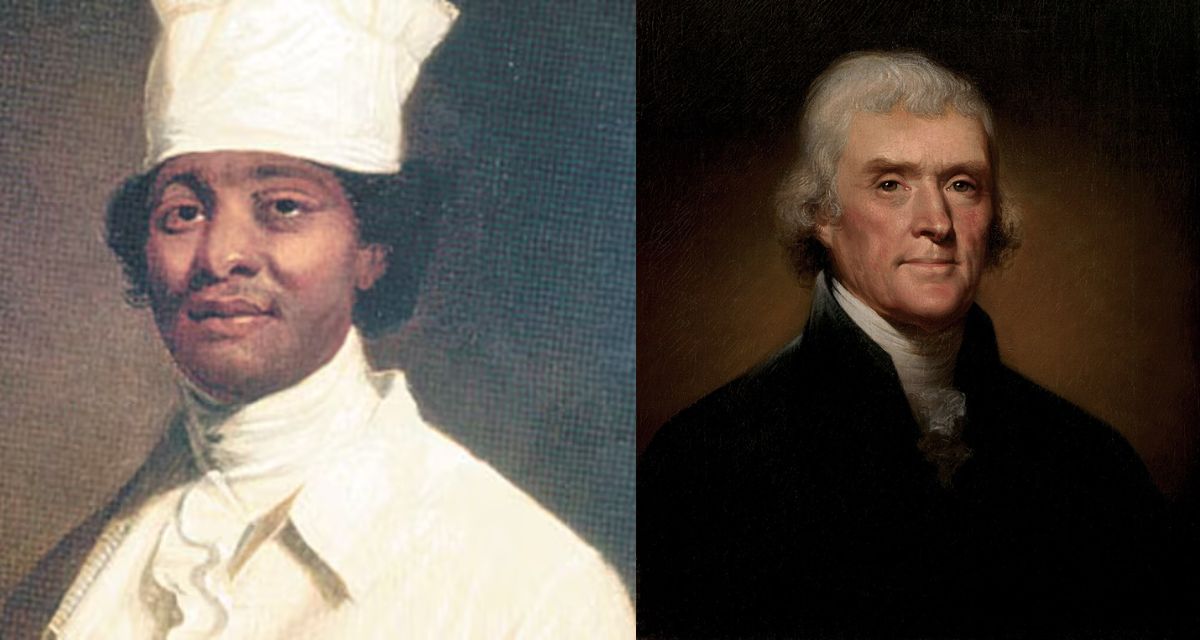
Thomas Jefferson‘s accomplishments as a Founding Father of the United States are unmatched. He drafted the first version of the Declaration of Independence, founded the University of Virginia, and was America’s third President.
His Monticello plantation estate in Charlottesville, Virginia, remains central to his legacy. Jefferson enslaved approximately 400 people there, including siblings James and Sally Hemings. Jefferson reportedly fathered six children with Sally.
James Hemings became Jefferson’s Chef de cuisine and was professionally trained in Paris. He not only cooked delicious meals for Jefferson, but also played an integral role in bringing many foods Americans love today to the United States.
James Hemings was Jefferson’s slave
Hemings was born in 1765 and was initially owned by the father of Martha Jefferson (Thomas’ wife). When he passed away, Thomas inherited Hemings, as well as his mother and several of his siblings.
They were transferred from his father-in-law’s plantation to Monticello. Hemings later became a valet for Jefferson while he served as Governor of Virginia. In 1781, he protected Jefferson’s wife and children when British troops invaded Richmond, Virginia.
Hemings would then travel to France with Jefferson in May 1784, when Jefferson served as the U.S. Minister to France. In Paris, Jefferson had Hemings trained in “the art of haute cuisine.”
Hemings was trained in French cuisine
Hemings was just 19 when famed French caterer and restaurateur Monsieur Combeaux taught him. In 1787, Hemings was deemed the “Chef de Cuisine” (a.k.a. the head chef) by Jefferson at the Hôtel de Langeac, the U.S. Embassy equivalent.
Hemings cooked for elites and dignitaries and was paid a salary that was reportedly only half of what the previous head chef made. Jefferson also hired a French tutor for him. He learned to make famous French dishes that he brought back to the United States, including crème brûlée, meringues, ice cream, French fries, and macaroni and cheese.
Hemings left France with Jefferson in October 1789. In 1790, Jefferson was appointed Secretary of State, which moved Hemings, still enslaved, to Philadelphia, where he again prepared lavish dinners for important political and social figures. Jefferson paid him, and they ultimately returned to Monticello in 1793. There, Jefferson wrote an agreement to free Hemings.
Hemings’ freedom and legacy
Hemings was finally freed on February 5, 1796, almost two years after his return to Monticello. During that time, he trained his younger brother Peter to replace him.
Jefferson wrote in his discharge of Hemings:
“This indenture made at Monticello in the county of Albemarle and commonwealth of Virginia on the fifth day of February one thousand seven hundred and ninety six witnesseth that I Thomas Jefferson of Monticello aforesaid do emancipate, manumit and make free James Hemings, son of Betty Hemings, which said James is now of the age of thirty years so that in future he shall be free and of free condition, and discharged of all duties and claims of servitude whatsoever, and shall have all the rights and privileges of a freedman. In witness whereof I have hereto set my hand and seal on the day and year abovewritten, and have made these presents double of the same date, tenor and indenture one whereof is lodged in the court of Albemarle aforesaid to be recorded, and the other is delivered by me to the said James Hemings to be produced when and where it may be necessary.”
Hemings was one of the most influential chefs of the 18th century. Michael Twitty, author of 2017’s The Cooking Gene: A Journey Through African-American Culinary History in the Old South, notes that “James Hemings should be a national name. Because he was the best. He wasn’t just a black chef. He wasn’t just a slave chef. He was the best chef.”
A signature dish: “snow eggs”
In a recent episode of Tasting History with Max Miller, one of Hemings’ famous recipes from France that Jefferson loved, called “snow eggs,” is discussed. The recipe came from a Jefferson family cookbook owned by Jefferson’s granddaughter, Virginia Jefferson Randolph Trist.
The recipe reads:
Take 10 eggs, separate the yolks from the whites and beat the whites as you do for savoy cake, till you can turn the vessel bottom upward without their leaving it; when they are well beaten put in two spoonfuls of powdered sugar and a little orange flower water or rose water if you prefer it. Put a pint of milk in a sauce pan with 6 oz. sugar and orange flower or rose water; when your milk boils, take the white, spoonful by spoonful and do them in the boiling milk; when sufficiently poached, take them out and lay them on a sieve. Take out a part of the milk according to the thickness you wish to give the custard; beat up the yolks and stir them in the remainder; as soon as it thickens, take the mixture from the fire; strain it through a sieve, dish up your whites and pour the custard over them. A little wine stirred in is a great improvement. – James, cook at Monticello”
Miller meets with Chef Ivey Boyd in Colonial Williamsburg, Virginia, to make Jefferson’s beloved dish. Boyd replaces orange blossom water with fresh orange peel for a “more modern” taste that isn’t as “perfumey.”
In a final taste test, Miller is delighted and describes the custard as “so smooth.” Chef Boyd notes that the egg whites are “nice and creamy and fluffy, as they’re supposed to be.”








.jpg)