
Every parent has experienced the two-stage reaction to their kid falling down while running around. Step one: Freeze and hold your breath. Maybe if you don’t react, they won’t cry. Right? Step two: This time, they’re actually hurt. Here come the tears. You move in to go inspect the boo-boo and. Good news… ’tis but a scratch!
But for some reason they won’t stop crying and saying how bad it hurts. “Come on, shake it off,” you insist. “It’s not that bad.” You wonder if they’re hamming up the near-invisible wound for a little extra attention, maybe you start to get annoyed.
A new study just found that if you behave this way, you’ll scar your children for life. OK, just kidding. They’ll be fine! But there is a simple, more effective way to handle boo-boos, both big and small.
A study in the journal aptly named Pain reveals that validating a child’s pain, however minor, can have huge benefits.
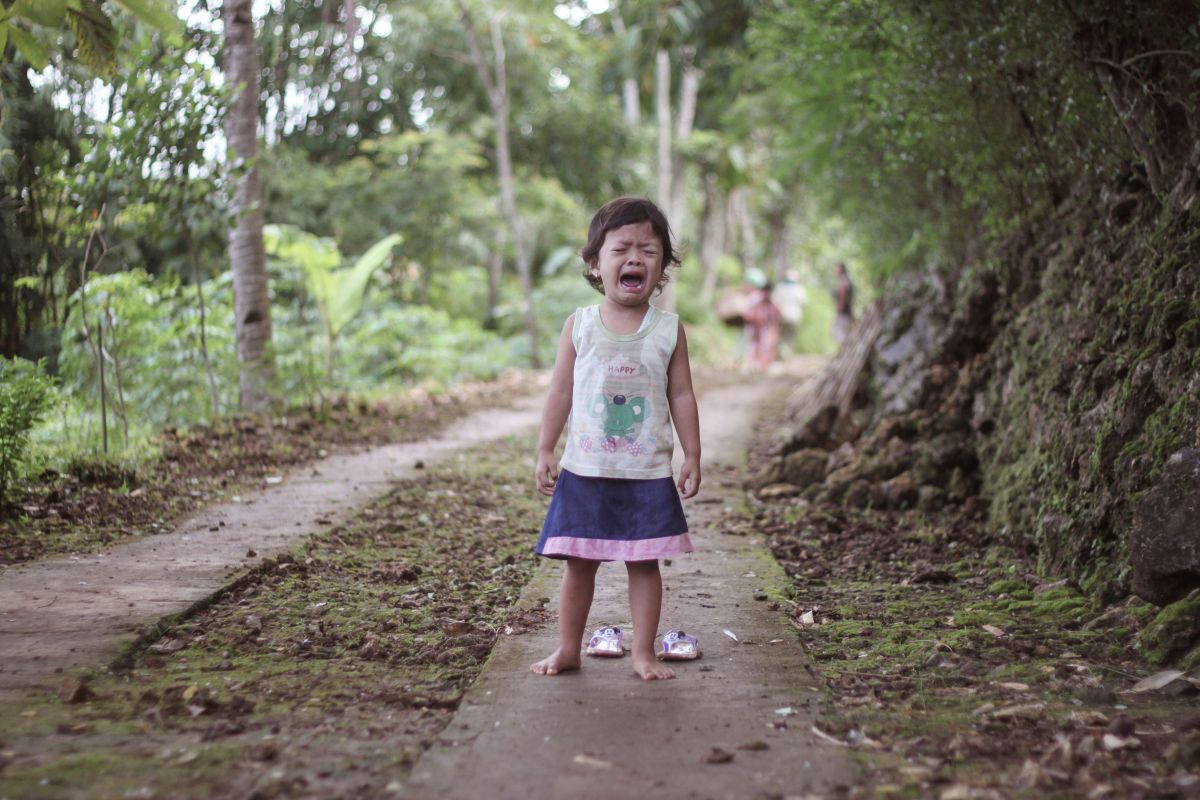
Whether a child has a microscopic scrape on their knee or is going into the hospital for a major operation, validation is the key.
How do you validate a child’s pain, fear, or discomfort? It can take a lot of forms, including active listening (“I hear you…”), naming emotions or sensations (“It sounds like it stings.”), praising or engaging with their healthy coping habits (“Great job being brave!”), or even just telling them it’s normal and OK to feel whatever they’re feeling (“I understand why you’re scared.”)
In Psychology Today, Ashley Hawthorn, a sensory studies expert, explains the study’s relevance like this:
As adults, we develop a higher tolerance of pain. Small aches and pains are easily ignored in many cases. Sometimes, we expect children to be able to do this, too. But we forget that they’re still learning what pain in, how to recognize it, and most importantly, how to cope with it.
A simple gesture to the effect of “Yes, you have correctly identified that you are in pain!” — as silly as it sounds — can help a child build confidence in their internal experiences.
Even if you think they may be blowing that pain out of proportion. That confidence can build on itself and continue to reap benefits long into adulthood.
“When a parent or doctor validates a child’s experiences in a way that matches their expressed vulnerability, it helps the child to feel accepted, builds connection and trust, and may help the child to develop critical skills in regulating their emotions,” lead study author Dr. Sarah B. Wallwork told Science Daily.
It makes sense the more you think about it.
If a parent or doctor questions the validity of a child’s pain, it may make them more apprehensive about coming forward later in life. And this is true of everyone, not just children! We all need to be told and shown that what we’re feeling is valid.
“By validating children’s experiences of pain, they are likely to hold fewer negatively biased memories of pain and be in better position to seek help in the future, when then need it,” Wallwork said.
Because pain is heavily tied to emotions and memories, using this approach can actually help children experience less pain when they’re older. Wild, right?
Critically, validation and reassurance are different things, and can have very different outcomes
Validation means agreeing that your child’s pain is real and, well, valid. It might sound like “I’m sorry that hurts,” or, “It’s OK to be nervous.” Validation is not to be confused with reassurance. Reassurance is meant to be positive and make a person feel better about the situation. “You can get through this!” or “Don’t worry, you’re OK.”
Confusingly, there’s some evidence that reassurance has a negative effect on children’s pain and distress, even though it sounds comforting!
A study in The Journal of Pediatrics says: “Reassurance may serve as a warning to the child that the caregiver is anxious, knows something bad is about to happen, or both.”
Maybe this explains why initially ignoring it when your toddler topples over can sometimes prevent the hysterical tears, versus running over immediately with concern. It sounds like a lot to remember, but the framework is really simple. The next time your kid is in pain, scared, worried, or all of the above — all you have to do is listen and believe them.
If you can distract them or help them cope with their pain in a healthy way? You’re cruising to Parent of the Year status.

In a small village in Pwani, a district on Tanzania’s coast, a massive dance party is coming to a close. For the past two hours, locals have paraded through the village streets, singing and beating ngombe drums; now, in a large clearing, a woman named Sheilla motions for everyone to sit facing a large projector screen. A film premiere is about to begin.
It’s an unusual way to kick off a film about gender bias, inequality, early marriage, and other barriers that prevent girls from accessing education in Tanzania. But in Pwani and beyond, local organizations supported by Malala Fund and funded by Pura are finding creative, culturally relevant ways like this one to capture people’s interest.
The film ends and Sheilla, the Communications and Partnership Lead for Media for Development and Advocacy (MEDEA), stands in front of the crowd once again, asking the audience to reflect: What did you think about the film? How did it relate to your own experience? What can we learn?
Sheilla explains that, once the community sees the film, “It brings out conversations within themselves, reflective conversations.” The resonance and immediate action create a ripple effect of change.
MEDEA Screening Audience in Tanzania. Captured by James Roh for Pura
Across Tanzania, gender-based violence often forces adolescent girls out of the classroom. This and other barriers — including child marriage, poverty, conflict, and discrimination — prevent girls from completing their education around the world.
Sheilla and her team are using film and radio programs to address the challenges girls face in their communities. MEDEA’s ultimate goal is to affirm education as a fundamental right for everyone, and to ensure that every member of a community understands how girls’ education contributes to a stronger whole and how to be an ally for their sisters, daughters, granddaughters, friends, nieces, and girlfriends.
Sheilla’s story is one of many that inspired Heart on Fire, a new fragrance from the Pura x Malala Fund Collection that blends the warm, earthy spices of Tanzania with a playful, joyful twist. Here’s how Pura is using scent as a tool to connect the world and inspire action.
A partnership focused on local impact, on a global mission
Pura, a fragrance company that recognizes education as both freedom and a human right, has partnered with Malala Fund since 2022. In order to defend every girl’s right to access and complete 12 years of education, Malala Fund partners with local organizations in countries where the educational barriers are the greatest. They invest in locally-led solutions because they know that those who are closest to the problems are best equipped to solve and build durable solutions, like MEDEA, which works with communities to challenge discrimination against girls and change beliefs about their education.
But local initiatives can thrive and scale more powerfully with global support, which is why Pura is using their own superpower, the power of scent, to connect people around the world with the women and girls in these local communities.
The Pura x Malala Fund Collection incorporates ingredients naturally found in Tanzania, Nigeria, Pakistan, and Brazil: countries where Malala Fund operates to address systemic education barriers. Eight percent of net revenue from the Pura x Malala Fund Collection will be donated to Malala Fund directly, but beyond financial support, the Collection is also a love letter to each unique community, blending notes like lemon, jasmine, cedarwood, and clove to transport people, ignite their senses, and help them draw inspiration and hope from the global movement for girls’ education. Through scent, people can connect to the courage, joy, and tenacity of girls and local leaders, all while uniting in a shared commitment to education: the belief that supporting girls’ rights in one community benefits all of us, everywhere.
You’ve already met Sheilla. Now see how Naiara and Mama Habiba are building unique solutions to ensure every girl can learn freely and dare to dream.
Naiara Leite is reimagining what’s possible in Brazil
Julia with Odara in Brazil. Captured by Luisa Dorr for Pura
In Brazil, where pear trees and coconut plantations cover the Northeastern Coast, girls like ten-year-old Julia experience a different kind of educational barrier than girls in Tanzania. Too often, racial discrimination contributes to high dropout rates among Black, quilombola and Indigenous girls in the country.
“In the logic of Brazilian society, Black people don’t need to study,” says Naiara Leite, Executive Coordinator of Odara, a women-led organization and Malala Fund partner. Bahia, the state where Odara is based, was once one of the largest slave-receiving territories in the Americas, and because of that history, deeply-ingrained, anti-Black prejudice is still widespread. “Our role and the image constructed around us is one of manual labor,” Naiara says.
But education can change that. In 2020, with assistance from a Malala Fund grant, Odara launched its first initiative for improving school completion rates among Black, quilombola, and Indigenous girls: “Ayomidê Odara”. The young girls mentored under the program, including Julia, are known as the Ayomidês. And like the Pura x Malala Fund Collection’s Brazil: Breath of Courage scent, the Ayomidês are fierce, determined, and bursting with energy.
Ayomidês with Odara in Brazil. Captured by Luisa Dorr for Pura
Ayomidês take part in weekly educational sessions where they explore subjects like education and ethnic-racial relations. The girls are encouraged to find their own voices by producing Instagram lives, social media videos, and by participating in public panels. Already, the Ayomidês are rewriting the narrative on what’s possible for Afro-Brazilian girls to achieve. One of the earliest Ayomidês, a young woman named Debora, is now a communications intern. Another former Ayomidê, Francine, works at UNICEF, helping train the next generation of adolescent leaders. And Julia has already set her sights on becoming a math teacher or a model.
“These are generations of Black women who did not have access to a school,” Naiara says. “These are generations of Black women robbed daily of their dreams. And we’re telling them that they could be the generation in their family to write a new story.”
Mama Habiba is reframing the conversation in Nigeria
Centre for Girls' Education, Nigeria. Captured by James Roh for Pura
In Mama Habiba’s home country of Nigeria, the scents of starfruit, ylang ylang and pineapple, all incorporated into the Pura x Malala Collection’s “Nigeria: Hope for Tomorrow,” can be found throughout the vibrant markets. Like these native scents, Mama Habiba says that the Nigerian girls are also bright and passionate, but too often they are forced to leave school long before their potential fully blooms.
“Some of these schools are very far, and there is an issue of quality, too,” Mama Habiba says. “Most parents find out when their children are in school, the girls are not learning. So why allow them to continue?”
When girls drop out of secondary school, marriage is often the alternative. In Nigeria, one in three girls is married before the age of 18. When this happens, girls are unable to fulfill their potential, and their families and communities lose out on the social, health and economic benefits.
Completing secondary school delays marriage, and according to UNESCO, educated girls become women who raise healthier children, lift their families out of poverty and contribute to more peaceful, resilient communities.
Centre for Girls’ Education, Nigeria. Captured by James Roh for Pura
To encourage young girls to stay in school, the Centre for Girls’ Education, a nonprofit in Nigeria founded by Mama Habiba and supported by Malala Fund and Pura, has pioneered an initiative that’s similar to the Ayomidê workshops in Brazil: safe spaces. Here, girls meet regularly to learn literacy, numeracy, and other issues like reproductive health. These safe spaces also provide an opportunity for the girls to role-play and learn to advocate for themselves, develop their self-image, and practice conversations with others about their values, education being one of them. In safe spaces, Mama Habiba says, girls start to understand “who she is, and that she is a girl who has value. She has the right to negotiate with her parents on what she really feels or wants.”
“When girls are educated, they can unlock so many opportunities,” Mama Habiba says. “It will help the economy of the country. It will boost so many opportunities for the country. If they are given the opportunity, I think the sky is not the limit. It is the starting point for every girl.”
From parades, film screenings to safe spaces and educational programs, girls and local leaders are working hard to strengthen the quality, safety and accessibility of education and overcome systemic challenges. They are encouraging courageous behavior and reminding us all that education is freedom.
Experience the Pura x Malala Fund Collection here, and connect with the stories of real girls leading change across the globe.
Despite society having made a lot of progress when it comes to same-sex relationships and alternative families, it’s not so commonplace that many queer parents are still presented with questions about their lifestyle from straight people.
And while queer parents probably (rightfully) grow tired of answering certain questions day in and day out, having open conversation helps break through the lack of understanding which causes stigma and misconceptions in the first place. In a now-viral video shared to their Instagram, lesbian moms Allie and Sam Conway answer commonly asked questions they get as a queer married couple with twins.
What’s it like to be lesbian parents?
Of course, they started with the age-old question:
“Who’s the real mom?”
Though people by and large are able to differentiate biological connection from emotional connection (like with adoptive parents or step-parents to take on an active role in their step children’s lives), this is still a question that same-sex parents face regularly. And it’s a fairly harmful one at that, as it implicitly undermines the non-biological parent’s role in the family.
Allie also told Upworthy that the usual response to this answer is “oh my gosh! That’s amazing!” Which makes her—and us—”smile so much.”
Next up:
“Who’s the dad?”
To which they replied: “there isn’t a dad.”
This is also a question fused with negative connotation, as it suggests a father figure is necessary for raising well-adjusted kids. But research shows that kids born to same-sex parents fare just as well as the children of straight couples, indicating that what’s really necessary for a child’s development is two healthy, loving parents. That’s it.
Okay, this next one actually had an answer that surprised some folks:
“Who carried them?”
Though Sam wanted to be the one to get pregnant, Allie agreed to try after Sam’s “long fertility journey” of three IUI’s, three embryo transfers and multiple chemical pregnancies with one miscarriage.
However, the couple used Sam’s eggs, and Sam did the breastfeeding.
How the heck did that happen, you might wonder. Don’t worry, you’re not alone. So did lots of viewers. Sam underwent induced lactation, which tricks the body into thinking it’s pregnant and producing breast milk—it’s something often utilized by adoptive mothers.
What is induced lactation?
Induced lactation replicates the natural hormone process that happens when a woman gives birth. In this process, women are often given hormone supplements, such as estrogen or progesterone, to mimic the effects of pregnancy. This process may go on for months. About two months before the expected birth, the woman is then given a breast pump to stimulate lactation.
“Mummy and other mummy,” Sam quipped. “We’re rotating all day,” Allie added.
Without proper understanding, stigma persists. That’s how myths like “queer parents turn their children gay” or “children of two-mother families are more likely to be bullied” continue. And while it’s certainly not the responsibility of parents like Allie and Sam to educate folks on the realities of queer parenting, it’s great that they do offer genuine insight.
And thankfully, they are usually met with positive reactions from people, Allie tells Upworthy. Which only further encourages them to answer more question and offer glimpses into “different types of families.”
At the end of the day, families are made up of people who love and support one another. Everything else is just window dressing.
Check out even more heartwarming family content from Allie and Sam on Instagram and YouTube.
Robbie Pierce, his husband, Neal Broverman are no strangers to bigotry. The men and their two young children were traveling on an Amtrak train in California in 2022 when they were harassed by a fellow passenger at a stop in San Jose; an incident that made headlines.
“All of a sudden, there was a man standing there next to me,” Pierce told The Advocate. The man told their son, “Remember what I told you earlier. They stole you and they’re pedophiles,” Pierce recounts. The man also said that gay people are abominations. (Broverman is the editorial director for print media at Pride, The Advocate’s parent company.)
The police were called and the man was thrown off the train, but the incident was a frightening reminder that gay families could be the target of bigots any time and anywhere, even in liberal Northern California. “It’s a new level of homophobia out there,” Pierce added.
Seven months later, Pierce’s son was the victim of harassment, this time from a child at a park.
“A random unattended 7-year-old at the park told me and my son that gay people are the devil,” he recounted in a viral X thread. “My son scoffed, but the boy said it was true because God said so.”
Maybe it was the incident months prior. Maybe it was a lifetime of harassment and judgment. But whatever it was, in that moment, Pierce had had enough. He reacted to the boy’s hatred — which he probably learned at home — with his own lesson.
“I told him parents made up God to make their Kids do what they want. His eyes got so big,” he wrote on X.
A random unattended 7yo at the park told me and my son that gay people are the devil and are going to hell. My son scoffed, but the boy said it was true because God said so. I told him parents made up God to make their kids do what they want. His eyes got so big.
It’s worth wondering: Did God really ‘say so’? Biblical scholars are split on the Bible’s true message around homosexuality. It appears open to interpretation, and it’s clear that many people choose to interpret the words in a hateful and negative way, going so far as to show their children that it’s OK to approach and confront gay people over their identities.
Addressing complex issues like religion and sexuality with a young child, who’s a stranger, is a tricky needle to thread, so Pierce admits he had some reservations about his response. But he stands by his decision.
“I’m sorry but if you teach your kids to hate I’m going to teach them to disobey you,” he wrote on X.
I'm sorry but if you teach your kids to hate I'm going to teach them to disobey you.
As someone who has been harassed by religious, homophobic people in the past, Pierce took the opportunity to help steer a young child away from hatred. At the age of 7, most children believe whatever their parents tell them. However, Pierce planted a seed in the child’s mind that may one day encourage him to challenge his indoctrination when he gets older. The kid will likely remember that interaction for many years to come, and may look back at it with shame one day. That shame could be the much-needed catalyst for change.
“I was shocked at first and then…well…you may have planted a seed to grow a fine human out of the little homophobic bigot he was being trained up as. I can’t argue with that,” one user wrote on X.
The vast majority of commenters on X agreed with Pierce’s response to the child’s comment.
But what Robbie said wasn't exactly wrong? And if you're going to hell anyway, why not say it lol.
However, some people thought Pierce’s response to the child was inappropriate.
Bigoted words or not, it was still a child, and many people thought there may have been a more tactful way to teach the kid a lesson rather than invalidating his entire faith. Or perhaps Pierce could have tracked down the boy’s parents and given them an earful instead.
maybe because the conversation was with a 7yo child? Are we going to victimize ourselves to THAT degree?
This wasn't an admirable way to handle this situation.
My personal beliefs don't have anything to do with it. I believe God is Love and I love all the gays. I love children.
That was quite wrong of you to do to a kid. You had a chance to enlighten a child. You could have told him that gay people are just like everyone else and should be respected. Instead you threw his mind into darkness and chaos. You made a bad situation worse.
I’ll take: you are telling the truth and you took the time to own a seven year old kid to make yourself feel better. Very big of you. Or. You are making things up again. Either way, probably not something to hold as a moment of righteousness. Be better.
One thing is clear: Something in our culture is definitely broken when we’re more intent on policing people’s responses to bigotry and hate versus addressing the root cause of these divides. The boy’s parents should be the one on trial in the court of public opinion for teaching their son that this kind of behavior is acceptable.
No matter how one feels about Pierce’s reaction, what’s clear is that there is something very inappropriate about a 7-year-old child openly harassing LGBTQ families. The unfortunate problem is that this type of hyper-religious upbringing can cause lasting emotional and psychological trauma to a child. And it’s a common problem. A recent study in the growing field of religious trauma found that 1 in 3 Americans suffer from trauma related to religion at some point in their life.
While we might be quick to dismiss the child’s behavior as innocent or simply as a symptom of growing up in a religious household, the more we learn about religious trauma, the more these children appear to be the victims of abuse. Hopefully Pierce’s words will help the boy rethink his relationship with his faith, and his parents, down the road.
This article originally appeared two years ago. It has been updated.
Leslie Harter-Berg from Vancouver, Washington, lost her husband, Ryan, in 2019 when he died suddenly after an aneurysm and stroke. The couple was in Palm Springs, California after visiting Disneyland with their two sons, Wit (then 3) and Rory (1), when he passed away. “So I flew back from Cali as a single mom, solo business owner and widow, a term I thought only applied to old ladies,” she told Newsweek.
In 2022, she found love again with a new man, Sol, and in 2023, they had a son, Rhys. “I feel very blessed and lucky that I was able to find love twice,” she told People. “I can only imagine Ryan telling me not to waste this one life I get.”
The perfect way to celebrate her husband’s life with her children
But she still wanted her two oldest sons to understand the amazing man their father was and to experience him in some way. So, every year on his birthday, they would do something Ryan loved, such as watching a classic film or playing with LEGO.
In 2021, while going through Ryan’s belongings, she found a bucket list he had written in a high school journal. It paints a vivid picture of a young man’s hopes and core beliefs about family, friendship, and adventure. Since the bucket list was discovered, they have done something on it every year on Ryan’s birthday. Here’s the list:
One year, the family accomplished #26 in his life by dressing up as pirates and going out in public, and #16 by playing chess in a park. April 2, 2026 will mark the fifth year that the family has been checking things off his list.
“My kids look forward to it every year!” she told Newsweek. “Especially as they get older and closer to the age Ryan was when he made it, I think it’s meaningful to get a glimpse into who their dad was.”
So far, the kids’ favorite activity on the list has been one of the most challenging.
“My kids’ favorite was probably building the three-foot-high card tower, which proved almost impossible,” she told Upworthy. “One of my friends was determined, and it took about three hours to finally get the cards to stay in place. We threw a big party and ate Ryan’s favorite snacks.”
After more than six million people saw her TikTok post about the bucket list, many contacted her to help her family complete it. One said they’d let them borrow their mansion to cross off #15.
“Someone on Lake Michigan said he’d be in Japan and my kids and I could experience mansion life to cross off Ryan’s ‘live in a mansion’ bucket list item,” she said. “Tempting, but we opted not to take him up on it. It has been so sweet to see how the Internet has rallied to want me to help complete it. A web design firm reached out, offering to build a website, another item on his list. Many people in the comments said they’d want to check off Ryan’s items too, which means so much. He lives on in his quirky little list.”
A vacation to Disney World is still considered the gold standard by many when it comes to family getaways. It has everything from good food to thrill rides, childhood nostalgia, and more.
But all that joy and magic sometimes come at a cost. Not just the financial price tag, but also the hard work it takes to afford those tickets and arrange the trip—work that doesn’t necessarily end when you step foot inside the parks. One family learned this lesson the hard way, firsthand.
The Mouselets are three siblings who’ve teamed up, using their shared love of all things Disney, to run social media accounts and podcasts where they share their favorite tips and secrets about the parks.
Recently, they arranged to take their parents to Disney World, and the excitement was palpable:
Unfortunately, the work didn’t end there for their poor dad. In other clips shared by The Mouselets, he’s forced to whip out his laptop at lunch, tap away at his phone while waiting for a show to begin, and even take another urgent call while dressed in full Mike Wazowski garb, of Monsters, Inc. fame.
Their dad even brought an entire multi-monitor setup to their room at the Grand Floridian Resort to bang out a few spreadsheets (or something like that).
The siblings edited it all into a brilliant, horror movie–inspired supercut:
Even though they have well over a million followers on social media, The Mouselets could never have predicted how popular the video of their dad would become. To date, it’s received nearly five million views on TikTok and Instagram.
Overwhelmingly, people are showing respect for their dad’s hustle:
“Someone’s gotta pay for y’all’s vacation”
“Taking the call is what pays for those trips.”
“Disney doesn’t pay for its self”
“I respect this man. The family appreciates his hard work.”
In another post, The Mouselets clarified that they were the ones who arranged and paid for the trip, not their dad. Still, the video serves as a bittersweet reminder of what it must have taken to bring three kids to Disney World and instill in them a lifelong love—one that would later inspire them to start a business like The Mouselets.
Put another way, their dad knew he had work to do but simply couldn’t pass up the chance to spend time with his kids. So, like many parents, he decided to “do it all.”
“Work-life balance” and vacation, or time off, have become messy concepts
Gen Zers are pushing back hard against hustle culture, but a lot of modern companies still expect employees to go the extra mile, work well beyond 40 hours per week, and stay digitally connected even during personal and vacation time.
There’s something sad about watching Papa Mouselet miss out on what should be quality time, but apparently he’s not the only one. Commenters chimed in with their own “life goes on, even at Disney” moments:
“me taking my college exam while in line for guardians”
“i was in a meeting on the skyliner”
“I have a park photo from the ride of my husband taking a work call on Haunted Mansion. Dad had to pay for the next Disney trip somehow”
“Have done a full on Zoom on people mover”
“I had a job interview on the dumbo flying elephants”
“He’s not [alone], my husband does this too”
Disney magic is powerful stuff, but it doesn’t come out of nowhere. The hard work and planning it takes often go unseen and unnoticed. Other times, unfortunately, the work refuses to wait until you get home. But that doesn’t mean you can’t still have a great trip.
It all worked out for the whole family
As for Mr. Mouselet, viewers were relieved to know he did, in fact, have a wonderful vacation—once he’d handled his business, that is.
Not all heroes wear capes. Some wear black Savage jackets. And some aren’t even 14 yet. Such is the case for Josue Carrizosa, who shared a piece of his day with his dad, Junior. His simple act of kindness brought Junior (and many others on social media) to tears.
In a now-viral clip posted on TikTok, Josue sits on a carpeted floor and casually tells his father about something that happened at school that day. “A girl had her period mid-class, and she was wearing khaki pants. So it was showing right here.” (He shows on his thigh where menstrual blood might have appeared.)
He continues, “And when she got up to walk to the nurse, everyone was laughing at her. But me and my friends, we were the nice ones. And I gave her my jacket…the Savage one? I gave her that one because it’s black, so you can’t see it.”
Josue pantomimes wrapping a jacket around his waist to represent what his young female friend might have needed at the time.
Junior asks, “Did she ask you for it?” Josue confirms she didn’t. “No, I just said ‘Here. Use my jacket.’ And then me and my friend took her to the nurse. And we got signatures for it.”
“Do you know the girl?” “No,” Josue answers matter-of-factly, as he gets up and moves over to a desk area. Junior lets him know he’s proud: “That was nice of you!”
Josue Carrizosa. Photo credit: TikTok
“Aligned with kindness”
A young boy showing such profound, unprompted empathy is truly resonating with the online community. The clip has garnered more than 2.1 million likes and 61,000 comments from people sharing how impressed they are. (Many even want to put together a wish list of gifts to send Josue for his lovely good deed.) One commenter beautifully writes, in part, “He’s already aligned with kindness.”
Another makes a checklist: “He knows about periods. He has empathy. He did something to help. He was comfortable telling his dad about it. Someone is raising a good man.”
A self-described “girl mom” was extra impressed, writing, “As a girl mom, you don’t even understand how comforting this is.”
This TikToker says what many are thinking: “We need more boys like this in the world.”
Upworthy had the honor of speaking with Junior, who shared that Josue has always exemplified this level of empathy. “When he was little, he came home one Christmas week and asked me for wrapping paper. He wanted to wrap his old toys for kids that didn’t have anything. His idea.”
And this has become a pattern. “He has shown empathy in the past from giving to the homeless. And when we collected old pillows and blankets to pass out to the less fortunate.”
Although Junior isn’t sure whether Josue and the girl stayed friends, he said his son has “a lot of friends because he’s the smallest in his class, but is one of the coolest, nicest souls.”
When asked where that empathy might have come from, at least in part, Junior spoke with pride, saying, “He learned empathy from me because I have taught them to donate to the homeless since they were little.”
It’s a good news/bad news situation for parents of young kids. The good news? Everyone wants to spend time with the kids! Grandparents, aunts and uncles, friends. They all want a relationship and lots of special moments with the little ones. It’s why people assume if you have family nearby that you’re “so lucky,” and that you’re overrun with free babysitting offers. Ha! If only.
The bad news comes down to one phrase: “When are you bringing them over?” Parents have been frustrated by the expectations of orchestrating stressful visits for generations — loading the kids in a car or on an airplane only to spend hours chasing them around in an un-baby-proofed environment and watching routines go to hell.
Now they’re sounding off on social media and airing their grievances.
Why visiting grandparents and other relatives is so challenging for parents
A mom recently took to Reddit to vent about everyone in her life wanting her to “bring the kids to them.”
“My parents live 30 mins away and always bug me about not coming to visit them,” she writes. They constantly ask, “Why don’t you bring our granddaughter to come see us?”
The post struck a nerve with parents, who chimed in with hundreds of passionate comments. The fascinating discussion highlights a few things that make arranging visits with young kids a potential nightmare for parents.
Grandparents’ houses are rarely childproofed
Grandparents love their breakable decor! Ceramic doo-dads, glass vases everywhere. They can’t get enough. In fact, they like to dedicate massive pieces of furniture only to housing their fine china, which they never use, but which is also extremely valuable and sentimental.
And while they should be able to decorate their house however they see fit (they’ve earned the right!) that doesn’t make it a good environment for toddlers and babies.
Blue and white porcelain vases on a shelf. Phot credit: Canva
“Last week was the last straw, I took my daughter to my parents and of course she went EVERYWHERE! flooded their toilet, broke a vase, and tried multiple times to climb their furniture,” the Reddit mom writes.
Parents in a foreign environment are on constant safety duty and can rarely sit down
Let’s be honest. Sometimes these “visits” are hardly worth the effort. After all, it’s hard to get much catch up time when you’re dutifully chasing your kid around.
“They don’t understand that my 3 yo … is absolutely wild,” writes another user in the thread. “She has no self preservation and nothing we do works. She doesn’t listen, she throws, she bites, she refuses to use the potty. It’s exhausting and then … they expect us to entertain them, when I’m trying to just keep my kid from jumping off the stairs and into an ER visit.”
A visit at the grandparents’ house is often not a fun catch-up time for mom and dad. It’s rare to get to sit down and have an adult conversation when they’re busy trying to play Safety Police. It’s common to leave one of these visits frustrating and like it wasn’t really a visit at all.
Even just putting the kids in the car for a 20-minute drive is more work than it seems
Taking the kids out of the house requires packing a bag, bringing extra clothes, loading up on snacks, etc.
It seems easy to “pop over” but it actually absorbs the majority of the day between prep, visit, and aftermath. In the case of the OP mom and her parents that are “just” 30 minutes away, that’s an entire hour of just driving, not counting any visiting time. If anyone’s ever driven with young kids, you know that’s an eternity! For a drive like that, you need snacks, you need entertainment. You may have to clean up spills, deal with traffic tantrums, or pull over to break up a fight. It’s really a lot of work.
Naps and routines go to hell
Parents with babies and toddlers know all too well — there is a price to pay for taking the kids out of the house for too long.
Chances are, the baby won’t nap in a strange environment and then you’re stuck with a cranky kid the rest of the night. You can and will try, bringing your little pack-and-play and your best intentions, but the process will be draining and probably unsuccessful.
And then guess what? You’re totally screwed when you go home later, yay!
Kids with special needs require even more consistency
Kids with autism or ADHD can really struggle outside of their zone of safety. They might become severely dysregulated, have meltdowns, or engage in dangerous behaviors. This adds even more stress to parents and makes the visits even less fun and satisfying in the end.
Explaining and mediating the generational divide
A man holds his granddaughter. Photo credit: Canva
Why is this a conflict almost all parents can relate to?
Is this a Boomer vs Millennials thing?
Some experts think that generational values and traditions might play a role.
“Many Boomers were accustomed to more traditional, hierarchical family dynamics, where visiting grandparents was a way for the younger generation to show respect,” says Caitlin Slavens, a family psychologist.
But that’s not to say this is a new problem. I can remember my own parents driving me and my brothers over an hour to visit my grandparents seemingly every other weekend, but very few occasions where they came to visit us. It must have driven my parents nuts back then!
Plus, it’s easy to forget that it’s hard for older people to travel, too. They may have their own issues and discomforts when it comes to being away from their home.
“But for today’s parents, balancing careers, kids’ routines, and the demands of modern parenting is a much bigger undertaking. Grandparents might not always see how childproofing their space or making the trip themselves could make a huge difference, especially considering how travel and disruption can impact younger kids’ moods and routines,” Slavens says.
“So yes, this divide often comes down to different expectations and life experiences, with older generations potentially not seeing the daily demands modern families face.”
Is there any hope for parents and grandparents coming to a better understanding, or a compromise?
“First, open conversations help bridge the divide—explain how much of a difference it makes when the kids stay in a familiar space, especially when they’re very young,” suggests Slavens.
“Share practical details about the challenges, like childproofing concerns or travel expenses, to help grandparents see it from a parent’s perspective. You might even work together to figure out solutions, like making adjustments to create a more child-friendly space in their home or agreeing on a shared travel plan.”
Ultimately, it’s a good thing when grandparents, friends, and other relatives want to see the kids. We all have the same goal. Just look at how incredible it can be when everything goes right:
“It’s helpful to approach the topic with empathy, focusing on everyone’s goal: more quality time together that’s enjoyable and low-stress for everyone involved. For parents, it’s about setting boundaries that work, and for grandparents, it’s about recognizing that flexibility can really show the parents that you are … willing to make adjustments for their children and grandchildren.”
Enjoyable, low-stress quality time is something everyone can get behind.
This article was originally posted two years ago. It has been updated.
Some believe responding “What?” when your name is called is rude. Parents are often fond of responding to a child saying “what” with a good old-fashioned “Don’t ‘what’ me.” Others aren’t too bothered by it and think a more polite response is a bit too formal.
Angelica Daniell, 38, currently stationed at Fort Bragg in North Carolina, says teaching her children to respond to their names with “Yes?” has brought more peace to her home. She was raised in a “What?” family, and changing the rule in her home has made a big difference.
Are you in a “what” family or a “yes” family?
“When you guys were growing up, and your parents would call you, and they’d say your name, would you say, ‘What?’ Because I grew up like, ‘what?’ You know?” she began her TikTok video.
“Ever since my kids could talk, my husband taught our kids to say ‘yes.’ So if we call Ray, he’d say, ‘Yes.’ And then he needs to come—like, yes, I hear you, but I’m coming. You don’t stay in that place and talk to you from downstairs, and you’re upstairs,” she said. “I don’t know, I just thought that’s such a special and precious thing. And I love when I call my kids, and they say, ‘Yes?’ and they come to me. I can’t tell you what that does for me.”
The big problem people have with using “what” as a response to a family member calling their name is that it makes them sound annoyed. It’s like they mean to ask, “What are you bugging me about?” or “What do you want?” By contrast, saying “yes” signals that you’re welcoming the request or favor and are ready to help.
Not everyone agrees. “I definitely grew up as a ‘what’ type of family. I still don’t see anything wrong with it. I’m not sure why people find it disrespectful,” one person said in the comments.
“My mom always said, ‘Don’t what me,’” another added.
“Even hearing ‘what’ even from other adults.. feels disrespectful,” said another.
The discussion also pointed to a bigger issue. “Genuine question for adults currently in/raised in a ‘what’ household… do y’all answer ‘what’ at work when someone calls you!?” a commenter asked.
Daniell believes that when children are polite in the home, it follows them throughout their lives. “Our home is the dress rehearsal, and the world is the stage,” she told Newsweek. “If our kids say ‘yes’ to us, our hope is they will also say it to their teachers, friends [and] coaches.”
Napoleon Hill, author of the mega-bestseller Think and Grow Rich, believed that it’s important for parents to be polite to their children as well.
“Politeness to others is usually born out of respect for the individual, which you learn as a child,” Hill wrote. “When you are treated with respect by other members of the family, you learn to respect them as well. The self-esteem that results from being recognized as a unique person by the people who matter most to you helps you develop the confidence necessary to succeed later in life. Politeness and consideration for others are habits that—once developed—usually stay with you for a lifetime.”
When people debate whether it’s better to live in a “what” or a “yes” family, it’s important to recognize that manners start at home. Even though the “what” folks may think the “yes” folks are being too formal, the habits formed at home will help define a child’s life in the real world. Finding manners in school or the office is a lot harder when you never had them at home.
In fact, he doesn’t just talk about it. Videos of him demonstrating how he uses an automatic foam sprayer, brushes, wash mitts, microfiber drying towels, and more have inspired thousands of people to follow in his footsteps. That says a lot. This is bathroom cleaning, after all.
In Part 1, Sebastian explains that once a month, he deep-cleans the bathroom, starting with dusting and vacuuming. First, he removes everything from the space. Then he uses a Swiffer duster and an industrial air scrubber to suck up all the dust he displaces (not a standard bathroom-cleaning tool, for sure). After dusting, he vacuums. Thoroughly.
Then comes the fun part: the automatic foam sprayer.
Sebastian mixes Dr. Bronner’s Castile Soap, isopropyl alcohol (to disinfect), and water in the foam sprayer. Then he hoses down the entire shower, tub, toilet, sinks, and countertop with the foamy mixture, which is oh-so satisfying.
Then he starts scrubbing with car wash brushes. Also so satisfying.
Are you wondering how on Earth he’s possibly going to rinse all of that off? Fear not. He has a system.
That system includes a spray bottle (with a design that puts all others to shame) and a squeegee. Spraying the foam with water keeps it from drying out and makes it easy to squeegee away. Then he goes in with a big, honking car wash mitt to remove the rest.
The mitt might be the best part, though Sebastian gets particularly excited about the microfiber towel that comes next.
“The best towel ever made,” he says. “It is a microfiber towel made by The Rag Company for the automotive detailing industry. And it is quite literally the most absorbent towel I’ve ever used in my entire life.”
And he’s still not done. He cleans the remaining surfaces (window sills, tops of lights, top of the door frame, etc.) with castile soap. Then he goes in with sodium percarbonate (an eco-friendly oxygen bleach powder) to clean the sink bowls, toilet, tub, and grout.
Then he rinses it all off with his superabsorbent microfiber towel, and voilà! A sparkly clean bathroom.
People in the comments expressed how impressed and inspired they were by Sebastian’s cleaning regimen:
“Wow. People’s minds are going to be blown. I did not see the squeegee or the puffy glove coming. 👏👏❤️❤️”
“This inspired me to do a much-needed scrub of my own shower last night at 10:30pm, and for that I thank you.”
“It has never occurred to me to clean a bathroom like this but honestly it looks very thorough!!”
“This is SUCHHHHHHH a brilliant and effective way to clean a bathroom! My dad worked at a car wash for years and years and I feel like he would have loved this.”
“Ok, I know the products aren’t sponsored but they should be. I am ready to BUY. This is a masterclass in adulting.”