Neuroscience totally backs this 90-second hack to get your sanity back
Lives are getting busier all the time, making it feel impossible to get everything on our to-do list done while still managing our overall wellbeing. Sometimes even 10 minutes of stretching becomes a herculean task. But the good news is: when it comes to mood regulation, you might only need to spare a measly 90…
Lives are getting busier all the time, making it feel impossible to get everything on our to-do list done while still managing our overall wellbeing. Sometimes even 10 minutes of stretching becomes a herculean task. But the good news is: when it comes to mood regulation, you might only need to spare a measly 90 seconds.
While the “90 second rule” might initially come across as a passing TikTok hack, it’s a concept coined by Dr. Jill Bolte Taylor, the neuroscientist who famously survived a severe stroke, which provided her a unique, firsthand perspective on brain function.
How the 90-second rule works
As Taylor explains it: “We’re only doing three things inside of our brain at any moment in time. We think thoughts, we feel emotion, and run physiological loops to what we’re thinking and feeling.”
Taylor claims that it takes about a minute-and-a-half for any feeling–be it anger, anxiety, or fear, etc.—to pass through organically. So our job is to allow that feeling to metabolize, essentially. And by the end of that process, your brain has a nice reset.
Taylor added that she even tries to “enjoy” whatever she’s feeling during those 90 seconds. “I will celebrate every time the wave of emotion hits me…and then it’s gone,” she says.
Photo credit: Canva
In an interview with Bustle, Djuan Short, LCSW, a licensed trauma therapist and founder of Dahlia Rose Wellness Center, added that another benefit of the 90-second rule is that it “interrupts the urgency” of everyday life, and suggests intentionally incorporating them into “high-demand days.”
“Most people are not exhausted because they are doing too much. They are exhausted because they never fully stop,” Short says. “In a culture built on notifications, deadlines, and visibility, even a brief pause can feel radical. Ninety seconds feels small enough to be possible, but meaningful enough to feel like something that belongs to you.
Catch the urge: Immediately recognize when you feel stressed, angry, or triggered.
Set a timer: Allow yourself exactly 90 seconds to feel the sensation without judgment.
Breathe and feel: Focus on where the emotion exists in your body (e.g., tight chest, hot face) and let it pass.
Release: After the 90 seconds are up, check in with yourself. Taylor explains that if you do happen to still feel lingering emotions after those 90 seconds, that means you’re rethinking the same thought, which restimulates the same emotional and physiological response. Recognize this in a mental loop and consciously choose to stop feeding the emotion.
At its core, the 90-second rule reminds us that many of our emotional reactions, while valid, are a cocktail of hardwired survival instincts and chemical processes. Learning to work with these sensations, rather than stuffing them down or being ruled by them, gives us power back in the only thing in life we do have control over: ourselves.
In a small village in Pwani, a district on Tanzania’s coast, a massive dance party is coming to a close. For the past two hours, locals have paraded through the village streets, singing and beating ngombe drums; now, in a large clearing, a woman named Sheilla motions for everyone to sit facing a large projector screen. A film premiere is about to begin.
It’s an unusual way to kick off a film about gender bias, inequality, early marriage, and other barriers that prevent girls from accessing education in Tanzania. But in Pwani and beyond, local organizations supported by Malala Fund and funded by Pura are finding creative, culturally relevant ways like this one to capture people’s interest.
The film ends and Sheilla, the Communications and Partnership Lead for Media for Development and Advocacy (MEDEA), stands in front of the crowd once again, asking the audience to reflect: What did you think about the film? How did it relate to your own experience? What can we learn?
Sheilla explains that, once the community sees the film, “It brings out conversations within themselves, reflective conversations.” The resonance and immediate action create a ripple effect of change.
MEDEA Screening Audience in Tanzania. Captured by James Roh for Pura
Across Tanzania, gender-based violence often forces adolescent girls out of the classroom. This and other barriers — including child marriage, poverty, conflict, and discrimination — prevent girls from completing their education around the world.
Sheilla and her team are using film and radio programs to address the challenges girls face in their communities. MEDEA’s ultimate goal is to affirm education as a fundamental right for everyone, and to ensure that every member of a community understands how girls’ education contributes to a stronger whole and how to be an ally for their sisters, daughters, granddaughters, friends, nieces, and girlfriends.
Sheilla’s story is one of many that inspired Heart on Fire, a new fragrance from the Pura x Malala Fund Collection that blends the warm, earthy spices of Tanzania with a playful, joyful twist. Here’s how Pura is using scent as a tool to connect the world and inspire action.
A partnership focused on local impact, on a global mission
Pura, a fragrance company that recognizes education as both freedom and a human right, has partnered with Malala Fund since 2022. In order to defend every girl’s right to access and complete 12 years of education, Malala Fund partners with local organizations in countries where the educational barriers are the greatest. They invest in locally-led solutions because they know that those who are closest to the problems are best equipped to solve and build durable solutions, like MEDEA, which works with communities to challenge discrimination against girls and change beliefs about their education.
But local initiatives can thrive and scale more powerfully with global support, which is why Pura is using their own superpower, the power of scent, to connect people around the world with the women and girls in these local communities.
The Pura x Malala Fund Collection incorporates ingredients naturally found in Tanzania, Nigeria, Pakistan, and Brazil: countries where Malala Fund operates to address systemic education barriers. Eight percent of net revenue from the Pura x Malala Fund Collection will be donated to Malala Fund directly, but beyond financial support, the Collection is also a love letter to each unique community, blending notes like lemon, jasmine, cedarwood, and clove to transport people, ignite their senses, and help them draw inspiration and hope from the global movement for girls’ education. Through scent, people can connect to the courage, joy, and tenacity of girls and local leaders, all while uniting in a shared commitment to education: the belief that supporting girls’ rights in one community benefits all of us, everywhere.
You’ve already met Sheilla. Now see how Naiara and Mama Habiba are building unique solutions to ensure every girl can learn freely and dare to dream.
Naiara Leite is reimagining what’s possible in Brazil
Julia with Odara in Brazil. Captured by Luisa Dorr for Pura
In Brazil, where pear trees and coconut plantations cover the Northeastern Coast, girls like ten-year-old Julia experience a different kind of educational barrier than girls in Tanzania. Too often, racial discrimination contributes to high dropout rates among Black, quilombola and Indigenous girls in the country.
“In the logic of Brazilian society, Black people don’t need to study,” says Naiara Leite, Executive Coordinator of Odara, a women-led organization and Malala Fund partner. Bahia, the state where Odara is based, was once one of the largest slave-receiving territories in the Americas, and because of that history, deeply-ingrained, anti-Black prejudice is still widespread. “Our role and the image constructed around us is one of manual labor,” Naiara says.
But education can change that. In 2020, with assistance from a Malala Fund grant, Odara launched its first initiative for improving school completion rates among Black, quilombola, and Indigenous girls: “Ayomidê Odara”. The young girls mentored under the program, including Julia, are known as the Ayomidês. And like the Pura x Malala Fund Collection’s Brazil: Breath of Courage scent, the Ayomidês are fierce, determined, and bursting with energy.
Ayomidês with Odara in Brazil. Captured by Luisa Dorr for Pura
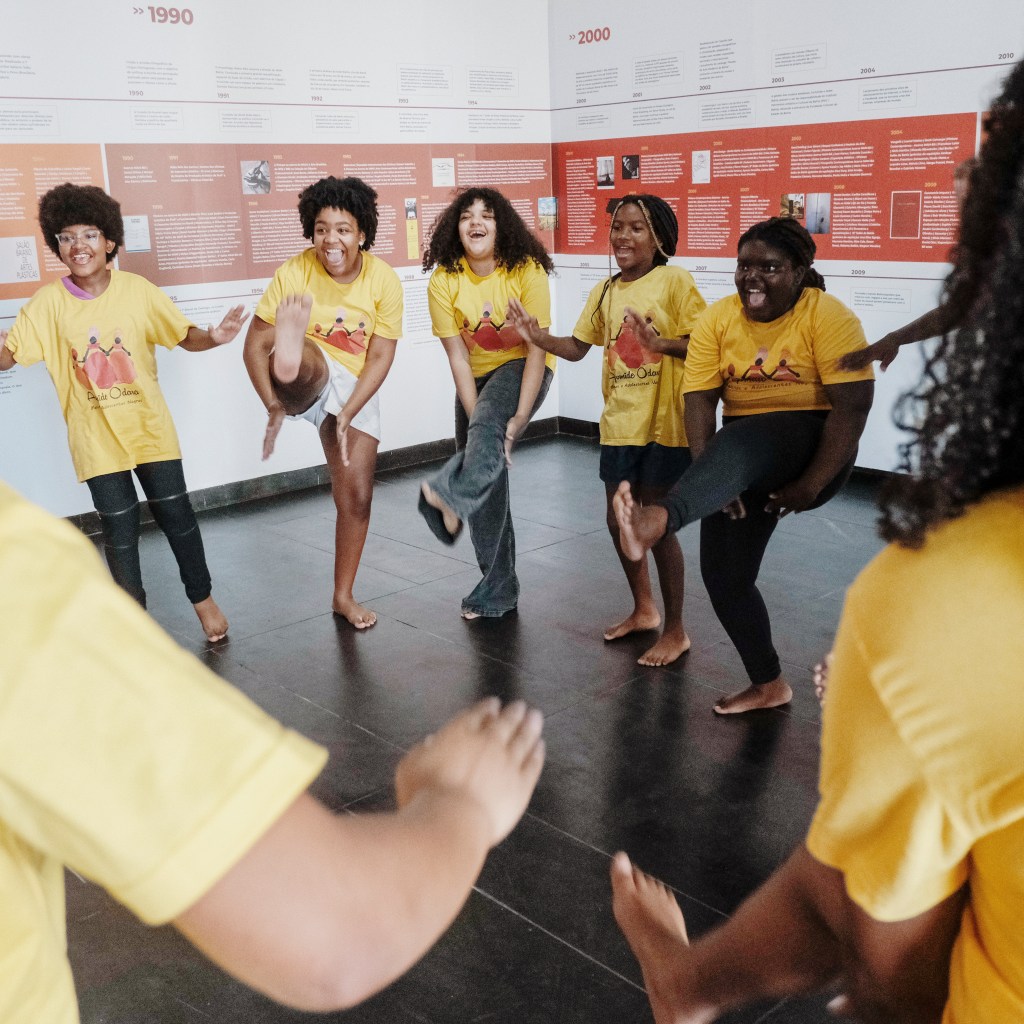
Ayomidês take part in weekly educational sessions where they explore subjects like education and ethnic-racial relations. The girls are encouraged to find their own voices by producing Instagram lives, social media videos, and by participating in public panels. Already, the Ayomidês are rewriting the narrative on what’s possible for Afro-Brazilian girls to achieve. One of the earliest Ayomidês, a young woman named Debora, is now a communications intern. Another former Ayomidê, Francine, works at UNICEF, helping train the next generation of adolescent leaders. And Julia has already set her sights on becoming a math teacher or a model.
“These are generations of Black women who did not have access to a school,” Naiara says. “These are generations of Black women robbed daily of their dreams. And we’re telling them that they could be the generation in their family to write a new story.”
Mama Habiba is reframing the conversation in Nigeria
Centre for Girls' Education, Nigeria. Captured by James Roh for Pura
In Mama Habiba’s home country of Nigeria, the scents of starfruit, ylang ylang and pineapple, all incorporated into the Pura x Malala Collection’s “Nigeria: Hope for Tomorrow,” can be found throughout the vibrant markets. Like these native scents, Mama Habiba says that the Nigerian girls are also bright and passionate, but too often they are forced to leave school long before their potential fully blooms.
“Some of these schools are very far, and there is an issue of quality, too,” Mama Habiba says. “Most parents find out when their children are in school, the girls are not learning. So why allow them to continue?”
When girls drop out of secondary school, marriage is often the alternative. In Nigeria, one in three girls is married before the age of 18. When this happens, girls are unable to fulfill their potential, and their families and communities lose out on the social, health and economic benefits.
Completing secondary school delays marriage, and according to UNESCO, educated girls become women who raise healthier children, lift their families out of poverty and contribute to more peaceful, resilient communities.
Centre for Girls’ Education, Nigeria. Captured by James Roh for Pura
To encourage young girls to stay in school, the Centre for Girls’ Education, a nonprofit in Nigeria founded by Mama Habiba and supported by Malala Fund and Pura, has pioneered an initiative that’s similar to the Ayomidê workshops in Brazil: safe spaces. Here, girls meet regularly to learn literacy, numeracy, and other issues like reproductive health. These safe spaces also provide an opportunity for the girls to role-play and learn to advocate for themselves, develop their self-image, and practice conversations with others about their values, education being one of them. In safe spaces, Mama Habiba says, girls start to understand “who she is, and that she is a girl who has value. She has the right to negotiate with her parents on what she really feels or wants.”
“When girls are educated, they can unlock so many opportunities,” Mama Habiba says. “It will help the economy of the country. It will boost so many opportunities for the country. If they are given the opportunity, I think the sky is not the limit. It is the starting point for every girl.”
From parades, film screenings to safe spaces and educational programs, girls and local leaders are working hard to strengthen the quality, safety and accessibility of education and overcome systemic challenges. They are encouraging courageous behavior and reminding us all that education is freedom.
Experience the Pura x Malala Fund Collection here, and connect with the stories of real girls leading change across the globe.
Here’s something we all know but rarely think about: 75% of the human body is made up of water. Essentially, we’re water balloons with legs, or whatever the heck Flubber was.
But what if you’ve been drinking water, that sweet elixir of life, all wrong? Or, at the very least, ineffectively? Just as every plant has its ideal growing conditions, according to doctors and medical professionals, the temperature of the water we drink matters a lot more than you might think.
Room-temperature, ice-cold and straight from the fridge, slightly warm for no reason at all: when it comes to drinking water, everyone has their own unique methods of getting the job done. But while we continue to chug our preferred water temperatures without question, we might be missing out on some serious health benefits—or even causing ourselves unnecessary discomfort.
Medical experts have discovered that water temperature, when used at the right time, can significantly improve your wellbeing, affecting everything from how we digest our food to how well we perform during workouts. All water hydrates, but the temperature at which you drink it can make all the difference.
Room-temperature water is your digestive system’s best friend
Good morning! Many dieticians and wellness experts recommend drinking room-temperature water (about 68°F) first thing in the morning to gently activate your gastrointestinal tract (It also promotes regular bowel movements, FYI). This gentle approach is often referred to as “Japanese water therapy,” and encourages sipping 4-5 glasses (about ¾-cup each) upon waking then waiting 45 minutes before breakfast. It’s also great for everyday hydration, since room-temperature water is often easier to gulp.
Why it works
“In Chinese medicine we advocate drinking warm water because of its effect on the digestive system,” Dr. Jill Blakeway, a licensed doctor of acupuncture and Chinese medicine, explains. “Drinking cold water can congeal the fats in food and because of that can make the digestive system sluggish.”
Your body absorbs room-temperature water more easily, causing minimal disruption to the digestive system, making it the go-to option for sensitive stomachs.
Ice-cold water is perfect for workouts and hot days
This one is for the athletes and fitness gurus: Cold water (around 41°F from the fridge or 60°F from the tap) is your new best friend. Like a refreshing summer breeze, cold water has a natural way of cooling the body down during or after an exercise. It also gives your metabolism a tiny boost: according to research, your body expends about five calories per ounce of ice while warming the water to body temperature.
Why it works
Studies show that drinking cold water triggers a special reflex that helps you to stop sweating sooner, effectively lowering your core temperature and enhancing overall performance.
“It turns out that sweating stops before fluid can completely be incorporated into the body,” says gastroenterologist Dr. Brian Weiner. “There’s some kind of reflex that acknowledges liquid intake, and studies have shown that it kicks in more at the cold tap water level.”
Hot water (130-160°F) can be incredibly soothing when you’re under the weather. So, if you’re feeling congested or battling a sore throat, a nice mug of hot water might be just what the doctor ordered. A 2008 study found that hot drinks work like a natural remedy, providing quick, lasting relief from runny noses, coughing, sore throats, and fatigue.
Why it works
Like a warm summer rain, hot water creates steam that helps clear sinus congestion, while its pacifying warmth relaxes the gastrointestinal and digestive muscles. In fact, a small study showed that warm water worked wonders for patients recovering from surgery, improving their comfort and digestive health.
Warm or hot water can also literally melt away stress, as long as temperatures are kept comfortably warm: water above 160°F can scald your esophagus or damage your taste buds.
Migraines. Do not drink cold water! Research from 2001 found that the refreshing drink can trigger—or even exacerbate—headaches in those who are already prone to them.
Achalasia. If your esophagus is compromised, cold water can worsen symptoms. Try swapping in warm water instead, which can help soothe and relax the lower esophageal sphincter.
Hot, sweaty days. Surprisingly, despite what old wives’ tales might say, warm water can actually make you feel less thirsty, which registered dietician Vanessa Rissetto warns “can be dangerous on days when your body is losing water through sweating to try to keep cool.”
We all know drinking water is important, but just as a garden thrives with the right care at the right time, you can optimize and customize that all-essential water you drink throughout the day. Whether that’s out of a Stanley tumbler, Owala water bottle, or Yeti flask, is up to you.
This article originally appeared last year. It has been updated.
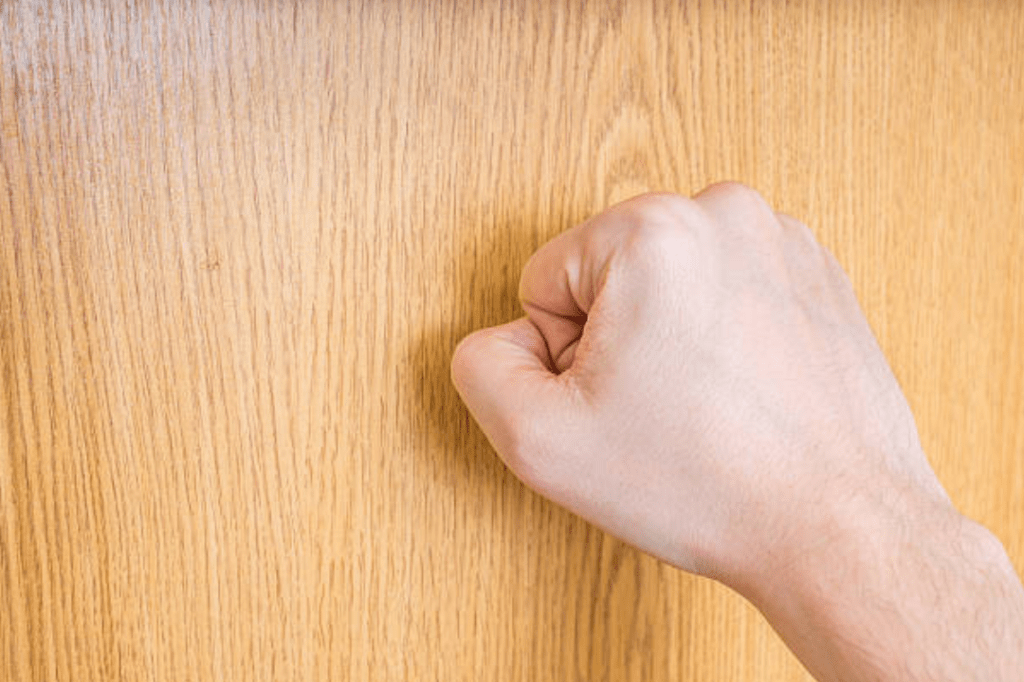
You’re having a great week. No mishaps, no drama, no unexpected bills. “I’m on top of the world!” you shout out loud. Then, suddenly, your hand shoots out to the nearest wooden surface. Your knuckles rap on it a few times, and you didn’t even think about it. What was that?
Sixty percent of Americans “knock on wood,” according to a 2015 60 Minutes/Vanity Fair poll. Most do it almost automatically. But where does the habit come from?
It’s compulsory. Many don’t think before they knock on wood. Photo credit: Canva
It seems like everyone has a different answer. Ask a group of people, and you’ll get a mix of shrugs, half-remembered myths, and a few confident answers based on a big pile of nothing.
The honest truth: nobody knows for sure. What we do have, however, are a few compelling theories, a paper trail leading back to the 19th century, and fascinating science that explains why we keep doing it—even when we don’t believe in it.
“Knock on wood” or “Touch wood?” Depends on where you live
In the United States, we knock. In the United Kingdom, they touch. Both phrases describe rapping knuckles on wood after saying something hopeful—and they mean the same thing: don’t tempt fate.
Ever heard someone in Britain say “Touch wood!” after hoping for good luck? It’s the UK equivalent of “knock on wood” in other countries. People say it (and sometimes literally touch a wooden object) to avoid jinxing something they want to happen. For example: “The weather’s been perfect all week, touch wood it stays like this for the weekend.” “I’ve never had a speeding ticket, touch wood.” It’s one of those little British superstitions you’ll hear everywhere, from pubs to workplaces. #Johnsenglishpage#learnenglish#learnenglishwithus#englishtutor#englishlessons#englishtips#naturalenglish#englishlanguage#englishlearning#studiareinglese
What do all these diverse customs have in common, and what do they reveal about human nature?
The ancient tree spirit theory (and why scholars don’t like it)
The most romantic explanation traces the phrase “knock on wood” back to pre-Christian pagan traditions. This theory suggests that ancient Celtic and Indo-European cultures believed trees were inhabited by spirits or minor gods, especially oak, ash, and hazel. Knocking on a tree trunk could awaken those spirits to ask for protection, show gratitude for good luck, or drive away malevolent forces lurking in the woods.
It’s a beautiful story. Sacred groves existed across ancient Europe, serving as meeting places between people and the divine. The Druids worshipped the oak. The Scandinavians based their entire cosmology on the ash tree, Yggdrasil. The Germanic Norns—three fate-weaving goddesses—directed destiny through the World Tree itself.
But there’s a problem. As folklorists Jacqueline Simpson and Steve Roud note in A Dictionary of English Folklore, there’s no direct evidence linking these ancient traditions to the modern “knock on wood” superstition. More than a thousand years passed between Europe’s Christianization and the first recorded mention of touching wood. This long interval suggests the practice wasn’t passed down continuously.
🌿 D R Y A D S 🌿 We have all knocked on wood to ward off bad luck, or to prevent something we said from becoming true. But where does this superstition come from? Well the most widely accepted explanation dates back to ancient pagan cultures such as the Celts, who believed that tree spirits known as Dryads resided in trees. A Dryad is a tree spirit, an elf-like tree entity whose life force was connected to the tree. The Celtic people revered trees, and saw them as powerful living beings who played a large role in Celtic culture. Each tree has its own magic, wisdom and sacred meaning. ✨ It was thought that knocking on wood was a way to rouse the tree spirit and ask it for protection, to ward off bad luck, or to show gratitude for good luck. Druids, witches and wise women carried small carved pieces of certain trees around with them which are said to host a resident Dryad, creating a moveable protection token. These would have been in the shapes of wands or staffs. Ordinary folk also would have also carried these, however they might not have been carved for the same ritualistic purpose, but for straightforward protection. 🌿 To create your own talisman you must first go to a sacred space such as an old grove, leyline, sacred spring or site, and find a tree just as the setting or rising sun strikes light upon its trunk. 🌿 From there connect with the tree, ask it for its protection and inform the Dryad of your intentions, as arrogantly cutting off a branch without first asking will anger the spirit. 🌿 From there you can transform your piece of Livewood into a wand, staff, or Ogham stave. You can add pieces on to it such as precious gems, stones, feathers, leather etc. If you have followed the ritual correctly you will end up with a powerful protection token which can be used in meditations, divinations and rituals. . . . . #Dryads#treespirits#treewisdom#treelore#celticfolklore#celtictraditions#celticotherworld#celticgods#celticgoddesses#celticmythology#paganism#paganculture#paganworship#natureworship#pagantraditions#naturegods#naturegoddess#sacredspace#sacredearth#sacredplace
The earliest known written reference to “touch wood” as a superstitious practice appears in Ballads in the Cumberland Dialect, published in 1805 by R. Anderson. Folklorists connect it to a game called “Tiggy Touchwood,” a form of tag in which players were safe from being caught as long as they touched something wooden, such as a door, a fence, or a tree. Touching wood meant you were protected.
“Given that the game was concerned with ‘protection,’ and was well known to adults and children, it is almost certainly the origin of our superstitious practice of saying, ‘touch wood.’ The claim that it goes back to tree spirits is complete nonsense.”
Religious and historical theories
Although the game theory has the strongest evidence, it’s worth knowing the other stories in circulation.
Could the reason why we “knock on wood” come from religious backgrounds? Photo credit: Canva
The Christian Cross Theory suggests that knocking on wood invokes the protective power of Christ’s crucifixion. While religious relics like the True Cross were cherished for their supposed protective powers, this theory mainly explains how the custom may have been reinterpreted through a Christian lens rather than its original genesis. Scholars point to the lack of medieval records linking this idea to superstition, suggesting it is likely a later adaptation tied to seeking divine protection.
The Jewish Persecution Theory, another proposed origin, links wood-knocking to coded signals allegedly used by Jewish communities to signal safe passage during the Spanish Inquisition. While this theory points to another possible protective motivation for the ritual, it’s difficult to verify and appears less frequently in academic literature. Its inclusion illustrates the wide range of narratives people have constructed to make sense of the custom.
The Miners and Sailors Theory points to a more practical foundation: knocking on wooden beams to test their stability, which by extension may have led to a superstition about safety. Similarly, sailors knocked on deck wood for good fortune at sea. Together, these theories suggest how everyday safety rituals could evolve into superstition—even when direct documentation is limited.
Why our brains keep doing it anyway
This is where the science gets truly fascinating. Even people who recognize the habit as irrational still engage in it. And there’s a solid reason why—one that has nothing to do with tree spirits or sacred crosses.
Jane Risen, a behavioral science professor at the University of Chicago, has spent years exploring this very contradiction. In a 2016 article in Psychological Review, she found that individuals can recognize a belief as irrational in real time yet still choose not to challenge it—a phenomenon she terms “acquiescence.” As she explained:
“We see people maintaining these beliefs that they themselves acknowledge are irrational. They’ll say, ‘I know it’s crazy, but I’m going to do this.’ We have [these beliefs] because they’re the output of pretty basic cognitive processes.”
Two systems drive human thinking. The fast, intuitive one makes judgments before the slower, more deliberate system can catch up. As Risen explained, “Detecting an error in your intuitive belief doesn’t necessarily lead you to correcting it. It seems that some intuitions are just very difficult to shake.”
But that’s not all. Researchers at the University of Chicago Booth School of Business published a 2013 study in the Journal of Experimental Psychology finding that the physical motion of knocking on wood is just as important as the saying itself.
There are psychological aspects to why we knock on wood. Photo credit: Canva
Here’s what the study found: participants who knocked downward—pushing force away from themselves—felt a bad outcome was less likely than those who knocked upward or simply held an object. The study suggests this outward physical motion creates a feeling of pushing bad luck away. Rituals like spitting or throwing salt may work the same way.
There’s an emotional payoff, too. “These beliefs and behaviors actually do end up regulating your emotions,” Risen told Discover magazine. “When you knock on wood, you may worry about this less.”
Jacqueline Woolley, a psychologist at the University of Texas at Austin, found that superstitious beliefs are most prevalent around ages five and six, before skepticism begins to develop. Meanwhile, Nadia Brashier, a researcher at Harvard University, observed that adults around age 70 tend to be less superstitious than those around age 19, as accumulated life experience typically reshapes the brain’s understanding of cause and effect.
The meaning behind the knock
Here’s what the research and folklore actually agree on: the phrase “knock on wood” is almost certainly not thousands of years old. Its documented history dates back to the 19th century, likely rooted in a children’s game of tag. The pagan, Christian, and persecution theories make for interesting stories, but none have the same weight of supporting evidence.
What holds up the tradition is psychology. Whether the gesture started with a game of Tiggy Touchwood, a fragment of the True Cross, or a coded knock on a synagogue door, it endures today because of how the human brain functions. We’re wired to seek some control over what we cannot control. A small physical act—touching something solid, directing force away from the body—provides that sense of comfort, even if only for a moment.
The next time your hand reaches for the nearest table after saying something hopeful, you don’t need to feel embarrassed. You’re doing something humans have practiced across cultures for at least two centuries, probably longer. Call it a habit, call it superstition, call it a small act of hope. Whatever you call it, the impulse remains the same: to hold on, just for a moment, to the good things in front of you.
Humans have devised many ways of measuring things in an attempt to learn more about our world, including numerical systems that help get us all on the same page. But we haven’t always agreed. The ongoing battle between the imperial and metric systems demonstrates the challenge of standardizing measurement. As most of the world uses the base-10 metric system, the United States remains the primary imperial holdout.
But one thing we agree on is how we measure time, or at least how we measure hours and seconds. And oddly enough, it’s not using the metric system. Why is that? How did we decide to split days into 60-minute hours and 60-second minutes instead of splitting them into, say, hundredths?
Why 60-minute hours and 60-second minutes? Photo credit: Canva
Why there are 24 hours in a day
Let’s start with how we got the 24-hour day. We measure time, in general, by years using the Earth’s full orbit of the sun. But we could really split that year up any way we choose. The rising and setting of the sun gives us a framework for days, so that’s a helpful divisor. However, daylight length varies greatly from place to place and from season to season. So how did we land on 24 hours in a day?
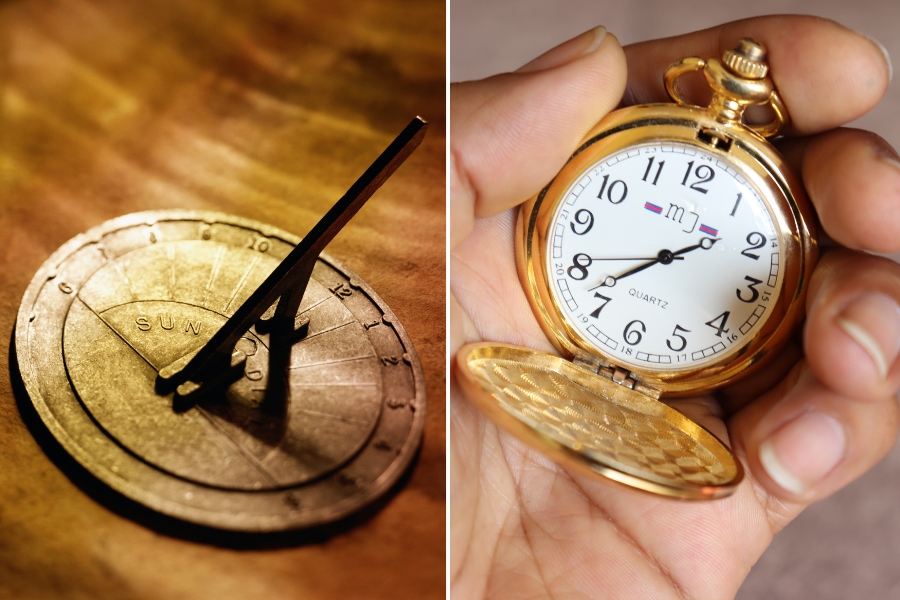
We have the ancient Egyptians, Babylonians, and Greeks—and their affinity for duodecimals (counting by 12)—to thank for that. They each had a way of breaking light and dark hours into 12 parts each, giving us a 24-part day. However, those 12 parts were not measured equally.
The way we organise time is strange.
365 days in a year, 12 months (of 31, 30, 28, or sometimes 29 days), 52 weeks, 7 days in a week, 24 hours in a day, 60 minutes in an hour, and 60 seconds in a minute.
“The concept of fixed-length hours, however, did not originate until the Hellenistic period, when Greek astronomers began using such a system for their theoretical calculations. Hipparchus, whose work primarily took place between 147 and 127 B.C., proposed dividing the day into 24 equinoctial hours, based on the 12 hours of daylight and 12 hours of darkness observed on equinox days. Despite this suggestion, laypeople continued to use seasonally varying hours for many centuries. (Hours of fixed length became commonplace only after mechanical clocks first appeared in Europe during the 14th century.)”
Why there are 60 minutes in an hour
Oddly enough, the need for a standard way to divide 12-hour days and nights into smaller parts led us back to ancient times once again. The Babylonians used a sexagesimal (base-60) system to make astronomical calculations, which they had inherited from the Sumerians, who used it around 2000 B.C.
What makes 60 special? With 12 divisors (1, 2, 3, 4, 5, 6, 10, 12, 15, 20, 30, 60), it can be evenly divided in more ways than any other number up to and including 100, which has only nine divisors.
Fun fact: every time you look at a clock, you are using a 4,000 year old idea. The reason we have 60 seconds in a minute and 60 minutes in an hour comes from ancient Babylonian mathematics, not modern science.
Using that system, Greek astronomer Eratosthenes (276 to 194 B.C.) divided a circle into 60 parts to measure latitude. Hippocrates honed this sexagesimal (base-60) system by adding in longitude a century later. Ptolemy later improved those measurements, subdividing the 360 degrees of latitude and longitude into smaller parts.
The first 60 parts became known as partes minutae primae, or “minutes.” The second division of 60 became partes minutae secundae, or “second minute” (what we now call seconds).
Minutes and seconds were first used in geography, not time measurement. Photo credit: Canva
Those minutes and seconds were used for measuring latitude and longitude, not time, but a circle is a circle. The very first round clock displays divided hours into halves, thirds, quarters, and even twelfths, but not sixtieths. The 60-minute hour didn’t become popularized until minutes were put on mechanical clocks at the end of the 16th century. The spread of the Gregorian calendar around that time also helped universalize how humans measured time, but countless questions remained about the precision of timekeeping.
Exactly how long is a second?
After all, how long is a second exactly? We can measure it as a division of larger units of time, but on its own, how do we determine a standard for it? Precision and standardization in timekeeping became more and more important as things like train travel, where people had to know what time a train would arrive or depart, became more common.
That happened in 1967, when researchers gathered at the 13th General Conference of the International Committee for Weights and Measures. Among other things, they debated which element to use as the standard for atomic clocks. Ultimately, they landed on Cesium-133, which had been used in atomic clock research since the 1950s.
The video above explains exactly how and why scientists chose that element and made the calculation, but the result was that a second became formally defined as exactly 9,192,631,770 ticks of a Cesium-133 atom.
That may be far more than you ever wanted to know about time measurement. But isn’t it fascinating how a combination of ancient wisdom and modern technology gave us 60-minute hours and clocks that can tell us, down to the second, what time it is anywhere in the world? Aren’t humans amazing?
Shower liners are like any other piece of fabric; they need to be washed. As people become more environmentally conscious, fewer plastic shower liners are ending up in the trash. Instead, people have been investing a few extra dollars into reusable shower liners, but are finding that the dreaded orange stain is still showing up after a washing.
The orange stain seems to start creeping up, not long after hanging the bright white liner behind your shower curtain. What is this stain, and how can you get it out without having to replace the entire liner? According to experts, the orange stain can be caused by different things, but ruling out dye from a shower curtain, the likely culprits are hard water or bacteria.
“If you live in an area prone to hard water, then there’s a good chance that the orange stains in your shower curtains are caused by mineral buildup,” Allie Ogletree writes for Angi before later sharing the other culprit. “If your shower curtains are orange and slimy, then bacteria called Serratia marcescens could be the reason behind your orange shower curtains.”
While hard water is more of an annoyance than a health hazard, an orange stain caused by bacteria may be a bigger concern, making it a priority to keep it off your shower liner.
The Cleveland Clinic notes that this particular bacteria, often found on shower curtains, can cause unpleasant health issues. They write, “Serratia marcescens is bacteria that sometimes causes infections, including UTIs and pneumonia. You’re at higher risk for infection if you’re in the hospital or at a long-term care facility, have a weakened immune system or a medical device in your body. S. marcescens can be hard to treat because it’s often resistant to many antibiotics.”
Tossing the shower curtain into the washer may kill the bacteria, but it doesn’t always get the stain out. Cleaning experts have a solution.
Spray down the orange parts of the liner with an enzyme stain remover spray, then soak it in OxyClean and scrub with a soft brush. Once the first few steps are done, toss it in the washing machine with a half cup of baking soda. When the washer reaches the rinse cycle, add a half cup of vinegar. According to Real Simple, following these steps will have your shower liner looking good as new.
If you have a plastic liner, you can wash it by hand and skip a few of the steps, but you may still want to scrub any residue off with a scrub brush. Cleaning enthusiast Jeneva Aaron tells Real Simple, “You can soak a plastic liner in a baking soda and vinegar solution to remove soap residue.”
Going back to basics just may be what works. Angi touts using a simple vinegar and water mixture on the stain, allowing it to sit for 15 minutes before scrubbing, which can do the job. But you can take it one step further by adding baking soda to a few drops of white vinegar to create a paste to spread onto the grime, then scrub off.
According to the experts at Angi, “If your shower curtain still has discoloration after cleaning it, you can toss the shower curtain in the washing machine on the delicate setting to try to remove any remaining bacteria and then soak it in bleach to remove the orange. Just be sure to wear PPE, have good ventilation, and avoid mixing bleach and vinegar, as this creates a hazardous gas.”
One of the reasons bacteria builds up is due to the moisture in the bathroom, so ventilating the bathroom will help cut down on how often the liner needs to be washed. In addition to ventilating the bathroom, close the shower curtain and place it on the outside of the bathtub where it’s dry. Closing the shower curtain after getting out of the shower will allow the liner to dry completely, as it will not be folded onto itself.
Surprisingly, there’s no need to wash the shower liner weekly to aid in keeping the bacteria from discoloring it. Cleaning experts at Real Simple say that a fabric shower curtain should be washed once every three months, as long as a shower liner is used. The liner should be washed monthly to interrupt bacterial growth.