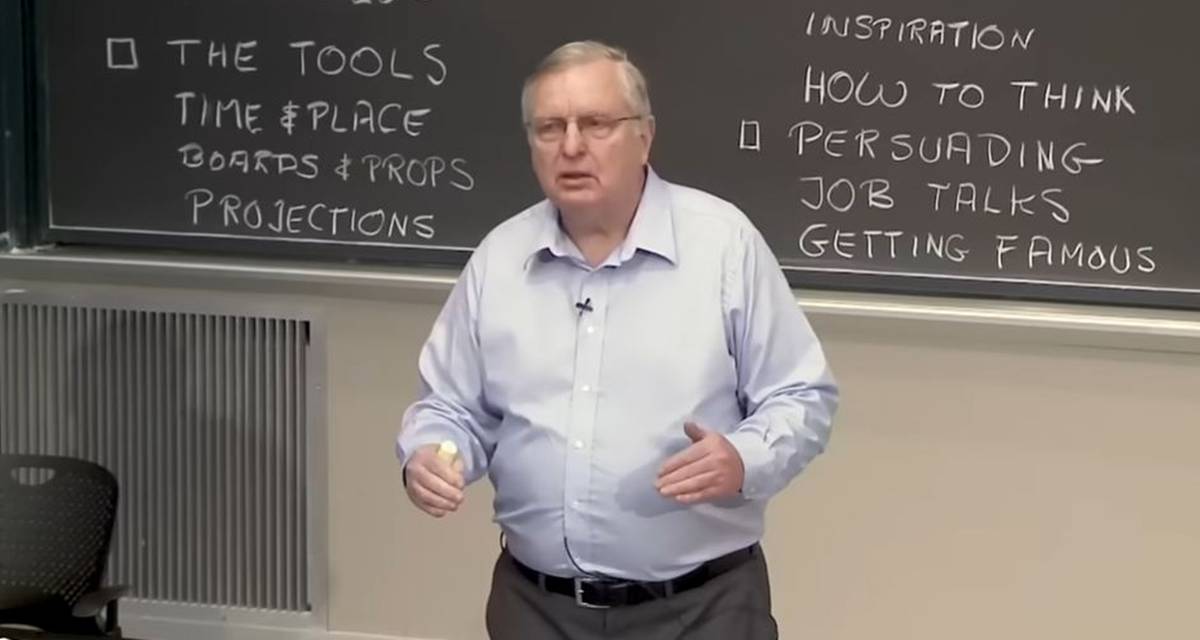
Patrick Winston was a professor at the Massachusetts Institute of Technology who specialized in artificial intelligence and human story comprehension for nearly 50 years. He taught from 1972 until his passing in 2019. For over 40 years, he gave an annual speech on the same topic to packed lecture halls: “How to Speak.”
The speech became incredibly popular and was always greeted with packed lecture halls. “The crowd was literally at capacity. Every seat filled. Every step filled. The ground surrounding the podium filled. And a crowd spilling out into the hallway straining to hear,” author Cal Newport wrote about attending the speech in 2008.
The speech covers the art of public speaking, specifically in lectures and presentations. Over the years, the speech grew to cover additional public speaking situations students and faculty would have to navigate. “There is much more now, of course, because I keep learning new things,” Winston said, according to MIT. “I’ve added techniques for passing oral exams, delivering successful job-interview talks, and ensuring that ideas become as famous as they ought to be.”
You can watch a 2018 recording ot the speech here:
Here are five of the most important takeaways from Winston’s speech:
1. Have a strong opening
Winston opens his speech by illustrating the importance of knowing how to communicate using a life-or-death metaphor.
“The Uniform Code of Military Justice specifies court-martial for any officer who sends a soldier into battle without a weapon. There ought to be a similar protection for students because students shouldn’t go out into life without the ability to communicate, and that’s because your success in life will be determined largely by your ability to speak, your ability to write, and the quality of your ideas, in that order,” Winston said.
He then advises ending your opening with a promise to the audience: “By the end of the next 60 minutes, you’ll have been exposed to a lot of ideas, some of which you’ll incorporate into your own repertoire, and they will ensure that you get the maximum opportunity to have your ideas valued and accepted by the people you speak with.”
2. Say it 3 times
Winston knows that it’s impossible to ask anyone to pay attention to an entire presentation. So, given his understanding of human nature, he said it’s best to repeat the same ideas a few times: “… at any given moment, about 20% of you will be fogged out no matter what the lecture is. So if you want to ensure that the probability that everybody gets it is high, you need to say it three times.”
3. Use props
Winston believes that using props on stage activates part of the audience’s mind.
“I’ll give you my lunatic fringe view on this. It has to do with what I would call empathetic mirroring. When you’re sitting up there watching me write on the board, all those little mirror neurons in your head, I believe, become actuated, and you can feel yourself writing on the blackboard,” Winston said.
4. How to inspire people
Over Winston’s decades of experience, he’s learned that if you want to inspire people, there is no magic bullet. You have to consider the audience. “What I found from the incoming freshmen is that they were inspired by some high school teacher who told them they could do it,” Winston continues. “What I found in the senior faculty, they were inspired by someone who helped them see a problem in a new way. And what I saw from everyone is that they were inspired when someone exhibited passion about what they were doing.”

5. End with a joke and a salute
Winston says to end with a joke based on a colleague’s advice. “I always finish with a joke, and that way, people think they’ve had fun the whole time,” the colleague said. Winston also advises against saying “thank you” at the end of a speech. “When you say thank you, even worse, thank you for listening, it suggests that everybody has stayed that long out of politeness and that they had a profound desire to be somewhere else,” he said.
Instead, Winston says to salute the people you were able to speak to or the institution that invited you. “So I could say, ‘Well, it’s been great fun being here. It’s been fascinating to see what you folks are doing here at MIT. I’ve been much stimulated and provoked by the kinds of questions you’ve been asking, it’s been really great. And I look forward to coming back on many occasions in the future.’ So that salutes the audience. You can do that.”
Sadly, after Winston passed away in 2019, the tradition of the “How to Speak” lecture ended as well. The good news is that the university saved the lecture for posterity and allows everyone to see it and share it through its OpenCourseware program.