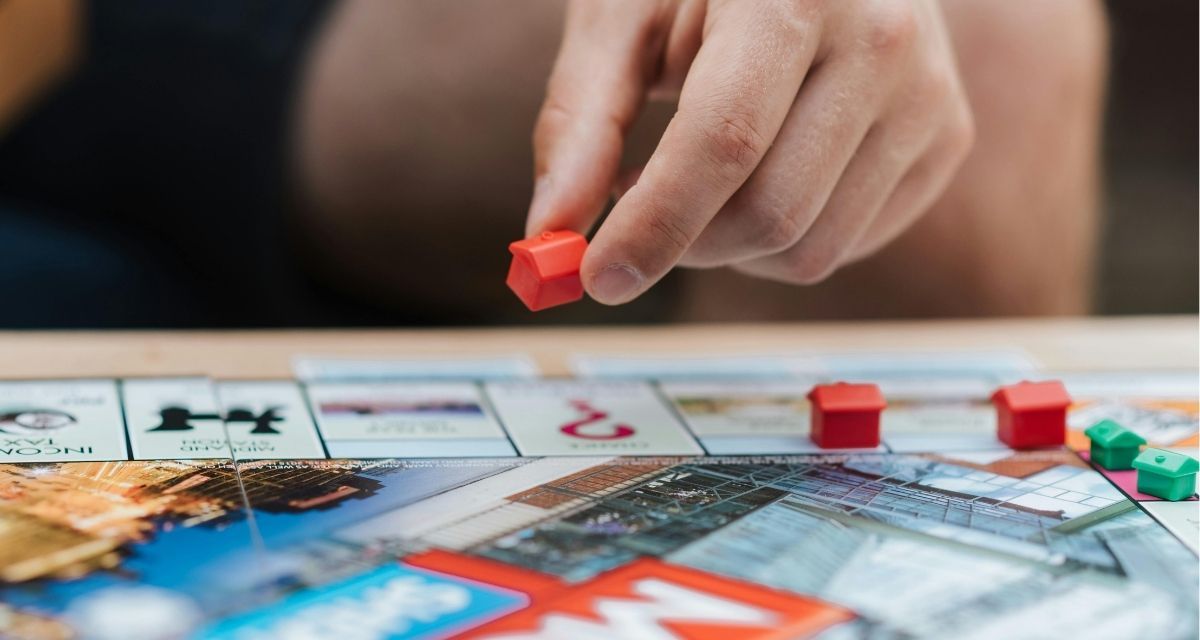
Anyone who’s played Monopoly knows how it usually goes: what starts as a fun game inevitably turns into an endless slog until everyone agrees to declare someone the winner. As it turns out, we’ve brought this agony on ourselves by not actually following the official Monopoly game rules.
A YouTuber who goes by @sblga explains says that, despite following all kinds of made-up “house rules,” most of us neglect one simple, official Monopoly rule that makes the game go much faster. It’s known as the “auction rule,” and it’s literally a game-changer.
(By the way, he also shares the game’s absolutely wild history, which is definitely worth sticking around for.)
How the ‘auction rule’ in Monopoly changes the game
Several scenarios can trigger the auction rule. The primary rule, however, is that when a player lands on a property and doesn’t want to (or can’t) buy it, the property immediately goes up for auction, and all players can bid on it.
There is no minimum bid, so bidding can start at just $1. Theoretically, if a player lands on Boardwalk and doesn’t buy it, another player (or even that original player) could nab it for far less than its $400 value through a bidding war. Players flush with cash can create monopolies simply by outbidding their opponents.
This rule means properties get picked up much more quickly, so the game doesn’t stall. It also forces players to strategize differently with their property purchases and money management. Can you imagine playing a full game of Monopoly in 30 minutes and having someone actually win? It’s possible with the auction rule. Who knew?

Monopoly ‘house rules’ ease the game’s ruthlessness
So if the auction rule has always been part of the standard game rules, why don’t more people use it?
Theories abound, but one big one is that most people just don’t read the official rules. Gameplay often gets passed down by family and friends, and for Monopoly in particular, “house rules” often trump official rules.
Some popular Monopoly house rules include:
- Free Parking jackpot, in which all tax payments go to the center of the board instead of to the bank. When someone lands on Free Parking, they collect the jackpot.
- Double salary landing on GO.
- First-lap immunity, meaning no one can buy property on their first lap around the board.
- No rent in jail, meaning if a player is in jail, they cannot collect rent when other players land on their properties.
People may not even realize that house rules aren’t standard. Someone likely eliminated the auction rule at some point to slow the game’s pace and/or reduce its brutality, and it spread and stuck.
What’s interesting about Monopoly house rules is that they often ease the game’s ruthlessness, which is ironic, considering why the game was created in the first place.
Monopoly’s origin story: A caution against unbridled capitalism
In January of 1904, a woman named Lizzie Magie patented a game called the Landlord’s Game. The game had two sets of rules: one used a single land tax and distributed wealth among players, resulting in a collective win, and the other let players build monopolies and ruthlessly fleece opponents.
It was meant to be a lesson, an indictment of unbridled capitalism. However, a heater salesman named Charles Darrow took a particular liking to the game and its monopoly rules. Without crediting the Landlord’s Game, Darrow created Monopoly as we know it and sold it to Parker Brothers.
“What Magie intended as a forecast of disaster became Monopoly’s sole objective,” Public Domain Review notes. A criticism of greed and power imbalance became a celebration of free-market capitalism. In 1935, Parker Brothers bought Magie’s patent for $500 and no royalties. Meanwhile, Darrow became a millionaire.
The tendency to add house rules to make Monopoly more fun and fair for everyone is a good sign. It may not be the original creators’ intention. Still, many prefer a “compassionate capitalism” version of the game (even if it does take five hours and no one really ever wins).