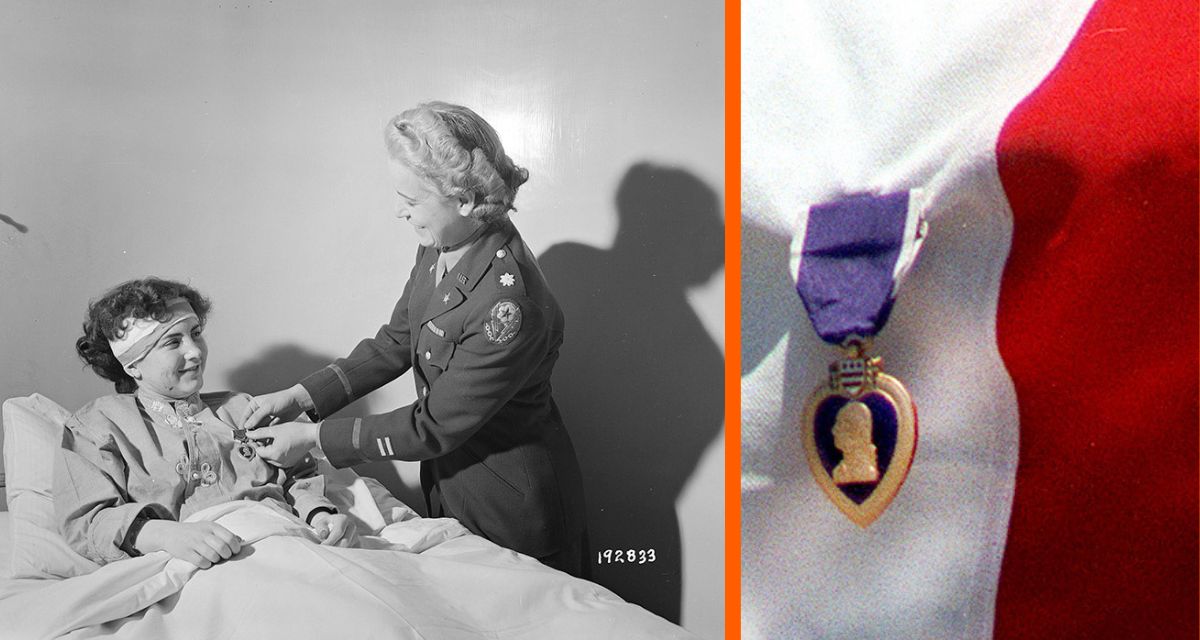
Every year on August 7, America honors its service members on Purple Heart Day. The Purple Heart is awarded to those who are injured or killed while serving in combat.
It’s an American military honor that was started by Gen. George Washington (the first president of the United States) during the Revolutionary War. It is also the oldest military decoration.
Since its creation, an estimated 1.9 million Purple Hearts have been awarded, according to the U.S. Department of Veterans Affairs.
Washington creates the Purple Heart
During the Revolutionary War, Washington was the commander in chief of the Continental Army. To honor his soldiers, he created the Badge of Military Merit (which was later renamed the Purple Heart).
Washington created it on August 7, 1782. It was announced in his Orders of the Day (per the National Archives):
“The General ever desirous to cherish a virtuous ambition in his soldiers, as well as to foster and encourage every species of Military Merit, directs that whenever any singularly meritorious action is performed, the author of it shall be permitted to wear . . . over his left breast, the figure of a heart in purple cloth. . . . Not only instances of unusual gallantry but also of extraordinary fidelity and essential service . . . shall be awarded.”
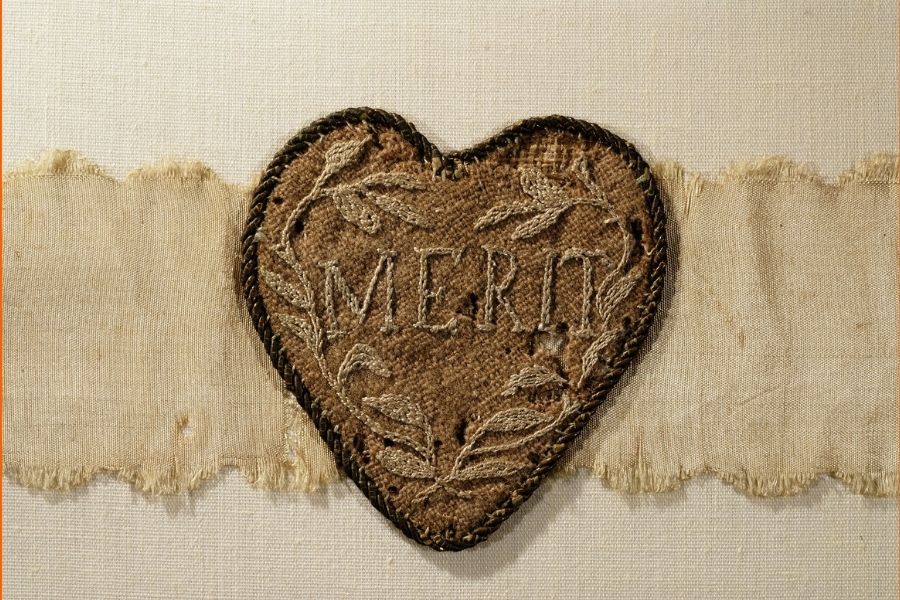
Photo credit: U.S. Department of War
Like the medal today, it was also purple and heart-shaped, but it was made of silk with a silver border and the word “MERIT” embroidered in silver, according to the Purple Heart Foundation.
He awarded it to three Continental Army soldiers: Sgt. Daniel Bissell, Sgt. William Brown, and Sgt. Elijah Churchill.
The Purple Heart is revived
After Washington created the Badge of Military Merit, it wasn’t used again until after World War I. Other famous military medals were created in the meantime, including the Army’s Distinguished Service Cross, the Navy Cross, and the Distinguished Service Medals awarded by both the Army and Navy.
However, military leaders saw a need for an award that would recognize service members of more junior rank. Gen. Douglas MacArthur, who became the Army chief of staff in 1930, took action to revive Washington’s award in honor of Washington’s 200th birthday.
The War Department announced in its General Orders No. 3 on February 22, 1932:
“The Purple Heart, established by General George Washington in 1782…awarded to persons who, while serving in the Army of the United States, perform any singularly meritorious act of extraordinary fidelity or essential service.”
It was retroactively awarded to servicemembers in World War I, as well as veterans of the Civil War, the Indian Wars, and the Spanish-American War. MacArthur originally intended for the Purple Heart not to be awarded posthumously. But that changed following the December 7, 1941, attack on Pearl Harbor.
Purple Heart criteria today
Since then, many changes have been enacted during various wars and under presidents including Franklin D. Roosevelt, John F. Kennedy, and Ronald Reagan.
The National Archives notes that “the Purple Heart may be awarded to any member of the Armed Forces of the United States who, while serving under competent authority in any capacity with one of the Armed Forces after April 5, 1917, is killed or wounded in any of the following circumstances:
- as the indirect result of enemy action (for example, injuries resulting from parachuting from a plane brought down by enemy or hostile fire).
- in action against an enemy of the United States,
- in action with an opposing armed force of a foreign country in which the Armed Forces of the United States are or have been engaged,
- while serving with friendly foreign forces engaged in an armed conflict against an opposing armed force in which the United States is not a belligerent party,
- as the result of an act of any such enemy or opposing armed force,
- as the result of an act of any hostile foreign force,
- as the result of friendly weapon fire while actively engaging the enemy, or
- as the indirect result of enemy action (for example, injuries resulting from parachuting from a plane brought down by enemy or hostile fire).”