
The rapid rise of artificial intelligence has many people across the globe worrying about whether they’ll lose their jobs. Leaders in the tech world have casually talked about doomsday scenarios involving a coming “job apocalypse” or a future in which no one will have a job. But, as history shows, just about every giant leap in technology has inspired nightmare scenarios that never came to fruition.
Those who fear the dark cloud of AI looming over their heads should take some solace in a quiet development at Ford Motor Company over the past three years. The company has slowly hired more than 350 veteran engineers, also known as “gray beards,” a mix of former employees and workers from suppliers, to address AI’s shortcomings.
AI can’t do much without ingesting human intelligence
“Artificial intelligence is a fantastic tool, but it’s only as good as the information you use to train it,” Charles Poon, vice president of vehicle hardware engineering at Ford, told The Guardian. “Over prior years, we didn’t pay as much attention as we should have to the experience of our most knowledgeable engineers that have been with us through many product cycles.”
Ford had installed 9,000 AI-powered cameras in its plants to detect quality issues and created automated tools for vehicle design. But AI tools are only as good as the information they’re fed, and the company failed to capture enough institutional knowledge before many senior engineers left the company.
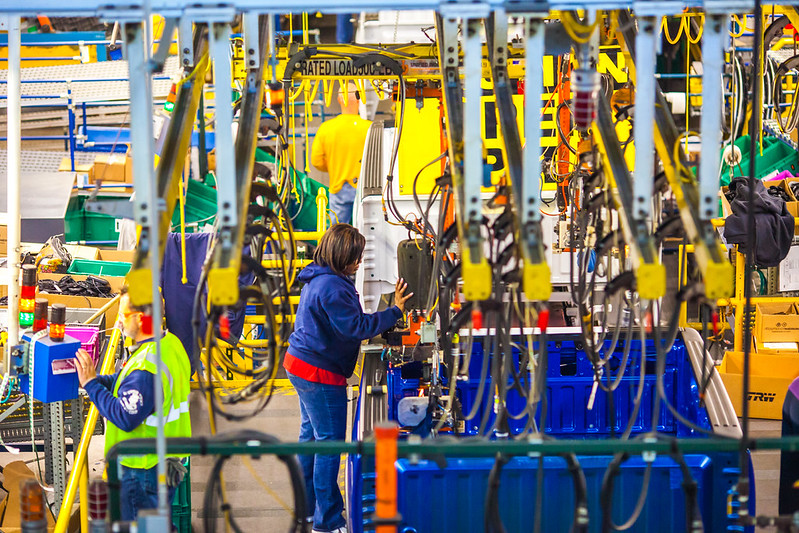
Photo credit: Thomas Hawk/Flickr
The AI failures cost the company “hundreds and hundreds of millions of dollars” in recalls and warranty costs. Ford says bringing back the engineers has resulted in $1 billion in cost savings in 2026.
“Mistakenly, we thought that by just introducing artificial intelligence and ingesting the design requirements that we had, that that would produce a high-quality product,” Poon said.
The company’s chief operating officer, Kumar Galhotra, said Ford had been “relying more and more on automated quality systems” that didn’t deliver. But the newly rehired specialists “hunt for failure points before a part ever reaches the plant floor.”
Tech columnist Joe Procopio believes that Ford won’t be the last company to re-embrace human labor after AI failures.
“Because Ford might be the first company to start calling back experienced technical talent—the first we know about, anyway—but it is far from the last BigCo that’s going to have to dial some numbers and have some awkward conversations across the spectrum of the organization,” Procopio wrote in an Inc. op-ed. “Big Tech leaders, you’ve got about three to nine months before these lessons hit everyone.”
That’s not the only positive news for the human labor market. PwC’s 2026 Global AI Jobs Barometer, which analyzed more than 1 billion job postings across 27 countries, found that the companies enjoying the biggest gains from AI aren’t doing so by eliminating positions. Instead, the report found that AI-driven growth led to more jobs. “Companies most able to use AI are seeing faster headcount growth than the least AI-exposed companies (52% vs. 36%) and higher wage growth (24% vs. 17%),” PwC said in its report.
It seems that Ford (and, if Procopio is right, many more companies) jumped the gun by embracing AI as a way to cut their labor forces, hoping the miracle technology could learn the job on the fly. Ford’s miscalculation isn’t just a misunderstanding of AI, but of history. It could be another example of Amara’s law, coined by futurist Roy Amara: “We tend to overestimate the effect of a technology in the short run and underestimate the effect in the long run.”