
Ever wonder why people 100 years ago died so much younger? It's these 14 reasons.
1796. That's when we invented vaccines.

Lifespans were shorter a century ago. Why?
An English doctor named Edward Jenner took incredible risks to try to rid his world of smallpox. Because of his efforts and the efforts of scientists like him, the only thing now standing between deadly diseases like the ones below and extinction are people who refuse to vaccinate their kids.
Unfortunately, because of the misinformation from the anti-vaccination movement, some of these diseases have trended up in a really bad way over the past several years.
Wellness involves a lot of personal choices and the tradeoff between personal liberty and shared public good.
Measles is the starkest example. In 2014, there were over 600 cases of measles in America during the first seven months of the year. According to the CDC, ten years later in 2024 there were 284 cases of measles nationwide. Though the numbers have improved in a decade, 89% of 2024's cases came from people who are unvaccinated or refused to share their vaccine status.
Anti-vaccination movements aren't new. Controversy, fear, and anti-vaccination rhetoric has plagued immunization efforts as far back as the early 1800s. Despite research conducted by the World Health Organization (WHO) showing that vaccines and immunization research has had a positive impact on global health, the anti-vaccination movements don't seem to be facing eradication any time soon.
The chart below was made by graphic designer Leon Farrant and uses data from the CDC and JAMA to show that vaccines have real public health benefits. Paired with decades of improved medical care, vaccines have nearly eradicated many formerly fatal illness like Polio, Measles, Malaria, and Diphtheria. The impact of one's personal health choices can have a significant impact on the population around them, in their communities, and even on a national level. It makes that trade-off all the more complicated and one not easily distilled into one convenient political or religious ideology.
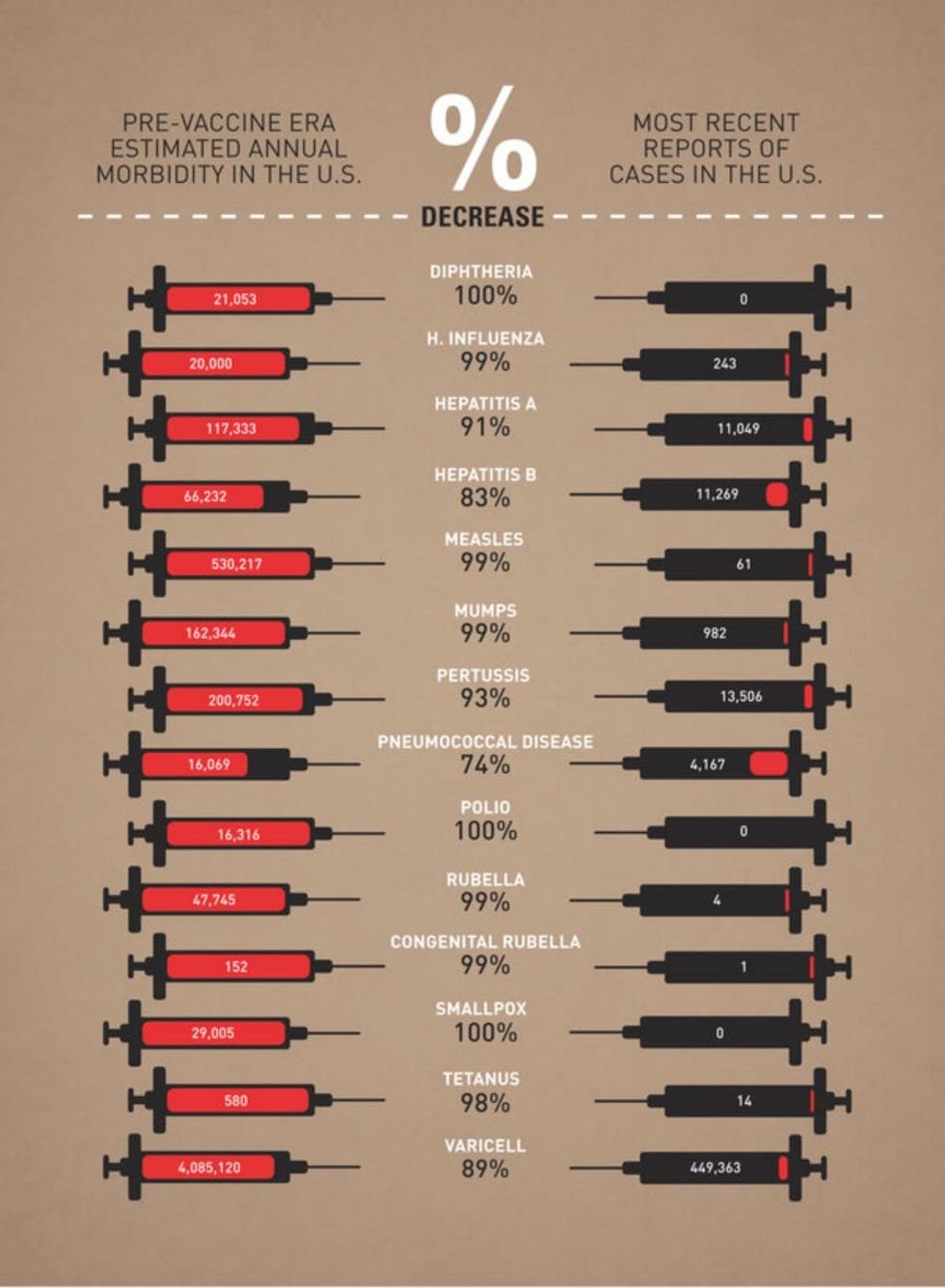
Obviously, the topic of vaccinations has become immensely more complicated and controversial over the years, especially since the onset of COVID-19 in 2020. But history teaches us valuable lessons and information is power. No matter how you feel about vaccines today, this chart is a reminder that medical science can be used for incredible good. Without breakthrough vaccinations in the past, many of us would likely not be here to have the debate about our personal choices now and in the future.
This article originally appeared eleven years ago.



A Generation Jones teenager poses in her room.Image via Wikmedia Commons
An office kitchen.via
An angry man eating spaghetti.via 


An Irish woman went to the doctor for a routine eye exam. She left with bright neon green eyes.
It's not easy seeing green.
Did she get superpowers?
Going to the eye doctor can be a hassle and a pain. It's not just the routine issues and inconveniences that come along when making a doctor appointment, but sometimes the various devices being used to check your eyes' health feel invasive and uncomfortable. But at least at the end of the appointment, most of us don't look like we're turning into The Incredible Hulk. That wasn't the case for one Irish woman.
Photographer Margerita B. Wargola was just going in for a routine eye exam at the hospital but ended up leaving with her eyes a shocking, bright neon green.
At the doctor's office, the nurse practitioner was prepping Wargola for a test with a machine that Wargola had experienced before. Before the test started, Wargola presumed the nurse had dropped some saline into her eyes, as they were feeling dry. After she blinked, everything went yellow.
Wargola and the nurse initially panicked. Neither knew what was going on as Wargola suddenly had yellow vision and radioactive-looking green eyes. After the initial shock, both realized the issue: the nurse forgot to ask Wargola to remove her contact lenses before putting contrast drops in her eyes for the exam. Wargola and the nurse quickly removed the lenses from her eyes and washed them thoroughly with saline. Fortunately, Wargola's eyes were unharmed. Unfortunately, her contacts were permanently stained and she didn't bring a spare pair.
- YouTube youtube.com
Since she has poor vision, Wargola was forced to drive herself home after the eye exam wearing the neon-green contact lenses that make her look like a member of the Green Lantern Corps. She couldn't help but laugh at her predicament and recorded a video explaining it all on social media. Since then, her video has sparked a couple Reddit threads and collected a bunch of comments on Instagram:
“But the REAL question is: do you now have X-Ray vision?”
“You can just say you're a superhero.”
“I would make a few stops on the way home just to freak some people out!”
“I would have lived it up! Grab a coffee, do grocery shopping, walk around a shopping center.”
“This one would pair well with that girl who ate something with turmeric with her invisalign on and walked around Paris smiling at people with seemingly BRIGHT YELLOW TEETH.”
“I would save those for fancy special occasions! WOW!”
“Every time I'd stop I'd turn slowly and stare at the person in the car next to me.”
“Keep them. Tell people what to do. They’ll do your bidding.”
In a follow-up Instagram video, Wargola showed her followers that she was safe at home with normal eyes, showing that the damaged contact lenses were so stained that they turned the saline solution in her contacts case into a bright Gatorade yellow. She wasn't mad at the nurse and, in fact, plans on keeping the lenses to wear on St. Patrick's Day or some other special occasion.
While no harm was done and a good laugh was had, it's still best for doctors, nurses, and patients alike to double-check and ask or tell if contact lenses are being worn before each eye test. If not, there might be more than ultra-green eyes to worry about.