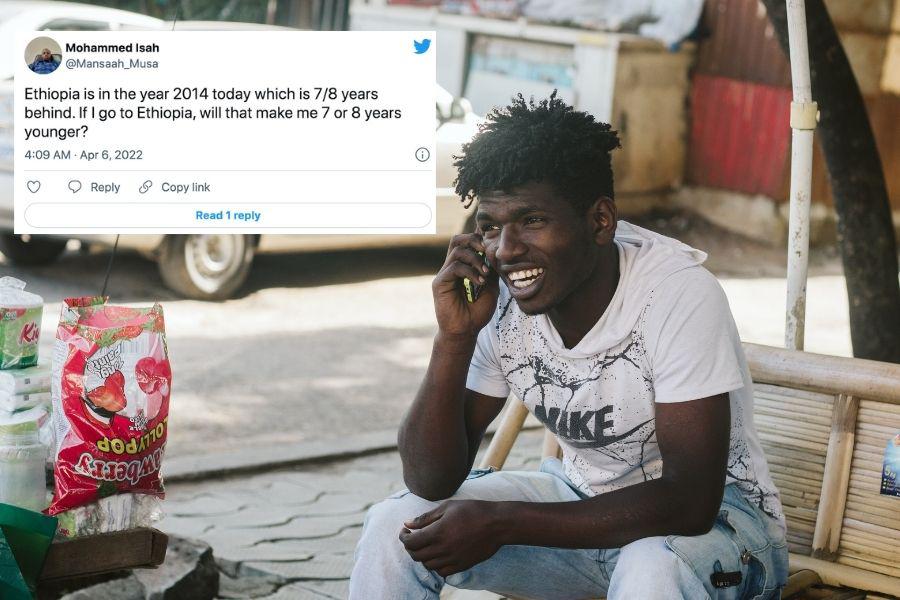
People are just now learning about Ethiopia's VERY different calendar and their minds are blown
2014 is the new 2022

Wanna feel younger? Move to Ethiopia.
Sure, dealing with different time zones around the world is a headache. But can you imagine dealing with completely different years? As mind-boggling as it sounds, this is the case in Ethiopia. While the rest of the world is currently living in 2024, in Ethiopia the year is currently 2017.
And suddenly we have all become Robin Williams’ character from "Jumanji." It’s actually all very simple. Where most of us are used to the Gregorian calendar, marked with 12 months of 28-31 days, the Ethiopian calendar consists of 13 months … sort of.
You see, each and every month has exactly 30 days, except for that bonus 13th month (called Pagumen), which has five days. Unless of course it’s a leap year. Then it has six.
That makes the Ethiopian calendar seven years and eight months behind the Western calendar, according to the BBC. Good luck buying the right airline ticket.
Not only is the Ethiopian calendar several days behind, but the entire concept of time is vastly different. Rather than 24 hours in a day, Ethiopian time uses a 12-hour day, from dawn to dusk, then dusk to dawn. Meaning 6 a.m. is noon, 6 p.m. is midnight. Up is down. And down is periwinkle. Is your head buzzing yet?
And now the real question: why?
Apart from a five-year occupation by Mussolini’s Italy, the oldest African country has never been colonized. And therefore, it calculates the birth of Christ differently. The BBC reports that when the Catholic Church amended its calculation in 500 AD, the Ethiopian Orthodox church didn't.
As such, Ethiopians (similar to several other cultures) don’t celebrate New Year's in December. Their holiday, called Enkutatash, takes place on September 11, or September 12 on leap years.
Whoa.
And while we’re on the subject, Enkutatash sounds like a pretty amazing shindig. Sure, there are gifts, children singing, all that. But the real point of attraction? The coffee ceremony. Which can last for hours. Heaven is a place on Earth. And it’s found in Ethiopia.Of course, Ethiopia isn’t the only country that technically has a very different year. I mean, the Thailand calendar—based on Buddha, not Jesus—is all the way in 2565! After all, there are as many ways of measuring time as there cultures throughout history.
A recent video posted on YouTube takes us on a historian guided explanation that has helped bring the Ethiopian calendar to the forefront of people’s minds.
To say that the now viral clip brought up some fun comments would be an understatement. Time might be a construct, but it’s also apparently a big conversation starter.

I can’t believe Ethiopia is in 2014 .. bro we’ve been lied to this whole time
— Hit Em Up! (@KADZ1L) April 6, 2022


I thought I should remind you that Ethiopia is approximately 7 years behind the rest of us.
— UNCLE K.🎶 (@v_kelcy) April 6, 2022
Today's date in Ethiopia is Monday 27th July, 2014.
So if there's something u wish u did in 2014, u can go to Ethiopia, do it and go back to your country.(2022).
Ethiopia is in the year 2014 today which is 7/8 years behind. If I go to Ethiopia, will that make me 7 or 8 years younger?
— Mohammed Isah (@Mansaah_Musa) April 6, 2022
every time I tell people that Ethiopia follows a different calendar, it short circuits their brain and I get to witness the exact moment everything they thought they knew come into question lmaooooo https://t.co/tfeMNhkiQJ
— Injera Mami 🇪🇹🪴 (@GloriaAlamrew) April 5, 2022
While coordinating schedules might be daunting, it’s cool to see that even though we are living on the same planet, we can still be living in very different worlds.
This article originally appeared on 4.13.22







a man sitting at a desk with his head on his arms Photo by
Can a warm cup of tea help you sleep better? If you believe it, then yes. Photo by 
A woman is getting angry at her coworker.via
A man with tape over his mouth.via
A husband is angry with his wife. via 
Three women sit on a blanket in the park. 
Two women engaging in a pleasant conversation inside a coffee shop
Two men engaging in a peaceful disagreement.
Resurfaced video of French skier's groin incident has people giving the announcer a gold medal
"The boys took a beating on that one."
Downhill skiing is a sport rife with injuries, but not usually this kind.
A good commentator can make all the difference when watching sports, even when an event goes smoothly. But it's when something goes wrong that great announcers rise to the top. There's no better example of a great announcer in a surprise moment than when French skier Yannick Bertrand took a gate to the groin in a 2007 super-G race.
Competitive skiers fly down runs at incredible speeds, often exceeding 60 mph. Hitting something hard at that speed would definitely hurt, but hitting something hard with a particularly sensitive part of your body would be excruciating. So when Bertrand slammed right into a gate family-jewels-first, his high-pitched scream was unsurprising. What was surprising was the perfect commentary that immediately followed.
This is a clip you really just have to see and hear to fully appreciate:
- YouTube youtu.be
It's unclear who the announcer is, even after multiple Google inquiries, which is unfortunate because that gentleman deserves a medal. The commentary gets better with each repeated viewing, with highlights like:
"The gate the groin for Yannick Bertrand, and you could hear it. And if you're a man, you could feel it."
"Oh, the Frenchman. Oh-ho, monsieurrrrrr."
"The boys took a beating on that one."
"That guy needs a hug."
"Those are the moments that change your life if you're a man, I tell you what."
"When you crash through a gate, when you do it at high rate of speed, it's gonna hurt and it's going to leave a mark in most cases. And in this particular case, not the area where you want to leave a mark."
Imagine watching a man take a hit to the privates at 60 mph and having to make impromptu commentary straddling the line between professionalism and acknowledging the universal reality of what just happened. There are certain things you can't say on network television that you might feel compelled to say. There's a visceral element to this scenario that could easily be taken too far in the commentary, and the inherent humor element could be seen as insensitive and offensive if not handled just right.
The announcer nailed it. 10/10. No notes.
The clip frequently resurfaces during the Winter Olympic Games, though the incident didn't happen during an Olympic event. Yannick Bertrand was competing at the FIS World Cup super-G race in Kvitfjell, Norway in 2007, when the unfortunate accident occurred. Bertrand had competed at the Turin Olympics the year before, however, coming in 24th in the downhill and super-G events.
As painful as the gate to the groin clearly as, Bertrand did not appear to suffer any damage that kept him from the sport. In fact, he continued competing in international downhill and super-G races until 2014.
According to a 2018 study, Alpine skiing is a notoriously dangerous sport with a reported injury rate of 36.7 per 100 World Cup athletes per season. Of course, it's the knees and not the coin purse that are the most common casualty of ski racing, which we saw clearly in U.S. skier Lindsey Vonn's harrowing experiences at the 2026 Olympics. Vonn was competing with a torn ACL and ended up being helicoptered off of the mountain after an ugly crash that did additional damage to her legs, requiring multiple surgeries (though what caused the crash was reportedly unrelated to her ACL tear). Still, she says she has no regrets.
As Bertrand's return to the slopes shows, the risk of injury doesn't stop those who live for the thrill of victory, even when the agony of defeat hits them right in the rocks.

