The new year is prime time for decluttering. As people take down holiday decor, figure out where to store it, and decide where new gifts should go, many are also resolving to get more organized.
Decluttering is not easy, but organization expert Dana K. White shares practical advice that can make the process far more successful.
She says the key to finally cracking the decluttering code was learning to let go of perfectly good items.
“If you try to declutter but struggle, here’s the realization I had to come to: decluttering means getting rid of perfectly good stuff,” she writes in the caption of a recent video on YouTube. “Instead of trying to make myself think something is bad, I have decluttering strategies that help me let go of good things that don’t fit in my home.”
She calls it a “major mindset shift” that “will free you to make the progress in your home that you’ve been wanting to make if you find yourself stuck in the process of decluttering or at the thought of decluttering.”
Why this mindset shift changes everything
White explains that while letting go of perfectly good items can be a difficult mindset shift, it pays off in a big way.
“I used to think that decluttering was getting rid of things that were not good or things I didn’t need or things that were not useful,” she says. “But that is actually not the heart of decluttering.”
Instead, she had to redefine what clutter really was.
“Clutter is anything that consistently gets out of control in my home,” she says. “That means what is clutter to me isn’t necessarily clutter to you. If it is something that is actually important enough to me that I keep it under control, then I don’t have to consider that clutter.”
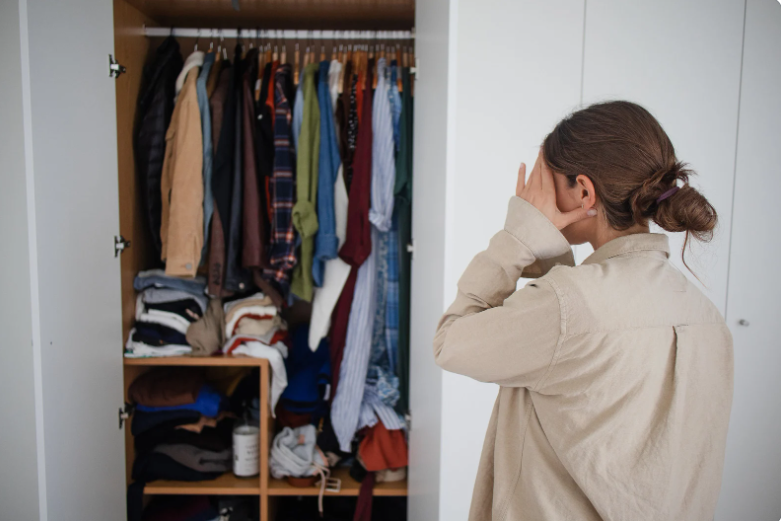
White says she noticed this most clearly when it came to clothing.
“With clothing, it was a huge mind-blowing moment for me to realize clothing could be clutter,” she says. “I didn’t know it because the phrase that came out of my mouth and into my brain was: ‘But clothing is useful. But clothing is something that we have to have.’ Clothing was out of control. I had so many clothes in my house that we could go way too long without having to do laundry. Therefore, the dirty clothes piles were out of control, ridiculously high. And that was clothing being out of control.”
White calls herself a “functionalist,” judging clutter by whether items fit in their space and are easy to access.
“I don’t consider myself a minimalist,” she explains. “My goal is not to have the least amount that I can possibly have. I don’t consider myself a maximalist, like how much can I possibly keep. I consider myself a functionalist. It allows me to still like an item and get rid of perfectly good stuff.”
What happened when people tried it
On Reddit, people embarking on their own decluttering journeys shared how White’s advice helped them.
“Yes that totally resonates with me and it was liberating as I purged glassware that I don’t use. But now I’m still working on selecting my favorite coffee cups. Argh,” one Redditor commented. Another shared, “It’s easy for me to let go knowing it’s going to someone else who might need or want to use it more than I ever had.”
Another declutterer wrote, “If you do not use it, just pitch it or give it away. You will never get your purchase value back. It does nobody any good sitting in a box in the garage for ten years.”
What makes this advice actually stick
Most decluttering advice tells you to evaluate your stuff, ask if it sparks joy, decide if you’ve used it in a year and imagine whether you’d buy it again today. White’s approach is different because it skips the evaluation entirely. The question isn’t whether something is good or useful. The question is whether your home can actually hold it without things getting out of control. That’s a much easier standard to apply, and it removes the guilt that usually stalls the whole process. You’re not saying the item is bad. You’re just saying it doesn’t fit, and that’s enough.
This article originally appeared in January It has been updated.