People with ADHD (Attention Deficit Hyperactivity Disorder) often struggle with organizational skills. According to a 2020 study, this may be due to impaired working memory in the brains of those with ADHD, combined with hyperactive motor engagement that inhibits the executive functions necessary to get organized.
Certified professional organizer Alison Lush, ICD® Master Trainer, CPO-CD®, CVOP, PPCC, defines this as “chronic disorganization.” Lush, who lives with ADHD and specializes in chronic disorganization, neurodivergence, and ADHD, discussed all things ADHD and disorganization in an interview on the Sorry, I Missed This podcast.
Host Kate Osborn, an ADHD educator and author of The ADHD Field Guide for Adults, chatted with Lush about ADHD and clutter specifically. Lush offered tips on how people with ADHD can overcome chronic disorganization.
ADHD, clutter, and chronic disorganization
During the intro, Osborn (who also has ADHD) shares that “for a long time I carried a lot of guilt, shame and embarrassment around the clutter—around my struggles with keeping up on keeping things organized and perfectly clean.”
She adds that people with ADHD can have a complicated relationship with their “stuff.” Lush affirms her, sharing that “ADHD folks are among the largest population who show up with chronic disorganization.”
Lush defines chronic disorganization in three parts:
- It persists over a long period of time.
- It frequently undermines quality of life.
- It recurs despite repeated self-help attempts.
On the flip side, Lush defines being organized as “I can put my stuff away without too much difficulty, and I can find my stuff without too much difficulty.”
Clutter, on the other hand, is two things, according to Lush.
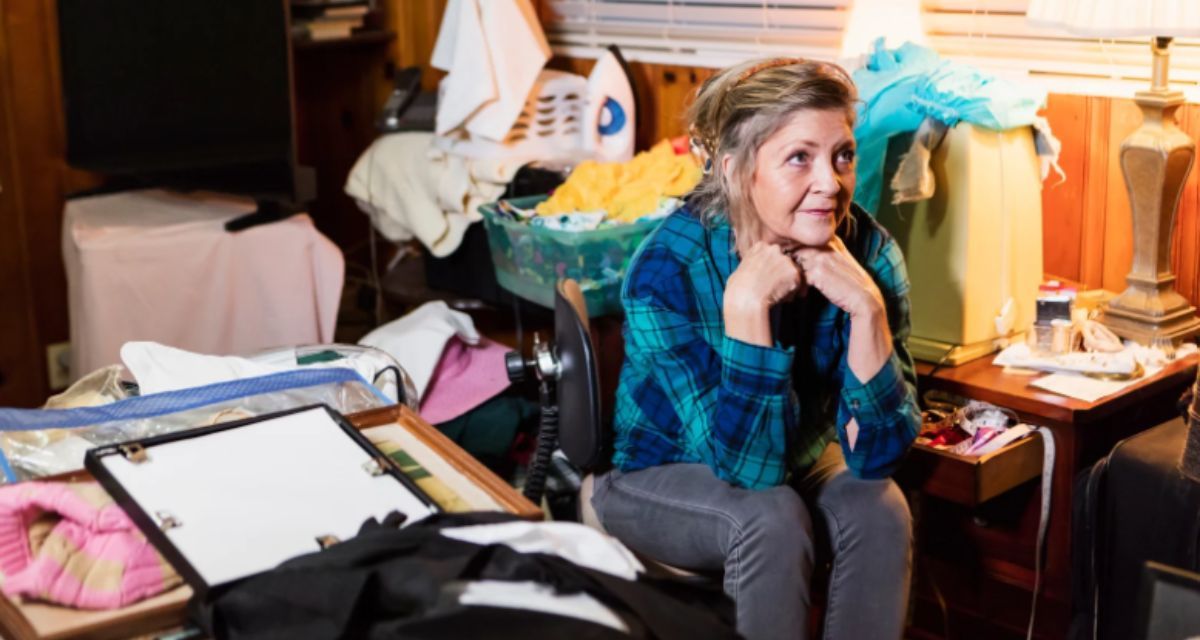
“Clutter could be the stuff that I just used if I just did a sewing project and got out all my sewing stuff and I had it all over the dining room table—and if I’m done (finished with the project) and walk away, it’s clutter that has a home that just needed to be put away,” she says. “But if my table is covered with stuff that doesn’t have a home, that’s like classic, big-time, hard to deal with CLUTTER.”
Shame and chronic disorganization
Lush, who identifies as someone with chronic disorganization but has worked her way out of it, explained the shame cycle that can happen with ADHD due to chronic disorganization.
“We have been so heavily programmed by the media and social media, and it’s telling us [about organization] that ‘this is what it should look like’, and ‘this is what it should be like’—and I hate the word ‘should’,” she says.
Osborn adds, “There’s this idea that you have to match your socks, you have to line your shoes up in nice little rows, you have to do your laundry a certain way. But a lot of times folks run into this disconnect between what I am capable of, what I have time for, what I have energy for, what I have executive functioning for, and, like, what I see on Pinterest, what I see the ‘momfluencers’ doing—I’m like, that’s not me.”
Lush emphasizes that being organized does not have to be aesthetically pleasing.
The shame of chronic disorganization can also lead people into a “more isolated life because they’re so ashamed to bring people into their homes and to be honest about how they’re living,” says Lush.
To combat that, she says getting in community with others who struggle is key.
“When you find other people who are dealing with the same challenges, you can actually be your true, authentic self and get the support and the empathy and the ideas and the brainstorming and the body doubling and the no judgment and the enthusiasm and the optimism from a safe-space community,” she says, adding, “I can’t emphasize enough how important community is for folks who are affected by chronic disorganization and ADHD. It’s an absolute game changer.”
Chronic disorganization tips
Throughout the episode, Lush offers plenty of advice on overcoming chronic disorganization. Here are six of her tips:
Figure out “homes” for your stuff
Nailing down an organizational system and figuring out where you might make a “home” for your stuff is vital.
“It doesn’t have to be ‘perfect.’ It doesn’t have to be ‘pretty,’” says Lush. “I sometimes even recommend to my clients that they just end up with a box of random stuff that was on the dining room table that doesn’t have a home, and put a label on it that says ‘Random Stuff That Was On The Dining Room Table’—and at least if it was in a box on the table, I have a chance of finding it.”
Do a ‘grounding’ exercise
The “grounding” exercise is all about goal-setting with certain spaces.
“For example, I look at my desk, and the grounding exercise is to ask myself, ‘What is it I want to accomplish when I’m sitting here at my desk or standing here at my desk, in my life?’ Because when we don’t ask ourselves this question, we’re just defaulting to the programming that we received from society, which is usually not helpful,” says Lush.
She adds that this will connect you with “bigger picture goals” about who you are and what you want to accomplish in your life.
“And that helps give us clarity [up here] about what belongs there and what doesn’t,” Lush says.
Label stuff
Don’t buy a label maker. According to Lush, she has her clients use painter’s tape and a marker.
“Labels are so helpful, so we don’t keep it all in our brain. [And] they tell us where the thing is; they tell us where to put it away; they tell us where to find it,” she says. “But when it’s done with painter’s tape and a Sharpie, I can rip it up and throw it out if I change my mind. So it gives me the flexibility. I’m not committed to anything. I’m not forced into anything. The stakes are low.”
Reset your space
Lush explains that clutter should be handled with a “reset.”
“If that pile of stuff on my dining room table has been there for a week or 10 days, it’s starting to grow roots. And when it starts to grow roots, it becomes more dangerous because then it starts being Velcro—and things start to attach to it, and I start not believing in my confidence that I can clear the table.”
If you notice after 10 days that you can no longer use the table, it’s time to reset.
“I’ll spend 20-30 minutes cleaning off the table and resetting. Half the stuff had a ‘home’ to go to, and only a few things didn’t…and it restores my confidence in my ability to maintain my table.”
Focus on maintenance
“What we’re trying to do is get to a point where you can deal with your stuff and keep up with the maintenance,” says Lush. “Maintenance is a huge part of disorganization, and what I always tell clients is—if you don’t know what else to do, just do some maintenance tasks like: do some dishes, fold some laundry, clear off a surface. Because all of that is going to help you.”
Avoid having a perfection mindset
Lush wants people to take pressure off themselves as they figure it all out.
“We’re not going to hit the target the first time around when we’re creating an organizing system. We’re just experimenting, and we’re trying to make it better than it was before,” she explains. “I’m not expecting to get the perfect system that’s going to last forever. Yes, I’m going to have to come back and revisit this and tweak it in the future.”