There are so many good things people love about social media. It can keep you connected to family members that you no longer live near. You can find community in hobbies and special interests that other people share with you. It can even be used as a source of income if you’re savvy enough to figure that out.
But with as much good as there is on social media, it can also be the source of emotional and mental distress. Between online bullying and internet trolls who just set out to harass unsuspecting people, social media can feel like a double-edged sword. In one instance, it’s making you feel less alone in the world, then in another, it’s making you feel unimportant. It can be difficult to navigate, especially as a child.
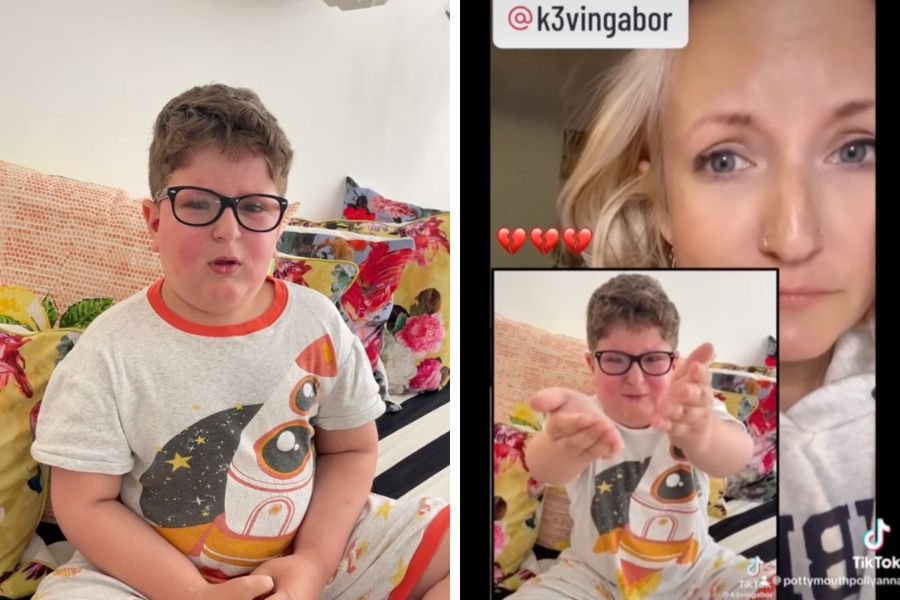
Kevin has been using TikTok to build an online community because it’s too dangerous for him to play outside. But for some reason, he was the target of mass reporting in an effort to get his account banned. Mass reporting is when a group of people report your videos or profile page repeatedly in order to get a creator permanently banned, forcing them to start their platform all over again from zero followers. Instead of giving up after the trolls tried to take his account down, Kevin decided to try to appeal to them, and in return, he found a whole community.
“You know I can’t play, I can’t run. I can’t hang out with friends outside. I can’t do a bunch of stuff,” Kevin pleads. “Because I could break something and I have an online community so that I can share and have friends with and you’re trying to take that away from me.”
https://www.tiktok.com/t/ZT8Yhfj6u/
His tearful video didn’t go unnoticed. It was viewed over 10.5 million times and the TikTok community rallied behind the boy and his family, sending followers and even Legos his way. Creators from all over made videos showing their support for Kevin, including Rosie O’Donnell. His account quickly grew to a million followers
Mandy, a creator who answered Kevin’s call, compiled a video of multiple creators wishing him well and encouraging others to follow him and do the same. Heartwarming doesn’t seem like a strong enough description. You might need to grab a tissue for the video below.

A Somali refugee and current resident of Minneapolis, the multimedia artist and activist draws on her lived experiences to create work that explores trauma, displacement, and resilience. But like so many of the guests on Freedom to Thrive, an award-winning podcast produced by the National Immigration Law Center (NILC), Mansour doesn’t want to focus only on trauma; she also wants to celebrate the unexpected beauty she’s found during difficult experiences.
“One of the beautiful things about tragedies is that it activates hearts, and courageous people are born,” she says. For example, Mansour has noticed more Minnesotans than ever are reaching out to help the vulnerable, after the anti-immigrant crackdowns carried out by the Department of Homeland Security. “They are bringing food, they’re bringing extra clothes, they’re walking with people, and it’s just really beautiful.”
Hector Flores, co-founder of the Las Cafeteras and host of Freedom to Thrive, agrees with her. A child of immigrants himself, he has also seen how hope and hardship often live side by side.
Flores comes from a family with mixed status and is highly aware of the challenges immigrants and refugees in his community face, and how they’re affected by people’s misconceptions. “People want to know about trauma all the time, but we’re more than just undocumented,” he says. “We’re artists, singers, creatives … there’s so much richness in the culture.”
At its core, Flores’ comment is exactly what the Freedom to Thrive podcast is all about: Celebrating immigrants as complex, dynamic individuals, and challenging the dominant narrative that too often reduces them to symbols of hardship.
Launched in 2024, Freedom to Thrive explores heritage, resilience, community, and the ways art and comedy can spark social change. Now in its second season, the podcast continues to feature conversations with immigrants, policymakers, artists, musicians, activists, and more. Recent guests have included comedian Mo Amer, Grammy Award-winning singer Lila Downs, and Pulitzer Prize-winning author Viet Thanh Nguyen.
Where the first season focused on individual stories of identity and belonging, Flores says his goal for season two, where he joins as host, is to “take it to the next level” — using storytelling to highlight “the fact that we’re more similar than different.”
One recent podcast episode drives this point home. In December, Flores interviewed Bryan Andrews, a rising country music star and rural Missouri native who frequently uses his platform to speak about issues affecting immigrant families. At the heart of his message and his songwriting, Andrews says, is the idea that small-town Americans and the rest of the country, including immigrants, have more in common than they realize.
“It doesn’t matter where you’re from,” Andrews says on the podcast. “We’re all trying to make a living and we’re tired of getting railroaded by corporate greed or by politicians who don’t care.”
Rural Americans, Andrews says, are often stereotyped as racist and misogynistic but “the overwhelming majority of people in my home town have love in their hearts.” Media stereotypes often amplify differences and divide, he says, but at the end of the day, “we’re all in this together.”
Flores, who was raised in a working-class immigrant neighborhood in East Los Angeles, had similar thoughts. He says he often sees its residents stereotyped as wealthy, consumerist, and status obsessed. “That exists, but that’s not my life, that’s not my community,” he says. Like small-town Americans, people in the city “just want to work hard and take care of their families. We all want the same thing.”
Although the podcast tackles some heavy issues, each episode’s ultimate focus is how personal and collective struggles can be healed through art, driving home a message of hope and resilience:
Mansour’s episode about her experiences in Minnesota is just one of many examples. Flores asks her,
“What gives you hope for the people creating a home here?”
“The love I feel from other Minnesotans. It is trumping any hate we’re experiencing,” she replies.
CTA: Stream all episodes now on the Freedom to ThriveYouTube channel or the website,here.
The podcast has been nominated for a Webby in the “Belonging & Inclusion” category. You can vote for it to win until Thursday, April 16!
This article is part of Upworthy’s “The Threads Between U.S.” series that highlights what we have in common thanks to the generous support from the Levis Strauss Foundation, whose grantmaking is committed to creating a culture of belonging.
Chris Leavitt had been his mother’s primary caregiver for six months, ever since she suffered a stroke and he moved across the country to help her. He drives her to therapy appointments, helps her communicate, and tries to give her as much independence as possible on the days when that feels within reach.
December 20 was her 60th birthday. They’d already had a full day of therapy sessions, but Leavitt wanted to mark the occasion. He let his mother choose where to go for lunch, and she navigated them to Hole in One Bagel Deli, a strip mall spot on Route 33 in Neptune, New Jersey. It wasn’t a restaurant he knew. It turned out to be exactly the right place.
The obstacles of stroke recovery
Leavitt’s mother walks with a cane and still has difficulty speaking as she recovers. Once inside, ordering proved harder than expected. The menus were displayed on TV screens that were difficult to read in the lighting, and when Leavitt asked whether paper menus were available, there weren’t any. As he worked to help his mother communicate what she wanted, he was aware of the other customers around them, the noise, the weight of the moment.
That’s when manager Chris Hansen came around the counter.
The quiet kindness of a stranger
He didn’t make an announcement or draw attention to the situation. He simply started presenting options to her, one at a time, letting her point at what she wanted. A poppy seed bagel. Then lox. “I got you,” Hansen told her. “Don’t worry about it.” According to Leavitt, Hansen moved fluidly between helping them and the other customers coming in and out, never once making them feel like an inconvenience.
“From the moment we walked in, the manager Chris showed us incredible grace and patience,” Leavitt wrote later on GoFundMe. “In truth, I’m not sure I would have figured out what she wanted on my own.”
When their food arrived, Hansen returned to the table with something they hadn’t ordered: a chocolate pastry. He told them the whole meal was on the house. When Leavitt tried to refuse, Hansen insisted. “Please, please enjoy.”
The power of a random act of kindness
Leavitt said his mother didn’t fully register what had just happened. But he did. “It took everything in me not to sob inside the deli,” he wrote.
As they were leaving, Hansen said one thing that stayed with Leavitt long after they drove away: “What’s the point of life if you can’t be nice every once in a while?”
Responding in kind
Leavitt, who has worked in hospitality for 15 years, posted about the experience to his Instagram following of over 400,000 people. The response was immediate. Within a day, he’d received more than a thousand comments and messages. He also quietly launched a GoFundMe to benefit Hansen directly, as a thank you. As of late December, it had raised more than $16,500.
The comment that seemed to resonate most with viewers came from someone who put it simply: “A man crying because his mom was treated with respect and dignity is pure gold.”
Julian wasn’t expecting anything unusual when he pulled up to pick up his stepdaughter from school. Just another ordinary afternoon errand. But when one of her classmates pointed at him and asked who he was, his stepdaughter answered without hesitating for even a second.
“That’s my dad.”
Stepping up to just ‘dad’
Julian shared the moment in a TikTok video that quickly resonated with thousands of viewers, many of whom have lived some version of this story themselves. He said he wasn’t sure she’d ever give him that title — not because things were bad between them, but because he’d never pushed for it. He’d just tried to show up, consistently, and let her lead.
That’s what made the moment so meaningful. She didn’t say it for him. She said it because it was simply true to her.
People knew how it made him feel
The comments filled up almost immediately with people who understood exactly what that kind of moment feels like. One commenter wrote that her husband cried the first time one of his stepsons said the same thing. Another, who grew up with a stepfather herself, offered a perspective worth sitting with: “She will see you differently the moment you just call her your daughter, not a stepdaughter. Just like how you felt — that feeling is the same both ways.”
Kids are figuring things out, too
That symmetry is easy to miss in blended families, where so much of the emotional weight tends to fall on the adults trying to figure out their role. Kids are often doing the same calculus quietly on their end, watching to see if this person is going to stick around, wondering what to call them, not wanting to get it wrong either.
Julian ended his video saying he was going to take her out for food — which, as many commenters pointed out, is about the most dad response imaginable.
The title of “dad” isn’t something you can ask for or negotiate. It’s conferred. And apparently, a school pickup on an ordinary afternoon is exactly the kind of place where it happens.
Charles Boehm had never written an obituary before. When his father Robert died in October 2024 after a fall in his Clarendon, Texas apartment, Charles sat down in his Houston home, completely stumped, and did what anyone would do.
He Googled it.
“I decided to Google, ‘What do you put in an obituary?’” he told The Washington Post. What came up changed everything. He found the obituary of a Connecticut man named Joe Heller, written with wit and irreverence and genuine love, and immediately thought: that sounds like something my dad would do.
So Charles did the same. What he wrote for Robert Adolph Boehm, 74, of Clarendon, Texas (population 2,000) went viral almost instantly when Robertson Funeral Directors shared it on Facebook. It has since been viewed more than a million times.
The viral obituary of a Texas man
It begins like this:
“Robert Adolph Boehm, in accordance with his lifelong dedication to his own personal brand of decorum, muttered his last unintelligible and likely unnecessary curse on October 6, 2024, shortly before tripping backward over ‘some stupid mother****ing thing’ and hitting his head on the floor.”
It continues. Robert was born in Winters, Texas in 1950, “after which God immediately and thankfully broke the mold and attempted to cover up the evidence.” He managed to avoid the Vietnam draft by getting his wife Dianne pregnant three times between 1967 and 1972. His youngest son Charles arrived in 1983, the obituary notes, “with Robert possibly concerned about the brewing conflict in Grenada.”
His lack of military service was, the obituary observes, “probably for the best” — given that Robert later took up shooting as a hobby and managed to blow two holes in his own car’s dashboard on two separate occasions. His wife Dianne, “much accustomed to such happenings in his presence, may have actually been safer in the jungles of Vietnam the entire time.”
Good grief: Humor helps a family heal
There’s the fashion: homemade leather moccasins, a wide collection of unconventional hats, boldly mismatched shirts and pants. The career: he became “a semi-professional truck driver — not to be confused with a professional semi-truck driver.” The hobbies: historical weapons spanning from a 19,000 BC French atlatl to a Soviet-era Mosin-Nagant, plus a wide selection of harmonicas he kept on hand but rarely played. When Robert’s wife Dianne died in February 2024, Charles wrote that God had gotten her “the hell out of there for some well-earned peace and quiet.” In her absence, Robert had thrown himself into entertaining the people of Clarendon with what the obituary calls his “road show.”
It closes: “We have all done our best to enjoy/weather Robert’s antics up to this point, but he is God’s problem now.”
Attendees at the funeral were requested to wear “outlandish or mismatched outfits” in his honor.
The reaction said it all
Chuck Robertson, who owns the funeral home and received the obituary, told The Washington Post he almost choked on his breakfast laughing. “I told people in the office, ‘Well, this is going to get us some attention,’” he said. “I’d never had a family come through the doors that wrote an obituary as classic as that one.”
Charles said he was astonished by the response. “I was sad that my father was going to be forgotten and that my parents’ small life would get packed up into my trailer and that would be the end of it everywhere but inside my own mind,” he told TODAY. “That obituary was intended to ease my own pain and make a handful of people in a town of two thousand smile instead of frown, and it’s probably done that for 2 million at this point.”
The message behind the laughs
He also has a message for anyone reading: don’t let your parents slip through the cracks in small towns. “There are people all over the country like my dad,” he said. “They go there to retire, then when they’re old, their kids scatter and they end up alone.”
When the family cleaned out Robert’s apartment, they found four harmonicas immediately.
Amanda had a sign in her yard that read: “Mister Rogers did not adequately prepare me for the HOA.”
It’s a funny sign. It’s also, for anyone who grew up watching Fred Rogers teach an entire generation that neighbors treat each other with patience and kindness, a completely reasonable sentiment. Her HOA did not see it that way. They sent her a notice to remove it.
As she explained in a TikTok video posted to @corporate.amanda, she had suspected for a while that her HOA wasn’t exactly operating by the book. What she found confirmed it. The board hadn’t filed the required paperwork with the state to remain an active entity year over year. They hadn’t held their mandatory annual meetings. They had no minutes to show members. Technically, legally, they didn’t exist as an organization with any enforcement power.
“I know that they can’t technically do anything,” she said. “They can’t even represent themselves in court because they aren’t an entity at this time.”
Sweet petty revenge
So Amanda did not remove the sign. Instead, she spent a week driving around the neighborhood documenting every HOA violation she could find among board members’ own properties. Then she mailed the photos to each of them.
She also sent the board a formal request for five years’ worth of records — meeting minutes, audit documents, board formation paperwork — fully aware they couldn’t produce any of it. “I already know the answers to all these,” she said. “They haven’t done an audit. They haven’t done the things they are supposed to do.”
At the time of her video, they hadn’t responded to her emails in six days.
“I actually have a full-time job, and I am a mom, and I am in school,” Amanda said, “so I do have better things to do. But I am so petty that I have made this my new life mission.”
The response in the comments was immediate and enthusiastic, including from someone who works at an attorney’s office representing HOAs: “You’re absolutely right. If they got an attorney, that’d be the first thing they’d notice.”
Dean Whitehead is 23 years old and in his first year of teaching high school English. He’d heard enough complaints from students about boring essay topics to know he needed to try something different. So one day he set up a camera in his classroom, opened a shared document he’d titled “Argumentative Fun,” and gave his students an assignment unlike anything they’d been asked to do before.
Ten minutes. Any topic. No grammar corrections, no spelling deductions. The only way to win bonus points was to be genuinely convincing.
“It has to be something you feel so strongly about that you can type for 10 minutes straight,” Whitehead told them, as captured in his TikTok video posted to @mrcoachwhitehead. A few students immediately had questions. One asked for a minute to think. Whitehead gave them eleven. Voice-to-text was off the table.
Students take writing to another level – their own
The essays came in. They were, as promised, unhinged.
One student ranted about curfews, arguing that weekends should be completely free because school is already hard enough. Another went after boys in general. One made a detailed case for wanting to be rich specifically so they could give money to their friends and family. Someone addressed the injustice of teachers confiscating phones. One student, apparently undaunted by the fact that their teacher was reading this, wrote in the middle of their essay that Whitehead wasn’t actually the best teacher.
Caillou hits a big nerve
But the winner, and it wasn’t close, wrote about Caillou.
For those who have blocked the PBS Kids animated series from memory: Caillou is a perpetually four-year-old Canadian child who whines his way through every episode and faces consequences for approximately nothing. The student’s essay, Whitehead reported in a follow-up video that has now been viewed more than 11 million times, cited Caillou’s baldness as suspicious and his ability to get away with everything as a fundamental injustice. “When I say this was the most convincing rant I’d received, I mean it,” Whitehead told his class. “I also hated Caillou.”
Five bonus points, awarded.
Finding passion through freewriting
What surprised Whitehead most wasn’t the content — it was the quality. When students actually cared about their topic, the mechanics followed. “The craziest surprise was they actually did fantastic on their own with grammar and creating full, complete sentences,” he wrote in the comments. “I was super proud of them.”
The technique Whitehead stumbled onto has a real name: freewriting. Teachers have used low-stakes, high-freedom writing exercises for decades precisely because removing the fear of being graded wrong tends to unlock students who’ve otherwise decided they hate writing. The catch is getting them to care about the topic enough to sustain it. Turns out strong opinions about animated characters work just fine.
Like most marsupials, wallaby joeys typically remain inside their mother‘s pouch for up to nine months to grow, nurse, and stay warm. At around six to seven months, they begin emerging to explore, but will continue returning to the pouch for security.
A baby in need
But when Blossom, a baby albino wallaby, showed up at Lindsay Clarity’s UK-based animal rescue center, Animal School, she was far too young to manage without that safe, enclosed space.
Unfortunately, Blossom’s mom was nowhere to be found, and every other resident wallaby at the rescue already had a joey tucked into their pouch. There was no natural substitute available.
Clarity, who had years of experience caring for vulnerable animals (particularly rearing babies), stepped in with a creative solution. She placed a soft pink pillowcase inside a backpack and turned it into a portable pouch. The setup gave Blossom the warmth and closeness she needed to feel secure.
Clarity carried Blossom in that improvised pouch for an entire year. She compared the experience to “walking around like a pregnant lady,” sharing with GeoBeats Animals that it became part of her daily routine.
Feeding Blossom required extra effort. Specialized milk and a particular bottle had to be shipped from Australia so the joey could develop properly. Every detail mattered, and Clarity stayed committed through it all.
Growing strong
The care paid off. Blossom did indeed “blossom,” eventually outgrowing her pouch and exploring the world on her own terms. Today, she’s developed a distinct personality, described as “more catlike than doglike,” and even showed a fondness for soft, calming sounds, which Clarity plays herself.
Not to mention, she has a loyal fanbase invested in the daily adventures of her life. What began as an emergency rescue turned into a journey that many people feel connected to.
As for Clarity, she credits Blossom with changing her life, saying, “Caring for her is one of the most rewarding things I have ever done.”
Fascinating wallaby facts
Blossom’s story also highlights how remarkably adaptable wallabies are: able to live in forests, rocky areas, or open grasslands. They are known to be opportunistic feeders, grazing at dawn and dusk to avoid midday heat. They also have the ability to pause pregnancy, which aids survival in uncertain environmental conditions.
Albino wallabies like Blossom are especially rare. Their lack of pigmentation gives them their striking pale appearance, though it can also make them more vulnerable in the wild due to reduced camouflage.
However, Blossom is, of course, just one of the many happy animals at Animal School. For Clarity, inspiring others to learn about animals has been a lifelong passion. And when she’s not running animal therapy sessions, “Creative Creatures” art classes, or various other onsite activities, she loves using social media to offer glimpses into the continuously fascinating animal kingdom.
To stay up to date with Blossom and the other Animal School residents, be sure to head over to Instagram and give a follow.
“Job treating you alright?” “Looks like this weekend is gonna be a real scorcher.” “That Cowboys game was outrageous.” These are some conversational snippets one might hear that could lead to immediate panic—that insufferable “small talk” lies ahead. But new research published in the Journal of Personality and Social Psychologyclaims that people actually like, and often benefit from, these kinds of conversations.
Researchers discovered that even though people reported not looking forward to “boring” conversations, a majority found them quite fun.
The team mixed and matched respondents to cover all bases. In one experiment, they observed conversations in which “one person finds the topic boring.” In another experiment, they created a situation where both participants “find the topic boring.” They also tested groups based on whether the participants were strangers or friends.
In a piece published by the American Psychological Association (APA), researchers reported that, after studying 1,800 participants, “people consistently underestimated how interesting and enjoyable conversations about boring topics would be.”
Some might question what topics are considered (potentially) “boring” in the first place:
“Topics were many and varied, including World Wars I and II, nonfiction books, the stock market, cats, and vegan diets. In some cases, participants were asked to suggest a topic they found boring (responses included such topics as math, onions and Pokemon).”
Elizabeth Trinh, a doctoral student at the University of Michigan and lead author of the study, said she was excited about the results.
“We were both surprised and excited by how robust the effect was,” she said. “People consistently expected conversations about seemingly boring topics to be less interesting than they turned out to be.”
“Serves a real purpose”
Upworthy spoke with licensed therapist Rebecca Tenzer, owner of Astute Counseling and Wellness Center. She explained why many of us feel anxious about so-called small talk, only to find it entertaining.
“While it gets dismissed a lot, small talk actually serves a real purpose when it comes to mental health,” Tenzer said. “These smaller, everyday interactions help people feel connected, acknowledged, important, and can even build self-esteem. Even if the conversation is simple or surface-level, there are meaningful impacts and a lot of gain.”
Tenzer also supported the idea that these micro-conversations, no matter the topic, have significant benefits.
“We’re seeing more evidence that even brief social exchanges can improve mood, teach social norms, and reduce feelings of loneliness,” she said. “Along with those interactions are often positive body language exchanges, smiles, and even laughter, all of which are happiness chemical hacks needed to boost mood.”
“Small talk acts as a low-pressure way to engage with others, which can help regulate the nervous system and make social interaction feel easier over time,” Tenzer added. “Not every conversation needs to be deep to have value. It’s nice to force yourself to slow down, take a minute to chit-chat, be in the moment, and stay present. It’s not a huge time commitment and often has lasting benefits throughout the day.”
“Predictable, consistent, and not threatening”
Lisa Chen, a licensed psychotherapist, concurred, telling Upworthy that these types of conversations can help put people at ease, even if they might not expect it.
“As a psychotherapist who works with high-achieving, often socially guarded clients, I see how ‘low-stakes’ interactions create a sense of safety in the body,” she said. “Even brief exchanges like saying ‘hello’ to the barista making your coffee or making casual conversation at work help remind our nervous system that the world is predictable, consistent, and not threatening.”
Chen says small talk can help lower anxiety.
“It lowers social anxiety over time, builds relational confidence, and gently reinforces that we belong in shared spaces,” she said. “But small talk isn’t just for those who struggle with social anxiety. It’s for everyone. Small talk strengthens our sense of belonging, improves our mood, and keeps us from becoming too transactional or isolated from others. It also softens intensity and creates moments of ease that prevent stress and burnout.”
We know that collectively performing under pressure requires some special qualities, but what are they? That’s the question NASA seeks to answer as it looks ahead to sending humans to Mars. When it comes to team dynamics, a small crew on a 10-day stint around the moon is one thing. A team stuck on a spaceship for months and living together on a planet two million miles from home is another.
NASA’s Human Research Program studies human behavior in teams to analyze the implications of long-duration space missions. After observing team dynamics and roles in groups in various studies, one delightful conclusion can be drawn.
Every team needs a clown.
NASA ran a study on a potential trip to Mars and found the most important trait for team dynamics was humor pic.twitter.com/tB3gQlKZPL
According to NASA, astronauts have returned from stints on the International Space Station and reported that humor played a critical role in diffusing tension between people working on the I.S.S. The same finding has come from research studies in analog environments. (Analogs are places like Antarctica, where the desolate and extreme environment somewhat mimics a place like Mars.)
“You need a clown on the team,” said Noshir Contractor, Ph.D., professor of behavioral sciences at Northwestern University. In other words, you need someone who can make their teammates laugh.
Contractor is conducting a study titled Crew Recommender for Effective Work in Space (CREWS). Using research data from an analog study, her team is developing a computer model to help select the best individuals to form a crew.
“We don’t have a perception that we’re going to tell them who to send on a mission,” Contractor said, according to NASA. “But if they have a collection of people, it will work like a weather forecast model. It’s a predictive model that says if you choose this particular crew, here is what you are likely to see in terms of team dynamics. And, if problems arise, here is how to intervene to ease those problems.”
Easing problems is one place where the clown plays an important role. Research shows that positive humor can increase communication and social support and create a pleasant environment. Most of us have experienced how a well-timed joke or witty response can stop tension in its tracks.
Tension often manifests physically. We feel it in our bodies when emotional stress is high. According to the Mayo Clinic, laughter can stimulate circulation and help muscles relax, easing some of the physical symptoms of stress. Laughter also releases endorphins that make us feel good and promote social bonding.
What about teams that aren’t in as extreme circumstances as going on a mission to Mars or wintering in Antarctica? Dr. Adil Dalal of the Forbes Coaches Council says humor has a “transformative power” that unlocks the ability to do serious work well in the professional world.
Photo credit: Canva – Laughing with your colleagues may help improve team performance.
“When we laugh, cortisol, the stress hormone that can narrow thinking and trigger defensive behavior, drops significantly,” writes Dalal. “Laughter also causes the release of dopamine, oxytocin and endorphins, which are associated with motivation and learning. In the workplace, this means that laughter can encourage new behaviors and insights. It can also strengthen trust, which is essential for psychological safety and sustained high performance among employees.”
So if you’re leading a team or part of a team that appears to be struggling, perhaps some clowning around is in order. As Dr. Dalal writes, “Fun is not the opposite of seriousness—it is the pathway to sustainable excellence.”
If NASA touts the vital role humor plays in teamwork and success, perhaps we all ought to give it a little more weight in our own teams.