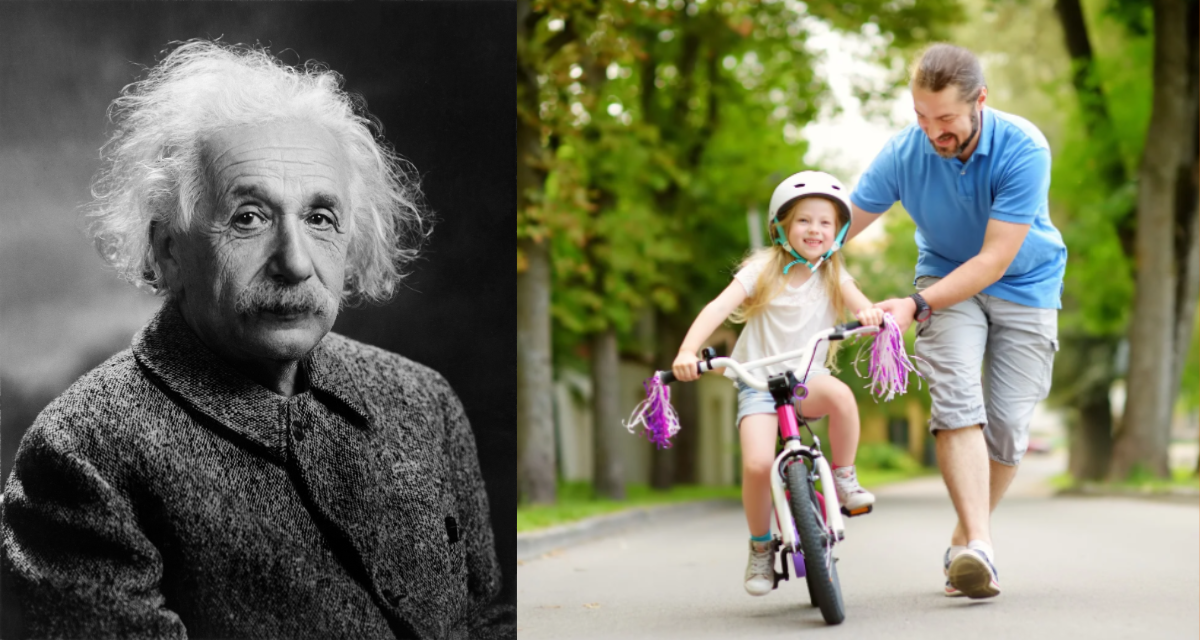
Kids today are struggling with resilience. A study from the Johns Hopkins Bloomberg School of Public Health found that only 40% of school-age children in the United States were “flourishing.”
Study leader Christina D. Bethell explained more about how researchers defined “flourishing.” She noted, “Family resilience and connection were important for flourishing in all children, regardless of their level of adversity. Parent-child connection had a particularly strong association with child flourishing.”
And it’s that lack of resilience that highlights the struggle many kids face today, as well as the challenge for parents trying to instill it in them. It’s something Albert Einstein was aware of in the early 1900s and worked to cultivate in his three children.
Einstein’s advice on resilience
Einstein was the father of three children with his first wife, Mileva Marić: a daughter named Lieserl, and two sons, Hans Albert and Eduard. Eduard was the youngest and had great intellectual potential, and he was studying for a career in medicine.
However, Eduard was afflicted by schizophrenia, which derailed his professional life. He was in and out of a psychiatric sanatorium in Zurich, Switzerland, throughout his life. Einstein described Eduard as having a “delicate nervous system.”
But the relationship between father and son produced a famous quote from Einstein on raising resilient children, drawn from a 1930 letter to his son Eduard:
“Life is like riding a bicycle. To keep your balance you must keep moving.”
Einstein encouraged his son to keep moving forward despite his challenges, comparing life’s difficulties to riding a bike and the skills needed to do so, such as balance and momentum.
How to raise resilient kids
According to the American Psychological Association (APA), resilience is the “process and outcome of successfully adapting to difficult or challenging life experiences, especially through mental, emotional, and behavioral flexibility and adjustment to external and internal demands.”
Many parents want to raise resilient children. The APA has shared several helpful ways parents can strengthen their children’s resilience:
Be a healthy parent
A child’s resilience begins with having a healthy caregiver. “If you want a child to be functioning well, tend to the person who’s tending the child,” Suniya Luthar, PhD, a professor of psychology at Arizona State University, explained.
Parents who sought extra support from resources like community support groups and mental health services showed more positive parenting outcomes.
Stick with a daily routine
Structure is key to raising resilient kids. Keeping things consistent with schedules, such as setting times for schoolwork and play, creates an environment of comfort and can better help them develop emotional regulation.
Establish time to check in
Having regular talks with kids can help them feel safe, express themselves, and receive support. The APA recommends that parents “listen to their concerns and fears when they address them with you and let them know you are there for them.”
Build them up by reflecting
Focusing on past “wins” and moments of strength during difficult times is another important way to continue building resilience. Discuss times of accomplishment, such as when kids trusted themselves or made “appropriate decisions.”