Adele helped facilitate an impossible-to-top surprise proposal at her concert

Last night, Adele’s first live concert in four years aired on CBS, and it was a night to remember for more reasons than that. Held at the beautiful Griffith Observatory in Los Angeles, the concert was a star-studded event with gorgeous views of the city. Hearing and seeing Adele sing in a stunning black evening…

Adele, proposal, engagement
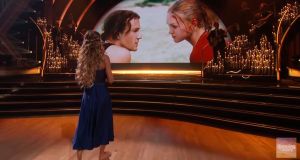
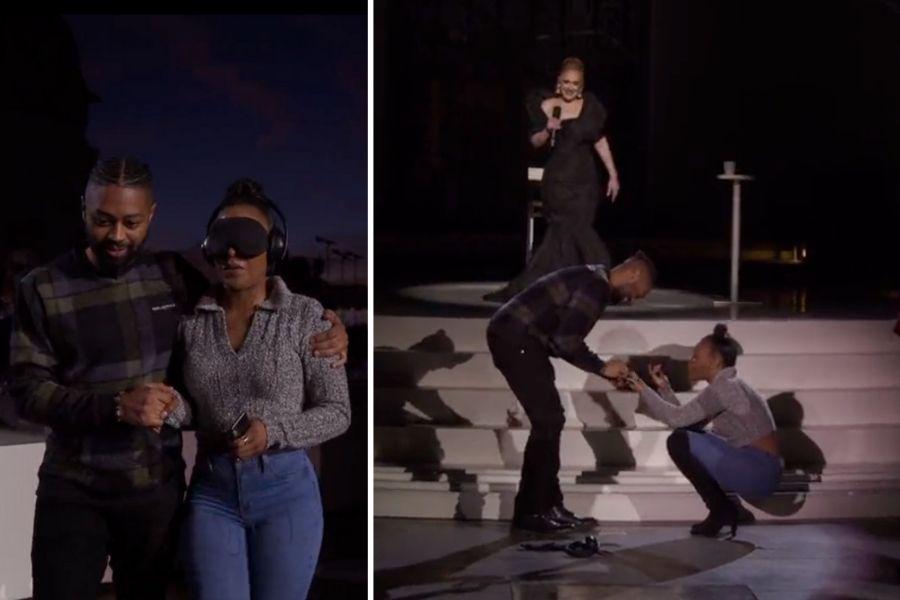
Photo credit: CBS/TwitterQuentin Brunson proposed to his girlfriend Ashleigh Mann with the help of Adele and friends.

Last night, Adele’s first live concert in four years aired on CBS, and it was a night to remember for more reasons than that.

Held at the beautiful Griffith Observatory in Los Angeles, the concert was a star-studded event with gorgeous views of the city. Hearing and seeing Adele sing in a stunning black evening gown while the sun set behind her felt almost indulgent in its perfection, but the night was made even more special with a surprise proposal Adele helped orchestrate.

After Adele told the audience to be “really bloody quiet” and had the lights turned down, Quentin Brunson led his girlfriend, Ashleigh Mann, to the front of the stage. She was wearing noise-canceling headphones and a blindfold and had no idea where she was. When she took them off, she found Quentin down on one knee. She could see and hear the crowd, but it wasn’t until after Quentin went through his tearful proposal that Ashleigh found out where she was and who she was with.

Watch:


Can you even imagine? “What is happening? Where am I? OMG, I’m getting engaged! Oh, Adele—HELLO! What? I’m on you’re ‘One Night Only’ special that millions of people around the world are going to be watching on television? Take a seat in the front row, you say? Right here between Lizzo and Melissa McCarthy? UM, OKAY. Oh, you’re singing to me now. Am I dreaming?”

How does one even take in such an experience? It was all so beautiful and clever and surprisingly real. Ashleigh’s “Oh my god, I’ve been your girlfriend for so long” and her “In real life?” during the proposal and her simple, “Yeah” that sealed the deal were so dang cute. But her face when she saw Adele was absolutely priceless. And then Adele’s cackle—AH HA!

The performance of “To Make You Feel My Love,” just iced the cake. So, so sweet. We’re all wiping our eyes with you, Melissa McCarthy.

Quentin and Ashleigh were interviewed by Gayle King on CBS This Morning and shared how the proposal came to be:

Ashleigh said she thought they were going to go on a hayride because they had been talking about going to a pumpkin patch. Ha.

Quentin himself didn’t even know the surprise proposal opportunity was going to involve Adele herself until a couple of days before it happened. And the couple has had to keep the whole thing a secret since the filming—even from their friends and family—which had to have been torture.

What a fun and memorable night. Even people who aren’t fans of public proposals gave props to the surprise. Any proposal that involves Adele singing directly to you in person is pretty much impossible to criticize and impossible to top.

Congratulations to the happy couple!

  • New Canadian law means millions of Americans are now eligible for Canadian citizenship
    Photo credit: CanvaA family in Canada.

    Are you an American who has fantasized about having dual citizenship with Canada, our neighbor to the north? It opens you up to greater job opportunities, allows you to move between countries depending on economic conditions, and lets you qualify for domestic tuition in both nations. Further, with two passports, international travel becomes a lot easier, and you have more options when it’s time to retire.

    Dual citizenship also gives you greater freedom when it comes to health coverage. Would you prefer the private system in the United States or the single-payer system in Canada?

    Millions of Americans may now qualify for Canadian citizenship

    After a new Canadian law was passed in December 2025, millions of Americans, especially those in the Northeast, may be able to qualify for Canadian citizenship more easily. The passage of Bill C-3, part of the Canadian Citizenship Act, reversed a 2009 law that limited eligibility for Canadian citizenship to first-generation relationships only.

    Now, Canadian citizenship is open to anyone who can provide proof of direct lineage from a parent, grandparent, or even great-grandparent who became a Canadian citizen on or after January 1, 1947 (this date differs for those who lived in the province of Newfoundland). However, if the ancestor renounced Canadian citizenship, eligibility stops there.

    Are those with dual American-Canadian citizenship eligible for Canadian healthcare?

    poutine, canada, gravy fries
    Some fries with gravy. Photo credit: Canva

    Americans who are eligible for dual citizenship and want to take advantage of Canada’s universal healthcare can qualify if they live in Canada for a certain number of days each year. For example, if you live in Ontario for at least 153 days a year, you can qualify for Canada’s healthcare system. However, if you have dual citizenship, you can’t simply travel from Detroit to Windsor whenever you want to see a doctor.

    Since the law was passed in late 2025, thousands of Americans have applied for dual citizenship. Nicholas Berning, an immigration attorney at Boundary Bay Law in Bellingham, Washington, said that his legal practice has been “flooded” with applicants. Amandeep Hayer, an immigration attorney in Vancouver, British Columbia, told The Associated Press that his practice went from 200 cases a year to over 20 consultations a day. Hayer estimated that millions of Americans could qualify for dual citizenship under the new law.

    Cassandra Fultz, an Ottawa-based immigration consultant, said that her American caseload has surged from 10 applicants a month to 100. “There’s been a very steady increase in interest in moving to Canada since November 2024, which is unprecedented. I’ve never seen this in my 17 years in the industry,” Fultz told CNN.

    canada, canadian lake, canadian flag, woman in hat, blue lake
    A woman looking at a Canadian lake. Photo credit: Canva

    How much does it cost?

    If you have documents proving that you had a parent, grandparent, or great-grandparent who was a Canadian citizen, the cost to apply for Canadian citizenship is only $75 CA ($55 U.S.). However, costs can quickly rise if you need to hire an attorney or obtain death or marriage certificates to prove your case.

    There’s an old saying: “But without one nest, a bird may call the world its home.” If you’re an American who wants to broaden your horizons and expand your opportunities to choose the life you wish, check your family tree. You may be eligible for Canadian citizenship.

  • People are bewildered to learn that half of Canada lives south of North Dakota
    Photo credit: CanvaThere are lots of fun facts about the United States-Canada border.

    Canada is north of the United States” sounds like a basic fact that even elementary school children know to be true. But is it really? It turns out, the actual geographic reality isn’t quite that simple.

    In fact, the Canadian-American border is all kinds of weird when you start examining it closely. The long part that looks like a straight line on the map is actually 900 zigzagging lines. Sometimes that “straight” line along the 49th parallel varies by hundreds of feet. There’s a disputed island along the border that both countries claim as their own.

    But perhaps the most surprising factoid about the border is how much of it (and the Canadian population that lives above it) is actually south of the northernmost U.S. states.

    If someone told you half of Canadians live south of North Dakota and Washington, it sounds wrong, right? But it’s right.

    @geomap.bytes

    You Can Travel SOUTH to Canada?! 🤯 The Border Fact No One Expects 🇺🇸🇨🇦 #TikTokLearningCampaign #didyouknow #geography #usa #canada

    ♬ original sound – GeoMapBytes

    As a geomap.bytes TikTok video explains, about 70% of Canadians have historically lived south of the 49th parallel. But even more surprising is that around half of all Canadians live south of the southern borders of North Dakota and Washington. An even wilder fact is that the southernmost point in Canada sits south of some part of 27 U.S. states. It’s even slightly south of a small part of Northern California.

    According to the video, more Americans than Canadians live north of Canada’s southernmost point, Middle Island in Lake Erie. How is that true? Let’s look at the math.

    The population of Canada as of 2026 is approximately 40 million people, so 50% would be around 20 million. The U.S. population is a little over 342 million, so only about 6% of the U.S. population needs to live north of Middle Island for that math to work out. It does, as RealLifeLore explains:

    Commenters (especially those who don’t live near that part of either country) are bewildered by these counterintuitive facts:

    “Wow this is crazy: if you go south from Detroit you end up in Canada 🤯🤯🤯”

    “Journey: ‘born and raised in South Detroit’ …so Canada.”

    “I mean it’s like I knew this because I know where the border is yet I’ve never really thought about it or really registered it in my brain.”

    “Geography can be really weird at times.”

    Though it may sound strange at first, the way the populations pan out actually does make sense geographically. Canada may be enormous land-wise, but the most easily habitable parts, climate-wise, are in the southern part of the country. The major population centers of Toronto, Montreal, and Ottawa are all in that triangular area between Michigan and New York. And the vast majority (90%, according to the CBC) of Canadians live within 100 miles (160 km) of the U.S. border.

    More surprising facts about Canadian-American geography (from Across the Globe):

    • The U.S.-Canada border is delineated by the longest clear-cut strip of land in the world.
    • Point Roberts, Washington, is only accessible by car if you drive through part of Canada.
    • The northernmost point in the contiguous U.S. is a bit of Minnesota jutting up into Canada. It was the result of a mapmaking mistake.
    • The disputed island mentioned at the beginning of this article is home to nearly 10,000 puffins.
    • The international border runs along the yellow centerline of a street that separates Derby Line, Vermont from Stanstead, Quebec.
    • At the border crossing in Blaine, Washington, a 67-foot concrete arch straddles the border between the two countries. The words “Children of a common mother” mark the American side. “Brethren dwelling together in unity” is written on the Canadian side.
    • The Great Lakes that sit between the two countries hold 21% of the world’s fresh water.
    • Lake Michigan is the only one of the Great Lakes that lies entirely within the U.S.

    Canada and the U.S. have been on friendly terms for the vast majority of their mutual history, which is quite remarkable considering the history of the world. There’s a lot to love about our northern neighbors and a lot to know about the crooked line that delineates the two nations.

  • American working in Finland made videos comparing work cultures. The differences are wild.
    Photo credit: CanvaA man happy at his desk; a man passed out on a couch.
    ,

    American working in Finland made videos comparing work cultures. The differences are wild.

    From 4:30 AM wake-ups to getting tucked in by Jeff Bezos at 1 AM, this parody of the American workday hits way too close to home

    Finland gets a lot of attention for its approach to work-life balance, from four-day workweek experiments to generous parental leave policies. This has created some pretty entertaining stereotypes about what working in Finland must be like. Dan Toomey, an American who works for Morning Brew in Finland, decided to lean all the way into those stereotypes with a pair of TikTok videos that have people laughing at how painfully accurate they are.

    In the first video, Toomey shows what Americans think the average Finnish workday looks like. It starts with him stepping out of his morning sauna, followed by hot chocolate hand-delivered by his company.

    Breakfast? Muesli and pine needles, naturally.

    Around 11 AM, he finally sits down to work. “Since we all work at Spotify,” he explains, he begins his day by listening to ambient synth music while wrapped in a felt blanket. His daily $5,000 bonus arrives in the mail. He has a casual chat about Eurovision with Finland’s 36-year-old Prime Minister. Lunch is cold herring and more pine needles, followed by a walk through Narnia. He wraps up at 3:30 PM after his first and only meeting of the day, just in time for his second bonus to arrive.

    The American workday video, on the other hand, looks like something from a particularly dark comedy sketch.

    It begins at 4:30 AM on a Sunday. The American worker “sprints out of bed in record time,” recites the pledge of allegiance, and prepares breakfast: 12 eggs and a gallon of whole milk, consumed while staring at his phone. He writes emails for three hours straight before his first meeting, where everyone “shares big numbers, then makes a million dollars” as cash literally rains down on him.

    Lunch is “every fast food there is,” eaten quickly before he squats at his desk to memorize a PowerPoint presentation. The workday finally ends at 1 AM when he places a spreadsheet under his pillow and gets tucked into bed by Jeff Bezos himself.

    The videos are obviously satirical, but they hit a nerve because they’re rooted in real cultural differences. Finland genuinely does have policies that prioritize employee well-being in ways that seem almost fictional to American workers. Meanwhile, American hustle culture has created an environment where working yourself to exhaustion is often worn as a badge of honor.

    Both videos have been praised not just for their humor, but for their critique of what we’ve normalized in our work cultures. As conversations about sustainable work practices continue, maybe the real question isn’t whether the stereotypes are accurate. It’s which version of the workday we actually want to be living.

  • She refused to ‘sacrifice’ her upgraded seat so a mom could sit next to her preteen kids
    Tammy Nelson refused to change seats for mom and kids

    If you’ve traveled on an airplane in the last several years, you know it’s much cheaper to choose the basic seats in the main cabin. There’s nothing inherently different about these particular seats, other than the fact that it will be randomly selected by the airline. If you’re traveling alone, that’s really not a bad deal, but if you’re traveling with a party that you’d like to keep together, like your children, the risk gets to be a little higher. One mom traveling with an 11 and 15-year old took the risk and banked on a stranger accommodating…that’s not quite how it played out.

    Her seat was taken, on purpose

    Tammy Nelson did a double take at her ticket after seeing the mom in her window seat. Of course, people accidentally sit in the wrong seats on planes all the time. However, Nelson quickly realized that this was no accident. This mom boarded the plane with her older children and had taken it upon herself to sit in the same row as her children, essentially commandeering a stranger’s seat. Nelson assumed it was a mistake and informed the woman that the seat was in fact hers but the response she received was surprising.

    “She said, ‘Oh, you want to sit here?’,” Nelson told Good Morning America. “She said, ‘Oh, well I just thought I could switch with you because these are my kids.’”

     That’s an interesting assumption considering seats are assigned and many people, like Nelson, pay extra to have the seat they prefer. Now, there’s no telling if funds were tight and this was an unplanned trip for the mom and kids which caused her to buy the more budget friendly tickets or if she was simply being frugal and was banking on the kindness of a stranger.

    Either way, Nelson specifically paid for a window seat due to motion sickness and though she paid extra, she was willing to sit in the other row if that seat was also a window seat. But it turns out, it was a middle seat.

    Surely there’s someone out there that loves the middle seat. Maybe a cold natured person that enjoys the body heat of two strangers sitting uncomfortably close. Or perhaps someone that doesn’t mind accidentally sleeping on an unsuspecting passenger’s shoulder. But that person wasn’t Nelson, so when the middle seat was offered in exchange for her bought and paid for window seat, she politely but firmly declined.

    @myconquering

    Having had only 90 minutes of sleep the night before and knowing I had to give a presentation to 500 people, I desperately needed some sleep, so I did not agree to switch seats. 🤷‍♀️ Before anyone comes after me… the kids looked like they were about 11 and 15 years old. And the mom was in arms-reach of both of them from the middle seat in the row behind us. The mom proceeded to complain for at least 15 minutes to the person next to her loud enough for me to hear. But the woman actually defended me – several times. It was so kind and I appreciated it so much because I was feeling really guilty. 🤦‍♀️ #airplaneseat#seatswitching#airplanekarens

    ♬ original sound – MyCONQUERing

    The internet had a lot to say

    Her refusal to give in to the mom’s seemingly entitled request for Nelson’s seat has resulted in parents and child-free people cheering her on after she posted the details on her TikTok page, MyCONQUERing, which quickly racked over 3.4 million views.

    “Nope. If it’s not an upgrade it’s a sacrifice,” a commenter wrote.

    “You did the RIGHT thing. Folks need to plan their travel together. Lack of planning on their part does not constitute an inconvenience on yours,” one person said.

    “I have 3 kids and have sat in different rows when they were passed toddler age. I agree, book your flight earlier,” another said.

    “You were right. As a woman with 3 children, I always pay extra so we’re sat together,” another mom said.

    This story actually changed things

     Luckily, there’s been enough incidences like this to prompt actual change. More airlines are guaranteeing free family seating for parents with children under a certain age (not that that does much more the woman in this story, but still). The U.S. Department of Transportation proposed a rule under the Biden administration requiring airlines to provide fee-free family seating, but as of 2026 its future under the Trump administration remains uncertain. Five of the 10 largest airlines currently guarantee free family seating voluntarily.

    This article originally appeared three years ago. It has since been updated.

  • Anne Hathaway shares the ‘unintended consequence’ of her iconic ‘Princess Diaries’ makeover
    Photo credit: RedditAnne Hathaway in The Princess Diaries.
    ,

    Anne Hathaway shares the ‘unintended consequence’ of her iconic ‘Princess Diaries’ makeover

    One of the film’s most memorable moments came with a “terrible side effect.”

    It’s a trope as old as time: the charming, yet conventionally unattractive girl gets a makeover, and suddenly her looks match her winning personality, opening an entire world of possibilities…and love interests. 

    And how do we know she’s conventionally unattractive? Glasses (because attractive people don’t read and can see perfectly, duh) and unkempt curly hair. 

    In pop culture, almost nothing instantly clocks a woman as less desirable or polished. At best, they can be the carefree bohemian or funny best friend. But you can bet you bottom dollar that if they are to be seen as a romantic love interest in any way, shape, or form, that hair is gonna be flat-ironed within an inch of its life. It’s screenwriting 101, people. 

    An era-defining transformation

    One lasting example of this is the makeover scene in The Princess Diaries, wherein Mia Thermopolis (played by Anne Hathaway) goes from adorkable to refined thanks to a bit of hair straightening, plus some makeup, contacts, and intense eyebrow tweezing. 

    In a recent interview with People, Hathaway shared that the filmmaker never actually intended to promote the “curly = ugly” stereotype. It was actually just a logistical strategy. 

    “My natural hair is rather straight, so we had to create a contrast,” she shared, adding that going with her naturally straight hair meant “less time in the makeup trailer” overall. 

    …with “unintended consequences”

    As a result, however, the message many audiences read was “curly hair is unattractive,” which Hathaway labeled as a “terrible, completely unintended side effect.”

    If the comments section was any indicator, Hathaway was correct in saying the “unintended consequence” of that scene was the profound effect it left with viewers. 

    “I (a curly haired girly) started straightening my hair after I saw the scene at 12.”

    “Yeah, watching this movie when it came out as someone who had curly hair and glasses did something to me lol.”

    “I had curly hair and glasses when this movie came out and was bullied for both. I was in middle school and to this day I can’t watch this movie because it made me feel like the bullies were right. As an adult I know better but the gut feelings are still there.”

    Granted, the creative decision might have been made in part for practical reasons, but let’s not forget that this movie came out in the early 2000s…a fairly rigid time period for beauty standards overall. The Princess Diaries was far from the only movie to portray curls (or glasses, or freckles, or anything past a size 2) as “ugly.” For all its good parts, the film was definitely a product of its time. 

    Straightening out the curl narrative

    Thankfully, we’ve seen a lot of progress in this department. Not only do we see far more characters in media sporting their curls, but, thanks to social media, there’s a much larger wealth of knowledge for how to style and take care of curly hair.

    Truly, there’s an entire language (I’m 2C to 3B type myself…iykyk) dedicated to curls now that simply did not exist at an earlier time. Not knowing that curls require an entirely different routine left many of us to resort to straightening or making peace with feeling like the ”ugly” one. 

    Even still, curls that aren’t styled and left in their Mia Thermopolis state are still often viewed by society as unprofessional, undesirable, or unclean in some way. That’s why representation matters. It’s so important to have our pop culture reflect a different reality so that we might start internalizing a different story and unlearning harmful stigma.

    All this to say…Princess Diaries 3 should definitely let Mia’s curls go free. Just sayin’. 

  • Disney re-animates 3 iconic songs to include ASL, and the Deaf community calls it ‘incredible’
    Photo credit: The Walt Disney Company and Walt Disney Animation Studios/YoutubeMoana 2, Frozen 2, and Encanto

    On April 27, in celebration of National Deaf History Month, Disney unveiled three beloved songs completely reanimated to feature the characters performing in American Sign Language (ASL).

    The idea for the project, titled Songs in Sign Language, came from Senior Animator and Director Hyrum Osmond, whose Disney credits include Frozen (2013) and Zooptopia (2016). 

    In a special “making of video,” Osmond recalled growing up with a father who was “hard of hearing,” but never learning sign language to communicate with him. 

    “I have a lot of regret about that, because I couldn’t connect with him. I wanted to take down barriers with this project. It’s really all about connection.”

    A groundbreaking effort rooted in authenticity

    In a never-before-done undertaking for the studio, a team of more than 20 animators, many of them passionate volunteers, collaborated with the Tony Award-winning company Deaf West Theatre to curate signs that best matched each character’s specific personality. 

    This didn’t only involve hand movements, but “facial grammar” as well, meaning specific ways the face is used in ASL to further convey linguistic information. Raised eyebrows, for example, are used at the end of a sentence when asking simple questions. Furrowed eyebrows, on the other hand, are used when asking more complex “Who, What, Where, Why” type questions.

    These efforts—done without AI, praise be—resulted in new animation for approximately 95% of the shots from “The Next Right Thing” (Frozen 2), “We Don’t Talk About Bruno” (Encanto), and “Beyond” (Moana 2). 

    This is far from Disney’s first attempt at making its magic available in ASL. There have been many heartwarming stories of characters in the park using sign language to connect with guests. But, save that one episode of the Little Mermaid series in the ’90s (iykyk), this is something completely new. 

    “We’ve never done anything like this at Disney Animation before,” shared Osmund. 

    People are already speaking out in praise of Songs in Sign Language, and hoping it leads to more. 

    “As someone who is partially deaf in one ear, I fully support this and think it’s very important and heartwarming that they’re doing this.”

    “I would love to see more Encanto, Frozen II and Moana 2 songs in ASL! I am currently learning ASL and I’m a senior in high school, my ASL teacher who is hearing and is learning ASL like me and my classmates are would love this!”

    Many of the compliments weren’t even about inclusivity. People also shared relief to see “creativity breaking through again,” as one viewer put it. 

    “Disney if you get back into funding cool, artistic and niche things like this that people want you’ll win people back over !!!!!!! What was special was always the details and that’s been lost the last 6 years or so. This is amazing,” commented one viewer. 

    DJ Kurs, artistic director for Deaf West Theatre, also hopes the collaboration will lead to more. 

    “Disney stories are the universal language of childhood. The chance to bring our language into that world was a historic opportunity to reach a global audience. Working on this project was very emotional. For so long, we have known and loved the artistic medium of Disney Animation. Here, the art form was adapting to us. I hope this unlocks possibilities in the minds and hearts of Deaf children, and that this all leads to more down the road.”

    Where to watch

    Songs in Sign Language is currently only available to stream on Disney+, but we know it’s only a matter of time before the Internet does its thing. 

  • At 6:30 a.m., Japanese radio plays ten minutes of ‘Radio Taiso’ and it’s getting people moving
    Photo credit: CanvaTwo people exercise in a park.
    ,

    At 6:30 a.m., Japanese radio plays ten minutes of ‘Radio Taiso’ and it’s getting people moving

    “Radio Taiso was inspired a century ago by a similar radio program in the United States.”

    It’s early morning and you’re snuggled tightly under the warm covers. Your alarm buzz isn’t quite enough to entice you to get up and en route to begin your day. But what if there was a public radio announcement with a trusty reminder that it’s good for the body, if possible, to get up and move? Well, in Japan, there is.

    The Associated Press posted a clip on YouTube of people lightly stretching in various locations across Japan. They explain that this is a common practice. “This is how Japan wakes up,” a voiceover shares. “It’s called Radio Taiso. In English, it’s radio exercise. It’s a very simple idea. At 6:30 in the morning, on the radio, you get music. You get choreography to exercise by. People gather in city parks to do it. People gather in their offices. At schools. You can do it at home.”

    Good for all ages

    The exercise regimen is nothing too heavy. “The exercises are not very strenuous—just exercise and basic calisthenics,” they explain. “It’s suitable for all ages and everybody can do it. You can exert yourself a lot if you want, but you don’t have to.”

    The host of the segment points out that Japan has a “long-lived population.” He shares, “As we all know, Japan is famous for longevity. I wouldn’t say that Radio Taiso is why, but it certainly can’t hurt anything.”

    According to the BBC, Japan continues to break records for long, healthy lives: “The number of people in Japan aged 100 or older has risen to a record high of nearly 100,000, its government has announced. Setting a new record for the 55th year in a row, the number of centenarians in Japan was 99,763 as of September.”

    100-year history

    In a recent article, Yahoo!life explains that this tradition has been around for nearly a century. “Radio Taiso has an almost 100-year history,” write article author Stephen Wade, “formally introduced in 1928 and coinciding with the enthronement of Emperor Hirohito. The tradition endures because the exercises are suitable for all ages and capabilities, and easily accessible.”

    Even more interestingly, Wade shares the roots of the exercise, writing, “Radio Taiso was inspired a century ago by a similar radio program in the United States sponsored by the Metropolitan Life Insurance Co. The Japan Radio Taiso Federation says officials of the postal ministry visited the United States in the 1920s and returned to Japan with the concept.”

    The Japan Society explains that these routines, of course, are helpful for all ages. On their website they write, “Fun for children and adults alike, Radio Taiso is commonly used for group warm-ups in Japan and the whole school will participate in the exercises at the beginning of school Sports Day.”

    They add that it gained popularity because of the positive mental and physical effects it seemed to have on citizens. “The purpose of Radio Taiso is to improve general health and fitness,” they write, “and the routine is therefore designed to be simple and accessible to all. It requires no equipment, can be done in a small space, and can be modified for those with mobility issues.”

    Simple movements

    The movements, as mentioned, are simple. Similarly to yoga, it begins with arm exercises. Participants lift their arms up and move them in gentle circles. Then, they slightly bend and twist their legs.

    This continues for about ten-second intervals, adding bends in each direction, like a ballet routine. Then, there’s more twists, shoulder movements, slight hopping, and squats. Wade shares, “Each movement is repeated four to eight times, with instructions throughout to relax, breathe, and inhale and exhale slowly.”

    Kodomokai

    I reached out to an old high school friend, Nathan Hillyer, who has been living in Japan for quite some time. He confirmed that while it still exists, it’s mostly practiced by and beneficial to the elderly. “In the park near where I live, old people tend to go there to do it. It is run by NHK Radio 1 at 6:30 in the morning,” he shares.

    He adds that his wife, Asuka Hillyer, shared that she would wake up early to do it back in the day. “My wife said when she was a kid, she would do it as a part of the ‘kodomokai’ (community kids club). They would get a stamp or something every morning, and if they had a certain number by the end of the year, they would get a prize. They would show up wearing their community paper kind of tied around their neck.”

    Hillyer also recalled that the radio exercises began in the West. “I remember watching old American comedies in black and white, maybe W.C. Fields or something like that. They were in funny situations in which someone is trying to do their radio exercises and hearing the voice, but either they can’t keep up or something happens in the real space which is not matching the radio routine.”

    He adds, “In Japan, it is quite the phenomenon because the Japanese tend to be very community-oriented.”

  • Fake towns on real maps: Why ‘phantom settlements’ exist and how one became real…sort of
    Photo credit: CanvaWhat do you do when you see a town name on a map but it doesn't actually exist?
    ,

    Fake towns on real maps: Why ‘phantom settlements’ exist and how one became real…sort of

    Algoe, New York, was a fake town at the heart of a legal dispute between two mapmakers.

    When you look at a state map, you see cities and towns of various sizes and populations. Even the tiniest towns with a handful of people—or even just one resident—have a place on the map.

    One might assume, then, that every named town on every published map is a real place. But as it turns out, there have been imaginary towns on maps, from centuries ago up until the relatively recent past. And they were published that way on purpose.

    The map trap was a clever way to prevent plagiarism

    They’re called “phantom settlements” or “paper towns” and are part of a phenomenon known as map traps. Basically, map traps are place names conjured out of thin air and put on a map to protect a mapmaker’s copyright.

    It may seem strange for a professional mapmaker to make a map wrong on purpose, but it’s actually rather brilliant. Historically, cartography has been an incredibly important profession. Before the Internet and global positioning systems, paper maps were how people oriented themselves and found their way from place to place. Creating an accurate map was a vital and valuable skill.

    If a cartographer created and published a map, they wouldn’t want people to plagiarize it. Inventing phantom settlements—pretend places with fake names that only exist on a map—was a way for cartographers to essentially “watermark” their original maps. If someone else made a map that included the fake town (or street or other detail), it would be clear whose map they had plagiarized.

    Two women looking at a map. Photo credit: Canva

    The confusing nonexistence of Algoe, New York

    One of these phantom settlement map traps was (or wasn’t?) Algoe, New York. If you’ve read John Green’s novel Paper Towns, you’re probably familiar with it. It’s not a real town. It never existed.

    Algoe was the brainchild of Otto Lindberg and Ernest Alpers from General Drafting Company. In the 1930s, they were commissioned to create a map of New York and dropped the fictional Algoe at a dirt road intersection in the Catskill Mountains.

    Some years later, Rand McNally published a map that included Algoe. The trap worked. Or did it? When General Drafting threatened to sue the mapmaking giant, Rand McNally told them they would lose.

    general store, geography, maps, mapmaking
    Who knew a general store could be enough to prove a place existed? Photo credit: Canva

    In an ironic twist of events, an “Algoe General Store” had been built at the intersection where Algoe was located (but didn’t really exist) on the map. The store owner had seen Algoe on the map and named his general store accordingly. Rand McNally claimed it had obtained the coordinates for Algoe from county records. And those records showed the Algoe General Store located at that place on the map, hence Algoe showing up on their map.

    Do map traps still exist in the age of online maps?

    Though there wasn’t a real town there and the shop didn’t last long, the general store’s name was enough to prove that a place called Algoe did exist. In fact, it was apparently included on Google Maps up until 2014, even though it was never actually a real place.

    Today, if you type “Algoe, New York” into a Google Maps search, it comes back with a “no results” message. The same goes for “goblu” and “beatosu,” two fictional places in Michigan that were included in the official map of Michigan in 1978. (Variations of “Go Blue” and “Beat OSU” were a shout-out to the rivalry between the University of Michigan and Ohio State University by Peter Fletcher, the former chairman of the Michigan State Highway Commission. The map was also reprinted after some complaints.)

    It’s hard to know how many phantom settlements in countries around the world have snuck into our modern navigation systems, but by now, it’s safe to guess they’ve mostly, if not entirely, been weeded out.

    But hey, if you want to invent your own town, maybe start by building a general store with your proposed town’s name on it. It seems to be the way to go.

Identity

People are bewildered to learn that half of Canada lives south of North Dakota

Family

Why people have been accidentally giving Einstein credit for this powerful quote about fairytales

Science

She emailed her boss to request time off. The ‘gibberish’ she wrote saved her life.

Culture

American working in Finland made videos comparing work cultures. The differences are wild.