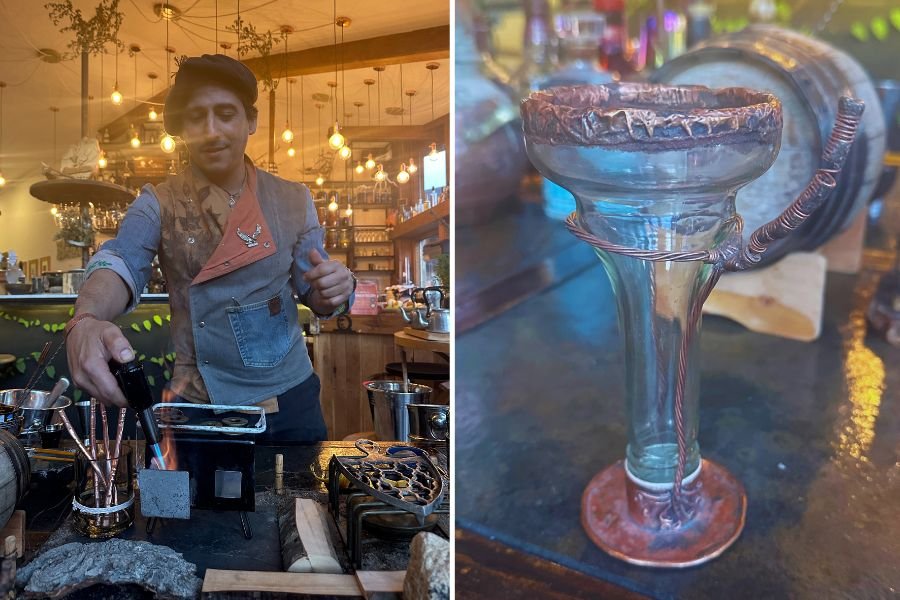
When people talk about sustainability in the food and drink industry, there’s a lot of talk about plastic straws and reducing waste. But at Bar Pionero, the sustainability standard is set much, much higher. They do things I didn’t even know were possible, and they don’t do things a lot of people—those who put profit before protection of the environment—would do in the name of conservation.
And most of it comes down to the vision of elite bartender Federico Gil.
Gil and his brother founded Bar Pionero 14 years ago, after moving to Chilean Patagonia from Uruguay. The bar sits adjacent to the main lobby of the Las Torres Hotel, just inside Torres del Paine National Park, and with its wall of windows framing a towering mountain, just being in the bar is an experience. The food is good, and as someone who doesn’t drink, I was delighted by the incredible mocktail offerings. But the highlight of the bar is Gil himself.
Watching Gil speak about sustainability was mesmerizing, even with him speaking in Spanish and me only understanding a few words of what he said. For the details, I needed the English-speaking translator, but Gil’s passion for sustainability needed no translation; it was genuine and palpable. Federico Gil shares how Bar Pionero creates its sustainable cocktails. Annie Reneau
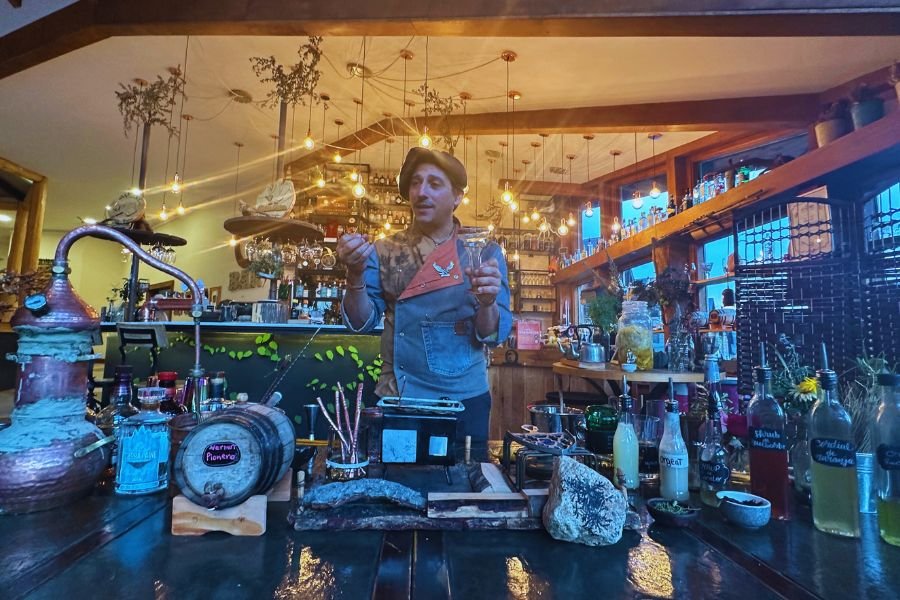
On a practical level, here are some of the zero-waste practices the bar has implemented:
– Not only do they not use plastic straws but they use signature copper straws. Chile is the world’s largest copper producer, so the metal is plentiful. It’s also naturally anti-bacterial (though they have a sanitation process they use to clean them, of course).
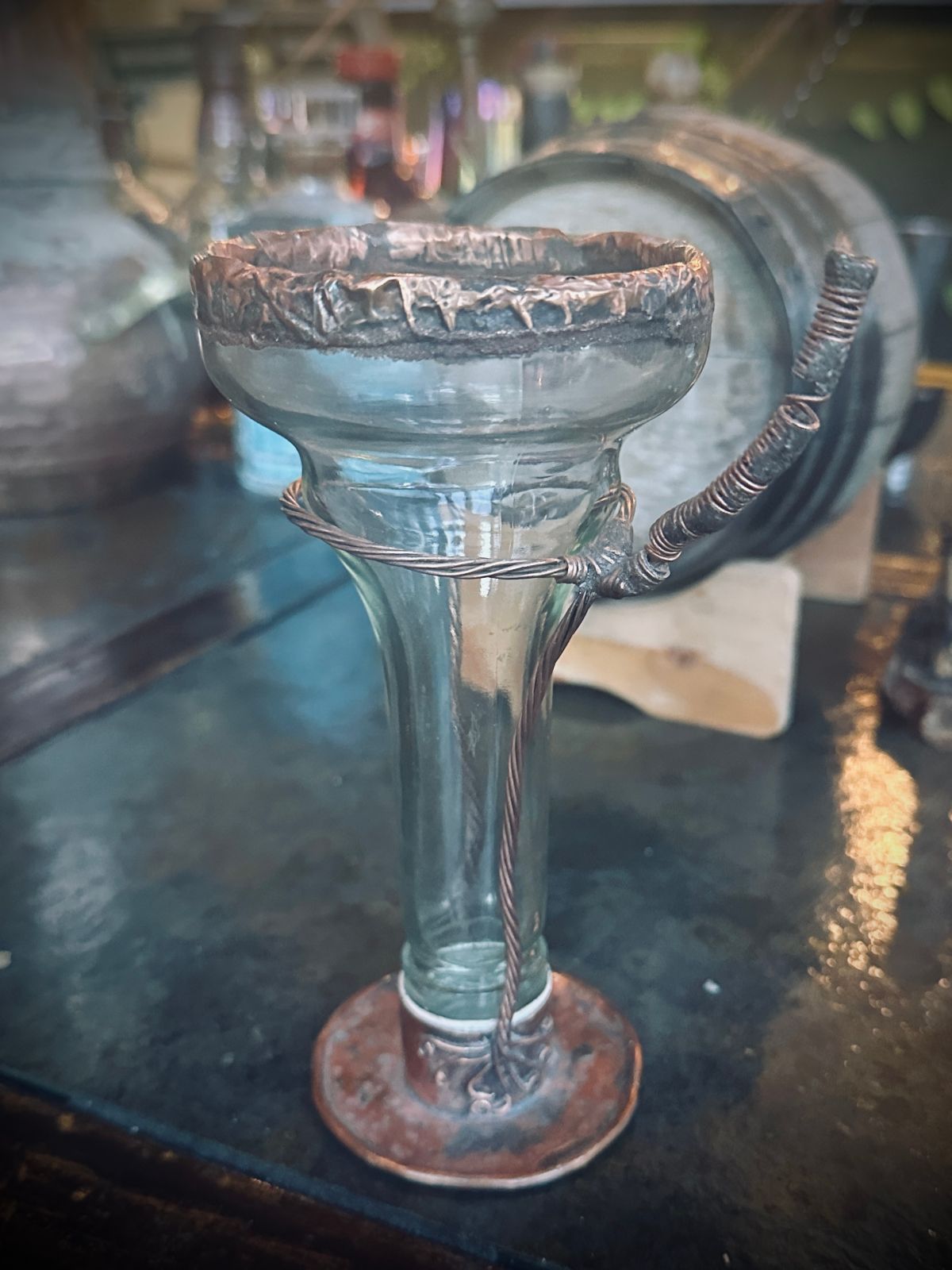
– They repurpose bottles and jars into drinking glasses and tools for the bartenders. Sometimes they even combine them with copper. Check out this gorgeous glass made from an upside down glass bottle top and copper.Cocktail glass made from a glass bottle top and copper Annie Reneau
– They make their own mixes, spirits, bitters, vinegars, etc. from the plants that grow naturally in the surrounding landscape as well as from the organic garden on site.
– They also make vinegar by capturing and repurposing the dribbles of beer that come out of the tap after a draft beer is poured.
– They brew their own beer using pure glacial water and hops grown in the garden. The byproduct of the brewing process then goes back into the garden as fertilizer.Glacier in Torres del Paine National Park, part of the Southern Patagonia Ice Field Annie Reneau

– They distill their own gin in small batches, using glacial water, 13 botanicals from the natural landscape and the clay left behind from the moving glaciers. Gil says his goal with the gin is to convey the “spirit of the ice.” Glacial gin. Who knew?
The gin is so unique, Gil could certainly make money distributing it around the world, but he refuses. Same with the beer.
“The world doesn’t need one more gin or one more beer,” he says. The most sustainable way is not to sell it outside the hotel, where it would have to be shipped and transported. “We’re not thinking about how much we can sell, but what impact we have,” he adds.
It’s literally putting their money where their mouth is, knowing they could have a lucrative product on their hands but not capitalizing on it because of the environmental impact that would have. And it’s not just a guess—Gil says the bar actually keeps track and calculates their environmental impact using various measures.Federico Gil painting a lemon extraction onto a frozen rock from Torres del Paine National Park Annie Reneau
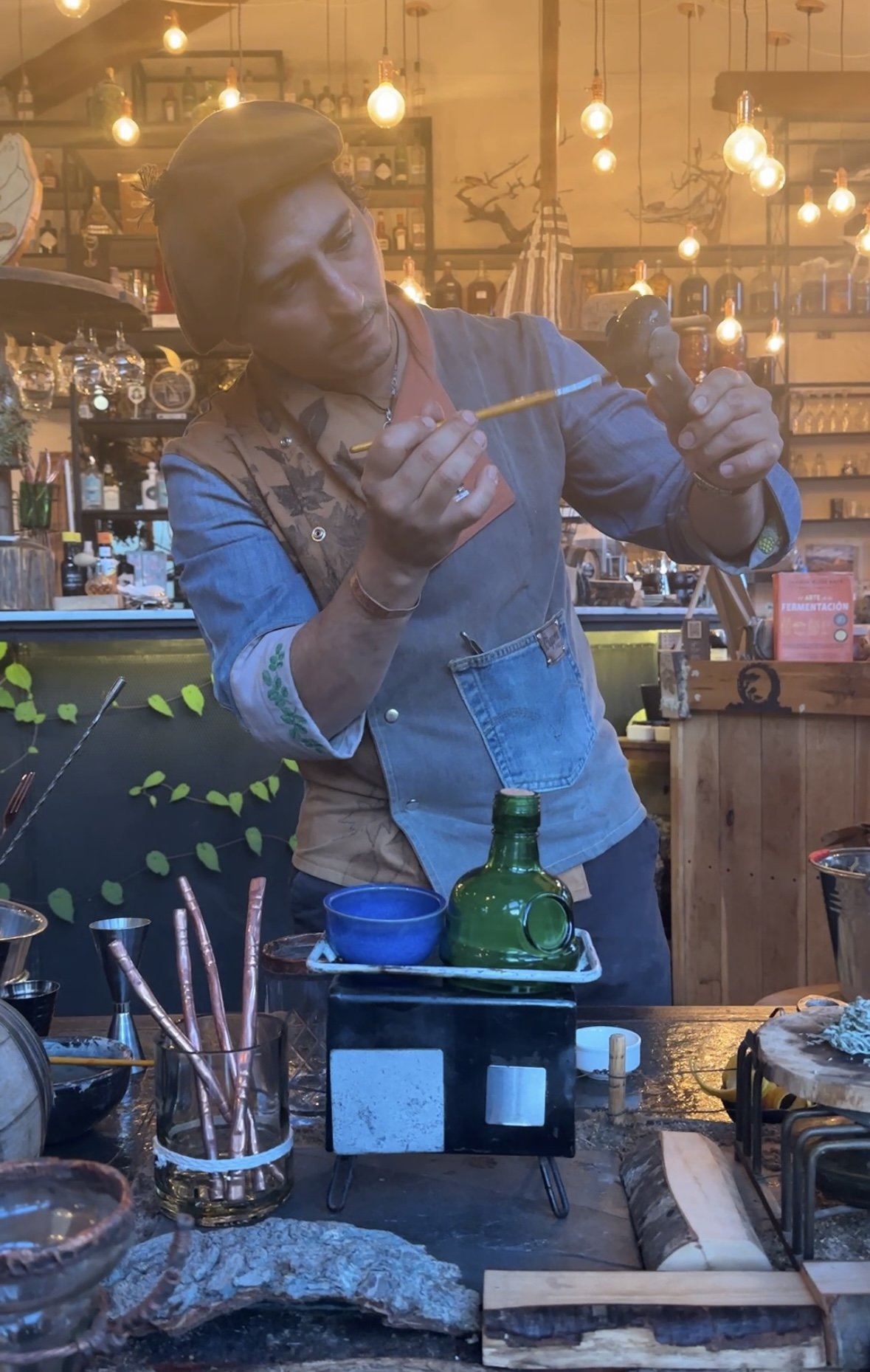
On top of all of that, watching Gil craft a cocktail is like watching an artist at work. He’s as passionate about creativity as he is about sustainability, and it shows. I watched him light herbs on fire and set a glass bottle top over the flame to capture their essence, then paint a homemade cold extraction of lemon onto a frozen stone from the park, then shake together various liquids created from park botanicals and put it all together into glass made of layers of jar and glass tops.
I’d never seen anything like it, and I’ve rarely seen anyone who walks the sustainability talk so clearly in their work. It not only gave me hope for the conservation of Torres del Paine and Patagonia (which is stunning—a place bucket lists are made for, seriously), but also made me realize how much we have to learn from one another as we strive to protect our beautiful planet.
If you’d like to see Federico in action, check out this video from my experience there:
From Pakistan to Tanzania, the most effective education solutions are community-led. Here’s how local leaders, in partnership with Malala Fund and supported by Pura, are mobilizing entire communities.
When asked to describe what Tanzania smells like, Grace Isekore closes her eyes and breathes in deep. For a moment, she’s somewhere else entirely. Tanzania is a rich tapestry of sights and scents, from the smell of sea mist that permeates the coastline to the earthy cardamom and cloves she cooks with in her kitchen. But when Grace emerges from her reverie, her answer is unexpected.
“Tanzania smells like peace,” she says, her eyes still closed. “I see a beautiful country where we are free to move, free to speak. And there is peace within the community.”
For Grace, that sense of peace isn’t just something she smells; it’s something she works toward every day. As a project coordinator with Pastoral Women’s Council (PWC), a women-led organization that empowers pastoralist communities in northern Tanzania, she has seen firsthand how girls flourish when they have the opportunity to attend school. Like scent, education not only connects girls to their own culture, but also helps broaden their horizons, realizing new possibilities for themselves and others. That transformation reshapes entire communities and ripples outward, with the potential to change countries and transform the world for the better.
Different scents, different approaches, and communities driving change
Spices in Tanzania. Captured by James Roh for Pura
For Grace and others around the world, education is freedom, as well as a pathway to a stronger community. Rooted in that shared belief, Pura, a home fragrance company, was inspired to build on their four-year partnership with Malala Fund to create something truly unique: a fragrance collection that connects people through scent to communities in Tanzania, Nigeria, Pakistan, and Brazil, where barriers to girls’ education are among the highest.
Using ingredients from each region, the new Pura x Malala Fund Collection uses scent to transport people to these regions directly. “Future in Bloom,” for example, invokes Pakistan’s lush valleys through notes of jasmine, cedarwood, and mango; while Tanzania’s fragrance, “Heart on Fire,” evokes the spirit and joyfulness of the girls who live there through cardamom, lemon, and green tea.
The new Collection honors the work Malala Fund does every day, partnering with locally-led organizations in these four countries to ensure every girl can access and complete 12 years of education. Each scent celebrates the joy, tenacity, and courage of the women and girls driving change on the ground, while also augmenting Pura’s annual grant to Malala Fund by donating eight percent of net revenue from the Pura x Malala Fund Collection to Malala Fund directly.
Just as each country’s scent is unique, so too are their needs related to education. But with support from Malala Fund and Pura, local leaders are coming up with creative ways to mobilize entire communities (parents, teachers, elders, and the students themselves, in their pursuit of solutions, understanding that educating girls helps everyone thrive. Here’s how their efforts are creating real, durable impact in Tanzania and Pakistan, and creating a ripple effect that changes the world for the better.
Parent-teacher associations help Maasai girls and their communities in Tanzania problem-solve
A girl’s school in Tanzania. Captured by James Roh for Pura
Northern Tanzania, Grace’s home, is home to pastoralist communities like the Maasai, a nomadic people who have moved with the seasons to nurture the land and care for their livestock for centuries. The nomadic nature of this lifestyle creates significant and unique barriers to girls’ education. Longstanding gender roles have enabled Maasai to survive in the harsh environment and have placed great value on both women and men. Over time, as nomadic life has been threatened by the privatization of land and stationary education models have been implemented, the reality of pastoralist livelihood has shifted and introduced new complexities. Now, the sheer distance to schools is both a practical challenge and one that often comes with danger from the landscape, predators, and potential exposure to assault along the journey. Girls shoulder the responsibility of household chores and there is often cultural pressure around early marriage – both leading to boys’ education being prioritized over girls’.
“There are very, very good [pastoralist] cultural practices, which are passed from generation to generation,” says Janet Kimori, an English teacher at Lekule Girls Secondary School in Longido, Tanzania. But when cultural practices act as educational barriers, “you have to sit down and look for where you are going to assist. As a school, as an individual, the school administration—all of us will chip in and know how we are going to deal with this problem.”
PWC works to ensure girls are able to exercise their right to an education while also preserving pastoralist culture. One successful approach, the organization found, has been the formation of Parent Teacher Associations (PTAs), created with help from Malala Fund. In PTA meetings, students, parents, teachers, elders, and government officials meet, discuss educational barriers, and come up with community-led solutions that preserve and honor their culture while advancing educational outcomes.
PTA meeting in Tanzania. Captured by James Roh for Pura
One recent PTA meeting highlights how these community-led solutions are often the most effective. At Lekule Girls Secondary School, the lack of fresh water forces girls to walk long distances to collect water for the school’s kitchen during the school day, and these long journeys not only disrupt class time but can leave girls vulnerable to sexual assault in isolated areas. Through facilitated discussion, PTA members landed on a solution: installing a borehole to pipe in fresh water to the school. Reliable access to water creates a better learning environment for the girls, but it also benefits the community at large, as local governments are then more likely to invest in health clinics and other community resources nearby.
With a solution in place, the PTA was then able to discuss ideas and map out a course of action. The women would raise money for the cost of the borehole, while the men would recruit workers to dig the hole and lay the pipe. Together, they would ask government officials to match their investment.
The benefits of PTA meetings within the pastoralist communities are undeniable. “The girls are talking and addressing issues in a confident way, and parents feel they are part of the resource team to solve challenges happening at school,” Grace says. One unexpected benefit: The larger cultural impact these PTA meetings have created. Thanks to the success of PTAs within pastoralist communities, the models are now being endorsed on a national level, and schools across Tanzania are starting to use them to solve problems in their own communities. When a community creates opportunities for girls to learn, everyone benefits.
Safe spaces in rural Pakistan help students and their parents connect, then drive change
Safe space for girls meeting in Pakistan. Captured by Insiya Syed.
A continent away in Pakistan, the country’s northernmost region of Gilgit-Baltistan seems like a land untouched by time. The region’s looming mountains, snow-capped peaks, lush valleys and crystalline lakes draw nature lovers and landscape photographers from around the world, but living among this kind of breathtaking scenery has its drawbacks. Schools in the region are few and far between, and the area’s harsh climate often makes roads inaccessible for travel. Poverty and gender-based discrimination are additional obstacles, making school even further out of reach, and girls are affected disproportionately. Going up against these barriers requires a persistent, quiet strength that’s found in the women who live there and reflected in Pakistan’s signature scent.
Saheli Circles are how local leaders in Gilgit-Baltistan are bridging the gap between girls and education. An Urdu term for “female friend,” Saheli Circles are after-school safe spaces where girls explore subjects like art and climate change, while also developing skills that help them manage emotions, set goals, and build positive relationships. Girls study in groups, visit the library, play sports, and tackle filmmaking and photography projects, all designed to develop self confidence and teach the girls how to advocate for issues that matter to them. But the work doesn’t stop there.
“What we’re trying to achieve here will only be impactful if it trickles down to the home environment and the school environment,” says Marvi Sumro, founder and program director of Innovate, Educate, and Inspire Pakistan (IEI), the local organization that developed the Saheli Circles model and partnered with Malala Fund in 2021 to make it a reality. Ever since, Saheli Circles have grown to involve teachers, elders, and parents to encourage relationship building that’s essential for young girls and adolescents. “Our spaces can give mothers and daughters an opportunity to interact a little differently—do an art activity, or have a cup of tea together, or some good conversation,” Marvi says.
The relationship building is what makes the biggest positive impact throughout the community. Recently, one Saheli Circle was able to bring together parents, teachers, and administrators to advocate for better education at their local school, and together they convinced the department of education to hire a science teacher. Another Saheli Circle organized a fund where members of the community can contribute monthly to pay for uniforms, books, and other school expenses for the girls in their village, eliminating those small, hidden costs that are often a barrier to education for many. A third Saheli Circle was able to produce a short film about how gender-based household chores can take away valuable study time from girls, leaving them at a disadvantage. “The girls put the film together and showed it to the mothers, and the response from the mothers was just beautiful,” Marvi says.
Girls smiling in Pakistan. Captured by Insiya Syed.
The education and relationship building that the girls receive in Saheli Circles connects them to larger opportunities and economic freedom that are not possible in their hometown. “For girls in Gilgit-Baltistan, education is extremely important because of the fact that we’re so far away from where the economy is, where the opportunity is. Education becomes this bridge for us, for our girls, to access all the opportunity and economy that exists in [larger cities].”
From rural Tanzania to remote Pakistan, local organizations prove every day that prioritizing girls’ education benefits everyone. Communities that lift up girls are able to secure resources like clean water and well-staffed schools, as well as build stronger relationships.
These outcomes are only possible because of the women and girls who work tirelessly in these regions to overcome barriers and drive progress. The Pura x Malala Fund Collection is a way to honor them, celebrate their achievements, and unite people the world over around a shared belief that education is freedom. Like scent, that belief can build, travel, and has the possibility to transform the world.
Experience the Pura x Malala Fund Collection here, and connect with the stories of real girls leading change across the globe.
In April 1970, a year after Apollo 11 put the first man on the Moon, three astronauts set off to complete NASA’s third lunar landing. Instead, two days after the Apollo 13 launch, the mission became one of simple survival. An explosion on the spacecraft caused critical damage, forcing the crew and everyone at Mission Control to problem-solve in real time.
As lead flight director, Gene Kranz was in charge of the Apollo 13 mission. (You may remember actor Ed Harris portraying Kranz in the 1995 film Apollo 13.) His leadership helped avert disaster, bringing the astronauts home safely. In addition to other programs, Kranz served as a flight director for seven Apollo missions, including Apollo 11.
Now, at 93 years old, he has watched humanity return to the Moon. In an interview with WTVG-TV, Kranz shared how he felt witnessing the Artemis II mission more than five decades after the Apollo missions he helped oversee.
“It took me back, made me young again,” Kranz said when asked about seeing the new images of the Moon. “I’m 93 right now, and I was in my thirties, 34, when we landed on the Moon. And it’s like starting all over again. And I just wish I’d talked to the NASA interns, the new people coming in…We must have about—the last session was about three weeks ago—we had about 60 of them, and I looked at these kids, and I was jealous. Anything I’ve ever done, I would trade them to be in their position.”
Kranz said that looking at images of the Moon makes him think of the astronauts and controllers he worked with, as well as the material they brought back.
“And [I] just say, ‘Thank God we had a mission,’” he said.
Gene Kranz working in the Mission Control Center in Houston in 1965. Photo credit: NASA
Now we’re “back on track,” Kranz said, as Artemis program takes us to the Moon to build a habitat. “It’s going to be a new era in space exploration.”
Kranz said he’s “too proud to even describe” how he feels about NASA reaching this point.
“You know, I came in as a young pup,” he said. “I was a fighter pilot—I did flight test. I was there in the very beginning. And all I can think of are the great people that I worked with that made all of this possible.”
Kranz shared that he had written his high school thesis on how humans would land on the Moon. It was titled The Design and Possibilities of an Interplanetary Mission.
Gene Kranz working at his flight director’s console in the Mission Operations Control Room, 1965. Photo credit: NASA
“It is really strange to have written that description, written in that term paper—by the way, I got a 98—and be the person that actually took Neil Armstrong to the Moon for the first time,” he said. “I lived as an explorer. I lived with explorers.”
Kranz also shared one of the downsides of the Apollo missions in the 1960s and ’70s: the quality of the photo and video technology of the time wasn’t equal to the task.
“Now I see the imagery we have, and I said, ‘My God, if we had that image, we could have better directed the crew when they were on surface to go pick up that rocket, to go do this thing right on the line,’” he said. “I think we could have had a much better operation. But we did the best with what we had.”
Indeed, they did—and not just when it came to images. When the fate of the Apollo 13 crew was up in the air (or, more accurately, out in space), Kranz famously declared, “Failure is not an option.” Not only did Apollo mission scientists do the best with what they had, but they also engineered ways to pull off one of the most harrowing feats in human history.
How remarkable that this legendary leader in lunar exploration has lived to see a second round of Moon missions, and what a delight it is to hear him share his reaction.
It is not unheard of for someone to grab something off the rack to wear immediately after purchasing. In fact, this is a fairly common occurrence in the United States. But a dermatologist warns that this behavior could be damaging to your skin.
Cleveland Clinic dermatologist Dr. Shilpi Khetarpal tells WDIV 4 that she recommends everyone wash their clothes before wearing them. “There’s a few reasons why. The first is that many bright colors can bleed onto skin or other fabrics before the first wash. So when you wash them at home first before wearing them, you’re preventing that from transferring onto your skin,” she tells the outlet.
Anyone who has purchased dark blue or black jeans knows just how annoying it is when the ink bleeds onto other clothing, furniture, and skin. This isn’t new information for most people, and those with very sensitive skin are likely more apt to pre-wash new clothes to avoid skin irritation. Those without hypersensitive skin may feel more inclined to keep yanking those tags off and stepping into unwashed new clothing.
Khetarpal and other dermatologists say, not so fast. Skin irritation doesn’t only occur because someone has sensitive skin. Still, a recent survey conducted by Tommy John reveals that only 22% of Americans always wash new clothes before wearing them. Other things are going on in the construction and packaging of new clothing that might give others pause.
According to Dr. Khetarpal, some manufacturers add formaldehyde and other chemicals to keep clothes from wrinkling or molding when shipping. There’s also the concern of fungus, bacteria, and other things lingering on clothing from people handling the items or trying them on.
“You never know who tried on the garment before you bought it, so you don’t know about germs on their skin, nose, mouth. In fact, a few studies have been done looking at bacteria and viruses lingering on clothes after they have been tried on—fecal bacteria and nasal viruses were commonly found. Lice, scabies, and even bed bugs can also live on clothing for a few days,” Dr. Jami L. Miller, Associate Professor of Dermatology at Vanderbilt Health and Medical Director of the Dermatology Clinic at Vanderbilt Health One Hundred Oaks, tells Southern Living.
A 2014 study completed by Stockholm University in Sweden tested 31 different clothing items. The scientists found “Quinoline and ten quinoline derivatives were determined in 31 textile samples. The clothing samples, diverse in color, material, brand, country of manufacture, and price, and intended for a broad market, were purchased from different shops in Stockholm, Sweden. Quinoline, a possible human carcinogen, was found to be the most abundant compound present in almost all of the samples investigated.”
While it all sounds very scary, Dr. David C. Gaston, Assistant Professor of Pathology, Microbiology, and Immunology atVanderbilt Health, tells Southern Living, “The risk of obtaining a communicable disease from clothing in a retail store after being tried on by another person is vanishingly small and essentially non-existent if the clothing is new.”
The scientific consensus is to wash new clothes just to be on the safe side, but if you don’t have sensitive skin, you’re most likely fine-ish.
We are constantly being reminded of Isaac Newton’s famous quote, “If I have seen further, it is by standing on the shoulders of giants.” Eleven such giants were recruited as volunteers from Gallaudet University (then Gallaudet College) in Washington, D.C. in 1958. Their task was to help researchers understand the effects of weightlessness on Deaf people who didn’t experience motion sickness.
Deemed the Gallaudet Eleven, they helped pave the way for hundreds of space flights, including the most recent Artemis II. Ranging in age from 25 to 48 years, the eleven men included Harold Domich, Robert Greenmun, Barron Gulak, Raymond Harper, Jerald Jordan, Harry Larson, David Myers, Donald Peterson, Raymond Piper, Alvin Steele, and John Zakutney. Each and every one of them selflessly gave their time and their bodies to what would become monstrous breakthroughs in astrophysics.
Houston had a problem
Actor and Deaf activist, Nyle DiMarco, recently took to social media to share the historical tidbit, lest people forget. In an Instagram reel, he wrote,
“Everyone’s talking about Artemis II. The first humans to travel to the moon in 50 years. Historic mission. But nobody’s talking about the Deaf men who made it possible.
In the late 1950s, NASA had a problem. They needed to understand what weightlessness does to the human body. But every test subject kept getting violently motion sick.
So they came to Gallaudet.
Eleven Deaf men. Most of them had lost their hearing to spinal meningitis as children, which also damaged their vestibular system. Their inner ears couldn’t be overwhelmed. They were immune to motion sickness.
NASA put them in centrifuges. Zero-gravity flights. A rotating room for twelve straight days. One experiment on a ferry in choppy Nova Scotia waters. The researchers got so seasick they had to cancel it. The Gallaudet Eleven? They were playing cards.
Their bodies gave NASA the data it needed to send humans into space.
No Gallaudet Eleven — no Mercury. No Mercury — no Apollo. No Apollo — no Artemis II.
Sixty years later, four astronauts just flew 252,000 miles from Earth and came home safely. They stood on the shoulders of eleven Deaf men most people have never heard of. Now you know! #nasa #gallaudet11 #artemisii @nasa”
The post has already received nearly 400,000 likes and over 6,000 comments. One Instagrammer writes, “Diversity in all its forms is what makes us great. And all of us working together is what helps us advance as a civilization! Thank you for sharing this and bringing visibility to this piece of history, and thank you Gallaudet 11 for your contribution.”
The tests
The official NASA website shared some of the tests in which the brave volunteers took part. “One test saw four subjects spend 12 straight days inside a 20-foot slow rotation room, which remained in a constant motion of ten revolutions per minute.”
Then, of course, there were the zero-g flights. “In another scenario, subjects participated in a series of zero-g flights in the notorious ‘Vomit Comet’ aircraft to understand connections between body orientation and gravitational cues.”
They even took the volunteers to Nova Scotia to test big waves. “Another experiment, conducted in a ferry off the coast of Nova Scotia, tested the subjects’ reactions to the choppy seas. While the test subjects played cards and enjoyed one another’s company, the researchers themselves were so overcome with seasickness that the experiment had to be canceled. The Gallaudet test subjects reported no adverse physical effects and, in fact, enjoyed the experience.”
The test subjects themselves shared their experiences. Barron Gulak reminisced, “In retrospect, yes, it was scary…but at the same time we were young and adventurous.”
On DiMarco’s identical Facebook post, Harry Larson’s child, “Moose” Larson, shared a photo and wrote, “They were recently recognized with a cool plaque at Gallaudet! My dad is one of them and, funny enough, never really talked about it.” A commenter responded, “I’ve worked with your dad a lot on this project during the museum exhibition several years ago. He’s been so wonderful, always willing to come to events. I’m so glad he’s sharing his story now.”
There have been a lot of dubious medical research papers published over the years. Famously, there was the 1998 case series that kicked off what would become an entire movement of vaccine skepticism by falsely linking them to autism. Before that, there was a whole slew of research bought and paid for by the sugar industry designed to “downplay the risks of sugar and highlight the hazards of fat,” according to NPR.
Rarely, however, are studies so heavily, and intentionally, fictionalized as a paper that quietly popped up in some small corners of the Internet in early 2024.
Researcher tests AI hypothesis
Almira Osmanovic Thunström, medical researcher at the University of Gothenburg, knew that Large Language Models (LLMs) like ChatGPT, Claude, Google Gemini, etc. draw from an expansive knowledge base they’re trained on.
Training data can include anything and everything from books to Reddit posts to song lyrics to articles published in reputable medical journals.
Crucially, hundreds of millions of people log into these AI services every year to ask about symptoms and receive medical advice. It’s the natural evolution of the “Just check WebMD” approach. Thunström wanted to see if she could effect the output of these LLMs by planting bogus ideas into their training data.
So, she made up a disease. She called it “Bixonimania,” which includes symptoms such as sore, itchy eyes and discolored eyelids. Then, she fabricated an entire research study around the condition and uploaded a “preprint” of the paper to a couple of servers—a preprint being a version of the research paper that has not yet undergone peer review, but is still made available for the public to read.
Finally, with the seeds planted, and the false study publicly available for anyone (or anything) to see, Thunström waited to see if LLMs would begin spitting out “Bixonimania” as a diagnosis.
Fake disease finds serious legs in AI chats
If the experiment sounds ethically dubious, that’s fair, but Thunström made every effort to make it clear that the findings were completely false. Not only did she collaborate heavily with an ethics consultant on the experiment, she left plenty of breadcrumbs along the way.
For starters, the lead author of the study is listed as “Lazljiv Izgubljenovic,” a person who does not exist. Translated from Slovenian, the name means “The Lying Loser.”
Second was the name of the disease itself, which was chosen to be ridiculous sounding. “I wanted to be really clear to any physician or any medical staff that this is a made-up condition, because no eye condition would be called mania—that’s a psychiatric term,” Thunström said per Nature.com.
Early in the paper, the text “this entire paper is made up,” appears. As does a note that all of the fifty so-called “participants” were completely fictional. Toward the end, Thunström thanks such esteemed colleagues as “Professor Maria Bohm at The Starfleet Academy … onboard the USS Enterprise” and partners like “the Professor Sideshow Bob Foundation.”
Despite the warnings, and the fact that (nearly) any qualified human reading the paper would know it was a fake, it began showing up in search results and even had the authority to appear on Google Scholar.
AI chatbots began spitting out “Bixonimania” as a possible diagnosis to users within just a few weeks—users who were probably suffering from eye irritation due to too much screen exposure. Thunström even has the screenshots to prove that certain models, including Microsoft Copilot and Google Gemini, still refer to the disease as a “recently” proposed or described condition.
Then something even stranger happened.
“Bixonimania” gets cited by other research papers
The “Bixonimania” paper was never peer-reviewed or published in an official journal, for obvious reasons. But, soon enough, it was referenced and cited in a new paper that was peer-reviewed.
“Bixonimania is an emerging form of POM [periorbital melanosis] linked to blue light exposure; further research on the mechanism is underway,” the authors confidently wrote.
The papers referencing the made-up disease were later retracted.
More than just AI trickery
The TL;DR? People rarely read beyond the headline. In fact, one study (a real one!) found that more than 75% of people who share an article online haven’t even read it. Most of us trust anything that appears in a medical journal.
You’d think physicians and researchers would be more thorough, but the truth is they’re just as susceptible to time crunches, lapses of focus, and even taking shortcuts in their work from time to time. In other words, they’re only human.
This fascinating experiment isn’t just about how a researcher managed to fool AI, it speaks to bigger problems with how we use the technology and our daily media habits.
“The solution isn’t just better filters. It’s better habits, better norms, and better expectations around how we read, verify and cite. Human‑centred resilience has to come first,” an astute commenter wrote.
“This expose has huge implications for academia and ‘googling your symptoms’. I was/am worried about being the one taking the hit for a controversial experiment of this sort. It was done with very high guardrails and ethical considerations, I hope everyone reading will take that in to account,” Thunström elaborated on LinkedIn.
She recently decided to retract the papers and keep them private somewhere curious users can read them, but they’ll no longer be crawled by LLMs.
LLMs are powerful tools, but they can be dangerous. Photo Credit: Canva Photos
“The bixonimania experiment was never about exposing LLMs as flawed tools, or arguing they have no place in medicine. They do. It was about demonstrating that any system can be infiltrated and that researchers who blindly cite AI-generated references really should read what they’re quoting. I know this firsthand,” she says in another LinkedIn post, adding that she herself has been duped by AI-generated summaries of her own research papers.
“The failure wasn’t the system. It was how I used it.”
On February 1, 2003, a tragic reminder of how delicate life is struck those watching the landing of Space Shuttle Columbia (STS-107). Commander Rick D. Husband, Pilot William C. “Willie” McCool, and mission specialists David M. Brown, Kalpana Chawla, Michael P. Anderson, Laurel B. Clark, and Ilan Ramon were selected for Columbia’s 28th mission. The mission involved orbiting Earth while conducting experimental research.
What they didn’t know was that, during liftoff, a piece of insulation foam had compromised one of the shuttle’s heat shields. Upon reentry, with just 16 minutes remaining before they were expected to touch down, the shuttle met its fatal end.
Crew of the STS-107. Photo credit: NASA
Giant leaps
Many have recently taken a renewed interest in astrophysics, inspired by the awe of the Artemis II mission. Astronauts who devote their lives to space exploration are nothing short of magnificent. It’s a pursuit defined by equal parts devotion, incredible bravery, and the ability to see the big picture, quite literally. As astronaut Neil Armstrong famously put it, even “small steps” in this realm are “giant leaps for mankind,” a reminder of the importance of perspective within the smallest scientific details.
Letter from space
Mission specialist Brown had sent an email just one day before the crew was set to land, and his aerial view of our tiny blue marble of a planet clearly gave him perspective.
A Reddit user who said they were related to Brown shared the email and wrote, “I had a family member on Columbia, Dave Brown. We were at the launch and the disaster was put in a very different perspective for us, even though I didn’t know him that well. He emailed the family regularly and the day before reentry sent a very impactful email to us that became much more so after the incident.”
The email read:
“Friends, It’s hard to believe but I’m coming up on 16 days in space and we land tomorrow.
I can tell you a few things:
Floating is great – at two weeks it really started to become natural. I move much more slowly as there really isn’t a hurry. If you go too fast then stopping can be quite awkward. At first, we were still handing each other things, but now we pass them with just a little push.
We lose stuff all the time. I’m kind of prone to this on Earth, but it’s much worse here as I can now put things on the walls and ceiling too. It’s hard to remember that you have to look everywhere when you lose something, not just down.
The views of the Earth are really beautiful. If you’ve ever seen a space IMAX movie that’s really what it looks like. What really amazes me is to see large geographic features with my own eyes. Today, I saw all of Northern Libya, the Sinai Peninsula, the whole country of Israel, and then the Red Sea. I wish I’d had more time just to sit and look out the window with a map but our science program kept us very busy in the lab most of the time.
The science has been great and we’ve accomplished a lot. I could write more about it but that would take hours.
My crewmates are like my family – it will be hard to leave them after being so close for 2 1/2 years.
My most moving moment was reading a letter Ilan brought from a Holocaust survivor talking about his seven-year-old daughter who did not survive. I was stunned such a beautiful planet could harbor such bad things. It makes me want to enjoy every bit of the Earth for how great it really is.
I will make one more observation – if I’d been born in space I know I would desire to visit the beautiful Earth more than I’ve ever yearned to visit space. It is a wonderful planet.
Dave”
Data from the mission
While these precious lives were ended far too soon, their work was not in vain. NASA was able to salvage much of the data collected during the mission.
One of many examples was video footage that appeared to show a new, unexplained lightning-like phenomenon. In an article for New Scientist, Maggie McKee explains that researchers who pored over the footage saw a reddish glow unlike anything astrophysicists had seen at the time: “The glow occurred about 150 kilometres above the ocean near Madagascar and does not appear to be linked with thunderstorms.”
Similar to the tragic end of the Space Shuttle Challenger (STS-51L) mission, astrophysicists, as all good scientists do, find a way to carry on. They use these experiences to deepen their understanding and to advance science beyond what once seemed possible. In the words of Isaac Newton, “If I have seen further, it is by standing on the shoulders of giants.”
Ever wake up in the morning unsure of what you want to get out of the day? One day rolls into the next, and it’s easy to lose track of time and go on through our daily routines without any real purpose. That’s why, if we want to achieve our dreams and live the best life possible, it’s important to have a clear idea of what we’re working towards and to affirm it every morning.
Dr. Cindra Kamphoff, a certified mental performance coach who has worked with the Minnesota Vikings, USA Track & Field, and several Fortune 100 and 500 companies, created a 4-minute practice you can do every morning to have a successful day. She calls it the GRIT morning routine. “This simple GRIT routine gets my day started on the right foot!” she wrote on LinkedIn.
How to start your day using Dr. Cindra Kamphoff’s GRIT morning routine
To perform the GRIT routine, Kamphoff says that you should focus for one minute on each of the following:
1. Gratitude
“For one minute, remind yourself what you’re grateful for, the good things and the tough things,” she said in a YouTube video. Kamphoff told CNBC to envision a highlight reel of everything that has shaped your path. Think about the people you love, the blessings you’ve had in life, and the challenges that you’ve overcome to be the person you are today.
Gratitude is extremely important because it’s at the root of living a satisfied life. If you don’t appreciate the things you have in life, then it’s almost like not having them at all. A 2024 Harvard study found that gratitude is associated with greater emotional well-being, lower risk of depression, better sleep and heart health, and may even extend people’s lives.
“R is remember your purpose, or your ‘why.’ For one minute, remember and remind yourself why you do what you do,” Kamphoff says. If you haven’t found a specific purpose yet, that’s okay. Your purpose can be as lofty as creating a great movement that changes the world or as small as learning to be 1% kinder every day. Mark Manson, author of The Subtle Art of Not Giving a F*ck, says that finding purpose may feel overwhelming, so it’s best to boil it down to a simple question: “What can I do with my time that is important?”
“For one minute, state at least three intentions. These are the ways you want to show up today, less about what you want to do but who you want to be,” Kamphoff says. She says to consider “who you want to be” and how you “want to show up” in the world, whether at home or at the office. Some examples include: “I will be a more patient parent” or “I will do everything in my power to avoid being distracted.”
4. Talk to yourself powerfully
“The last step is T, which is to talk to yourself powerfully. For one minute, tell yourself who you really are,” she says. She suggests that people talk to themselves with statements that include “I will,” “I can,” or “I am,” she told CNBC. If you are going to a job as a teacher, tell yourself, “I am the best teacher these kids have ever had,” or if you have a mile-long to-do list, tell yourself, “I can accomplish everything on my list and more.”
As the great Taoist philosopher Lao Tzu once said, “The journey of a thousand miles begins with one step.” Every morning, we begin our own journey, and the most important thing is to take that step in the right direction. With the GRIT morning ritual, hopefully, finding that direction and staying on the path is a lot easier.
For millions of people, this sort of run-of-the-mill sleep advice feels like being handed a pamphlet about umbrellas in the middle of a tropical storm. The advice isn’t wrong, not really. But it’s basic. Generic. It fails to account for the wildly diverse reasons people struggle with sleep in the first place.
A new study from Concordia University feels radical for a simple reason: Instead of lumping all sleepers into “good” and “bad” categories, researchers identified five distinct sleep profiles, each with its own causes, brain patterns, and emotional fingerprints. Once you know which one sounds like you, the advice actually starts to make sense.
What they found: Your sleep isn’t just about what happens when you close your eyes. It’s deeply intertwined with your brain wiring, your emotional life, and how you move through the world during the day. These findings align with the current sleep-deprivation crisis. Six in ten adults aren’t getting enough sleep, according to the National Sleep Foundation, and the Centers for Disease Control and Prevention reports that one in three adults is chronically sleep-deprived. But not all of those sleepers are struggling for the same reasons, and that distinction matters more than previously realized.
Your sleep profile isn’t a quirky, fun fact like an astrological sign. Knowing which profile you belong to could unlock a good night’s rest—not just tonight, but for a lifetime.
Does this sound familiar? You get into bed exhausted, lie there for an hour, and suddenly your brain wants to review every awkward conversation you’ve had since 2009. When you do sleep, it’s shallow. You wake up wondering why you even bothered.
LC1, known as the Struggling Sleeper, is the most prevalent and clinically significant sleep profile. It is defined by a potent combination: sleep difficulty and underlying mental health struggles, including anxiety, depression, low mood, and poor concentration. These factors are so closely linked that it’s almost impossible to tell which came first. Research has consistently shown that insomnia and anxiety and depression have a bidirectional relationship, with each feeding and amplifying the other in a self-reinforcing cycle. Treating only the sleep without addressing the emotional root is like mopping the floor while the faucet is still running.
Brain scans reveal another neurological layer: Individuals with LC1 exhibit hyperactivity in emotional processing regions and reduced connectivity in areas tied to rumination and focus. The brain gets stuck in a loop. So when it’s 2 a.m. and you’re mentally planning contingencies for catastrophes that haven’t happened, this is your brain’s wiring, not a personal failure.
This one’s surprising. While Resilient Sleepers often carry real psychological stress—attention difficulties, low mood, pressure that would flatten most people—somehow, they sleep.
This profile offers a fascinating contrast to LC1. People in LC2 experience similar levels of psychological burden as those in Profile 1, but their sleep does not break down under that pressure. Researchers think this may reflect a neural resilience pathway—a different kind of wiring that prevents stress from taking over the sleep system.
Their brain scans reveal something intriguing: strong attention and control networks that act as a buffer, preventing emotional noise from flooding the sleep system at night. You might even underestimate your own sleep quality, thinking it’s worse than it actually is. Researchers believe this profile could be key to understanding what the brain can learn to defend, and whether those defenses can be developed in other sleepers.
For the Medicated Sleeper, sleeping aids are non-negotiable. Photo credit: Canva
Profile 3: The Medicated Sleeper (LC3)
Melatonin gummies, sleepy tea, a glass of wine, a Benadryl “just this once” that became every night—if sleep aids have quietly become non-negotiable, you probably recognize this profile.
Medicated Sleepers are often doing well by most measures—they’re socially active and physically healthy—but simply can’t fall asleep on their own without a little chemical assist. The trade-off? Mild declines in visual memory and emotional regulation, as sedating medications have been shown to affect both perceptual and emotional processing.
An important note: The researchers found that LC3, LC4, and LC5 were less robust than LC1 and LC2, suggesting these profiles may be more variable across populations and should be interpreted with caution.
Short Sleepers don’t need less sleep—they’re sleep-deprived. Photo credit: Canva
Profile 4: The Short Sleeper (LC4)
You’re efficient. You’ve adapted. So five and a half hours of sleep is fine—you’ve been running on it for years.
Here’s the hard truth: The brain scans of Short Sleepers look nearly identical to those of people who have pulled a full all-nighter. No, not just tired people—people who literally haven’t slept. As you can imagine, the cognitive costs of this sleeper profile accumulate quickly, often below the threshold of what we can feel but well above what researchers can measure.
LC4 is characterized by regularly sleeping fewer than six to seven hours per night, and the cognitive impacts are measurable: slower reaction times, decreased problem-solving ability, lower emotional patience, and difficulty managing interpersonal frustration. You may pride yourself on needing little sleep, having built an identity around efficiency. But your partner notices you snap more easily. You’ve forgotten three appointments this month. You’re not superhuman. You’re sleep-deprived, and your brain is working overtime to hide it from you.
You spend eight hours in bed, but you wake up exhausted. Throughout the night, everything in the world seems to keep you from rest—discomfort, noise sensitivity, a partner who snores—and despite spending plenty of time technically “sleeping,” Disturbed Sleepers rarely feel rested. The quality of sleep is just too fractured.
This was the only profile in the study to show a notable gender difference, with women scoring significantly higher—consistent with research showing that women experience greater sleep fragmentation over their lifetimes.
Why your sleep type matters
The stakes go well beyond feeling groggy. Each of these profiles carries unique long-term health risks, and the brain research is truly concerning.
The dementia connection
Every night, while you’re asleep, your brain quietly does something extraordinary. It activates what scientists call the glymphatic system—a built-in janitorial crew of fluid channels that weave between your brain cells. Their job? To flush out toxic proteins that accumulate during the day, including amyloid beta and tau. These are the same proteins that clump and tangle in the brains of people with Alzheimer’s disease.
When this system fails over time—as it does in people with the Struggling Sleeper, Short Sleeper, and Disturbed Sleeper profiles—toxic proteins don’t just linger; they build up. They cluster together. They trigger inflammation, worsening the problem. It’s a slow, silent spiral that can develop for years before anyone notices anything wrong.
The anxiety-depression loop
The relationship between sleep and mental health isn’t a one-way street where anxiety causes bad sleep. It’s more like a revolving door. Decades of research have confirmed that insomnia predicts the onset of depression, and depression predicts the worsening of insomnia. Each one fuels the other, back and forth, in a cycle that can go on for years.
If you treat depression alone and ignore sleep, you’ll often get incomplete results. If you treat only the sleep and overlook the underlying anxiety, the same issue occurs. The two are so closely connected that addressing one without the other usually leaves the whole thing unchanged.
The biggest takeaway from the research is the idea that sleep problems don’t all stem from the same place. They can’t all be fixed in the same way. What helps a Struggling Sleeper might do nothing for a Short Sleeper. What a Disturbed Sleeper needs is a completely different conversation from what a Medicated Sleeper needs. Here’s a rundown of what your sleeper profile requires for genuine rest:
Congrats! You’re doing something right, even if you’re not sure what it is.
Take a minute to take stock of your stress-management habits; something in your routine is actively protecting your sleep. Jot this down, whatever it is, and try not to trade it away when life gets busy. It’s doing more for your mental health than you realize.
One gentle caution: Resilience isn’t a permanent condition. Major life disruptions—loss, burnout, significant transitions—can shift your profile over time. Keep checking in.
If you’re a Medicated Sleeper (Profile 3):
No judgment here: a lot of people are in this category, and most of them didn’t plan to be.
Let’s name the thing directly: The belief that you’ve adapted to six hours is one of the most common and most convincing lies the sleep-deprived brain tells itself.
True Short Sleepers—people who genuinely thrive on less than seven hours due to a rare genetic trait—represent less than 3% of the population. Everyone else who “only needs six hours” has simply stopped noticing the deficit. Treat 7–8 hours the way you treat eating or exercise: a non-negotiable, not a nice-to-have.
If you’re a Disturbed Sleeper (Profile 5):
Sleep hygiene alone probably isn’t going to fix this, because the root is often physical, and physical problems need physical solutions.
A consistent sleep and wake schedule also helps anchor your circadian rhythm, making it easier for your body to build the biological pressure for sleep that actually gets you through the night.
Knowing your profile isn’t just interesting self-knowledge. It’s a starting point for solving the problem and finally getting the kind of sleep that makes everything else in life feel a little more possible.
We live in an age of conflict. Sharp political and social divides are everywhere, and while it’s easy to theoretically write off people who disagree with us on fundamental core issues and values, the reality is that we often must co-exist with them and learn to manage our conflicts in a healthy way. Sometimes that means putting aside our differences and “agreeing to disagree.” Something it means hashing them out.
The quickest way to stop having a constructive dialog with someone is when they become defensive. This usually results in them digging in their heels and making you defensive. This can result in a vicious cycle of back-and-forth defensive behavior that can feel impossible to break. Once that happens, the walls go up, the gloves come off and resolving the situation becomes tough.
Ripley is a bestselling author and the co-founder of Good Conflict, a media and training company that helps people reimagine conflict. Not surprisingly, she’s in high demand on news programs, conferences, and media summits these days.
How to have a constructive conversation
Let’s say you believe the room should be painted red and your spouse says it should be blue. Instead of saying, “I think blue is ugly,” you can say, “It’s interesting that you say that…” and ask them to explain why they chose blue.
The key phrase is: “It’s interesting that you say that…”
It shows genuine curiosity in their point of view. That’s critical to avoid someone shutting down on you.
Two men shake hands while a woman looks on. Photo credit: Canva
When you show the other person that you genuinely care about their thoughts and appreciate their reasoning, they let down their guard. This makes them feel heard and encourages them to hear your side as well. This approach also encourages the person you disagree with to consider coming up with a collaborative solution instead of arguing to defend their position.
It’s important to assume the other person has the best intentions while listening to them make their case. “To be genuinely curious, we need to refrain from judgment and making negative assumptions about others. Assume the other person didn’t intend to annoy you. Assume they are doing the best they can. Assume the very best about them. You’ll appreciate it when others do it for you,” Kaitlyn Skelly at The Ripple Effect Education writes.
Look out for signs of defensiveness like blaming, criticizing, making excuses, or being passive-aggressive. These are warning signals that your conversation is veering off the rails.
Phrases you can use to avoid an argument
The curiosity approach can also involve affirming the other person’s perspective while adding your own, using a phrase like, “On the one hand, I see what you’re saying. On the other hand…”
Here are some other phrases you can use:
“I wonder if…”
“It’s interesting that you say that because I see it differently…”
“I might be wrong, but…”
“How funny! I had a different reaction…”
“I hadn’t thought of it like that! For me, though, it seems…”
“I think I understand your point, though I look at it a little differently…”
Two men high-fiving one another. Photo credit: Canva
What’s the best way to disagree with people?
A 2016 study from Yale University supports Ripley’s ideas. The study found that when people argue to “win,” they take a hard line and only see one correct answer in the conflict. Whereas those who want to “learn” are more likely to see that there is more than one solution to the problem. At that point, competition magically turns into collaboration.
“Being willing to hear out other perspectives and engage in dialogue that isn’t simply meant to convince the other person you’re right can lead to all sorts of unexpected insights,” psychologist and marketing professor Matthew Fisher at Southern Methodist University tells CNBC.
The key words are “willing” and “genuine.” These phrases aren’t magic bullets designed to help you level your opponents. You have to actually, truly be willing to learn about their perspective and be open to changing your mind.
Let me know in the comments if this data rings true to you and your experience of conflict. And check out danharris.com for more from Amanda Ripley including what she has to say about “conflict entrepreneurs,”people who inflame turmoil to benefit themselves. #conflict#healthyconflict#communication#tenpercenthappier#10percenthappier
Another common tip that usually comes from the world of couple’s counseling is to stop seeing the other person as your adversary. If you can imagine the two of you on the same team versus the problem, your conversations will be more productive.
In a world of strong opinions and differing perspectives, curiosity can be a superpower that helps you have more constructive conversations with those with whom you disagree. All it takes is a little humility and an open mind, and you can turn conflict into collaboration, building bridges instead of walls.
This article originally appeared two years ago. It has been updated.