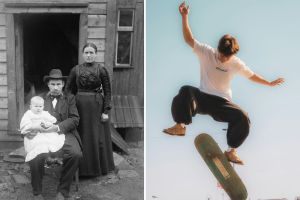
Millennials born in the early ’80s may have hit the sweet spot between modern technology and everyday life. The key? It was all about learning to adapt as they grew into adulthood.
They’re called elder Millennials, which is a sticking point for some. Actually, Erica Dhawan, a leadership expert, first called this microgeneration “geriatric” Millennials, which some found even more egregious. But labels aside, this group fell between the quieter world of Boomers and Gen Xers and the noisier dial-up sounds of the ’90s. This often gave elder Millennials a clear advantage in getting the best of both worlds.
Childhood without the internet
Like their Gen X cousins, elder Millennials grew up without the internet or cell phones. This lack of constant scrolling and/or being reachable at all times rooted them in some ways, like encouraging more playtime outside. But unlike Gen X, many of whom didn’t get online until they were already young adults, elder Millennials could learn new tech as it grew and evolved.
In a piece for Fortune, Success Editor Hillary Hoffower explains the “four types of Millennials.” She mentions Dhawan and explains that, from a workplace standpoint, they have it all. “This early ’80s cohort, on the cusp of Gen X, was the first to grow up with PCs in their homes but also feels comfortable with TikTok,” she (Dhawan) wrote. “Because they straddle the line between digital native and digital adapter, she believes they can bridge the divide between older and younger workers in the workplace, teaching both traditional body language and digital skills.”
Tale of two cities
Hoffower then quotes Jason Dorsey, president of the Center for Generational Kinetics: “In this way, the ‘geriatric Millennial’ microgeneration is a bit more like Gen X ‘because they sort of have the wind at their back and had more of a foothold than the segment of Millennials right after them,’ Dorsey says. While they still struggled with high student debt, this stronger footing put them in a better financial position to pay their loans. This is where he says the ‘tale of two cities’ of Millennials emerges.”
In a post on X, user @HardPass4 sums up exactly why elder Millennials so often thrive: “An elder Millennial is one who grew up without the internet or cell phones, it all arrived in our formative years, which allowed us to retain the necessary social skills to learn the technology without it becoming a crutch, therefore making us into productive members of society.”
‘Hella adaptable’
The post’s comments lit up like a fire. One explains, “Basically we’re Gen X that learned technology.” Another points out the adaptability aspect: “It also made most of us hella adaptable because no standard stayed around for long.”
Another X user completely agrees and compares it to younger Gen Xers. “100%. It’s also why younger/mid Gen X can sit down with various machine learning tools and get crazy output and then be able to communicate and put the knowledge to work with other people. Working at Arby’s gave more real skills than coding camp.”
Feeling their feelings
For the record, some Millennials have come up with what they feel are better terms than “geriatric” or “elder” Millennials. Reporter Lizzy Acker shares in The Oregonian that it has always rubbed her the wrong way. “As a person born in 1982, I would like to object to this classification, mainly because I am not old and am still annoyed about my ‘geriatric’ pregnancy a year and a half ago, but also because I don’t like the way it makes me feel and isn’t that, feeling your feelings, a lot of what being a Millennial is all about?”
Her suggestions include the Oregon Trail Generation, the Home Alone Generation, the Book It Generation, and yep…just plain Millennial.