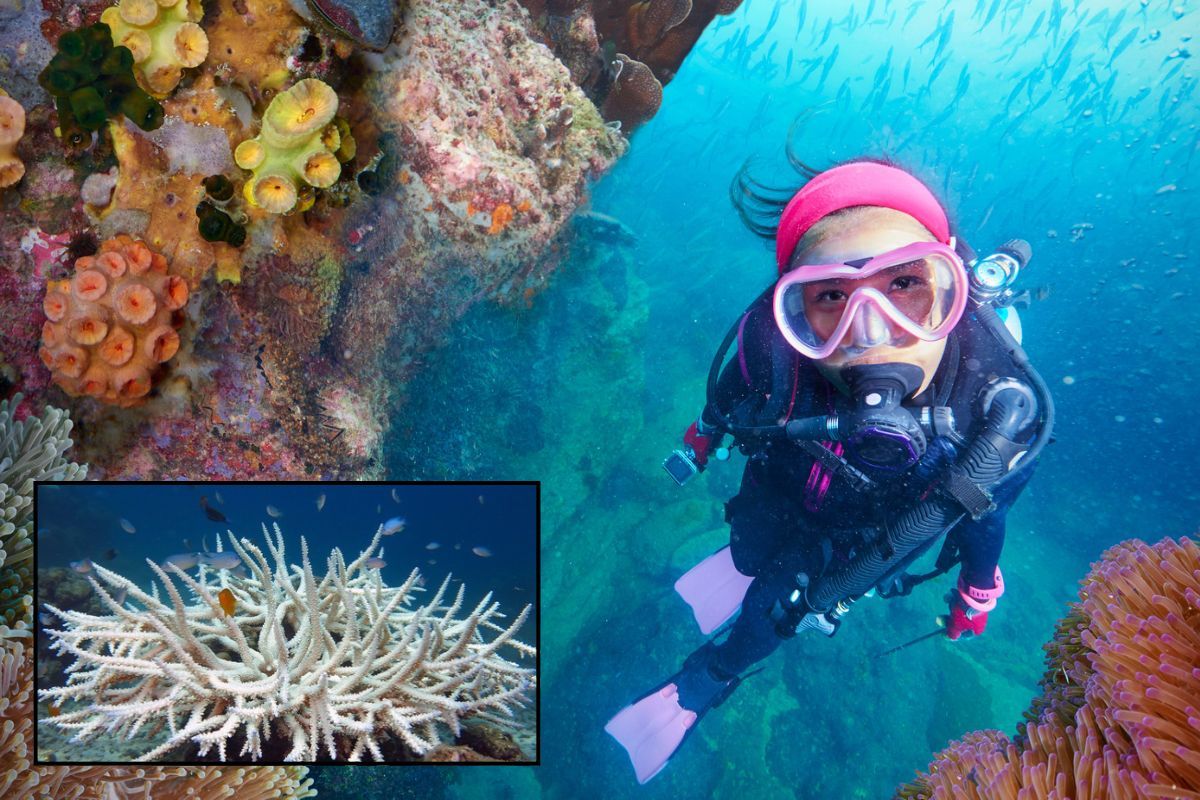
The oceans are in trouble. Rising temperatures due to climate change not only raise sea levels but also put enormous stress on coral reefs.
When waters get too warm, healthy coral will expel the helpful algae living inside them. The coral then becomes drained of color, severely weakened, and vulnerable to disease. In other words, “bleached coral” is dying coral.
The loss of coral and coral reefs devastates vast amounts of ocean wildlife, and humans too. So finding ways to stop, slow, or reverse coral bleaching is of major interest to scientists. And the latest breakthrough was completely unintentional.
Lab studying coral encounters a “happy accident”
Steve Palumbi is a professor of marine sciences at Stanford and an ocean researcher. One of his major research areas is coral, and his work recently led him to notice something pretty strange in his lab.
According to Science Alert, Palumbi had collected various samples from the same coral colony when two of the samples “fell” into each other inside their tank. One was bleached, or dying, and the other was completely healthy.
What’s strange is that by the time he noticed the two were touching, color had begun to return to the bleached coral, specifically at the point of contact.
“I was blown away watching the actual color of this healthy coral slowly spread over into this bleached coral,” Palumbi’s fellow Stanford marine scientist Danny Collins told Science Alert.
The bleaching had mysteriously reversed itself.
“Helping hands” method for reviving dying coral discovered
The researchers were incredibly intrigued by what they were witnessing. After further study, they realized that the healthy coral—through physical contact—was actually able to pass along some of its symbiotic algae to the unhealthy coral.
Testing revealed that bleached coral could make a miraculous recovery through prolonged contact with healthy coral. Crucially, direct physical contact was the key. If the pieces of coral were even a few millimeters apart, the process didn’t work. What they observed was the two corals “fusing” together and forming a “nutrient bridge” for the algae to transfer across.
Just one week of contact was sufficient to build up enough good algae on the bleached coral for it to fully recover in about seven weeks. It’s like a little life-saving hug.
In the wild, bleached coral can recover if environmental conditions, such as ocean temperatures, improve. But the process often takes months, which is too slow. Most coral that gets severely bleached ends up dying during that time period.
The groundbreaking method and research were recently published in Science Advances. Informally, the researchers are referring to the technique as “helping hands.”
Researchers temper real-world expectations
Bringing healthy coral into contact with bleached coral produced amazing results in the lab, but Stanford researchers still don’t know whether the effect can be replicated in the wild.
Even if it can, it’s a process that’s likely to be slow and labor-intensive, meaning “helping hands” won’t save the oceans on their own.
The technique could potentially be used in emergencies to save critically endangered reefs, but the worldwide coral reef network is going to need a lot more than that to return to its full strength.
Without ocean warming stopping or reversing course, coral bleaching is likely to continue and worsen. But scientists like the Stanford team are making amazing discoveries all the time that might just help us tilt the scales.