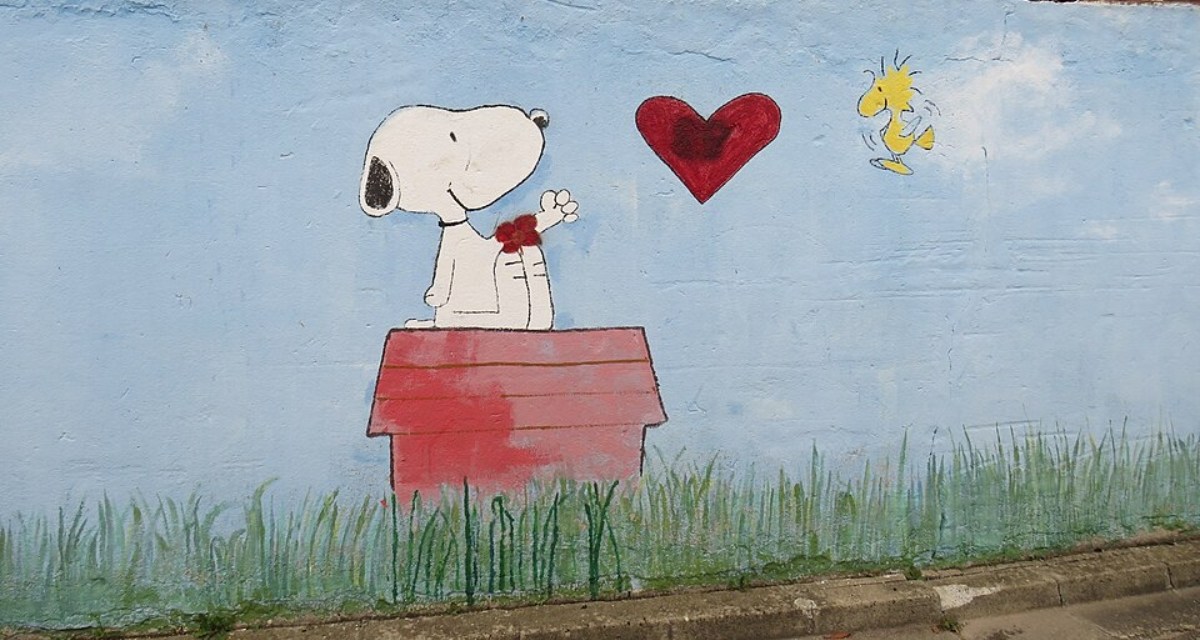
Sometimes, trips through our childhood bookshelves uncover the fact that the best life philosophies were in front of us all along. Wisdom was buried in the brightly colored pages of books meant for and about kids, written by brilliant authors and thinkers such as Dr. Seuss, Shel Silverstein, and, of course, Charles M. Schulz, the creator of the Peanuts comic strip.
Renowned English writer and actress Emma Thompson recently appeared at the Hay Festival in Wales, an annual event that, according to their site, celebrates “diverse voices from the worlds of art, literature, science, politics, music, and comedy to listen, talk, debate and create.” Thompson used some of her time to reminisce about beloved Peanuts characters and how they represent clear archetypes and ways of living.
‘Charlie Brown is the avatar of humility’
In a clip shared on Instagram, Thompson shares her thoughts with author Elizabeth Day: “Charlie Brown to me is the avatar of humility. The book that I brought…the title of the book is You’re a Winner, Charlie Brown, and he’s just standing with his head against a tree with a kite hanging around his neck. And there’s something terribly important within the masculine for me about Charlie Brown. That he’s a beautiful person. And he’s a humble person. And he’s not very successful, and he feels like a bit of a loser. Yet there he is, central to this great philosophy and central to this group of people.”
Thompson then brings up some of the other characters and how they relate to one another and bring out each other’s best. “Linus, who’s the greatest. I always wanted to marry Linus when I was little. You know, the kind of person who says, ‘I want to be a humble country doctor. And I’d drive around the whole country, being a humble country doctor. In fact, I’m going to be a world-famous country doctor!’ And all of these contradictions within.”
She continues, “And Lucy, Linus’s sister, who just shouts all the time! She’s just awful to everyone, and they’re all constantly in a state, with their hair, because Lucy’s been vile. But then [she] opens up a psychiatrist stand, charging five cents for a reading!”
The wisdom of children
“I do recommend going back to Peanuts,” she continues. Whenever I’m feeling a little bit low in the water, I will pluck one of those selections of cartoons and immediately feel better about myself, about my failings, about my stupid elderly ambitions. About everything! And this is supposedly children talking to one another. And the wisdom of children is also inherent in these beautiful, beautiful pieces of work. He’s (Schulz) remarkable.”
These comic strips and cartoons used children to serve as reminders that we’re all in this together. Perhaps Linus represents self-actualization. Lucy is pure confidence. Charlie, as Thompson mentioned, is all about humility.
Snoopy had all the answers
Thompson isn’t the first to use Peanuts characters to exemplify enlightenment. There’s an entire book called The Philosophy of Snoopy, which, according to the “official Peanuts store,” shows how Snoopy had it right all along. “The world’s most beloved beagle shares his philosophy on life in this beautifully produced gift book for all generations. In his inimitable style, Snoopy spends his days extolling the virtues of dancing, hanging out with his best bird friend Woodstock, pursuing a full supper dish, and giving his owner—our favorite lovable loser, Charlie Brown—the run-around.”
In 2011, the Charles M. Schulz Museum held an actual exhibition celebrating these philosophies. A press release shared that “sixty-five original Peanuts comic strips (would) be on display.” They explained, “From Charlie Brown’s ‘I only dread one day at a time,’ to Lucy’s renowned ‘Happiness is a warm puppy,’ the Peanuts Gang’s philosophies are explored.
Peanuts Philosophies focuses on the insights of Charlie Brown, Sally, Snoopy, Lucy, Linus, Rerun, and Peppermint Patty. ‘Most longtime Peanuts readers know that many of the characters are deeply philosophical. Much of what has fascinated and entertained us for decades has been the spectacle of little children afflicted with adult concerns,’ said Schulz Museum Curator Jane O’Cain.”
Deeply profound
The comments under Thompson’s clip support her ideas. Cartoonist Harry Bliss writes, “For years, I’ve been telling people what a deep comic strip Peanuts is, humanity buried within every strip—remarkable and timeless. It’s beautifully executed, sad, joyful, melancholy, funny, and profound.”