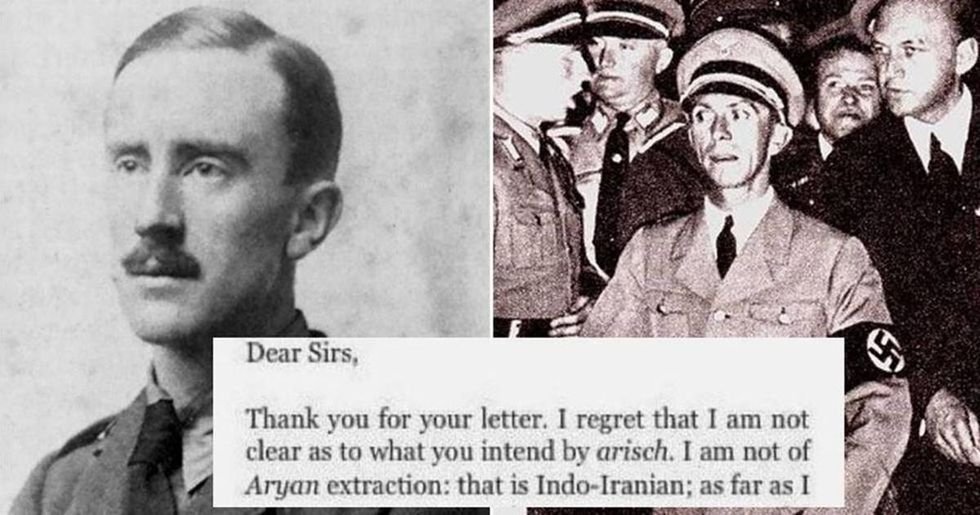
In 1933, Adolf Hitler handed the power of Jewish cultural life in Nazi Germany to his chief propagandist, Joseph Goebbels. Goebbels established a team of regulators that would oversee the works of Jewish artists in film, theater, music, fine arts, literature, broadcasting, and the press.
Goebbels’ new regulations essentially eliminated Jewish people from participating in mainstream German cultural activities by requiring them to have a license to do so.
This attempt by the Nazis to purge Germany of any culture that wasn’t Aryan in origin led to the questioning of artists from outside the country.
How the controversy first began
In 1938, English author J. R. R. Tolkien and his British publisher, Stanley Unwin, opened talks with Rütten & Loening, a Berlin-based publishing house, about a German translation of his recently-published hit novel, “The Hobbit.”
Privately, according to “1937 The Hobbit or There and Back Again,” Tolkien told Unwin he hated Nazi “race-doctrine” as “wholly pernicious and unscientific.” He added he had many Jewish friends and was considering abandoning the idea of a German translation altogether.
His sharp, unmistakable response
The Berlin-based publishing house sent Tolkien a letter asking for proof of his Aryan descent. Tolkien was incensed by the request and gave his publisher two responses, one in which he sidestepped the question, another that he handled in ’30s-style with pure class.
In the more forceful of his two draft responses, the version most widely quoted today, Tolkien notes that Aryans are of Indo-Iranian “extraction,” correcting the incorrect Nazi assumption that Aryans come from northern Europe. Tolkien scholars believe this particular letter was likely never actually sent to Germany; Tolkien left it to his own publisher, Stanley Unwin, to decide which of two drafts to forward, and the milder version is thought to be the one the Germans ultimately received. He cuts to the chase by saying that he is not Jewish but holds them in high regard. “I regret that I appear to have no ancestors of that gifted people,” Tolkien wrote.
Tolkien also takes a shot at the race policies of Nazi Germany by saying he’s beginning to regret his German surname. “The time is not far distant when a German name will no longer be a source of pride,” he writes.
Read Tolkien’s full letter here
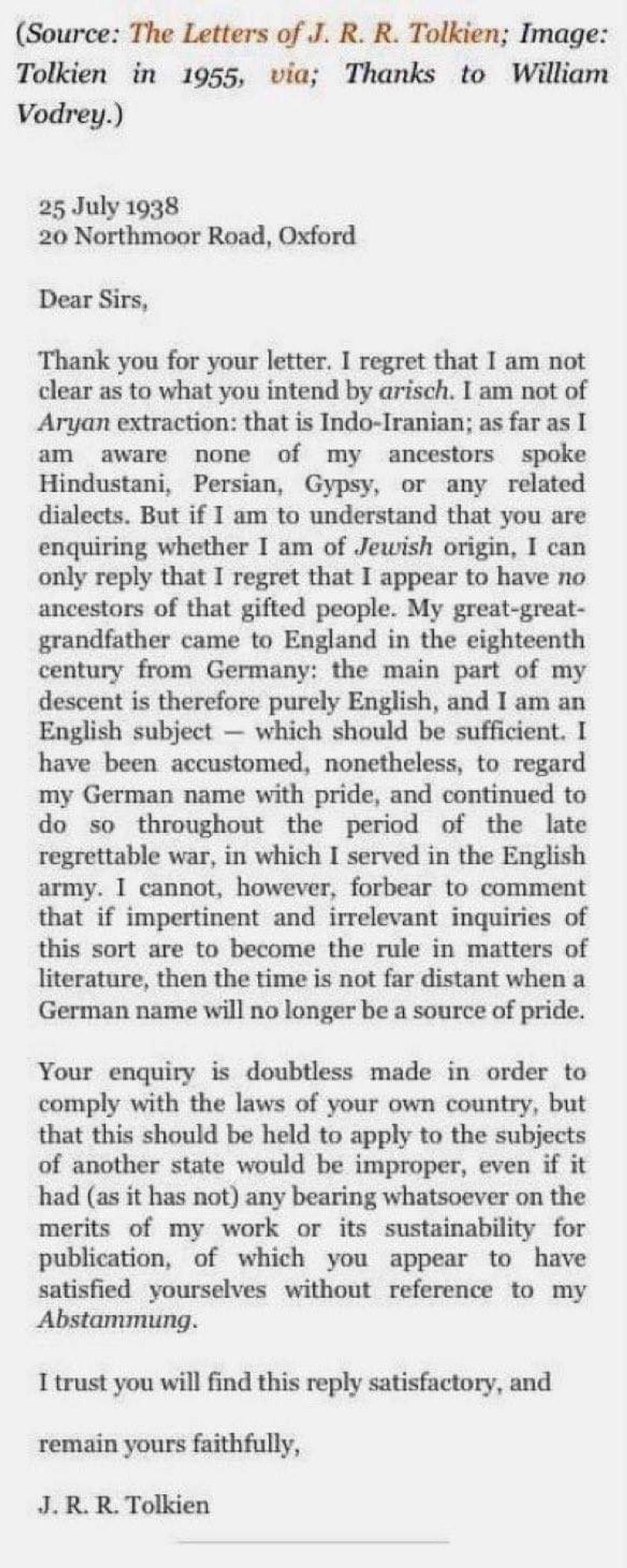
Here is the letter sent to Rütten & Loening:
25 July 1938 20 Northmoor Road, Oxford
Dear Sirs,
Thank you for your letter. I regret that I am not clear as to what you intend by arisch. I am not of Aryan extraction: that is Indo-Iranian; as far as I am aware none of my ancestors spoke Hindustani, Persian, Gypsy, or any related dialects. But if I am to understand that you are enquiring whether I am of Jewish origin, I can only reply that I regret that I appear to have no ancestors of that gifted people.
My great-great-grandfather came to England in the eighteenth century from Germany: the main part of my descent is therefore purely English, and I am an English subject, which should be sufficient. I have been accustomed, nonetheless, to regard my German name with pride, and continued to do so throughout the period of the late regrettable war, in which I served in the English army. I cannot, however, forbear to comment that if impertinent and irrelevant inquiries of this sort are to become the rule in matters of literature, then the time is not far distant when a German name will no longer be a source of pride.
Your enquiry is doubtless made in order to comply with the laws of your own country, but that this should be held to apply to the subjects of another state would be improper, even if it had (as it has not) any bearing whatsoever on the merits of my work or its sustainability for publication, of which you appear to have satisfied yourselves without reference to my Abstammung.
I trust you will find this reply satisfactory, and
remain yours faithfully,
J. R. R. Tolkien
A response that still resonates today
Wether or not this exact letter ever reached Germany, its point still landed, and still lands today. Tolkien didn’t need to shout to make his contempt clear. He simply took the Nazis’ own twisted logic, examined it with the precision of a philologist, and handed it back to them, dismantled by their own definitions.
Nearly ninety years later, “The Hobbit” has been translated into dozens of languages and sold hundreds of millions of copies worldwide, while the regime that once demanded proof of Tolkien’s bloodline collapsed within a decade of asking. Sometimes the most enduring response to hatred isn’t a raised fist. It’s a well-placed sentence that refuses to take the question seriously in the first place.
This article originally appeared five years ago. It has been updated.