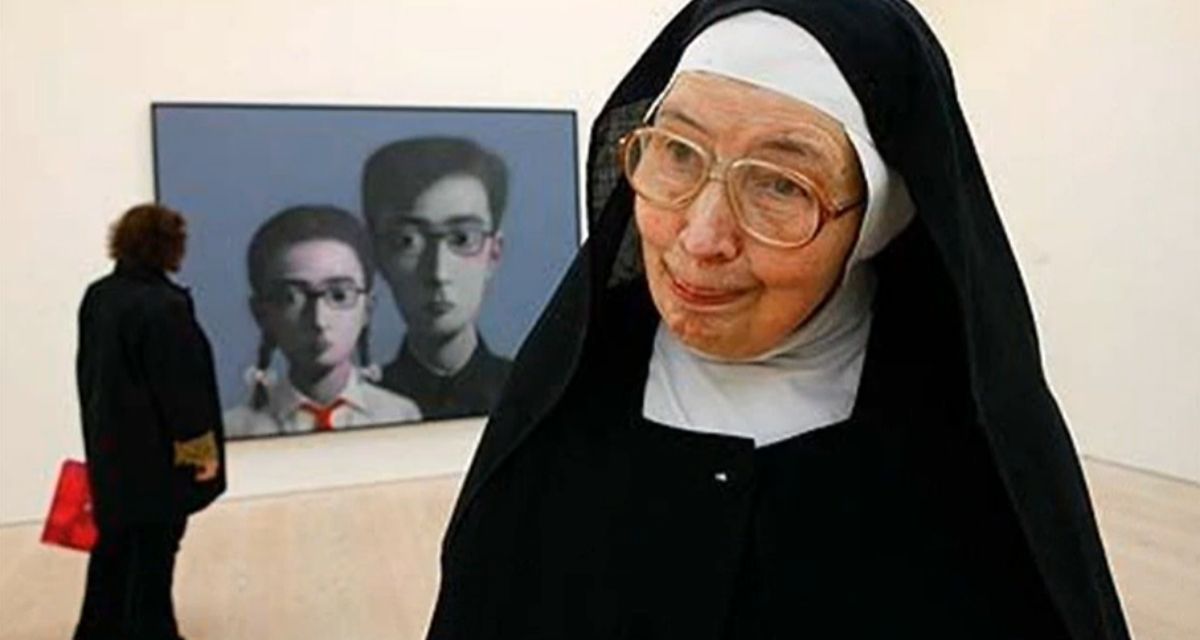
Sister Wendy Beckett educated the world about art and art history throughout the 1990s. A Carmelite nun who spent most of her time cloistered in prayer and solitude, her passion for art ultimately brought her into a public-facing role on television.
She was nicknamed the “Art Nun,” and had popular shows and series, including Sister Wendy’s Story of Painting on the BBC in Great Britain and Sister Wendy’s American Collection on PBS in the United States.
Her calm, informative, and easy-to-understand approach to educating viewers resonated with millions of people. Today, she continues to find young fans in Gen Z.
Who was Sister Wendy Beckett?
Sister Wendy Beckett was born in Johannesburg, South Africa, in 1930. Her family ultimately moved to Scotland and she became a nun at the young age of 16, joining the Sisters of Notre Dame.
In a 2004 interview, she told Independent Catholic News, “I was the first born of my parents – both of them were thrilled and privileged to have a daughter who wanted to be a nun. I had wanted to be a nun since I could think. I never had to say to them ‘I want to be a nun’ – it was known.”
Sister Wendy also pursued an education, graduating from Oxford University with top honors in English. She became a teacher and moved back to South Africa for 15 years. When health issues arose in 1970, however, she moved back to England—this time joining a Carmelite monastery where her life of solitude began.
She famously lived in a camper at the Carmelite monastery at Quidenham in Norfolk, England. By the late 1970s, her health continued to decline, and she was not able to continue her work as a “translator of medieval Latin manuscripts.” That’s when she turned to art.
Sister Wendy’s love for art
In the early 1980s, she was given permission to begin studying art “largely through books and postcard reproductions of the great works obtained from galleries.” She also started writing down her thoughts and opinions—which got noticed by a famous British cook and devout Catholic named Delia Smith, who encouraged Sister Wendy to have them published.
This led to Sister Wendy publishing a book in 1988 called Contemporary Women Artists, which opened doors to an appearance on an arts television show.
In an obituary published on Deadline, managing editor Erik Pedersen wrote of her television appearance, “Producer Nicholas Rossiter got Sister Wendy to talk about the paintings in Britain’s National Gallery for a 1991 BBC documentary. She and Moving Art were an instant hit.” The following year, her series titled Sister Wendy’s Odyssey premiered with a format that would go on to become her signature: she stood beside a piece of art and gave viewers a history lesson and personal take of the art and artist.
What followed was years of travel around the world to film her TV series and make appearances. Sister Wendy’s impact ultimately crossed over into pop culture.
Possibly the most evident proof she was beloved by people across the world was when she was parodied on Saturday Night Live in 1997. Actor Nathan Lane played Sister Wendy in a skit called “Sister Wendy Beckett’s Art Odyssey” in a mock-tour of New York City to see some of the Big Apple’s most famous art, with cheeky reviews from Lane’s “Sister Wendy.”
Sister Wendy Beckett finds new generation of fans
Sister Wendy passed away at the age of 88 in December 2018, but her legacy has continued to live on.
Recently, Gen Z has fallen in love with Sister Wendy thanks to social media and a viral Instagram Reel from ArtRKL. Taken from a 1996 BBC show, Sister Wendy breaks down one of artist Mark Rothko’s large abstract works in the clip with over 1.5 million views.
Her fierce passion and desire for her viewers to understand Rothko’s intention behind his art reels people in.
She says: “I am afraid a little…that somebody may think it’s just beautiful—lovely colors, no meaning—because meaning was what he was all about, and he would have been furiously angry if anyone thought that, and told you so in suitably salty language. It was subject matter that mattered to him—and the subject matter was the emotions. Because in a small painting, beg you little painting…you can control it. But with a large painting, it controls you. You’re taken into it. Unless of course, you look at it from a distance—that killing, assessing look. So to combat that, he insisted that always the lights were very dim, so that you couldn’t actually see the thing until you were right up against it. It’s so timeless that when I’ve had this encounter, I feel to return to the world of time, I have to shake my head and bring myself down to earth again.”
Fans react
In the comments, new Gen Z fans expressed how refreshing her takes were, while lifelong fans expressed their love for her:
“This is the best explanation of Rothko I’ve ever heard.”
“This series deserves a re-release.”
“I love this woman. So smart and intellectually sophisticated.”
“If more museums taught art with this enthusiasm people wouldn’t feel so alienated from it.”
“I loved Sister Wendy when I was a kid. A huge influence for me to go to art school and study art history.”
“My feelings on Rothko aside, Sister Wendy was one of the best things I discovered in my youth. She gave me the words for art I hadn’t yet found myself. I now use her book and videos to teach my own children. Thank you, Sister.❤️”
“Timeless international treasure, Sister Wendy we need you now more than ever.”
“Sister Wendy was awesome – loved watching her series. A brilliant communicator.”