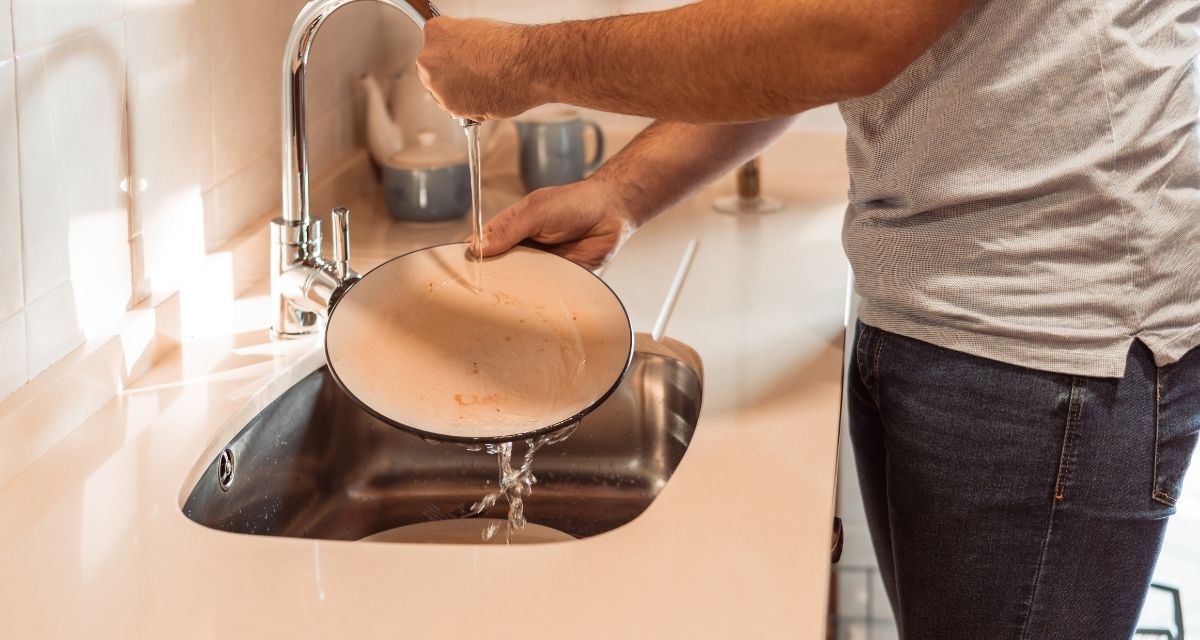
When people share their best life-changing advice, “Stop rinsing your dishes” doesn’t top many lists. But acting on that advice has changed my life, literally, and in ways I never would have imagined.
First, rejecting the rinse has genuinely saved me time, effort, and money. But it’s also taught me something fascinating about human nature and resistance to change.
Let me explain.
What made me ditch the habit of rinsing my dishes in the first place
Most people I know rinse off their dishes before putting them in the dishwasher. A good percentage of those people rinse dishes so thoroughly you can’t even tell they’re dirty by glancing at them.
I was never a super meticulous rinser, but I always rinsed. In my mind, dishwashers always kinda sucked at getting food off if the dishes weren’t rinsed fairly well.
Then I saw some viral videos and wrote a couple of articles about how dishwashers actually work. Experts left and right repeated the direction to only scrape food chunks off dirty dishes, but not rinse them.
I resisted this advice until I saw a video of someone explaining the logic in it. Modern dishwashers (basically since the late 1990s) have what’s called a turbidity sensor. During the initial rinse, the turbidity sensor senses how dirty the water is coming off the dishes. The washer then uses the dirtiness of the water to determine how hot and vigorously to wash the dishes.
Very dirty water = a more thorough wash. Barely cloudy water = a light wash. Essentially, the dishwasher senses how hard it needs to work based on the dirtiness of the dishes we put in it.
What happened when I stopped rinsing
I decided if I was going to test this, I was going to test it hard. The expert I watched said to scrape off the food chunks and leave everything else. Plate covered in spaghetti sauce? Load it. Bowl coated in dried yogurt? Throw it in. Smoothie glass empty but unrinsed? Yep, that, too.
Anything that wasn’t a chunk of food stayed on plates, cups, bowls, and even dirty pots and pans. The result? The dishwasher got all of it.
In fact, it worked far better than when most dishes are rinsed well but a few aren’t. That actually seems to be the worst way to use a dishwasher. You can either rinse everything thoroughly and basically use the machine as a sanitizer, or you can trust that a dishwasher is actually meant to wash dishes and let it do the full job.
I highly recommend the latter. Not rinsing dishes saves tons of work and water. I can’t even tell you how much easier it is to do the dishes now.
The problem? People resist the entire idea, and not just a little bit.
Why people resist change that might help them
The epiphany that dishwashers literally wash stuff off dishes, backed by my own evidence, was so life-changing I had to tell everyone I knew about it. Surely, others would love to know that rinsing dishes is a waste of time and water, right?
Not so much. The rinsing habit runs deep, it turns out.
Many people have been directed to “Rinse your dish!” since they were kids, and have vehemently required the same of their own children. Some resistance to not rinsing seems to come from ingrained messaging and habitual behavior, with a dose of “Surely, I can’t have been doing this daily my whole life without good reason, right? “ thrown in.
But what’s baffling to me is that so many people won’t even try it. Maybe it’s an assumption that the gunk on the plates will harm the dishwasher. Perhaps it’s a conscious or unconscious belief that modern appliances suck, and there’s no way theirs works well. Maybe they’ve tried putting one or two dirty dishes in with thoroughly rinsed ones before and had bad results, not fully understanding how the turbidity sensor works.
Or maybe it’s simply status quo bias, and it’s just more comfortable to keep doing what they’ve always done.
What all of this taught me about habits, human nature, and how I want to live
It may seem hyperbolic to state that not rinsing dishes has changed my life in some big existential way, but it kind of has. When you find out you’ve been doing unnecessary work for no good reason, it causes you to question every other thing you automatically do.
There’s a popular tale along these lines that goes something like this: A family always cut the ends off of their ham before baking it. Grandma picked up the habit from her mom, she passed it down to her kids, who in turn continued the tradition with their own children. One day, one of the grandkids asked why they always cut the ends off the ham, but no one knew. Finally, someone asked the great-grandmother where the habit came from. She said, “Oh, the pan we had was always too small for a ham, so we cut the ends to make it fit!”
The lesson here is that when we don’t know where the habits or “rules” we live by come from, they’re worth examining. Even if we think we know why we do them, it’s important to dig a bit to find out if our reasoning matches reality.
More importantly, my no-rinse experiment taught me to stay open to the possibility that I could be wrong, even decades into living life. It also reminded me to be willing to entertain change, even if it challenges my personal status quo.
Less work, cleaner dishes, an expanded mindset, and an openness to change—not a bad return on investment for one little dishwasher experiment.