You’ve probably walked past a place like Fugetsu-Do, a small family-owned shop with a well-worn counter. At the front, near the large windows facing the street, there’s usually a glass case filled with beautiful handmade artisan crafts. A case like this can contain all kinds of trinkets: leather, metal, antique, freshly wood-worked. Other times, it’s embroidered fabric or ceramic mugs with matching saucers painted in cheery colors. Pastries show up, too, in places like these, their heavenly scent wafting up and down the boulevard like an olfactory billboard.
On a busy street in Los Angeles’ Little Tokyo neighborhood, nestled between a ramen shop and a monster-themed toy store, Fugetsu-Do sits under its forest green awning and cherry-red Kanji lettering.
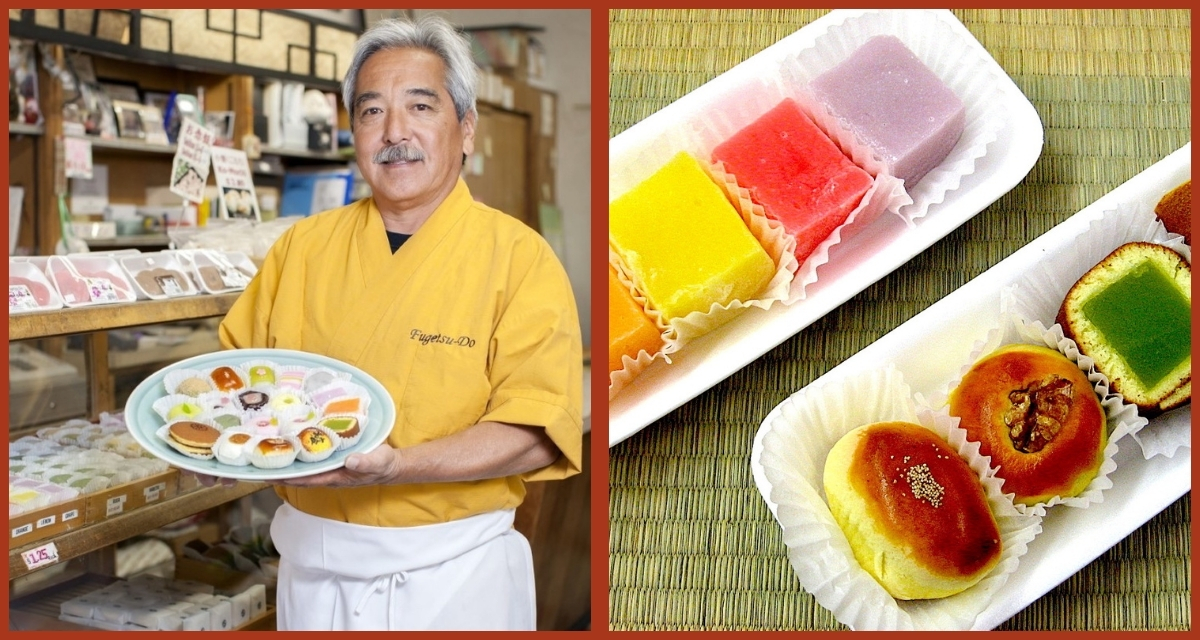
Inside, boxes of mochi and manju—soft, squishy Japanese confections in every conceivable color and design—stack neatly within glass cases, forming rows of lavender, mantis-green, and lovely pink hues. The mochi and manju here are minor miracles, crafted using a family recipe that’s traversed centuries, passed down from father to son and on.
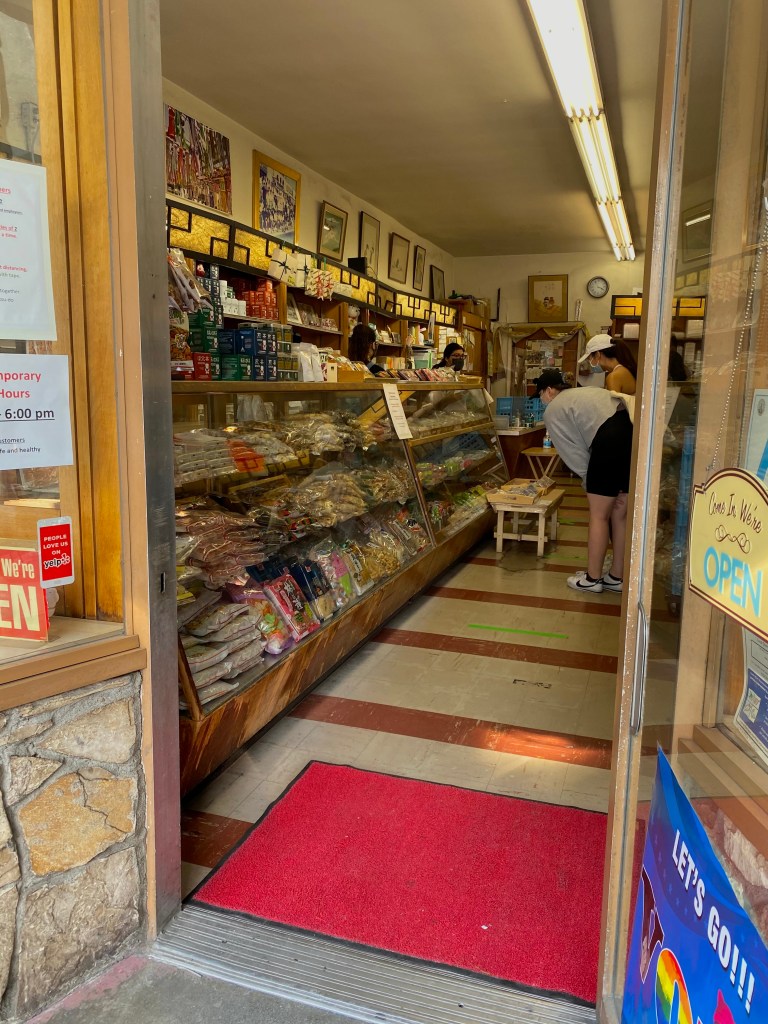
Fugetsu-Do’s existence is no small feat. The shop has been churning out its signature treats in Little Tokyo since 1903, making it the oldest Japanese-American business in the country. It’s the Kito family’s pride and legacy.
Today, Fugetsu-Do is a beloved neighborhood staple and pillar of Los Angeles’ Japanese American community. It is a place where lines often stretch out the door and spill into the street. Recently, Fugetsu-Do joined the lineup at one of L.A.’s biggest summer food events, taking their place among Michelin-star chefs, celebrities, and the city’s rising culinary stars. But more on that later.
All in all, it’s a big deal. But to fully appreciate its magnitude, you will need to know the stakes. To get where it is today, Fugetsu-Do and the Kito family would need to survive a World War, anti-Japanese racism, and more than a century of upheaval.
A sweets shop with a 123-year head start
The year was 1903, and founder Seiichi Kito had just arrived in California from Gifu, Japan. He set off to find Los Angeles’ downtown district, quickly settling into the neighborhood that would later become Little Tokyo. Japanese immigrants had lived here since the mid-1880s. Its rapidly growing population had created a bustling hub filled with churches, schools, mutual aid groups, and boarding houses that offered rooms for rent and a hot meal. In the early 1900s, it was home to the largest community of Japanese people in the U.S., and roughly 10,000 people lived and worked within its limits. Today, Little Tokyo is still important, but in a different way. Before World War II, there were more than 80 Japantowns across America. Now, there are only three: LA’s Little Tokyo, one in San Francisco, and one in San Jose.
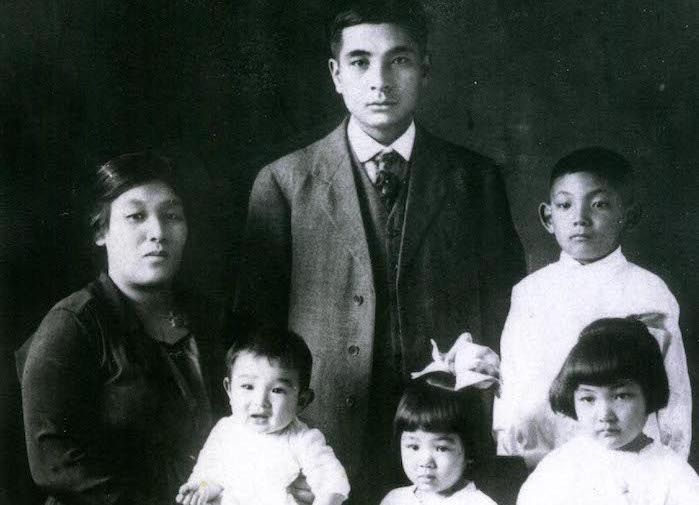
It’s not just a little candy store, it has connections to our culture and to our religion. –Brian Kito, third-generation owner of Fugetsu-Do
But back to Seiichi. Together with a few friends, the young Japanese immigrant opened Fugetsu-Do and began delivering its treats to customers. He stored the mochi and manju in a pouch slung over his shoulders like a backpack. Business soared just before holidays like New Year’s Day, the autumn equinox, and Girl’s Day (March 3), when special wagashi (which literally translates to “Japanese sweets”) are required for wishes of good health, luck, and blessings.
“Nobody had a pastry shop in Little Tokyo back then, so it would get very busy,” recalled Seiichi’s youngest son, Roy Kito, in an interview with the Los Angeles Times in 2002. “We would put up a rope and tell customers they couldn’t come into the store.”
The war that nearly ended it
Then one of America’s most painful chapters unfolded. It was 1942, and World War II was in full swing. Ten weeks prior, Japan attacked Pearl Harbor. The Allies were losing nearly everywhere. Trapped within a pressure cooker of military panic, political pressure, public hysteria, long-standing racism—and zero real evidence of any threat—President Franklin D. Roosevelt signed Executive Order 9066. This led to the forced removal and mass incarceration of roughly 122,000 men, women, and children. Nearly 70,000 were U.S. citizens.
On paper, Executive Order 9066 did not name any specific ethnic group. It gave military commanders the authority to designate zones and exclude “any or all persons” from them. In practice, it was used almost exclusively against people of Japanese ancestry living on the West Coast. And more than two-thirds of them were U.S.-born citizens.
Today, the U.S. remembers Executive Order 9066 as a grave racial injustice and civil liberties failure. Former President Joe Biden called it “one of the most shameful periods in our nation’s history.”
‘We had to live the American dream twice’
Soon after President Roosevelt’s Executive Order, the Kitos were sent to Heart Mountain Relocation Center in Wyoming, one of the ten camps used for the internment of Japanese Americans during WWII. Here, in the bleak and windy desert, they were surrounded by guard towers, barbed wire, and armed soldiers, and given identification tags to be worn at all times. The buildings were hastily built, poorly insulated, and highly vulnerable to Wyoming’s harsh, desolate conditions: dust, wind, extreme cold, and summer heat.
The Kito family, including Seiichi’s youngest son, Roy, were constantly reminded of their status as prisoners. Privacy became a rare luxury. They needed to haul coal for heat and regularly sweep their room for dust, which blew through gaps in the floorboards and the shoddily constructed walls. And yet, there were sweets. Roy watched as his father, hunched over a small stove, made manju for the rest of the camp at Heart Mountain. “When word spread around that my grandfather was a pastry chef,” writes Roy’s son, Brian Kito, “fellow detainees provided him with their sugar rations.”
Coming home, though, wasn’t simple. After World War II, Roy tried to reestablish his father’s confectionery shop in Little Tokyo, but he kept running into walls. Before leaving L.A., the Kito family had only days to liquidate the store’s inventory, and what they couldn’t sell, they put into storage. When they returned, the man who’d held their equipment demanded four years of back rent. It was impossible to pay, and Roy lost the machinery.
He and his wife, Kazuko (whom he met and married at Heart Mountain), began sleeping at Koyasan Temple, and Roy waited tables for 20 cents an hour. Then the day finally arrived: on May 5, 1946, Roy reopened Fugetsu-Do in a new location on East First Street, with the help of the Tanahashi family. His son, Brian, sums it up perfectly. “The store itself has this overlying passion to exist. It just wants to survive. That’s why it’s still here,” he said in a documentary about Fugetsu-Do. “We had to live the American Dream twice.”
More than a store
Ask Brian Kito what’s kept Fugetsu-Do alive 123 years after his grandfather opened it, and he’ll tell you it doesn’t really belong to him. “The community feels it’s theirs,” he told Discover Los Angeles. “It’s not just my store, it’s the community store.”

Now he’s handing it down to the next generation: his son, Korey, is training to become the fourth-generation owner of the family’s shop. To get there, he’ll need to become a master wagashi confectioner—something that takes a full ten years—spending thousands of hours making mochi and manju until his hands instinctively know what to do.
Mochi and manju: a quick guide
So what’s inside that glass case?
First, mochi: the soft, pleasantly chewy rice cakes made from steamed, then pounded rice. It’s often stretched around fillings like sweet red bean paste (anko) or fruit, and enjoyed best with a hot cup of tea.
And manju: its steamed-and-baked counterpart, made with cake flour and usually filled with anko, although some prefer custard or vegetables.
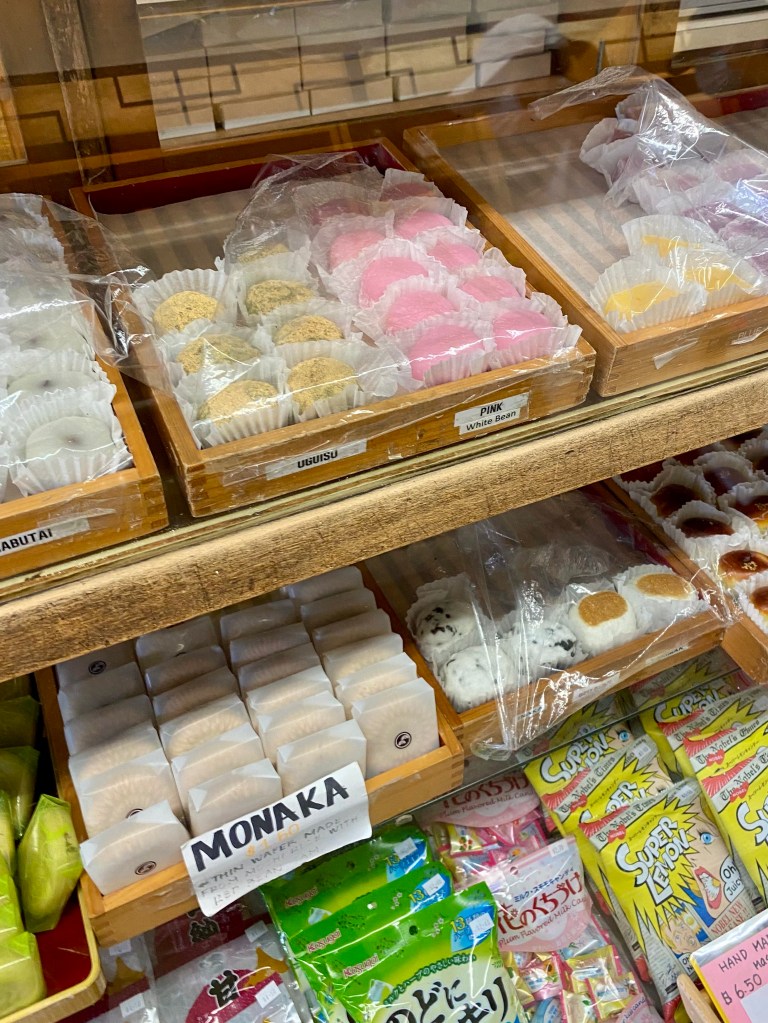
Fugetsu-Do offers endless options. Pale yellow mounds, dusted with kinako (roasted soybean powder), coat your tongue with a delicious taste that’s roasted, nutty, earthy, and sweet. Kiku mochi, which means “chrysanthemum,” are delicately shaped like the flower itself. Seasonal fruit dango pops up throughout the year, rotating through apple, mango, plum, blueberry, and sakura cherry blossoms in the spring. The fresh strawberry mochi are a particular delight.
Why this moment matters
For a place like Fugetsu-Do, survival is never fully behind you. Little Tokyo was recently named on a list of America’s 11 Most Endangered Historic Places, thanks to rising rents that threaten the neighborhood’s small, family-run businesses. It’s a slow, squeezing pressure. But if anyone can handle it, it’s Fugetsu-Do.
On June 27, 2026, Fugetsu-Do joined the lineup at the Family Style Food Festival at Los Angeles State Historic Park. With the warm California sun overhead and spirits high, the day nearly felt picture-perfect as people from across the city and beyond gathered to celebrate good food, music, and culture. The confectionery shop teamed up with L.A. designer Leeann Huang for an exclusive drop of mochi cakes, available for that one day only.
More than a century ago, in a neighborhood not far from here, Seiichi Kito set out rain or shine to deliver mochi to a growing community of Japanese immigrants. Since then, Fugetsu-Do has survived what most businesses never could: World War II and Japanese internment, the 1992 L.A. riots, the COVID-19 pandemic. And yet, here it is on a glorious summer day at the end of June in 2026, not just alive, but thriving.
The shop on First Street is, it seems, in good hands. As his father, Brian, prepares to hand it over, fourth-generation confectioner Korey Kito says he knows exactly what’s at stake: “Everything around us has been changing,” he said. “So I really want to keep Fugetsu-Do there and keep it open for another 100 years.”