It’s 1968, and you’re curled up in front of the TV, watching grainy footage of astronauts drift across the screen. Then, somewhere between the evening news and a commercial, a voice tells you: you can reserve a seat on the first passenger flight to the moon.
Nope, not a daydream, but an actual reservation with an actual airline.
All you had to do was call Pan Am.
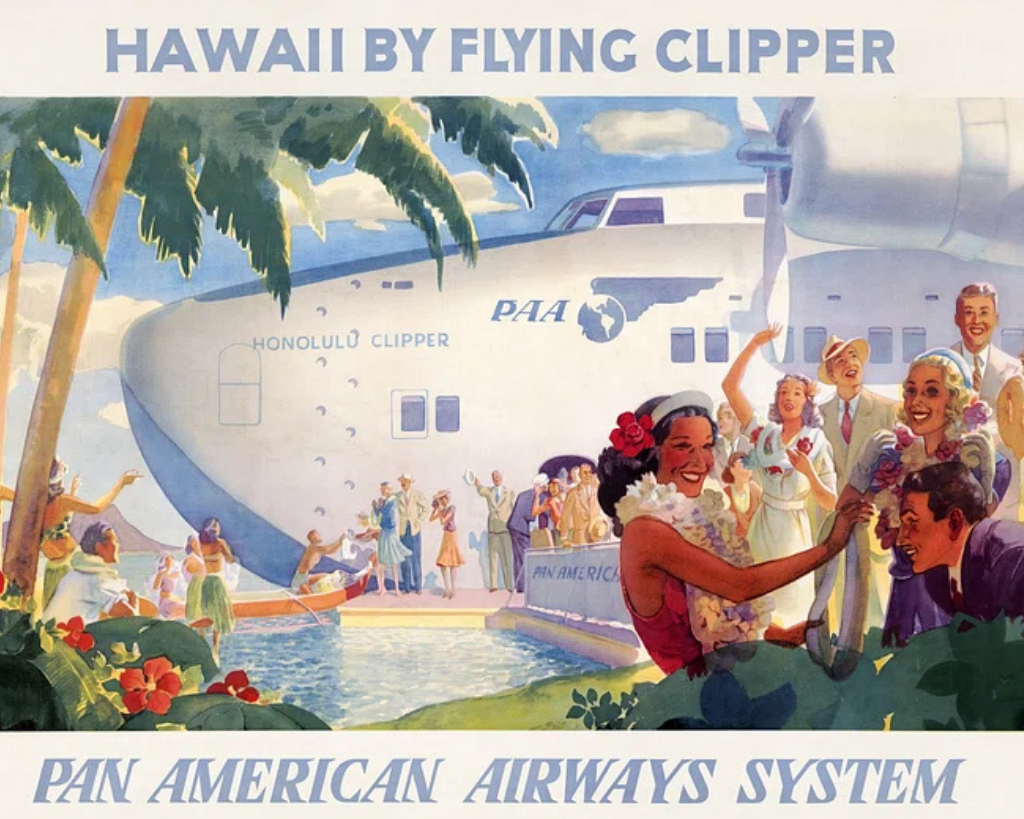
Photo credit: Rawpixel
For three remarkable years, that’s exactly what tens of thousands of people did. The Pan Am First Moon Flights Club (presented by Pan American World Airways) invited ordinary people to put their names on a list for a trip beyond Earth, and it became one of the most charming, audacious marketing campaigns in aviation history.
It started with one persistent dreamer
In 1964, an Austrian journalist named Gerhard Pistor walked into a Vienna travel agency and asked for a one-way ticket no one had ever sold: a flight to the moon. The clerk, baffled, had no idea what to do. The request was passed along to management, then to a supervisor, then another supervisor, until it landed on the desk of an airline that would actually say yes.
Eventually, it ended up at Pan Am.
Pan Am’s leadership saw something in the quirky request. Its publicity-savvy founder, Juan Trippe, knew an opportunity when he saw one.
How one oddball request became a national campaign
For a while, Pistor’s booking just sat there as a curiosity. Pan Am held onto the reservation, but there was no club, no cards, no campaign—just a single name on file, and the airline’s promise that the first flight would leave around 2000.
Then the culture caught up with the idea.
In 1968, Stanley Kubrick’s 2001: A Space Odyssey hit theaters, and audiences watched a sleek Pan Am “Orion III” glide toward an orbiting space station. The airline’s logo on the big screen made the whole “moon travel” idea feel less like a gag and more like a preview.
That same year, Pan Am decided to turn its random reservation list into something real: the First Moon Flights Club.
Book the moon
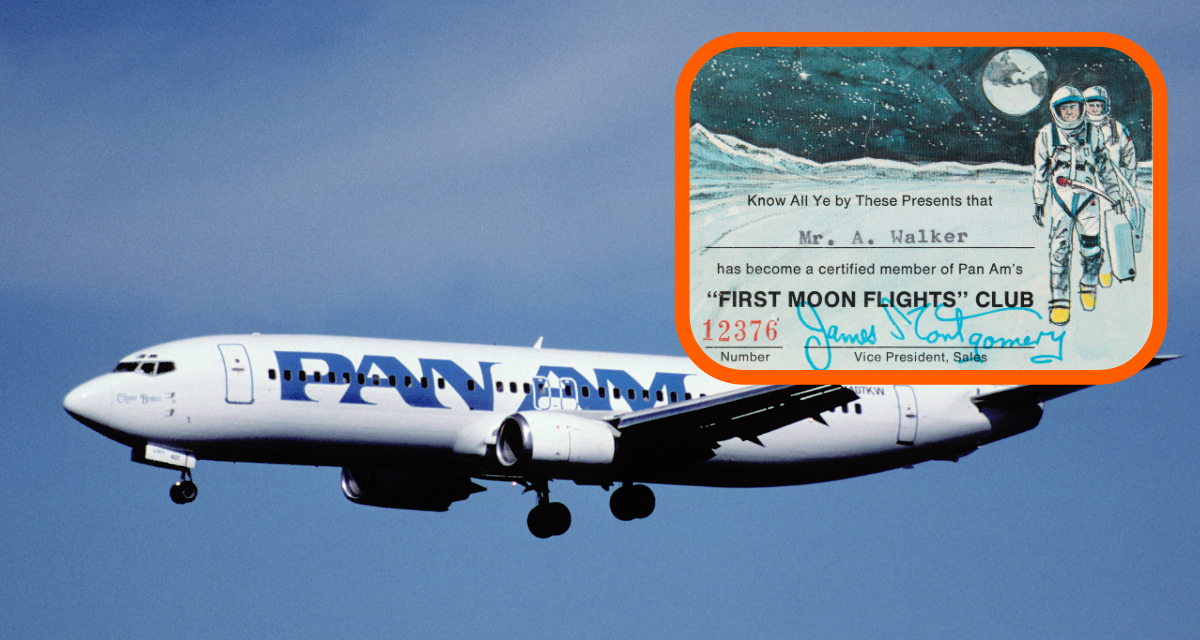
This is where Pan Am’s marketing department went to work. Joining the First Moon Flights Club was free—no deposit, no catch. You’d call Pan Am, give your name, and, just like that, boom: you were in line for the moon. In return, the airline mailed you an official membership card, numbered to show exactly where you stood in the queue.
Suddenly, the dream wasn’t abstract anymore. It was a card in your wallet, the kind of thing you’d pull out to show your friends.
Pan Am promoted the club just the way it promoted its glamorous earthbound routes: by leaning on its reputation as the most prestigious name in the sky, back in travel’s so-called Golden Age. There was a playfulness to it.
The fare, the airline said, was “not fully resolved, and may be out of this world,” a wink at both the cost and the destination.

Was it partly a publicity stunt? Sure. Aviation reporters and plenty of skeptics said so at the time. Did Pan Am actually start calculating ways to reach the moon and take its customers along for the ride? No, but the hype machine worked anyway.
The First Moon Flights Club tapped into something people genuinely believed was coming.
“Commercial flights to the moon are going to happen,” declared Pan Am spokesperson James A. Arey in 1985. “They might not happen next year, they might not happen in five years – but they will happen.”
Why people actually signed up
The momentum built in waves. Apollo 8 looped around the moon in late 1968, followed by Apollo 11’s landing in July 1969, and suddenly, a sci-fi idea felt close enough to touch. NASA announced it was preparing to take civilian “citizen observers” aboard space shuttles for $100,000 each as part of its Space Flight Participation Program.
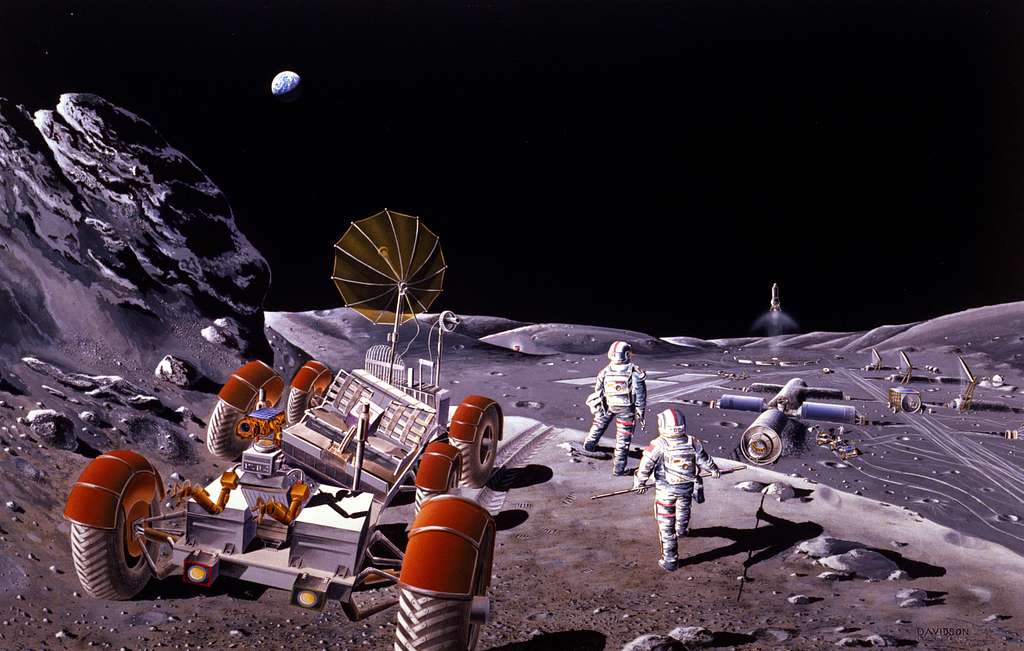
Every milestone sent a fresh surge of sign-ups to Pan Am. One person was so eager to sign up that he sent along a check for $1 million. By the time the club stopped taking names in 1971, more than 93,000 people from some 90 countries had put their names on the list.
“[The moon] seemed like a heck of a place to go to where no tourist has been,” William J. Kelly, a retired Air Force colonel, told the Los Angeles Times in 1985. “If they beat the undertaker to the front door, I’ll make it.”
And these weren’t all anonymous hopefuls. The roster reportedly included future President Ronald Reagan, beloved broadcaster Walter Cronkite (card #90,002), and Senator Barry Goldwater.
Everyone, it seemed, wanted a seat on the future.
So, did anyone make it to the moon?
You already know the answer. No commercial Pan Am flight ever left for the moon. Over the decades that followed, rising costs and an industry in upheaval slowly wore the airline down, and in 1991 Pan Am declared bankruptcy. The company was nine years shy of the 2000 launch date it once floated.
But the cards became keepsakes, and the people who held onto them never quite let go of the dream.
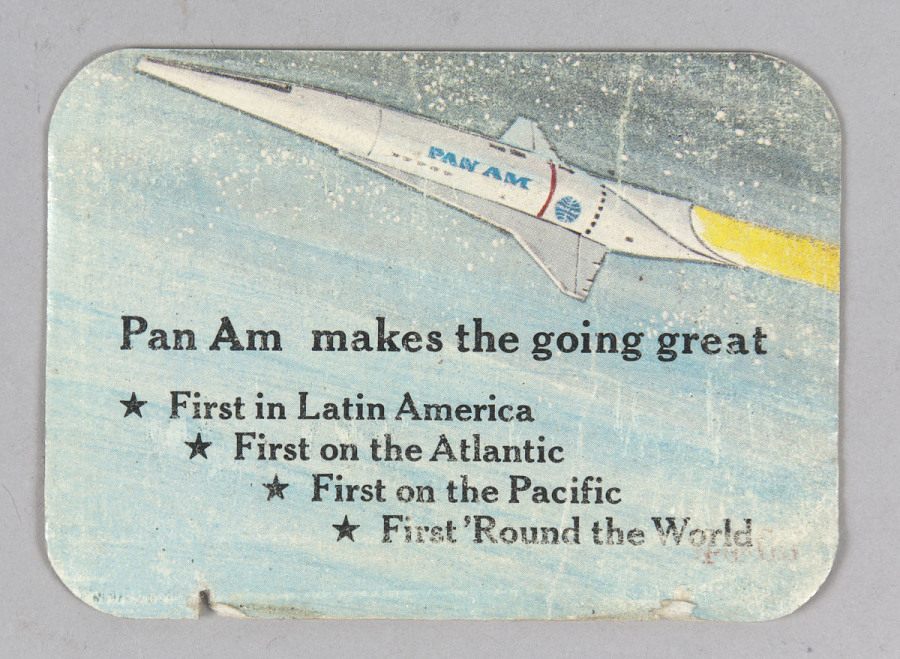
Photo credit: National Air and Space Museum
Consider Jeff Gates. The day after Apollo 11 landed in July 1969, he called up Pan Am to book his reservation to the moon, for two. The process was loose enough that nobody blinked. At the time, Gates was only 20 and not yet married. So when the agent asked for his wife’s name, and he didn’t have one to give, he told her to simply put down “Mrs. Gates.” He figured he’d have the details sorted by the time the flight left the ground.
Decades later, Gates donated his First Moon Flights Club card to the Smithsonian’s National Air and Space Museum. There it sits today: one small paper card, standing in for a very big dream.
The dream lives on
Look around today. Companies like SpaceX, Blue Origin, and Virgin Galactic are selling the very same dream Pan Am was selling more than 50 years ago: tickets to space for ordinary people, not astronauts.
Pan Am didn’t get the timeline right. It arrived at the moon-landing party a couple of decades too early. But it understood something true about us, and 93,000 people proved it: The urge to chase the stars is about as human as it gets. Half a century later, we’re still standing in line.