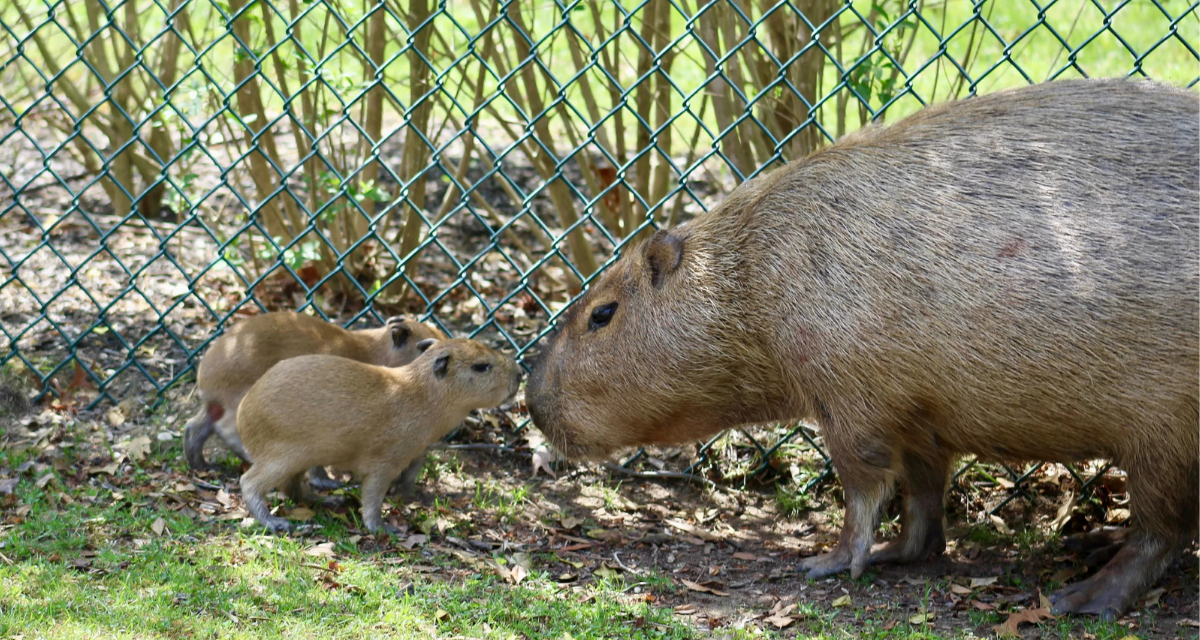
Somewhere in southern New Jersey, in a water-filled zoo habitat, two small animals you’ve probably never thought much about are about to take their first wobbly steps into the world.
The zoo has not announced their names yet. For now, they’re simply Buttercup and Goomba’s babies—two capybara pups at Cape May County Park & Zoo, whose arrival has turned into a local love story.
Born in mid-April 2026, they came into the world with their eyes open and alert; they were standing within hours. By their first week, they were nibbling grass alongside the adults, their tiny muzzles buried in clover as if they’d been doing it forever.
Cape May County Commissioner Vice-Director Andrew Bulakowski put it simply:
“What a wonderful joy to be blessed with additional capybara pups. Families love this exhibit, and their love will only grow with the sights of these new additions.”
They will not grow up alone. Their extended family—Budette, Marigold, and a group of older siblings from Buttercup’s October litter and Marigold’s November litter—hovers around them like a serene, fuzzy welcoming committee. They are serious about the job, too: someone always stands watch. Someone always seems ready with a nudge or a nuzzle.
Zookeepers and veterinary staff are monitoring Buttercup and her newborns closely, offering the young family regular breaks from the attention of visitors. Visitors who want a glimpse can watch from afar, on a bridge that overlooks the habitat. Patience is the price of admission to one of the sweetest scenes in the zoo.
The new capybara pups are incredibly cute. It’s difficult to look at them and not feel something inside you scream with delight. That feeling is important. In a way, it’s the entire point.
The world’s chillest giant rodent is stranger (and more important) than it looks
If you recognize capybaras at all, you probably know them from the Internet.
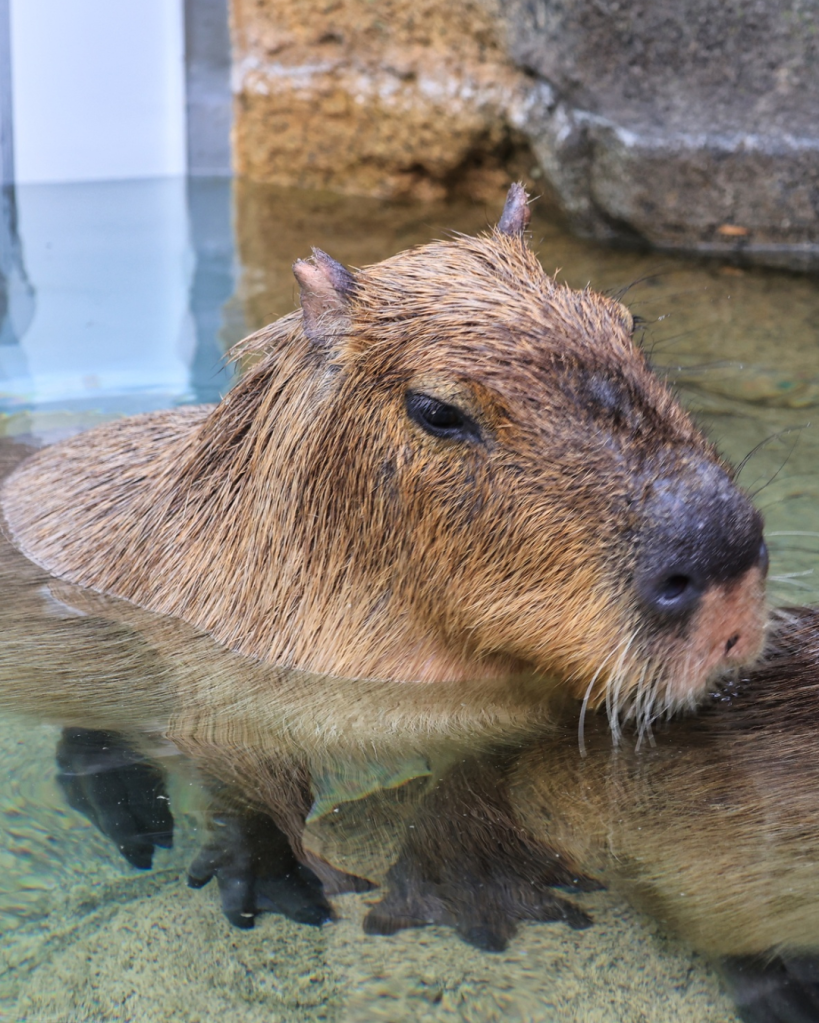
The barrel-shaped creatures have captured the hearts of millions online with their unbothered nature: capybaras soak in hot springs, capybaras let birds perch on their backs, capybaras quietly chew while chaos swirls around them. Capybaras are chill, patient creatures that look like they’ve unlocked a level of calm the rest of us can only dream of.
But how well do you really know the humble capybara?
Capybaras (Hydrochoerus hydrochaeris) are the largest rodents on Earth. An adult can weigh up to about 146 pounds and stretch more than four feet long. That can seem intimidating on paper, but in person, capybaras carry their size with a slow, steady ease.
Their bodies are built for life between land and water, and every anatomical detail tells that story: their eyes, ears, and nostrils are positioned near the tops of their heads, so capybaras can survey their surroundings while almost entirely submerged. Their feet are partially webbed, making them powerful swimmers who can hold their breath for up to five minutes—a crucial feature when a jaguar is watching from the riverbank and the safest move is to slide under the surface and wait it out.
Capybaras eat plants. They graze on grasses and aquatic vegetation with an almost comical level of focus. It’s a pretty strict diet, though they will add fruits and tree bark when the mood strikes or the season dictates. And they don’t just look calm; they talk. Capybaras communicate with an arsenal of barks, whistles, clicks, and soft purrs that help keep their tight-knit groups coordinated and close.
How a capybara family does childcare
In the capybara world, Buttercup’s new pups don’t “belong” to her and Goomba, the father. Rather, the entire group claims them.
In the wild, capybaras don’t raise their young alone. The babies don’t rely on a single caregiver; they inherit a whole network of protection. Capybaras are profoundly social animals and live in stable groups where group bonds are maintained through constant tactile contact, mutual grooming, and scent marking. Females nurse each other’s pups. Older animals act as lookouts and babysitters, regardless of whether they share direct DNA. Scientists call this alloparenting: shared childcare built into the species’ survival.
That shared responsibility is crucial. It gives capybara pups stronger odds of survival in those first fragile months. In some field studies, more than 70% of pups raised in stable groups survive their first year, a high rate for animals so low in the food chain.
In New Jersey, Buttercup’s family follows the ancient capybara way, too. While the zoo’s visitors see a cute capybara cuddle pile, this mammalian cluster represents a finely tuned system designed to keep vulnerable animals alive.
Why wetlands depend on capybaras
In the wild, capybaras roam across much of South America and function as quiet ecosystem architects. You’ll find them in the vast Pantanal wetlands of Brazil and Bolivia; they graze in the seasonally flooded savannas of Venezuela and Colombia. Capybaras even venture into the rewilding landscapes of Argentina’s Iberá region. Basically, wherever freshwater meets grassland, capybaras tend to appear sooner or later.
As professional grazers, capybaras help maintain diverse, open wetland vegetation. When they disappear, tall grasses quickly crowd out shorter plants, and overall plant richness drops by 25% or more. Simply put, when capybaras aren’t around, plants suffer. That change is drastic and can be felt through the insects, birds, and every other creature reliant on those important plants.
Within the circle of life, as prey, capybaras also anchor South America’s food chains: they’re hunted by jaguars, anacondas, caimans, and large raptors (such as harpy eagles). They’re a major food source; a jaguar can devour dozens of capybaras in a single year. That stat sounds brutal, but if you remove capybaras from that system, the entire food chain begins to wobble.
They’re also essential, given the way capybaras move seeds as they travel and graze. Constantly nibbling and wandering, capybaras have shaped how nutrients move through the wetlands. In conservation science, animals that hold this many threads together often receive a specific label: keystone species. Pull out a keystone, and the entire system starts to crack.
Not endangered, but not untouchable
Right now, the International Union for Conservation of Nature lists capybaras as a species of “Least Concern.” But that broad label can hide a lot of trouble.
For example, the capybara’s habitat is disappearing rapidly as people drain or convert wetlands into farmland at alarming rates. Hunters target capybaras for their meat and skins, which are used to make leather. Climate change creates more intense droughts and wildfires in places like the Pantanal, the world’s largest tropical wetland. In 2020, fires burned an estimated 30% of the Pantanal biome in a single season, scorching millions of acres, as jaguars and charred caimans fled their home.
So yes, there’s real danger here, despite the capybara’s “Least Concern” conservation label. But there’s also hope.
In early 2026, Brazil expanded its Pantanal national park, adding more than 116,000 protected acres to a landscape that badly needs institutional buffers. In Argentina, a long-term rewilding effort brought jaguars back to Iberá after roughly 70 years. Those jaguars now hunt capybaras again—for the first time in living memory—restoring a predator‑prey relationship that’s essential for local ecosystems.
The picture is complicated and is always evolving, but crucially, there’s still a window for change.
What a small New Jersey zoo has to do with all of this
On a map, Cape May County Park & Zoo looks like a sweet coastal stop between beach towns. In practice, it’s part of a much larger conservation network.
The zoo is free to visit and cares for more than 550 animals across over 200 species. Cape May County Park & Zoo holds accreditation from the Association of Zoos and Aquariums (AZA), which isn’t an easy feat: it signals that a zoo meets strict standards for animal care, conservation work, and education. Fewer than 10% of licensed animal facilities in the United States achieve accreditation, for context.
Together, AZA-accredited zoos and aquariums spend well over $200 million a year on field conservation. They fund habitat protection, support research teams, and help maintain genetically healthy populations of animals that might otherwise go extinct.
Buttercup and Goomba’s family exists, in part, because those in charge decided that capybaras deserve space, resources, and long‑term planning.
Picture an excited four-year-old, hands sticky from Dippin’ Dots. She presses her face against the enclosure as Buttercup nudges her new pups towards the water’s edge. This child doesn’t know what the Pantanal is. She’s never heard of the term “keystone species.” There is no word for “alloparenting” in kindergarten. But she does know this: there’s a mother, and those little animals matter to her. They also seem to matter to the zookeepers who clean, feed, and check in on them every day.
That simple realization—that another creature’s life is important, has value—is often where the seeds of conservation are planted.
Two pups, one bigger story
Right now, Buttercup’s newest pups are exploring their habitat one cautious step at a time. They nose at the water and trail behind older siblings as they wander through the grass. When something inevitably startles them, they retreat back into their capybara family—a pile of warm bodies and damp fur—where they’ll find safety, tucked beneath the chins of adults and between their sturdy shoulders.
These tiny capybara pups are unaware of the fact that, very far away, others just like them graze the floodplains of the Pantanal and Iberá. They have no idea of their importance, no way to know that their species is the key to holding the entire wetland ecosystem together, one blade of grass at a time.
But they don’t need to know that. Humans can own that knowledge—and do something about it. That’s the power of a story like this. Two baby capybaras in a New Jersey zoo aren’t a trivial subject; it’s a doorway. You start with Buttercup and Goomba’s adorable little family, and suddenly, context floods in. “Wetlands” are no longer a concept or a word in a textbook. They’re real, faraway places where animals like the capybara live, graze, and contribute to the ecosystem.