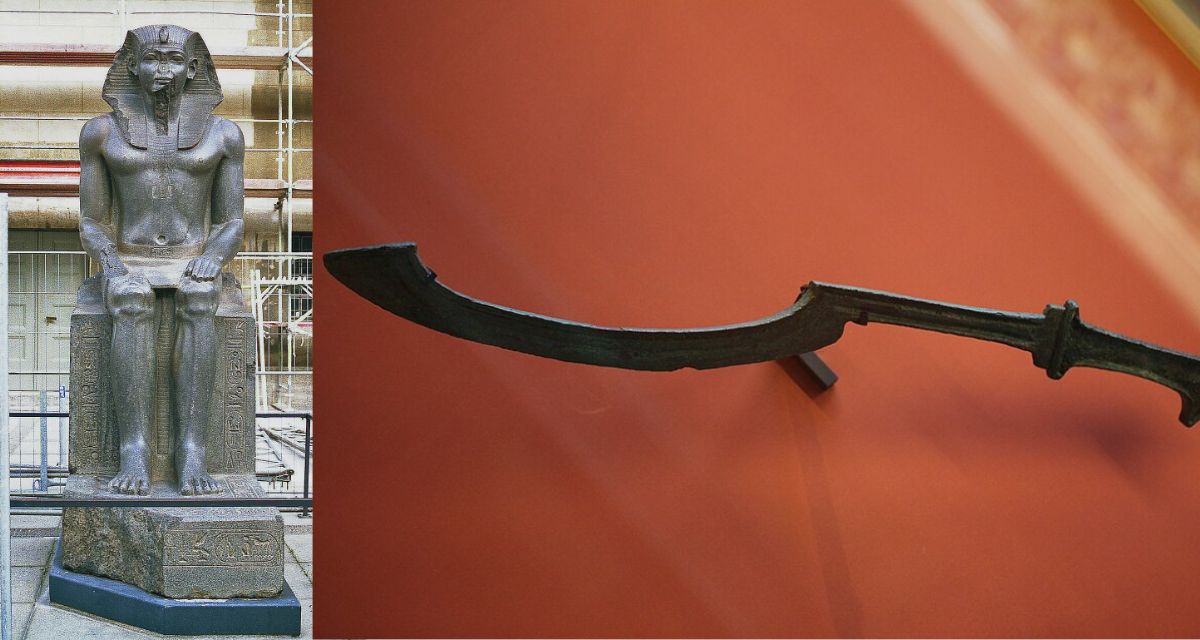
History paints a very specific picture of ancient women, especially royalty. At museums, we often see them portrayed in fine clothing, lounging in sunlit palaces, and living lives of leisure. It’s rare to see or hear of them fighting in battles or hunting game.
For generations, when archaeologists uncovered weapons tucked inside the tombs of mummified Egyptian princesses, they brushed off their presence as mere decoration. Historians presumed that the daggers and bows found in their burial chambers were simply symbolic tokens, something meant for the afterlife.
Now, with the help of modern technology, we know this was an unfortunate assumption.
A mistake that ended up rewriting history
During 1894 and 1895, a group of mummies and other ancient artifacts were excavated from the Dahshur funerary complex in Egypt. The findings were catalogued, but (for reasons no one can determine) six of the mummified bodies were moved and later stored, unmarked, in the basement of the Egyptian Museum in Cairo.
Over a century later, museum staffers rediscovered the bodies. Quickly, a team of scientists at the University of Beni-Suef decided to take a fresh look at these long-forgotten remains. The group used modern bioarcheological tech and methods during their examination.
What they uncovered was remarkable and revolutionary. It shattered how historians had viewed royal daughters of pharaohs past.
Their bones told a story that modern science couldn’t ignore
Led by bioarcheologist Zeinab Hashesh, the research team analyzed the skeletal remains of four royal sisters—Princesses Ita, Khenmet, Itaweret, and a fourth likely sister, Sathathormeryt. Experts believe each was a daughter of 12th Dynasty Pharaoh Amenemhat II. The team recently published their findings in the journal Frontiers in Environmental Archaeology.
Instead of pristine skeletons typical of privileged, royal life, the researchers found wear and tear they did not anticipate. The bones of these princesses showed heavy, pronounced muscle and ligament attachments in their upper bodies. Their skeletal structures bore the exact physical hallmarks of high-intensity, repetitive movements—but not the kind you might expect from the Egyptian peasant women who labored in the fields. These were the signs of warriors. These individuals regularly pulled heavy bowstrings, stabilized impact weapons, and tightly gripped sword handles.
Princess Itaweret, who lived to be between 20 and 34-years-old, displayed physical signs of being a skilled archer. Researchers even detected healed bone fractures, denoting that she’d engaged in high-risk activities. Princess Ita featured robust muscle attachments consistent with the handling of maces and other heavy weapons. They also found an ornate dagger buried beside her inside the sarcophagus.
Rewriting history proves it pays to keep an open mind
This discovery has unlocked new ways of viewing and understanding ancient Egypt’s royal familial structures. Far from passive figureheads, these princesses were trained fighters. They learned by actively participating in skilled combat and hunting. We now know the weapons buried with them were not symbolic. Each had entered the afterlife with genuine battle scars. The swords and bows are testaments to the powerful, resilient lives they actually lived.
These revelations are a powerful reminder of why we should always question old assumptions. History is far from fixed in stone. Sometimes, it’s just waiting for the right discovery—perhaps in the cool, dark recesses of a museum—to help it speak again.