upworthy
Add Upworthy to your Google News feed.
Google News Button
Community

People shared the adult problems "nobody prepared you for" and here are the 21 most relatable answers

These people get it.

adult, adult lesson, growing up, learning, adulting,

Being an adult is tough.

Nothing can ever fully prepare you for being an adult. Once you leave childhood behind, the responsibilities, let-downs, and setbacks come at you rapid-fire. Like Ferris Bueller wisely said, "Life comes at you fast." It really does. It’s also tiring and expensive, and there's no easy-to-follow roadmap for happiness and success. A Reddit user asked the online forum, “What’s an adult problem nobody prepared you for?” and there were a lot of profound answers that get to the heart of the disappointing side of being an adult.

One theme that ran through many responses is the feeling of being set adrift. When you’re a kid, the world is laid out as a series of accomplishments. You learn to walk, you figure out how to use the bathroom, you start school, you finish school, maybe you go to college, and so on.

However, once we’re out of the school system and out from under our parents’ roofs, there is a vast, complicated world out there and it takes a long time to learn how it works. The tough thing is that if you don’t get a good head start, you can spend the rest of your life playing catch-up.

Then, you hit middle age and realize that life is short and time is only moving faster.

Adulthood also blindsides a lot of people because we realize that many adults are simply children who got older, but didn't actually grow up. The adult world is a lot more like high school than a teenager could ever imagine.

The Reddit thread may seem a bit depressing at first, but there are a lot of great lessons that younger people can take to heart. The posts will also make older people feel a lot better because they can totally relate.

Being an adult is hard, exhausting, and expensive. But we’re all in this together and by sharing the lessons we’ve learned we can help lighten each other's load just a bit.

Here are 21 of the most powerful responses to the question: “What is an adult problem nobody prepared you for?”

1. Lack of purpose

"Lack of purpose. All your young life you are given purpose of passing exams and learning, then all of a sudden you are thrown into the world and told to find your own meaning," — Captain_Snow.

2. No bed time

bedtime, sleep, rest, enough sleep, adulthood, yawning

Woman yawning behind the wheel.

Image via Canva

"You can stay up as late as you want. But you shouldn't," — geek-fit

Sleep is a big one. According to the Center for Disease Control, sleep has a number of health benefits specifically for adults. Lose too much sleep and, conversely, it can put your health at serious risk.

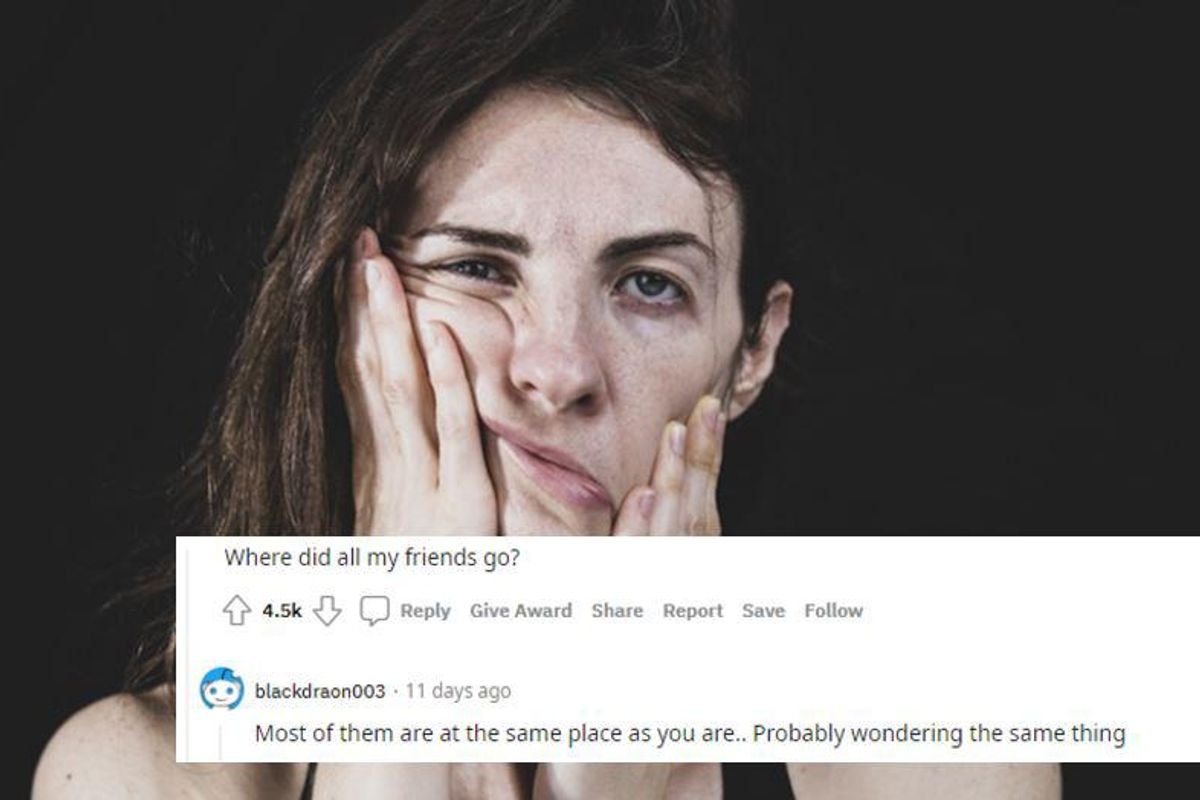
3. Friendships (or lack thereof...)

"Where did all my friends go?" — I_Love_Small_Breasts

Most of them are at the same place as you are ... Probably wondering the same thing," — Blackdraon003

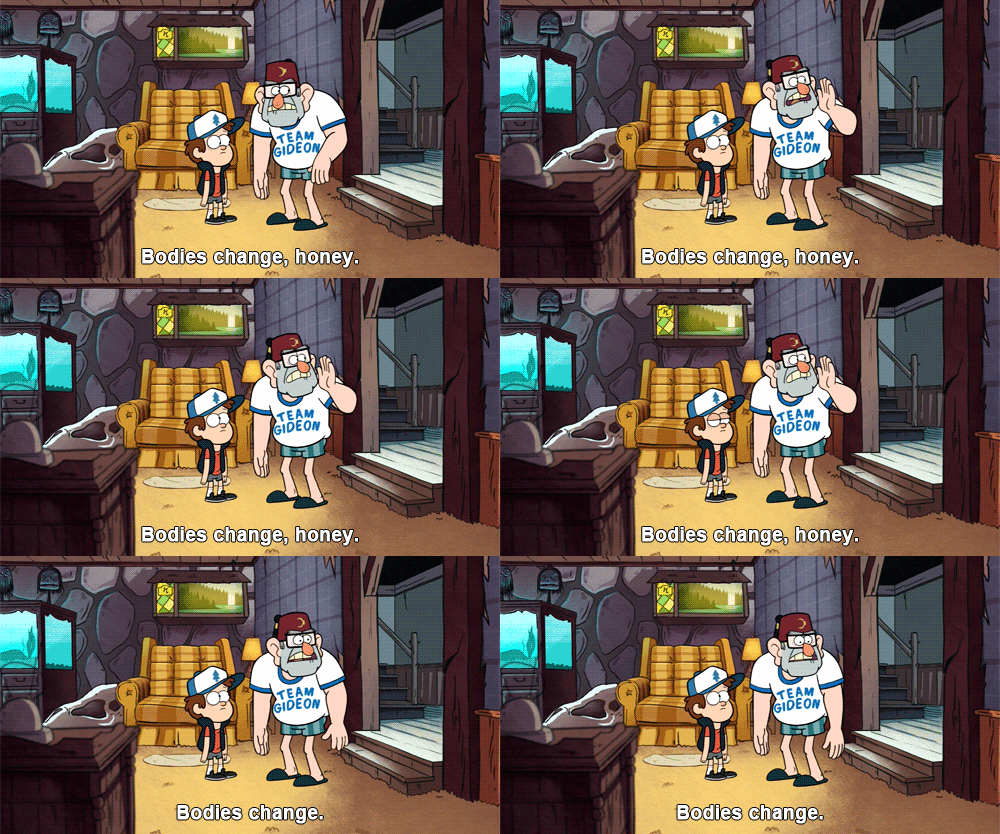
4. Bodily changes

bodies, weight gain, aging, changes, adult body

Yeah, bodies change.

38.media.tumblr.com

"I'm closer to fifty than forty, would have been nice to be better prepared for some of the ways your body starts to change at this point that don't normally get talked about. For instance your teeth will start to shift from general aging of your gums," — dayburner.

5. Learning people don't change

"Didnt know that other adults have the emotional intelligence of teenagers and its almost impossible to deal with logically," — Super-Progress-6386

6. Money

"$5K is a lot to owe, but not a lot to have," — Upper-Job5130

7. Our parents are aging, too

aging, parents, adulthood, illness, decline

Elderly man sitting on the couch.

Image via Canva

"Handling the decline and death of your parents," - Agave666

8. Free time

"Not having a lot of free-time or time by myself," — detective_kiara

9. No goals

"Not having a pre-defined goal once I was out of college. Growing up my goals were set for me: get through elementary school! then middle school! Then high school, and get into college and get a degree, then get a job, and then...? Vague "advance in your career, buy a house, find a spouse, have a kid or multiple, then retire." At 22 I had no idea how to break that down more granularly," — FreehandBirdlime

10. Constant upkeep

upkeep, fatigue, chores, maintenance,, adulthood

It can be a rat race.

Giphy

"Life is all about maintenance. Your body, your house, your relationships, everything requires constant never ending maintenance," — IHateEditedBGMusic

11. Exhaustion

"Being able to do so many things because I'm an adult but too tired to do any of them," — London82

12. Loneliness

"Being an adult feels extremely lonely," — Bluebloop0

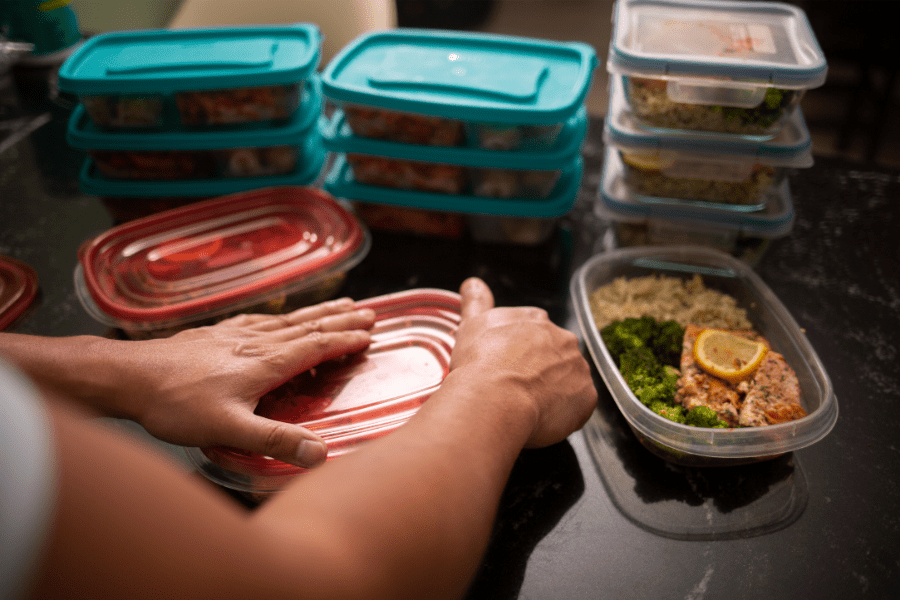
13. Dinner

meal prep, making dinner, cooking, prepare, adult, dinner time

Someone meal prepping.

Image via Canva

"Having to make dinner every. Fucking. Day," — EndlesslyUnfinished

14. Accelerated time

"The more life you’ve lived, the faster time seems to go," — FadedQuill

15. You're responsible for everything, even the stuff you don't mean

"You are held to account for bad behaviour for which you are negligent even if you had no intention to cause harm. As a lawyer, I see this all the time. People don't think they're responsible for mistakes. You are," — grishamlaw

16. Work is like high school

high school, cliques, teenagers, workplace, drama,

High school students.

Image via Canva

"The intricacies of workplace politics," — Steve_Lobsen writes. "

"When you're in school, you think that you won't have to deal with gossiping and bullying once you leave school. Unfortunately, that is not true," — lady_laughs_too_much

17. There's nowhere to turn

"How easy it is to feel stuck in a bad situation (job, relationship, etc) just because the cost and effort of getting out can seem daunting. And sometimes you just have to accept a figurative bowl full of shit because you can't afford to blow up your life," — movieguy95453

While adulthood feels this way, there are places to turn. Building community can help adults find friends, mentors, partners, colleagues, and even found family who can be there for them when they need it.

18. The happiness question

"Figuring out what makes you happy. Everyone keeps trying to get you to do things you're good at, or that makes you money, but never to pursue what you enjoy," — eternalwanderer5

19. Constantly cleaning

"The kitchen is always dirty. You’ll clean it at least three times every day," — cewnc

20. Being alive is like...really expensive

adulthood, adult, money, expenses, cost, saving, budget

Saying this to literally everything.

Giphy

"One adult problem nobody prepared me for is how expensive everything is. I always thought that as an adult I would be able to afford the things I wanted, but it turns out that's not always the case! I've had to learn how to budget and save up for the things I want, and it's been a difficult process," — Dull_Dog_8126

21. Keeping above water

"All of it together. I was relatively warned about how high rent is, car bills and repairs, how buying healthy food is expensive as hell but important for your health, how to exercise and save what you can, my parents did their best to fill in my knowledge about taxes and healthcare and insurance that my schooling missed, about driving and cleaning a household, about setting boundaries at work but working hard and getting ahead if you can, about charity and what it means to take care of a pet and others, about being a good partner if you were lucky enough to have one, about how dark and messed up the world is when you just read the news and what all that means to me and my community… I was reasonably warned about all of it.

"No one could have ever prepared me for how hard doing all of it at the same time and keeping your head above that water would actually be," — ThatNoNameWriter


This article originally appeared three years ago.

Once a refugee seeking safety in the U.S., Anita Omary is using what she learned to help others thrive.
Pictured here: Anita Omary; her son, Osman; and Omary’s close friends
True

In March 2023, after months of preparation and paperwork, Anita Omary arrived in the United States from her native Afghanistan to build a better life. Once she arrived in Connecticut, however, the experience was anything but easy.

“When I first arrived, everything felt so strange—the weather, the environment, the people,” Omary recalled. Omary had not only left behind her extended family and friends in Afghanistan, she left her career managing child protective cases and supporting refugee communities behind as well. Even more challenging, Anita was five months pregnant at the time, and because her husband was unable to obtain a travel visa, she found herself having to navigate a new language, a different culture, and an unfamiliar country entirely on her own.


“I went through a period of deep disappointment and depression, where I wasn’t able to do much for myself,” Omary said.

Then something incredible happened: Omary met a woman who would become her close friend, offering support that would change her experience as a refugee—and ultimately the trajectory of her entire life.

Understanding the journey

Like Anita Omary, tens of thousands of people come to the United States each year seeking safety from war, political violence, religious persecution, and other threats. Yet escaping danger, unfortunately, is only the first challenge. Once here, immigrant and refugee families must deal with the loss of displacement, while at the same time facing language barriers, adapting to a new culture, and sometimes even facing social stigma and anti-immigrant biases.

Welcoming immigrant and refugee neighbors strengthens the nation and benefits everyone—and according to Anita Omary, small, simple acts of human kindness can make the greatest difference in helping them feel safe, valued, and truly at home.

A warm welcome

Dee and Omary's son, Osman

Anita Omary was receiving prenatal checkups at a woman’s health center in West Haven when she met Dee, a nurse.

“She immediately recognized that I was new, and that I was struggling,” Omary said. “From that moment on, she became my support system.”

Dee started checking in on Omary throughout her pregnancy, both inside the clinic and out.

“She would call me and ask am I okay, am I eating, am I healthy,” Omary said. “She helped me with things I didn’t even realize I needed, like getting an air conditioner for my small, hot room.”

Soon, Dee was helping Omary apply for jobs and taking her on driving lessons every weekend. With her help, Omary landed a job, passed her road test on the first attempt, and even enrolled at the University of New Haven to pursue her master’s degree. Dee and Omary became like family. After Omary’s son, Osman, was born, Dee spent five days in the hospital at her side, bringing her halal food and brushing her hair in the same way Omary’s mother used to. When Omary’s postpartum pain became too great for her to lift Osman’s car seat, Dee accompanied her to his doctor’s appointments and carried the baby for her.

“Her support truly changed my life,” Omary said. “Her motivation, compassion, and support gave me hope. It gave me a sense of stability and confidence. I didn’t feel alone, because of her.”

More than that, the experience gave Omary a new resolve to help other people.

“That experience has deeply shaped the way I give back,” she said. “I want to be that source of encouragement and support for others that my friend was for me.”

Extending the welcome

Omary and Dee at the Martin Luther King, Jr. Vision Awards ceremony at the University of New Haven.

Omary is now flourishing. She currently works as a career development specialist as she continues her Master’s degree. She also, as a member of the Refugee Storytellers Collective, helps advocate for refugee and immigrant families by connecting them with resources—and teaches local communities how to best welcome newcomers.

“Welcoming new families today has many challenges,” Omary said. “One major barrier is access to English classes. Many newcomers, especially those who have just arrived, often put their names on long wait lists and for months there are no available spots.” For women with children, the lack of available childcare makes attending English classes, or working outside the home, especially difficult.

Omary stresses that sometimes small, everyday acts of kindness can make the biggest difference to immigrant and refugee families.

“Welcome is not about big gestures, but about small, consistent acts of care that remind you that you belong,” Omary said. Receiving a compliment on her dress or her son from a stranger in the grocery store was incredibly uplifting during her early days as a newcomer, and Omary remembers how even the smallest gestures of kindness gave her hope that she could thrive and build a new life here.

“I built my new life, but I didn’t do it alone,” Omary said. “Community and kindness were my greatest strengths.”

Are you in? Click here to join the Refugee Advocacy Lab and sign the #WeWillWelcome pledge and complete one small act of welcome in your community. Together, with small, meaningful steps, we can build communities where everyone feels safe.

This article is part of Upworthy’s “The Threads Between U.S.” series that highlights what we have in common thanks to the generous support from the Levi Strauss Foundation, whose grantmaking is committed to creating a culture of belonging.

quiet, finger over lips, don't talk, keep it to yourself, silence

A woman with her finger over her mouth.

It can be hard to stay quiet when you feel like you just have to speak your mind. But sometimes it's not a great idea to share your opinions on current events with your dad or tell your boss where they're wrong in a meeting. And having a bit of self-control during a fight with your spouse is a good way to avoid apologizing the next morning.

Further, when we fight the urge to talk when it's not necessary, we become better listeners and give others a moment in the spotlight to share their views. Building that small mental muscle to respond to events rather than react can make all the difference in social situations.


argument, coworkers, angry coworkers, hostile work enviornment, disagreement A woman is getting angry at her coworker.via Canva/Photos

What is the WAIT method?

One way people have honed the skill of holding back when they feel the burning urge to speak up is the WAIT method, an acronym for the question you should ask yourself in that moment: "Why Am I Talking?" Pausing to consider the question before you open your mouth can shift your focus from "being heard" to "adding value" to any conversation.

The Center for The Empowerment Dynamic has some questions we should consider after taking a WAIT moment:

  • What is my intention behind what I am about to say?
  • What question can I ask to better understand what the other person is saying?
  • Is my need to talk an attempt to divert the attention to me?
  • How might I become comfortable with silence rather than succumb to my urge to talk?

tape over muth, sielnce, be quiet, mouth shut, saying nothing A man with tape over his mouth.via Canva/Photos

The WAIT method is a good way to avoid talking too much. In work meetings, people who overtalk risk losing everyone's attention and diluting their point to the extent that others aren't quite sure what they were trying to say. Even worse, they can come across as attention hogs or know-it-alls. Often, the people who get to the heart of the matter succinctly are the ones who are noticed and respected.

Just because you're commanding the attention of the room doesn't mean you're doing yourself any favors or helping other people in the conversation.

The WAIT method is also a great way to give yourself a breather and let things sit for a moment during a heated, emotional discussion. It gives you a chance to cool down and rethink your goals for the conversation. It can also help you avoid saying something you regret.

fight, spuse disagreement, communications skills, upset husband, argument A husband is angry with his wife. via Canva/Photos

How much should I talk in a meeting?

So if it's a work situation, like a team meeting, you don't want to be completely silent. How often should you speak up?

Cary Pfeffer, a speaking coach and media trainer, shared an example of the appropriate amount of time to talk in a meeting with six people:

"I would suggest a good measure would be three contributions over an hour-long meeting from each non-leader participant. If anyone is talking five/six/seven times you are over-participating! Allow someone else to weigh in, even if that means an occasional awkward silence. Anything less seems like your voice is just not being represented, and anything over three contributions is too much."

Ultimately, the WAIT method is about taking a second to make sure you're not just talking to hear yourself speak. It helps ensure that you have a clear goal for participating in the conversation and that you're adding value for others. Knowing when and why to say something is the best way to make a positive contribution and avoid shooting yourself in the foot.

Humor

Olympic curling gets humor treatment as people recreate the bizarrely riveting sport at home

Using everything from Roombas to babies, people are embracing the joy of curling.

olympic sports, winter olympics, curling, curling stone, winter sports

Curling has become a surprisingly popular Olympic sport.

When curling became an official Olympic sport in 1998, it was met with a fair amount of curiosity and confusion, at least among people outside Canada, Scotland, and the Scandinavian countries where it has long been a winter sport tradition. Without an explanation of what's happening, curling can look downright bizarre: large stones sliding across the ice toward a target, while people vigorously sweep the ice in front of them as the person who threw the stone yells unintelligibly.

It's not obvious what skills are required for curling just by watching, which initially led people to poke fun at the event. More recent Olympic Games, however, have seen interest in curling grow as people find the sport strangely riveting. Now, curling has reached even greater heights of popularity, as evidenced by satirical curling-at-home videos popping up on social media.


Many of them use a combo of a Roomba and a Swiffer, which works perfectly:

Why Swiffer is not the official sponsor of all Olympic curling events is a mystery.

Some creators take it a little further, adding in the yelling component:


@amanda_carluccio

We’re now professional athletes. 🏅🇺🇸 #curling #usa #winterolympics #olympics #thecarluccios

Others use different household items, like a teapot, for a curling stone and add commentary:

@breanneallarie

Kitchen curling 🥌 I’m ready @Olympics #milanocortina2026 #roadtotheolympics #teamcanada #olympiccurling

And believe it or not, someone even used a baby as a curling stone, with the caption, "When new dads in Canada are left unsupervised."

So how exactly did we get here?

The history of curling

No one knows the exact origins of curling, but there is evidence of the sport (or something like it) being played by monks on frozen lakes and ponds in Scotland in the 16th century. Farmers would join in curling games during the winter months, and as the sport evolved through the 1800s, it became more organized. Rules were formalized, and people began traveling to watch and participate in competitions held outdoors in large Scottish cities. The Scots eventually took the sport with them to other countries, and by the 1900s, curling had transformed from a Scottish outdoor pastime into an international, mostly indoor sport.

- YouTube www.youtube.com

How does curling work as a sport?

Curling is played by two teams of four, with each team aiming to get its eight stones closest to the center of a target called a "house." Teams alternate "throwing" their stones, which really means gliding them along the ice. Sweepers brush the ice to help guide the stones, while the team captain, or "skip," gives directions, often by yelling, to place the stones where they want them to go.

After all 16 stones are thrown, the team with a stone closest to the center of the house scores one point for each of its stones that landed inside the house. The other team does not score at all in that round, called an "end." There are eight or 10 ends per game, depending on the event, and the team with the most points after all the ends have been played is the winner.

Here's a visual explainer that goes through the basics:

- YouTube www.youtube.com

Fun facts about curling

Tara Peterson of the USA Curling National Team shared some interesting facts about curling with Columbia Sportswear:

  • Modern curling stones are made of granite that comes from only two places: a quarry in Wales and an uninhabited island off the coast of Scotland called Ailsa Craig.
  • Curling is called curling because of the way the stone curves depending on how it's spun, but exactly how that happens is still a bit of a scientific mystery. Curling stones actually move in the opposite direction of what the turn would normally dictate according to physics.
  • Despite the yelling, curling is considered a polite "gentleman's" sport, with traditional etiquette rules observed before and after the game.
  • Though it may not be immediately obvious, you have to be in pretty good shape to curl. Throwing a 42-pound stone, even on ice, isn't as easy as it looks, and the person throwing it must remain crouched close to the ground for long periods. Sweeping also requires arm strength and cardiovascular endurance.

olympic sports, winter olympics, curling, curling stone, winter sports Curling requires more athleticism than it first appears.Photo credit: Canva

  • Curlers wear two different shoes, one designed for gripping the ice and the other for sliding. The slider sole is made of Teflon or stainless steel, while the grippy sole is made of rubber.
  • Curling is called the "roaring game," which might sound odd, but the sound of the stones gliding over the ice is apparently much louder in person than it sounds on TV.

Every sport is more fun to watch when you actually know what you're seeing, and curling is no exception. If you're wondering who to watch, Canada has traditionally dominated the sport, though Sweden trails by only two medals in total Olympic curling medals. And if you're curious how Scotland fares as the original home of the sport, its curlers compete under Great Britain's flag.

Love Stories

Photographer captured his wife's cancer journey until the end for the most beautiful reason

“When people see these photographs, I hope they see life before death."

cancer, breast cancer, chemotherapy, cancer treatment, photography, angelo merendino
Angelo Merendino (used with permission)

A photo series helps people understand the day to day reality of terminal cancer.

All images by Angelo Merendino, published here with permission.

Cancer is unfortunately common, but seeing someone's cancer journey from start to finish is pretty uncommon. Medical experiences are often kept private, for understandable reasons, so the public is usually shielded from the various ups and downs and the intimate moments of pain and struggle, as well as love and even joy, that come along with battling terminal cancer.


When I first saw the incredible photos Angelo Merendino took of his wife, Jennifer, as she battled breast cancer, I felt that I shouldn't be seeing this snapshot of their intimate, private lives. The photos humanize the face of cancer and capture the difficulty, fear, and pain that they experienced during the difficult time.

cancer, breast cancer, chemotherapy, cancer treatment, photography, angelo merendino Angelo and Jennifer were a happy couple.Angelo Merendino

But as Angelo commented: "These photographs do not define us, but they are us."

In his photo exhibition, Angelo wrote:

"Jennifer was diagnosed with breast cancer five months after our wedding. She passed less than four years later. During our journey we realized that many people are unaware of the reality of day to day life with cancer. After Jen’s cancer metastasized we decided to share our life through photographs."

cancer, breast cancer, chemotherapy, cancer treatment, photography, angelo merendino Angelo and Jennifer Angelo Merendino


cancer, breast cancer, chemotherapy, cancer treatment, photography, angelo merendino Jennifer was diagnosed with cancer in 2008.Angelo Merendino

cancer, breast cancer, chemotherapy, cancer treatment, photography, angelo merendino Her diagnosis came only five months after they were married.Angelo Merendino

On his website, Angelo writes:

"With each challenge we grew closer. Words became less important. One night Jen had just been admitted to the hospital, her pain was out of control. She grabbed my arm, her eyes watering, 'You have to look in my eyes, that’s the only way I can handle this pain.' We loved each other with every bit of our souls. Jen taught me to love, to listen, to give and to believe in others and myself. I’ve never been as happy as I was during this time."

However, the ups and downs of cancer journeys eventually take a toll. Having support is vital, but that doesn't mean everyone will understand or be able to be there the way we might hope.

cancer, breast cancer, chemotherapy, cancer treatment, photography, angelo merendino Losing hair is a common side effect of cancer treatment.Angelo Merendino

cancer, breast cancer, chemotherapy, cancer treatment, photography, angelo merendino Angelo and Jennifer decided to document her cancer journey.Angelo Merendino

“Throughout our battle we were fortunate to have a strong support group but we still struggled to get people to understand our day-to-day life and the difficulties we faced…

Sadly, most people do not want to hear these realities and at certain points we felt our support fading away.”

cancer, breast cancer, chemotherapy, cancer treatment, photography, angelo merendino Cancer can be lonely sometimes. Angelo Merendino

"People assume that treatment makes you better, that things become OK, that life goes back to 'normal,' Angelo wrote. "There is no normal in cancer-land. Cancer survivors have to define a new sense of normal, often daily. And how can others understand what we had to live with everyday?"

cancer, breast cancer, chemotherapy, cancer treatment, photography, angelo merendino Not everyone understands the journey.Angelo Merendino

cancer, breast cancer, chemotherapy, cancer treatment, photography, angelo merendino They captured the ups and the downs. Angelo Merendino

cancer, breast cancer, chemotherapy, cancer treatment, photography, angelo merendino They also captured the love and heartbreak.Angelo Merendino


“When people see these photographs, I hope they see life before death,” Angelo writes. “I hope they see love before loss.”


cancer, breast cancer, chemotherapy, cancer treatment, photography, angelo merendino Small joys are part of the journey.Angelo Merendino

cancer, breast cancer, chemotherapy, cancer treatment, photography, angelo merendino Celebrating Jennifer's 40th birthdayAngelo Merendino

cancer, breast cancer, chemotherapy, cancer treatment, photography, angelo merendino Having a support system makes a big difference. Angelo Merendino

cancer, breast cancer, chemotherapy, cancer treatment, photography, angelo merendino Every photo tells a story.Angelo Merendino


cancer, breast cancer, chemotherapy, cancer treatment, photography, angelo merendino There is love in every image.Angelo Merendino


cancer, breast cancer, chemotherapy, cancer treatment, photography, angelo merendino And then the after began.Angelo Merendino

Jennifer passed in 2011, and Angelo has had his own long healing journey in the years since. He told the Susan G. Komen Foundation in 2022 that finding a therapist who had lost a spouse helped him a lot.

“Healing has been an ongoing thing. I don’t want to forget how much it hurts, because I think the other side of that is how much I loved Jen, and how much she loved me,” Angelo said. “I try to remember how fortunate I am to be alive and to not take for granted all the things that I have in my life.”

cancer, breast cancer, chemotherapy, cancer treatment, photography, angelo merendino Jennifer's tombstone reads "I loved it all." Angelo Merendino

“If you’re going through this, keep moving forward,” Angelo said. “Be graceful with yourself. Know you you’ll find joy again. Something as simple as a sunset will make you more thankful than anything. There’s still so much life to live. Out of honor to Jen, I have to live my life again.

This article originally appeared thirteen years ago.


Jeff Tweedy, Wilco, karaoke, viral video, music
Photo credit: Susan Miller Tweedy

Jeff Tweedy sings his own song at karaoke.

On a January evening at a restaurant in Mexico, El Jefe patiently waited for his name to be called by the karaoke host. When it was, he gently walked to the stage in a pink baseball hat and black, thick-rimmed glasses. As he approached, the host gave him instructions on how to use the microphone. "You've got to hold it up here and just don't yell in the mic," he said, illustrating as El Jefe humbly listened.

He then proceeded to sing "Jesus, Etc." almost better than its original singer, Jeff Tweedy of Wilco. There's a reason for that: El Jefe, as it turns out, is Jeff Tweedy.


The song is track five on Yankee Hotel Foxtrot, which was released in 2002. According to the liner notes, it was written by Tweedy and Jay Bennett, a former member of the band who passed away in 2009. Pitchfork hailed the tune as "the 61st best song of the decade," which is high praise, especially considering how much excellent indie-rock music was coming out at the time.

Stereogum's Chris DeVille wrote about the album's 20th anniversary, noting that Wilco streamed it at no charge. "A bold and uncommon move at that time, and one that probably made the album sound even more experimental for those with dial-up internet connections," he wrote. DeVille added, "Yankee Hotel Foxtrot is THE Wilco album — the one that cemented their stature as one of the all-time great American rock bands."

There's a kind of perfection to Tweedy singing his own song at karaoke, and not just because it conjures so many memories for Wilco fans. Watching Tweedy in a Clark Kent–like, plainclothed role, when most fans know he can become Superman at any given moment, is something extra special.

www.youtube.com

Fans in the Instagram comments agreed.

"You guys are the coolest famous non-famous people ever," one person wrote. "How surreal. To write a song, make a record with that song (and many more) on it, and become well known in certain circles for that song and all the other songs, have that song turned into a karaoke selection because it has become that level of popularity, then sing that song like you're an everyday schmuck just doing karaoke one night on vacation, it's just…"

Another person described the scene and how lovely it all was: "My heart needed this. The children playing, palm trees swaying in the neon lights, that super fun 'Ladies' sign, a few enthusiastic 'woos' and a happy, humble El Jefe. Good stuff!"

One fan loved that Tweedy seemed to go unnoticed by the karaoke host. "My favorite part is the host showing him how to use the microphone," they wrote. Another person replied, "And the 'Jeffiest' reaction of playing it totally cool, no ego, totally kind, respecting the KJ's 'authority.' The least 'Do you have any idea who I am?' energy possible."

One comment summed up the many layers of coolness on display: "This is beautiful on so many levels. I always thought you 'made it' when your song ended up in a karaoke machine. Here it is, yet (maybe) no one knows him or the song — and that's perfectly fine with him. For that, I'm so happy for him. What a gift of a moment that must have been: to be respected, successful and famous without the bad fame part. That's the sweet spot. Just to put your hand in your pocket and sing your song for yourself and your family."

Upworthy had the honor of chatting with Tweedy's wife, Susan, who provided a little context for the evening. It all happened following this year's Sky Blue Sky festival, an all-inclusive vacation in Mexico featuring a musical lineup that included Dinosaur Jr., The Jayhawks, and, of course, Wilco.

"So after Jeff's festival, Sky Blue Sky, we stayed in the general area at a rental house for a few days to unwind," she said. "That night we were at La Buena Vida, a restaurant that apparently does karaoke every Wednesday evening."

Susan noted that she and their kids egged him on: "The kids and I told Jeff he should do it! He's never done it before, but it was all families and little kids running around, and we all thought it would be fun and funny! Our son Sammy checked to see if there were any Wilco songs available to do, and there were! We signed him up, and I think he was the last one to make it on for the night."

When asked whether Jeff was recognized, the answer was surprising.

"Nobody recognized him, although I did see a post a couple days later of someone who said they were there and that they were pretty sure it was him," she said. "But nobody said a word, and people were still talking and running around and mostly ignoring the karaoke during his whole song, just like for everybody else! It was really fun for all of us!!"

Mental Health

Man who created 'Reasons to Stay' website after brother's death, tearfully shares success story

People can write a letter to a stranger and be their reason to stay another day.

suicide prevention; suicide awareness; depression; mental illness; reasons to stay

Tearful man with head in his hands being comforted.

Editor's Note: This story discusses suicide. If you are having thoughts about taking your own life, or know of anyone who is in need of help, the 988 Suicide & Crisis Lifeline is a United States-based suicide prevention network of over 200+ crisis centers that provides 24/7 service via a toll-free hotline with the number 9-8-8. It is available to anyone in suicidal crisis or emotional distress.

Mental illnesses like depression don't discriminate. It can hit anyone, and not everyone survives their fight with the condition. Ben West, a man from the United Kingdom, has intimate familiarity with what happens when someone loses their battle with depression. He lost his younger brother, Sam, to suicide eight years ago.


In an effort to help with his own grieving process and connect with those who may feel alone, he created a website. The video launching the site Reasons to Stay went viral due to its touching story and noble mission. It's a website that allows people from across the world to leave letters of encouragement to people who may be contemplating suicide. The hope is that someone needing a reason to stay one more day will find their reason in one of those letters.

suicide prevention; suicide awareness; depression; mental illness; reasons to stay Comfort in a hug: a shared moment of empathy and support.Photo credit: Canva

The website is simple: it displays the latest letter on the home page, offers sign ups for letters to go directly to your email in the form of a newsletter, and shares places to seek help. If someone wants to read a different letter, all they need to do is refresh the page.

"This letter was written by someone in the world that cares. It was delivered to you at random when you opened this page," the Reasons to Stay website explains.

The creation of this website was strictly an act of compassion for fellow humans, but recently, West received an email revealing that his site saved a life. The website's founder wept while sharing the news on his Instagram page, saying, "I got a message today, and I'm not going to share the message, but what I can share is that it worked. It worked for someone. We can be fairly confident that it really worked for someone."

suicide prevention; suicide awareness; depression; mental illness; reasons to stay A comforting hug during an emotional moment.Photo credit: Canva

He admits that the person still has a difficult journey ahead, but celebrates that they get to continue on at all. "Like I said before, social media, it can be such a bad place, but how amazing that it can be used for something like this. Like, that person, maybe it wouldn't reach them if it didn't go viral, so thank you so much, everyone, for sharing and getting involved in this over the last couple of weeks. What a special thing. What an amazing thing. It worked."

According to the Centers for Disease Control, "One person dies by suicide an average of every 11 minutes. Over 49,000 people lost their lives to suicide in 2022. Every year, millions of Americans think about, plan, or attempt suicide."

In August 2025, JAMA Network released an article urging people to consider human connection as a form of suicide prevention. The authors of the article share that there's power in human connection, writing, "At a time when individuals experiencing suicidality often feel unseen, unheard, and burdensome, structured follow-up sends a clear message: you matter. You are not forgotten."

Reasons to Stay is putting human connection at the forefront in hopes of saving lives. People are moved by his selfless gesture, with some sharing their own stories of survival. One person shares, "From someone who tried to, this is essential. Wish I had that back then. Will definitely use your site if those thoughts ever come back to me. I’m so proud of you, and so is Sam. We’re safer now."

suicide prevention; suicide awareness; depression; mental illness; reasons to stay Woman seated against brick wall, covering ears with hands.Photo credit: Canva

Another writes, "My dad took his own life. I wish he could’ve had a website like this to go to. I am sobbing happy tears to know that someone’s life was saved, and I'm also so incredibly sorry for your loss. I understand the ache— but you made something beautiful for your brother."

"You may or may not be familiar with David Kessler’s “The sixth stage of grief,” but in that book he suggests that the 6th stage is: finding meaning. You’ve created meaning by saving others. Sam’s spirit and legacy lives on through you and his life and death now means, not just something to you, but something to many others around the world. What an absolutely beautiful and healing way to honour Sam, and what a gift this is to the world. Thank you Sam. Thank you Ben. So special. So powerful," someone else kindly shares.