It can be heartbreaking to realize that someone you love can’t live up to your expectations. It can be even harder to look back at choices you’ve made in life and know you could have been kinder or put more effort into things that really mattered.
However, when we bravely face the hard truths we have to learn in life, we become emotionally stronger. The struggle may be painful at the time, but as Ernest Hemingway wrote in “A Farewell to Arms,” “the world breaks everyone, and afterward, many are strong at the broken places.” On the other side of the emotional Rubicon is healing, wisdom, and strength.
A poster in Reddit’s emotional intelligence subforum asked users a very personal question that got to the heart of how they became stronger people: “What’s a harsh truth you had to accept to become emotionally mature?” The responses showed the power of taking personal responsibility and seeing yourself and others with rigorous honesty.

The discussion is a wonderful reminder of the gold that we can find on the other side of heartache and loss. Here are 11 of the best harsh truths people had to accept to become emotionally mature.
Here’s what people had to learn the hard way
1. Bad parents aren’t an excuse
“Having sh*tty parents is not an excuse to be a sh*tty adult. At a certain point, it’s on you to do the work and break the cycle.”
2. Nobody owes you anything, nobody is coming to save you
“That’s right, if you want change, start a revolution yourself.”
“Or, as my therapist put it, ‘the cavalry is not coming. It’s on you.’”
3. You never truly know what anyone is thinking
“You will never really know what people are thinking. They will say what they think people want to hear or avoid the truth. You truly have to trust yourself and work with yourself. Identify what you’re thinking and feeling, and then work with it. And there are no answers. Some things will always be a mystery and never solved.”
Psychologists call this phenomenon the Theory of Mind, which holds that we can understand and interpret others’ beliefs, thoughts, and feelings to read social situations. However, even though we may come close to understanding other people’s inner states, we can never be 100% sure.

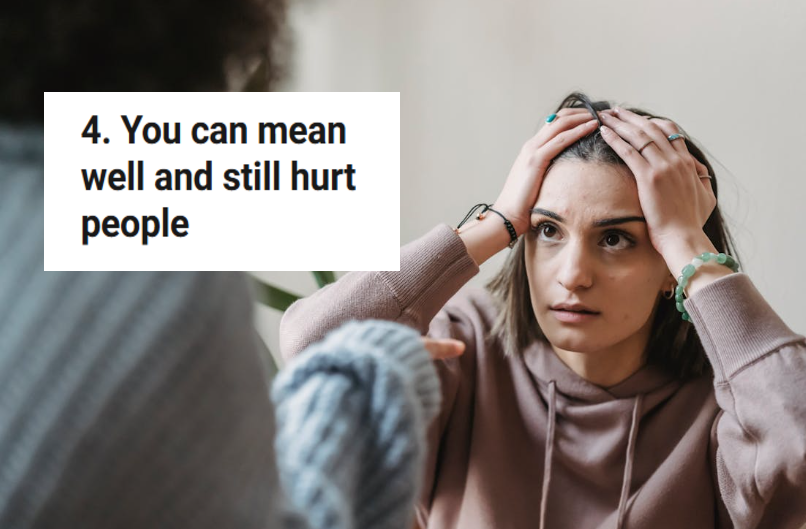
4. You can mean well and still hurt people
“Two things can exist at once! You can mean well and absolutely hurt someone’s feelings. You arent above accidentally upsetting someone.”
“This one is huge to me lately. I had to break up with someone who I do love, but I can’t be with anymore. He refused to believe I ever loved him if I was hurting him, I said two things can be true at the same time!”
5. Beware of takers
“Lots of folks are takers, and if you are a giver and don’t know this, they will drain you dry.”
“My mum always categorises people by ‘radiators’ and ‘drains.’”
6. Watch where you place your self-worth
“If you tie your self-worth to another person, you are giving them power to take your self-worth out the door with them if they leave. That’s not a power you want to give them, and I highly doubt they would want that either.”
7. People hear what they want to hear
“Feel what they want to feel, do what they want to do, say what they want to say… all we are control of is our boundaries and what we do with how we feel.”

Hard truths about your own role
8. Radical accountability
“Radical accountability is often not fun but will completely transform your capacity, integrity, self-trust, potential for growth, etc.”
David Goggins, a motivational speaker and former Navy SEAL, is known for championing the power of radical accountability. Here, he shares how he created an accountability mirror. He wrote his goals, insecurities, and hard truths about himself on Post-it notes and stuck them to his mirror, forcing himself to confront them every day until he’d worked through each one.
9. Being honest about motivations
“Being able to take responsibility for my actions means considering all of the harm I’ve caused and being able to look at my motivations honestly. It’s really hard to do that because the shame can be so strong, but it’s honestly really healing to be able to face yourself like that.”
10. You’re responsible for what you tolerate
“How people treat me is not my fault, but I am responsible for what I tolerate. I really didn’t want to have to be accountable for myself for a very long time. It was simply easier to blame anyone and anything outside of myself for what happened to me. But I must admit that my life transformed once I started taking responsibility. Many people don’t want to admit that they play their part in what happens to them (bar if they’re a child, obviously – and very serious cases of abuse and violence). And I was one of them.”
11. Some people will never reach emotional maturity
“That the people you love deeply and dearly may never become emotionally mature themselves. They may still try to defend and protect themselves even when all you wanted to do was be seen or heard. Taking it personally when you just want a resolution. It’s realizing their limits are so much smaller than yours. What it so simple for you to do, even things like taking accountability for your actions, seems like a fkn mountain for them that they aren’t willing to start climbing.”
Growing up hurts, but it’s worth it
At the end of the day, none of these truths are comfortable, and that’s kind of the point. Emotional maturity doesn’t arrive because someone hands it to you. It shows up in the moment you stop waiting for an apology that isn’t coming, stop blaming a childhood you didn’t choose, and start asking what you’re actually going to do about where you are now. That shift is rarely dramatic. It usually just looks like one honest conversation with yourself, repeated enough times that it finally sticks.
None of this means never getting hurt again, or never being disappointed by the people you love. It just means you stop being surprised by it, and you stop waiting for someone else to fix what’s yours to carry. That’s not a punishment. It’s the trade-off for finally getting to know yourself.
This article originally appeared in January. It has been updated.