
A successful, professional woman recently took to LinkedIn looking for advice on a scenario almost everyone can relate to: the dread and awkwardness of walking into a room full of strangers who all seem to know each other.
One of the most daunting social scenarios
Hallie Condon, a VP at Chili Piper, set the scene that’s at once perfect nightmare fuel for introverts or even confident, outgoing extroverts:
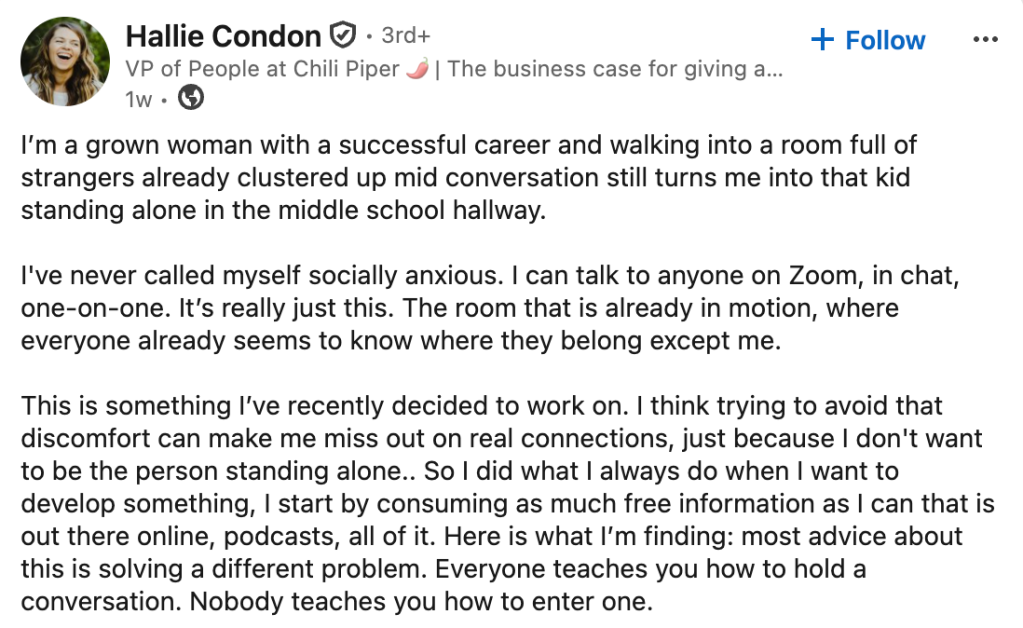
“Let’s say you walk into a room. You might know one or two people but they are busy in active conversations. Most other people at this event are in small groups chatting,” she writes. “I’m a grown woman with a successful career and walking into a room full of strangers already clustered up mid conversation still turns me into that kid standing alone in the middle school hallway.”
She adds that she’s not socially anxious and, in most situations, is quite confident.
“I can talk to anyone on Zoom, in chat, one-on-one. It’s really just this. The room that is already in motion, where everyone already seems to know where they belong except me.”
Everyone’s been there, whether you naturally thrive making small talk with new faces or whether it fills you with terror. It could be all the parents milling about before the PTA meeting, the cocktail hour at a business conference, or the neighborhood gathering that started with you.
It’s already difficult to confidently introduce yourself to new people, and it feels awkward joining a group that’s already mid-stream in discussing something you’re missing context for. Combining them both is truly an expert level task that even the most accomplished of us can find daunting.
Many of us wind up standing there pretending to look at something important on our phone.
What to do instead of freezing
Not one to be discouraged, Condon confessed she was determined to master this specific and mildly terrifying social situation.
“This is something I’ve recently decided to work on,” she noted.
She figured she’d start by soliciting free advice from her followers and other professionals on the platform.
“Everyone teaches you how to hold a conversation. Nobody teaches you how to enter one,” she writes. “What do you actually do?”
Dozens of commenters answered the call.
The power of the snack table, if there is one, came up multiple times. “Honestly, start at the food table. It’s much easier to strike up a conversation with someone when you’re both reaching for pretzels. And either way you’ll get some snacks,” one wrote.
Others advised using humor and vulnerability to win people over. “Going up to a small group and then being vulnerable. ‘I just came in, didn’t know anyone in the crowd. Instead of pretending to check important things on my phone, wanted to come up and say hi’ works like wonders,” someone suggested.
If you’re going to take the plunge and join a group, smile. “This is actually the advice therapists give to shy kids (I was one): smile. Because a lot of times, when we are anxious, we look closed off or unapproachable. That sends the opposite of ‘come meet me’ vibes. A smile is all it takes to transmit openness,” one commenter added.
Observe people’s body language. If you’re a good people reader, you can tell which groups are engaged in deep discussion and which ones are bouncing light small talk back and forth. “The key is finding a group that seems more animated, smiling, stuff like that. You’re usually joining a chat of people who also just met and were nervous about finding someone to talk to,” someone wrote.
Experts chime in with their best tips
Social anxiety, or even anxiety arising from super challenging social situations, is something therapists, business leaders, and communications experts deal with a lot.
Here’s what they have to say:
Rescue someone else who’s standing alone
“My favourite trick is to find the other person hovering near the edge of the room,” Mirna Huhoja-Doczy of Bits of Brand told Upworthy. “They are usually just as grateful to be rescued, and suddenly neither of you has to pretend your phone has become deeply fascinating.”
Roy Sheppard, former BBC news anchor and networking expert, advises, “Change your mission: Don’t walk in asking ‘Who can help me?’ Instead ask ‘Who looks like they could do with someone to talk to?’ The moment your attention shifts from yourself to helping someone else feel comfortable, your own anxiety begins to disappear.”
Listen and react before joining in naturally
Other experts advise people to not be afraid to stand somewhat awkwardly on the fringes of a group. Take the chance to listen, gain context about what the group is discussing, and then jump in once you truly have something to add.
“Avoid forcing a cold opener. Stand at the edge of an open group—a loose circle with a gap rather than a tight huddle. React to what’s being said before you add to it. That’s how you get invited in,” says Rod Mitchell, psychologist with Emotions Therapy Calgary. He adds that the dread of anticipation is almost always worse than the discomfort once you start talking.
Get there early
If at all possible, try to arrive before the event is in full-swing. Fashionably late be damned.
“It is much easier to help create a group than to break into one later,” says Ivan Wanis Ruiz, communications expert and instructor at the University of Toronto.
Even better, Ruiz says, if you can volunteer at the event or party: Working the registration desk, manning the snack table, passing out name tags. It’s an easy invitation to meet anyone and everyone.
Some social interactions come naturally to people. They just take a little outgoing energy and curiosity to engage. Others are far more challenging and require intentional effort: new strategies, techniques, even canned lines to get you started.
There’s no shame in asking for help navigating complex group dynamics, even for VPs or CEOs who should have all the confidence in the world. It’s a sticking point well worth overcoming.
As Condon astutely pointed out: “I think trying to avoid that discomfort can make me miss out on real connections.”