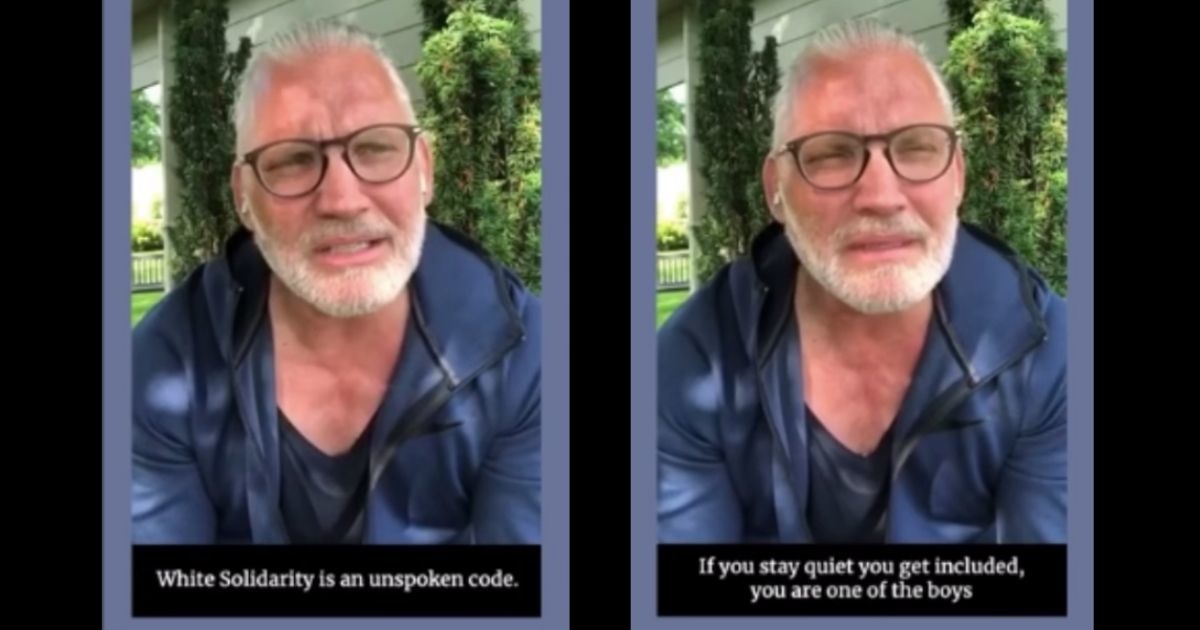
Man shares two lessons he learned from disrupting a racist joke in a group of white people

“Can you speak up? Because our silence is not benign?”

Array
Photo credit: Paul Scanlon/FacebookArray

Racist jokes are one of the more frustrating manifestations of racism. Jokes in general are meant to be a shared experience, a connection over a mutual sense of humor, a rush of feel-good chemicals that bond us to those around us through laughter.

So when you mix jokes with racism, the result is that racism becomes something light and fun, as opposed to the horrendous bane that it really is.

The harm done with racist humor isn’t just the emotional hurt they can cause. When a group of white people shares jokes at the expense of a marginalized or oppressed racial group, the power of white supremacy is actually reinforced—not only because of the “punching down” nature of such humor, but because of the group dynamics that work in favor of maintaining the status quo.

British author and motivational speaker Paul Scanlon shared a story about interrupting a racist joke at a table of white people at an event in the U.S, and the lessons he drew from it illustrate this idea beautifully. Watch:

Speaking up in a group setting where people have an unspoken sense of solidarity is difficult. Giving up social capital and being seen as a breaking a code of sorts is uncomfortable. But that that difficulty and discomfort are not excuses for staying quiet. As Scanlon points out, our silence is not benign, it’s malignant. Keeping quiet while a racist joke is being told and laughed at is harmful because it allows racism to go unchecked and white supremacy to remain secure.

An important point Scanlon makes is that not only do white folks allow harm to take place when we remain silent in the face of a friend, family member, colleague, or acquaintance making a racist joke, but we are actually rewarded for saying nothing. We maintain a sense of solidarity, we gain social capital, we’re seeing as agreeable and establish a sense of belonging. Those rewards are an insidious form of racism that many white people aren’t even aware we participate in. And we have to decide ahead of time that we’re going to give up that reward and embrace the inevitable awkwardness in order to do the right thing.

We have to decide that ending racism is more important than embarrassment. The more people who stand firm in that decision, the less awkward it will become and the sooner we can redefine what social capital and solidarity really mean.

This article originally appeared on 6.30.20
  • 50 emotions that don’t exist in the English language, but we all have experienced
    Elderly man gently touches the forehead of another man outdoors.

    English may boast one of the lengthiest vocabularies in the world, but there are still entire emotional universes Merriam-Webster can’t quite encapsulate. Thankfully, other cultures can. Our ability to understand these layered, sometimes conflicting feelings proves that beneath our differences, we share the same emotional language.

    Here are some of the most beautifully specific emotions that have no English equivalent, grouped by the inner worlds they illuminate. Together, they show one thing: human feelings are far more connected than we might assume,

    1. The many faces of love, longing, and heartache

    words with no english equivalent, untranslatable words, emotions words, language, english, french, dutch, korean, chinese, german, words, unique words
    Woman in denim jacket covers face with sleeve, standing outdoors with blurred background. Photo credit: Canva

    Chappell Roan said it best: “love is a kaleidoscope.” One of tenderness, ache, inevitability, and memory. These words perfectly capture the emotional fine print of human connection.

    • Saudade (Portuguese) – A deep nostalgic longing for someone or something loved and lost. The love that lingers long after the moment is gone.
    • Tu’burni (Arabic) – “I hope I die before you,” said not morbidly but because life without the beloved would be unbearable.
    • Onsra (Boro, India) – Loving for what you know will be the last time.
    • Mágoa (Portuguese) – A heartbreak so profound that its traces remain visible in gestures and expressions.
    • Sielvartas (Lithuanian) – A seemingly endless grief or emotional turmoil, often tied to loss.
    • Toska (Russian) – Spiritual anguish with no clear cause—sometimes love-sickness, sometimes existential ache.
    • Koi No Yokan (Japanese) – The feeling that you’re destined to fall in love with someone. Not love at first sight, but the inevitability of it.
    • Forelsket (Norwegian) – The consuming, euphoric high of new love. Technically, we do have an English equivalent (puppy love).
    • Mamihlapinatapai (Yaghan) – A shared look between two people, both hoping the other will initiate something they both want.
    • Gigil (Tagalog) – The irresistible urge to squeeze someone because they’re impossibly cute or beloved.
    • Jeong (Korean) – A deep, multifaceted emotional bond encompassing love, affection, empathy, and attachment.

    These words prove that love cannot be reduced to a single emotion.

    2. Awe, inspiration, and emotional transcendence

    words with no english equivalent, untranslatable words, emotions words, language, english, french, dutch, korean, chinese, german, words, unique words

    Woman with outstretched arms in a sunlit field, enjoying the outdoors. Photo credit: Canva

    Some emotions lift us out of our everyday selves—through nature, art, music, or inner stillness. These words celebrate those moments when the world feels bigger, deeper, or more alive.

    • Tarab (Arabic) – A musical ecstasy that transports you.
    • Duende (Spanish) – The visceral, spine-tingling feeling you get from powerful art.
    • Shinrin-yoku (Japanese) – The restorative calm from “forest-bathing.”
    • Dadirri (Australian Aboriginal) – Deep, contemplative, respectful listening.
    • Querencia (Spanish) – A place where your soul rests and regathers strength.
    • Ailyak (Bulgarian) – Doing things calmly and slowly, resisting the rush of life.
    • Ataraxia (Ancient Greek) – A serene calm that comes from acceptance and clarity.
    • Sukha (Sanskrit) – True, lasting happiness not dependent on circumstances.
    • Eudaimonia (Greek) – A form of human flourishing that includes joy, purpose, and even the ability to hold suffering with grace.

    These are the emotions that open us up to natural beauty and to the deeper parts of ourselves.

    3. Yearning, wanderlust, and the emotional pull of place

    words with no english equivalent, untranslatable words, emotions words, language, english, french, dutch, korean, chinese, german, words, unique words

    Lush forest with vibrant green and orange foliage in soft, misty sunlight. Photo credit: Canva

    These words capture the feelings that tie us to geography—whether we’re longing to leave, ecstatic to go, or transformed when we arrive somewhere new.

    • Fernweh (German) – A longing for faraway places you haven’t visited yet.
    • Dépaysement (French) – The disorientation (good or bad) of being somewhere entirely unfamiliar. Think of it as reverse déjà vu.
    • Resfeber (Swedish) – The nervous excitement right before a journey begins.
    • Vårkänsla (Swedish) – The giddy, heart-lifting feeling when spring finally returns.
    • Iktsuarpok (Inuit) – The restless anticipation of waiting for someone to arrive.
    • Waldeinsamkeit (German) – Also belongs here for its nature-rooted serenity.

    These words remind us that our surroundings shape our inner world.

    4. Connection, community, and shared human vibes

    words with no english equivalent, untranslatable words, emotions words, language, english, french, dutch, korean, chinese, german, words, unique words

    Friends laughing and drinking coffee at a cozy cafe table. Photo credit: Canva

    Some feelings only exist between people in crowds, in friendships, in shared silences, or in the subtle emotional temperature of a room.

    • Gezelligheid (Dutch) – Cozy, heartwarming togetherness.
    • 분위기 / Boon-wee-gi (Korean) – The overall atmosphere or vibe of a situation.
    • Fika (Swedish) – A ritualized break to slow down and connect (usually over coffee).
    • Mokita (Kivila) – A painful truth everyone knows but agrees not to mention.
    • Commuovere (Italian) – Being moved to tears by someone’s story or kindness.

    Human life is held together by shared awareness, and these words embody some of those shared experiences.

    5. Strength, resilience, and grit

    words with no english equivalent, untranslatable words, emotions words, language, english, french, dutch, korean, chinese, german, words, unique words

    Woman with curly hair in sunlight, eyes closed, wearing a purple top. Photo credit: Canva

    These words show that courage and resourcefulness take many forms.

    • Sisu (Finnish) – Deep perseverance and courage in adversity.
    • Orenda (Huron) – The human will’s power to shape the world despite fate.
    • Jijivisha (Hindi) – A zest for life; desire to live fully and vibrantly.
    • 加油 / Jiā yóu (Chinese) – “Add oil!” A cheer of encouragement and solidarity.
    • Desenrascanço (Portuguese) – Cleverly untangling yourself from trouble using creativity.
    • Pihentagyú (Hungarian) – A relaxed-brain quick-wittedness; clever mental play.

    Some emotions are fuel to keep us going.

    6. Humor, embarrassment, and the awkwardness of existence

    words with no english equivalent, untranslatable words, emotions words, language, english, french, dutch, korean, chinese, german, words, unique words

    Man smiling with hand over face, standing outdoors against a blue sky background. Photo credit: Canva

    Humans are messy. These words capture the cringiness that makes us lovable.

    • Jayus (Indonesian) – A joke so bad it’s good.
    • Age-otori (Japanese) – When your haircut makes you look worse.
    • Litost (Czech) – The sting of suddenly realizing your own misery—often with a dash of revenge fantasy.
    • Lebensmüde (German) – “Life tiredness” that sometimes explains reckless behavior.

    They celebrate the ways we laugh our way through being human.

    7. Serenity, fulfillment, and slower ways of living

    words with no english equivalent, untranslatable words, emotions words, language, english, french, dutch, korean, chinese, german, words, unique words

    Hand painting a still life on canvas with blue and orange tones. Photo credit: Canva

    These words name feelings we desperately need more English words for—the grounded peace that comes from completing something meaningful or living at a human pace.

    • Yuan bei (Chinese) – Perfect, satisfying accomplishment.
    • Ailyak (Bulgarian) – Calm, unhurried living.
    • Meraki (Greek) – Pouring your soul, passion, and creativity into what you do.
    • Querencia (Spanish) – A place of inner refuge and strength.
    • Ataraxia (Greek) – Acceptance-based tranquility.

    These words are all about the intrinsic fullness that comes from finishing something well, doing things with heart, and letting yourself breathe.

    8. The hard-to-define emotional in-betweens

    words with no english equivalent, untranslatable words, emotions words, language, english, french, dutch, korean, chinese, german, words, unique words

    Woman sitting on a chair in the water, writing in a notebook at sunset. Photo credit: Canva

    Some feelings sit in liminal spaces, hard to define but unmistakably human.

    • Torschlusspanik (German) – The fear that the door of opportunity is closing as you age.
    • Desbundar (Portuguese) – Letting loose and shedding your inhibitions.
    • Dadirri (Aboriginal) – Quiet, contemplative inner listening.
    • Dépaysement (French) – Emotional disorientation abroad (also fits here).

    “Bittersweet” is an English word that comes to mind, but how nice to have even more words to choose from.

    Why these words matter more than ever

    Maybe the real beauty of these untranslatable emotions isn’t that other languages have them and English doesn’t. It’s that humans everywhere feel them, even if we don’t always know how to say them out loud.

    So the next time you experience something too complicated to explain, take heart: there’s probably a word for it somewhere in the world…and someone who’s felt it, too.

    Sources: Berlitz, BBC, Thought Catalog, Collective Hub

    This article originally appeared last year. It has been updated.

  • An American in Paris explains European ‘bridge holidays’ and people are fascinated

    Photo credit: Canva Photos

    The Eiffel Tower, left, and a family at the beach.

    It’s no secret that work culture in Europe is a lot different from what it is in the United States. Europeans often get more time off and work fewer hours overall. Even so, you have to really live there to understand just how different things are.

    Justyn Lee is doing exactly that. He is an American living and working in Paris, and even he was surprised after moving there to discover a few new things about the work culture. One major takeaway? In France, the month of May barely exists.

    American living in Paris explains “le pont”

    In a LinkedIn post, Lee explains that France has four official holidays in the month of May. That’s kind of a lot, but not totally unusual compared to what Americans are used to. In November, we have Veterans Day and Thanksgiving, while in January there’s New Year’s Day and Martin Luther King Jr. Day. In France, there’s Labour Day, Victory in Europe Day, Ascension Thursday, and Whit Monday.

    However, he notes that “France does not operate on days. It operates on proximity.”

    Lee then explains something called “le pont,” which means “the bridge.” Whenever a holiday, or a day off from work, lands in the middle of the week, most companies just go ahead and make “the days in between disappear.”

    Americans are familiar with “the bridge” in a few scenarios. Most businesses are closed the Friday after Thanksgiving, for example. But in France, while it’s not legally mandated, it’s culturally accepted that most holidays turn into a four-day weekend.

    Lee says people take this opportunity to travel, go on vacation, or rest, only occasionally checking in on work. “Let’s circle back in June” is a common refrain.

    “May is not a month,” he writes. “C’est la vie.”

    It’s not just France that likes to stretch its holiday weekends

    The concept of “bridge holidays” is almost universal across European and Latin American work cultures. It exists under different names in France, Germany (Brückentage), Spain (hacer puente), Brazil (imprensar/emendar/enforcar), and more.

    There are tons of reasons for this extremely liberal vacation policy. European and Latin American countries have strong labor unions that protect workers’ rights, and most have universal healthcare, which lowers the economic pressures associated with working.

    Though bridge holidays and large amounts of paid time off are not completely universal, the U.S. does seem to be in the minority by not participating.

    How do countries like France keep the “trains running,” so to speak, in the month of May and other months full of holidays? Essential services are often still open, as are shops and small businesses in big cities like Paris. Tourism workers may not get such an extended break at the same time, since everyone is vacationing. But otherwise, typical office workers have a cultural agreement that non-urgent emails and meetings can simply…wait.

    Europeans chime in with a knowing nod

    Lee’s post struck a chord on LinkedIn, where dozens of commenters were eager to share their thoughts.

    “Love this post!” Marta Pastoriza Ares commented. “Haha Something veeery similar happens in Spain as well, and we also call it ‘hacer puente’ (bridging those bank holidays with the days ‘in between’). A culture trait I refuse to leave behind. Not ever!”

    “Very similar approach in Brazil when it comes to holidays,” Carolina O. Fraiel said. “We call it ‘imprensar’ (to squeeze), ’emendar’ (to connect) and ‘enforcar’ (to choke). And all it means is that people hope for holidays on Tuesdays and Thursdays to make the most of it.”

    “Very, very similar in Germany, we even also call those days between holidays and weekends ‘Brückentage’ (bridge days),” Alexander Lichanow said. “I would love to see US hustlebros froth and fume over this blatant disregard for grind culture.”

    Shahana Shaikh was fascinated by the unwritten rules in action: “Interesting how work culture isn’t just rules it’s the unwritten norms people quietly follow. Sometimes, without anything being formally announced, everyone just aligns around a shared rhythm. It shows that culture isn’t what’s written in policy, but what people actually practice every day.”

    And finally, Tim McNerney drew a humorous parallel to life in the U.S.: “European AE: Right guys, it’s July 31st. I’ll see you in September. Out of office is on. Leaving my work laptop at home. Don’t try and contact me. American AE: kidney surgery is tomorrow. Bring the docusigns by my bed, and I’ll make sure we get the red lines covered before they put me under. I should be good for the on-site the next morning too.”

    Americans in the comments were a bit flabbergasted to learn the meaning behind “le pont.” But would bridge holidays even work in America?

    Without federally mandated paid time off and some major changes to the cultural infrastructure, probably not. Americans also tend to get higher salaries than their European counterparts, and they like it that way.

    But that’s not to say that it’s all doom and gloom for overworked Americans.

    After COVID-19 and the work-from-home boom, many workers have found themselves with more flexibility than their office jobs previously allowed. In addition to formal “bridges” around Thanksgiving and Christmas, it’s become more normal for workplaces to be “quiet” around the holidays or during certain stretches of the summer.

    This understanding could become even more normalized in the coming years.

    The key thing that makes it work in France, though, is the social contract. There’s an unspoken agreement that life is more important than work, and things that aren’t urgent are sometimes going to have to wait. It’s an approach that we could, and probably should, adopt a little more of here at home.

  • People are bewildered to learn that half of Canada lives south of North Dakota
    Photo credit: CanvaThere are lots of fun facts about the United States-Canada border.

    Canada is north of the United States” sounds like a basic fact that even elementary school children know to be true. But is it really? It turns out, the actual geographic reality isn’t quite that simple.

    In fact, the Canadian-American border is all kinds of weird when you start examining it closely. The long part that looks like a straight line on the map is actually 900 zigzagging lines. Sometimes that “straight” line along the 49th parallel varies by hundreds of feet. There’s a disputed island along the border that both countries claim as their own.

    But perhaps the most surprising factoid about the border is how much of it (and the Canadian population that lives above it) is actually south of the northernmost U.S. states.

    If someone told you half of Canadians live south of North Dakota and Washington, it sounds wrong, right? But it’s right.

    @geomap.bytes

    You Can Travel SOUTH to Canada?! 🤯 The Border Fact No One Expects 🇺🇸🇨🇦 #TikTokLearningCampaign #didyouknow #geography #usa #canada

    ♬ original sound – GeoMapBytes

    As a geomap.bytes TikTok video explains, about 70% of Canadians have historically lived south of the 49th parallel. But even more surprising is that around half of all Canadians live south of the southern borders of North Dakota and Washington. An even wilder fact is that the southernmost point in Canada sits south of some part of 27 U.S. states. It’s even slightly south of a small part of Northern California.

    According to the video, more Americans than Canadians live north of Canada’s southernmost point, Middle Island in Lake Erie. How is that true? Let’s look at the math.

    The population of Canada as of 2026 is approximately 40 million people, so 50% would be around 20 million. The U.S. population is a little over 342 million, so only about 6% of the U.S. population needs to live north of Middle Island for that math to work out. It does, as RealLifeLore explains:

    Commenters (especially those who don’t live near that part of either country) are bewildered by these counterintuitive facts:

    “Wow this is crazy: if you go south from Detroit you end up in Canada 🤯🤯🤯”

    “Journey: ‘born and raised in South Detroit’ …so Canada.”

    “I mean it’s like I knew this because I know where the border is yet I’ve never really thought about it or really registered it in my brain.”

    “Geography can be really weird at times.”

    Though it may sound strange at first, the way the populations pan out actually does make sense geographically. Canada may be enormous land-wise, but the most easily habitable parts, climate-wise, are in the southern part of the country. The major population centers of Toronto, Montreal, and Ottawa are all in that triangular area between Michigan and New York. And the vast majority (90%, according to the CBC) of Canadians live within 100 miles (160 km) of the U.S. border.

    More surprising facts about Canadian-American geography (from Across the Globe):

    • The U.S.-Canada border is delineated by the longest clear-cut strip of land in the world.
    • Point Roberts, Washington, is only accessible by car if you drive through part of Canada.
    • The northernmost point in the contiguous U.S. is a bit of Minnesota jutting up into Canada. It was the result of a mapmaking mistake.
    • The disputed island mentioned at the beginning of this article is home to nearly 10,000 puffins.
    • The international border runs along the yellow centerline of a street that separates Derby Line, Vermont from Stanstead, Quebec.
    • At the border crossing in Blaine, Washington, a 67-foot concrete arch straddles the border between the two countries. The words “Children of a common mother” mark the American side. “Brethren dwelling together in unity” is written on the Canadian side.
    • The Great Lakes that sit between the two countries hold 21% of the world’s fresh water.
    • Lake Michigan is the only one of the Great Lakes that lies entirely within the U.S.

    Canada and the U.S. have been on friendly terms for the vast majority of their mutual history, which is quite remarkable considering the history of the world. There’s a lot to love about our northern neighbors and a lot to know about the crooked line that delineates the two nations.

  • American working in Finland made videos comparing work cultures. The differences are wild.
    Photo credit: CanvaA man happy at his desk; a man passed out on a couch.
    ,

    American working in Finland made videos comparing work cultures. The differences are wild.

    From 4:30 AM wake-ups to getting tucked in by Jeff Bezos at 1 AM, this parody of the American workday hits way too close to home

    Finland gets a lot of attention for its approach to work-life balance, from four-day workweek experiments to generous parental leave policies. This has created some pretty entertaining stereotypes about what working in Finland must be like. Dan Toomey, an American who works for Morning Brew in Finland, decided to lean all the way into those stereotypes with a pair of TikTok videos that have people laughing at how painfully accurate they are.

    In the first video, Toomey shows what Americans think the average Finnish workday looks like. It starts with him stepping out of his morning sauna, followed by hot chocolate hand-delivered by his company.

    Breakfast? Muesli and pine needles, naturally.

    Around 11 AM, he finally sits down to work. “Since we all work at Spotify,” he explains, he begins his day by listening to ambient synth music while wrapped in a felt blanket. His daily $5,000 bonus arrives in the mail. He has a casual chat about Eurovision with Finland’s 36-year-old Prime Minister. Lunch is cold herring and more pine needles, followed by a walk through Narnia. He wraps up at 3:30 PM after his first and only meeting of the day, just in time for his second bonus to arrive.

    The American workday video, on the other hand, looks like something from a particularly dark comedy sketch.

    It begins at 4:30 AM on a Sunday. The American worker “sprints out of bed in record time,” recites the pledge of allegiance, and prepares breakfast: 12 eggs and a gallon of whole milk, consumed while staring at his phone. He writes emails for three hours straight before his first meeting, where everyone “shares big numbers, then makes a million dollars” as cash literally rains down on him.

    Lunch is “every fast food there is,” eaten quickly before he squats at his desk to memorize a PowerPoint presentation. The workday finally ends at 1 AM when he places a spreadsheet under his pillow and gets tucked into bed by Jeff Bezos himself.

    The videos are obviously satirical, but they hit a nerve because they’re rooted in real cultural differences. Finland genuinely does have policies that prioritize employee well-being in ways that seem almost fictional to American workers. Meanwhile, American hustle culture has created an environment where working yourself to exhaustion is often worn as a badge of honor.

    Both videos have been praised not just for their humor, but for their critique of what we’ve normalized in our work cultures. As conversations about sustainable work practices continue, maybe the real question isn’t whether the stereotypes are accurate. It’s which version of the workday we actually want to be living.

  • At 6:30 a.m., Japanese radio plays ten minutes of ‘Radio Taiso’ and it’s getting people moving
    Photo credit: CanvaTwo people exercise in a park.
    ,

    At 6:30 a.m., Japanese radio plays ten minutes of ‘Radio Taiso’ and it’s getting people moving

    “Radio Taiso was inspired a century ago by a similar radio program in the United States.”

    It’s early morning and you’re snuggled tightly under the warm covers. Your alarm buzz isn’t quite enough to entice you to get up and en route to begin your day. But what if there was a public radio announcement with a trusty reminder that it’s good for the body, if possible, to get up and move? Well, in Japan, there is.

    The Associated Press posted a clip on YouTube of people lightly stretching in various locations across Japan. They explain that this is a common practice. “This is how Japan wakes up,” a voiceover shares. “It’s called Radio Taiso. In English, it’s radio exercise. It’s a very simple idea. At 6:30 in the morning, on the radio, you get music. You get choreography to exercise by. People gather in city parks to do it. People gather in their offices. At schools. You can do it at home.”

    Good for all ages

    The exercise regimen is nothing too heavy. “The exercises are not very strenuous—just exercise and basic calisthenics,” they explain. “It’s suitable for all ages and everybody can do it. You can exert yourself a lot if you want, but you don’t have to.”

    The host of the segment points out that Japan has a “long-lived population.” He shares, “As we all know, Japan is famous for longevity. I wouldn’t say that Radio Taiso is why, but it certainly can’t hurt anything.”

    According to the BBC, Japan continues to break records for long, healthy lives: “The number of people in Japan aged 100 or older has risen to a record high of nearly 100,000, its government has announced. Setting a new record for the 55th year in a row, the number of centenarians in Japan was 99,763 as of September.”

    100-year history

    In a recent article, Yahoo!life explains that this tradition has been around for nearly a century. “Radio Taiso has an almost 100-year history,” write article author Stephen Wade, “formally introduced in 1928 and coinciding with the enthronement of Emperor Hirohito. The tradition endures because the exercises are suitable for all ages and capabilities, and easily accessible.”

    Even more interestingly, Wade shares the roots of the exercise, writing, “Radio Taiso was inspired a century ago by a similar radio program in the United States sponsored by the Metropolitan Life Insurance Co. The Japan Radio Taiso Federation says officials of the postal ministry visited the United States in the 1920s and returned to Japan with the concept.”

    The Japan Society explains that these routines, of course, are helpful for all ages. On their website they write, “Fun for children and adults alike, Radio Taiso is commonly used for group warm-ups in Japan and the whole school will participate in the exercises at the beginning of school Sports Day.”

    They add that it gained popularity because of the positive mental and physical effects it seemed to have on citizens. “The purpose of Radio Taiso is to improve general health and fitness,” they write, “and the routine is therefore designed to be simple and accessible to all. It requires no equipment, can be done in a small space, and can be modified for those with mobility issues.”

    Simple movements

    The movements, as mentioned, are simple. Similarly to yoga, it begins with arm exercises. Participants lift their arms up and move them in gentle circles. Then, they slightly bend and twist their legs.

    This continues for about ten-second intervals, adding bends in each direction, like a ballet routine. Then, there’s more twists, shoulder movements, slight hopping, and squats. Wade shares, “Each movement is repeated four to eight times, with instructions throughout to relax, breathe, and inhale and exhale slowly.”

    Kodomokai

    I reached out to an old high school friend, Nathan Hillyer, who has been living in Japan for quite some time. He confirmed that while it still exists, it’s mostly practiced by and beneficial to the elderly. “In the park near where I live, old people tend to go there to do it. It is run by NHK Radio 1 at 6:30 in the morning,” he shares.

    He adds that his wife, Asuka Hillyer, shared that she would wake up early to do it back in the day. “My wife said when she was a kid, she would do it as a part of the ‘kodomokai’ (community kids club). They would get a stamp or something every morning, and if they had a certain number by the end of the year, they would get a prize. They would show up wearing their community paper kind of tied around their neck.”

    Hillyer also recalled that the radio exercises began in the West. “I remember watching old American comedies in black and white, maybe W.C. Fields or something like that. They were in funny situations in which someone is trying to do their radio exercises and hearing the voice, but either they can’t keep up or something happens in the real space which is not matching the radio routine.”

    He adds, “In Japan, it is quite the phenomenon because the Japanese tend to be very community-oriented.”

  • Texas dad and son have first encounter with a trans woman, and dad sets a powerful example
    Sometimes allyship is simple

    Now more than ever, the transgender community needs support. In Texas, the legislative environment for transgender people has only grown more hostile. In 2025, Texas enacted Senate Bill 8, known as the bathroom bill, banning transgender people from using facilities that match their gender identity in public buildings, schools and universities. A separate bill was also filed that would charge transgender people with gender identity fraud, making it a felony to identify as trans on official documents. Combined with earlier laws restricting gender-affirming care for minors and new definitions of sex in state law, the cumulative effect has been devastating for the transgender community in the state.

    Still, even if your heart is in the right place, it can be hard to know the best or most feasible way to even show up as an ally. And that’s the beauty of this story. Sometimes it really is a simple matter to accept people as they are and treat all humans with dignity, kindness and respect, even if we don’t fully understand them.

    A small moment with a big lesson

    A dad shared his first encounter with a transgender woman in his small Texas town, and the simple lesson he taught his son inspired hope in others. James Eric Barlow shared a video on TikTok describing how he and his son just saw a trans woman in real life for the first time.

    “We all know that there’s people that are disgusted whenever they see a trans person,” Barlow began. “And we all know of the people who don’t care if they see a trans person. “But apparently, we’re a third type of person (or at least I am, I can’t speak for him),” he says, indicating his son in the backseat who chimes in with “I am, too!”

    Barlow went on to explain how they had just had their first experience with a trans woman. It wasn’t anything major. She just walked through a door behind them and Barlow held the door for her, just as he would any other person. He didn’t even notice she was trans at first, but once he did, his immediate reaction was one we can all learn from.

    “When I tell you how happy it made me,” he said, beginning to tear up, “to be able to see somebody be out and open to the world here in small town Texas. You just gotta know how much bravery that takes. Right, Mikey?”

    “Hell yeah!” the son agreed.

    Barlow wanted to say something to her, but he didn’t want to make her feel uncomfortable, either.

    “But if you’re a trans woman and you came here to the Landmark truck stop in Clyde, Texas, just know we’re proud of you,” he concluded.

    The internet was moved by his reaction

    Barlow’s video was shared on Reddit, where it’s received a slew of views and comments that prove parents set the tone for their kids’ sense of acceptance.

    “Indoctrinate your children with kindness, compassion, consideration and respect for others.” – Toddthmpsn

    “When I was younger I would get my hair cut by a woman named Liz. She spoke Spanish so it was hard for to understand her English sometimes. My dad spoke Spanish so would translate for her and me. I noticed Liz looked a little different then other women. But I never said anything, I never felt any differently about her. She never scared me, or made me question anything. She was just Liz. As I got older I realized she was a trans woman. And it literally changed nothing. She was still just Liz. Liz was always kind and treated everyone warmly. I havnt seen her in years but I hope she is doing well. I really liked her.” – PerplexedPoppy

    “This literally happened to me as a child in the 80s. A cashier at a store we visited suddenly started dressing in a feminine style and it appeared that they were transitioning. My mom explained to me in an age appropriate way that sometimes people decide they want to be a man instead of a woman, or a woman instead of a man. She told me that people would probably be mean to the cashier and it was important for us to remember that and always be polite to her, as we would anyway. This was way before trans issues were as mainstream as they are now, but my mom had seen an episode of Phil Donahue where trans woman discussed their stories, and she recognized it as a medical issue. Core memory for me.” ZipCity262

    “As a trans woman, im deathly afraid whenever I have to go to rural areas. I can instantly feel physical tension when I walk into a gas station or a restaurant in these areas. Thank you for being supportive. Trans people need you now more than ever.” – rainbow_lenses

    This is what allyship actually looks like

    As this dad and son showed, it’s a simple matter to demonstrate non-judgmental acceptance in front of our kids so they hopefully will grow up without being bound by chains of bigotry they’ll later have to learn to unload.

    This article originally appeared three years ago. It has been updated.

  • Woman proposes to girlfriend on hockey jumbotron in sweet ‘Wheel of Fortune’ reveal
    Photo credit: via Toronto Sceptres (used with permission)A proposal at a hockey game.

    It’s fairly common to see someone propose on the Jumbotron at a sporting event. A couple from Virginia, however, found a new way to add some drama. They turned their Jumbotron proposal into a Wheel of Fortune-style game.

    It all went down at the Coca-Cola Center in Toronto, Canada, during a Professional Women’s Hockey League matchup between the Toronto Sceptres and the New York Sirens.

    The couple, Nina Borgeson and her partner, Meg Beizer, appeared to be playing a game similar to Wheel of Fortune during a break in the hockey match, but Meg knew otherwise. The announcer asked her, “What three letters are you going to guess next?” After the traditional RSTLNE were put up on the board, she replied, “W, O, U,” making it obvious what the puzzle said.

    Nina solved the puzzle:  ‘WILL YOU MARRY ME?”

    Meg then got down on one knee and, in front of the cheering crowd, she popped the question. Meg slipped the ring on Nina’s finger, they kissed, and Nina raised her hand in celebration. 

    The couple traveled to the game from Virginia, and when Meg learned that it was Pride night, she knew it was the perfect time to ask for Nina’s hand in marriage. “This league quickly became a big part of our life and something so special to us,” Meg told Queerty. “The community is unlike any other fan base I’ve ever seen. I knew sharing it with other fans would make our proposal that much more special and memorable, and it exceeded expectations. The amount of love and support we received was something we will truly never forget.”

    PWHL games have become a popular place for LGBTQ women to propose. Back in December, at an Ottawa Charge game, two women were being interviewed when the conversation veered into unexpected territory. “I love this community, I love everything that’s been given to us,” a woman named Theresa said into the microphone, “and I can’t think of a better moment to ask Dani…” she said before dropping to one knee and proposing.

    The PWHL just completed its third regular season, during which it saw attendance and viewership expand dramatically. This season, the league expanded from six to eight teams and saw attendance eclipse the million mark for the first time. Attendance was up 28% this season, with the average game attendance rising from 7,230 in 2024-25 to 9,304. Viewership is also up on the league’s YouTube channel. This season, viewership across the U.S. and Europe increased by 77%. 

    A growing community

    The league saw an opportunity for growth after women’s hockey made headlines in Milan earlier this year, with the U.S. women’s team beating Canada for the gold medal. “We knew this moment was going to be big for us,” PWHL executive vice president of business operations Amy Scheer told The Athletic, “and felt that this could be a game changer for us.”

  • Why a common World War II experience made Americans choose toilet paper over bidets
    Photo credit: PhotosNormandie/Wikimedia Commons & CanvaAmerican soldiers in World War II and a bidet.
    ,

    Why a common World War II experience made Americans choose toilet paper over bidets

    We’ll probably switch to the metric system before bidets.

    The bidet dates back to 18th-century France and, by all accounts, is more hygienic than toilet paper and better for the environment. But, much like the metric system, Americans aren’t adapting to them anytime soon.

    In fact, a 2022 poll found that only 12% of Americans “know a lot about” bidets. Americans make up 4% of the world’s population but use 20% of its toilet paper, while 70% of the world doesn’t use toilet paper at all.

    When you look at the numbers, bidets are a much better option for the environment and for one’s pocketbook than toilet paper. According to The Process, Americans cut down 31 million trees each year for toilet paper, and it takes 37 gallons of water to produce a single roll, while each use of a bidet requires only one-eighth of a gallon.

    Bidets also do a better job of cleaning your rear end than a square of toilet paper.

    “The direct application of water for post-toilet cleansing removes residual fecal matter more effectively than toilet paper alone,” Dr. Farhan Malik, a health and wellness expert, told KTVX-TV. “This can help prevent skin irritation and inflammation in the genital area. The gentle, targeted spray of water also reduces excessive wiping and tugging, which can lead to discomfort.”

    Why haven’t Americans adopted the bidet?

    When Americans were stationed in France during World War II, many visited bordellos, a fact they probably didn’t want people back home to know. In the bordellos, sex workers and their clients used bidets to clean up before and after their encounters, so Americans came to associate bidets with naughtiness and illicit behavior. 

    toilet, bidet, bathroom
    A bidet beside a toilet. Photo credit: Mura.Ts/Unsplash

    “GIs visiting bordellos would often see bidets in the bathrooms, so they began to associate these basins with sex work,” Maria Teresa Hart writes in The Atlantic. “Given America’s puritanical past, it makes sense that, once back home, servicemen would feel squeamish about presenting these fixtures to their homeland.”

    Even before World War II, bidets were associated with contraception and abortion. “The presence of a bidet is regarded as almost a symbol of sin,” Norman Haire, a pioneering gynecologist and sexologist, said in 1936.

    Bidets make economic sense

    What’s interesting is that, even though Americans rejected bidets on moral grounds, that resistance hasn’t been overridden by economic common sense. Americans spend $11 billion on toilet paper every year, and the average person in the U.S. uses 141 rolls annually. A single bidet attachment can cost as little as a one-time fee of $35.

    toilet paper, toilet paper stash, bathroom
    A whole lot of toilet paper. Photo credit: Erik Mclean/Unsplash

    Bidets have been found to be better for your health, the environment, and your wallet, but Americans still won’t switch from paper to a little spritz of water. If the runs on TP during the COVID-19 pandemic didn’t inspire Americans to change their ways, maybe nothing will. 

    “Toilet paper is not a necessity. It is a cultural habit wearing the costume of a necessity. Seventy percent of the human population proves that every single day,” The Process reports. “A product most of the world has never needed became the first thing Americans panic-bought when crisis arrived. Not medicine. Not food. Toilet paper. That tells you something, not about cleanliness, but about how habits take root. They do not grow from logic. They grow from one small misunderstood moment, repeated across a generation, then another, until the habit feels like instinct.”

Culture

The real inspiration for ‘Beauty and the Beast’ is far more heartbreaking than the fairytale

Culture

Fashion expert explains why ‘survival bias’ makes it seem like 19th century Victorian gowns were much smaller than they were

Family

Dad discovers his son has pinworms and pediatrician hits him with even worse news

Culture

Millennial asks Gen Zers what they do for fun, and the answers are surprisingly different