Toddlers can be hilarious. They’re learning the world around them while simultaneously acting as if they’ve got it all figured out. There’s nothing like arguing with a tiny version of yourself whose pants are on backwards and inside out. But even with all their sass, they’re mostly filled with adorable moments.
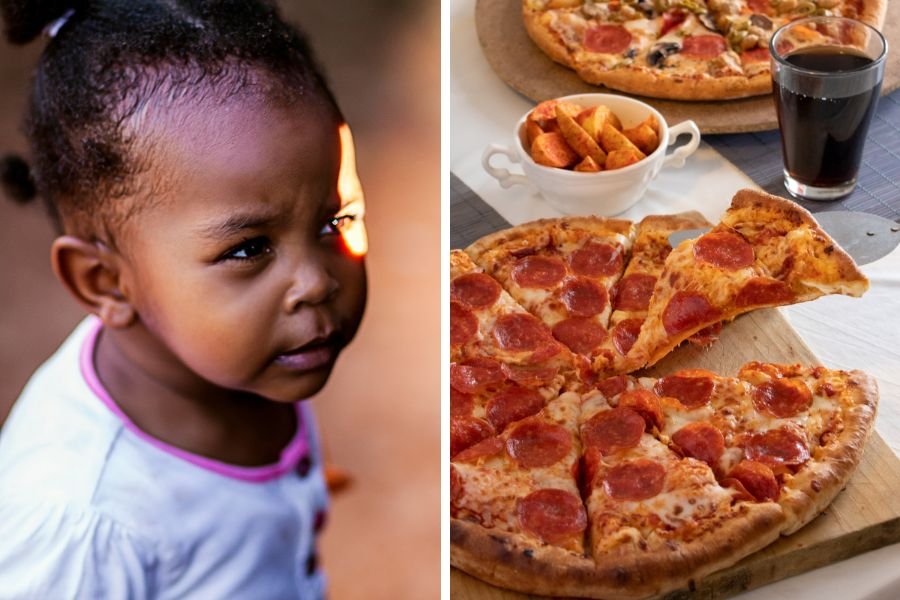
Caroline Victoria uploaded a video to her social media page of her toddler daughter saying her bedtime prayers. The little girl is wearing a pink satin bonnet laying on the bed with a sweet grin on her face as her mom starts prayer. Since the girl is just a toddler she is only contributing one word responses for the things she’s thankful for.
That tiny toddler voice only makes the answers even cuter. Caroline starts off by saying, “dear Lord, thank you for,” then she pauses waiting for the little girl’s response. She’s off to a pretty solid start by being thankful for her brother, Brandon and her mommy but things quickly take an interesting turn.
Caroline starts her off again, “thank you for?” The response was no longer a person in the house. This baby was thankful for pizza and she didn’t think her mom was taking her gratitude for the cheesy delicious meal seriously. You hear her mom laughing behind the camera before asking her again what she was thankful for.
If you thought the answer was going to change, you don’t know how much she appreciates pizza. The little girl rattled off pizza at least five more times in a row to make sure her point was taken proving to be a bit too much for Caroline who can be heard squeaking with laugher in the background.
Watch her request below:
Commenters can’t seem to get over how adorably hilarious the little girl is.
“She is a little comedian and a beauty,” one person writes.
“Too precious!! She grateful for her Pizza.. Amen,” another says.
“She didn’t add you in the prayer ma’am.She said her brother, me , and pizza.She didn’t say “mummy.” Go get your prayers somewhere else,” someone jokes.
“I’m with her Pizza is definitely something to be thankful for all the time,” another person declares.
Let’s all hope mom answers this little girl’s prayers and order some pizza. It’s clear that pizza is a top priority for her and until she has it her little brain will not be able to move on to pray for other things.
In a small village in Pwani, a district on Tanzania’s coast, a massive dance party is coming to a close. For the past two hours, locals have paraded through the village streets, singing and beating ngombe drums; now, in a large clearing, a woman named Sheilla motions for everyone to sit facing a large projector screen. A film premiere is about to begin.
It’s an unusual way to kick off a film about gender bias, inequality, early marriage, and other barriers that prevent girls from accessing education in Tanzania. But in Pwani and beyond, local organizations supported by Malala Fund and funded by Pura are finding creative, culturally relevant ways like this one to capture people’s interest.
The film ends and Sheilla, the Communications and Partnership Lead for Media for Development and Advocacy (MEDEA), stands in front of the crowd once again, asking the audience to reflect: What did you think about the film? How did it relate to your own experience? What can we learn?
Sheilla explains that, once the community sees the film, “It brings out conversations within themselves, reflective conversations.” The resonance and immediate action create a ripple effect of change.
MEDEA Screening Audience in Tanzania. Captured by James Roh for Pura
Across Tanzania, gender-based violence often forces adolescent girls out of the classroom. This and other barriers — including child marriage, poverty, conflict, and discrimination — prevent girls from completing their education around the world.
Sheilla and her team are using film and radio programs to address the challenges girls face in their communities. MEDEA’s ultimate goal is to affirm education as a fundamental right for everyone, and to ensure that every member of a community understands how girls’ education contributes to a stronger whole and how to be an ally for their sisters, daughters, granddaughters, friends, nieces, and girlfriends.
Sheilla’s story is one of many that inspired Heart on Fire, a new fragrance from the Pura x Malala Fund Collection that blends the warm, earthy spices of Tanzania with a playful, joyful twist. Here’s how Pura is using scent as a tool to connect the world and inspire action.
A partnership focused on local impact, on a global mission
Pura, a fragrance company that recognizes education as both freedom and a human right, has partnered with Malala Fund since 2022. In order to defend every girl’s right to access and complete 12 years of education, Malala Fund partners with local organizations in countries where the educational barriers are the greatest. They invest in locally-led solutions because they know that those who are closest to the problems are best equipped to solve and build durable solutions, like MEDEA, which works with communities to challenge discrimination against girls and change beliefs about their education.
But local initiatives can thrive and scale more powerfully with global support, which is why Pura is using their own superpower, the power of scent, to connect people around the world with the women and girls in these local communities.
The Pura x Malala Fund Collection incorporates ingredients naturally found in Tanzania, Nigeria, Pakistan, and Brazil: countries where Malala Fund operates to address systemic education barriers. Eight percent of net revenue from the Pura x Malala Fund Collection will be donated to Malala Fund directly, but beyond financial support, the Collection is also a love letter to each unique community, blending notes like lemon, jasmine, cedarwood, and clove to transport people, ignite their senses, and help them draw inspiration and hope from the global movement for girls’ education. Through scent, people can connect to the courage, joy, and tenacity of girls and local leaders, all while uniting in a shared commitment to education: the belief that supporting girls’ rights in one community benefits all of us, everywhere.
You’ve already met Sheilla. Now see how Naiara and Mama Habiba are building unique solutions to ensure every girl can learn freely and dare to dream.
Naiara Leite is reimagining what’s possible in Brazil
Julia with Odara in Brazil. Captured by Luisa Dorr for Pura
In Brazil, where pear trees and coconut plantations cover the Northeastern Coast, girls like ten-year-old Julia experience a different kind of educational barrier than girls in Tanzania. Too often, racial discrimination contributes to high dropout rates among Black, quilombola and Indigenous girls in the country.
“In the logic of Brazilian society, Black people don’t need to study,” says Naiara Leite, Executive Coordinator of Odara, a women-led organization and Malala Fund partner. Bahia, the state where Odara is based, was once one of the largest slave-receiving territories in the Americas, and because of that history, deeply-ingrained, anti-Black prejudice is still widespread. “Our role and the image constructed around us is one of manual labor,” Naiara says.
But education can change that. In 2020, with assistance from a Malala Fund grant, Odara launched its first initiative for improving school completion rates among Black, quilombola, and Indigenous girls: “Ayomidê Odara”. The young girls mentored under the program, including Julia, are known as the Ayomidês. And like the Pura x Malala Fund Collection’s Brazil: Breath of Courage scent, the Ayomidês are fierce, determined, and bursting with energy.
Ayomidês with Odara in Brazil. Captured by Luisa Dorr for Pura
Ayomidês take part in weekly educational sessions where they explore subjects like education and ethnic-racial relations. The girls are encouraged to find their own voices by producing Instagram lives, social media videos, and by participating in public panels. Already, the Ayomidês are rewriting the narrative on what’s possible for Afro-Brazilian girls to achieve. One of the earliest Ayomidês, a young woman named Debora, is now a communications intern. Another former Ayomidê, Francine, works at UNICEF, helping train the next generation of adolescent leaders. And Julia has already set her sights on becoming a math teacher or a model.
“These are generations of Black women who did not have access to a school,” Naiara says. “These are generations of Black women robbed daily of their dreams. And we’re telling them that they could be the generation in their family to write a new story.”
Mama Habiba is reframing the conversation in Nigeria
Centre for Girls' Education, Nigeria. Captured by James Roh for Pura
In Mama Habiba’s home country of Nigeria, the scents of starfruit, ylang ylang and pineapple, all incorporated into the Pura x Malala Collection’s “Nigeria: Hope for Tomorrow,” can be found throughout the vibrant markets. Like these native scents, Mama Habiba says that the Nigerian girls are also bright and passionate, but too often they are forced to leave school long before their potential fully blooms.
“Some of these schools are very far, and there is an issue of quality, too,” Mama Habiba says. “Most parents find out when their children are in school, the girls are not learning. So why allow them to continue?”
When girls drop out of secondary school, marriage is often the alternative. In Nigeria, one in three girls is married before the age of 18. When this happens, girls are unable to fulfill their potential, and their families and communities lose out on the social, health and economic benefits.
Completing secondary school delays marriage, and according to UNESCO, educated girls become women who raise healthier children, lift their families out of poverty and contribute to more peaceful, resilient communities.
Centre for Girls’ Education, Nigeria. Captured by James Roh for Pura
To encourage young girls to stay in school, the Centre for Girls’ Education, a nonprofit in Nigeria founded by Mama Habiba and supported by Malala Fund and Pura, has pioneered an initiative that’s similar to the Ayomidê workshops in Brazil: safe spaces. Here, girls meet regularly to learn literacy, numeracy, and other issues like reproductive health. These safe spaces also provide an opportunity for the girls to role-play and learn to advocate for themselves, develop their self-image, and practice conversations with others about their values, education being one of them. In safe spaces, Mama Habiba says, girls start to understand “who she is, and that she is a girl who has value. She has the right to negotiate with her parents on what she really feels or wants.”
“When girls are educated, they can unlock so many opportunities,” Mama Habiba says. “It will help the economy of the country. It will boost so many opportunities for the country. If they are given the opportunity, I think the sky is not the limit. It is the starting point for every girl.”
From parades, film screenings to safe spaces and educational programs, girls and local leaders are working hard to strengthen the quality, safety and accessibility of education and overcome systemic challenges. They are encouraging courageous behavior and reminding us all that education is freedom.
Experience the Pura x Malala Fund Collection here, and connect with the stories of real girls leading change across the globe.
Saturday Night Live UK debuted over the weekend on Sky TV (and Peacock in America), and already, one performer is a fan favorite. In a skit titled “David Attenborough’s Last Supper,” the famed naturalist, played by George Fouracres, invites several of “history’s greatest Britons,” who have been resurrected thanks to his brother Richard Attenborough’s “Jurassic Park technology.”
Naturally, the sketch featured a slew of impressive celebrity impersonations, from Freddie Mercury to Winston Churchill to Agatha Christie. But even in a sea of notable performances, it was comedian Jack Shep’s Princess Diana who really stole the show.
Watch:
While Shep’s Diana does speak here and there—thanking Attenborough for the invitation and reassuring Freddie Mercury that if a menu item “has an asterisk next to its name, then it comes with free rice”—most of the laugh-out-loud moments come from her coy, flirtatious glances at the camera while others are speaking. The People’s Princess has, after all, long been a queer icon. But this takes things to a whole new level.
Reactions
One leisurely scroll through the YouTube comments makes it clear that Shep was a fan favorite. Many are eager for Diana to become an SNL UK staple.
Saturday Night Live UK premiered last night and we can’t stop thinking about Jack Shep’s impersonation of gay icon Princess Diana! The British version of the long-running US sketch show debuted with host Tina Fey and musical guest Wet Leg. ‘The Last Supper with David Attenborough’ saw a dinner party featuring a number of resurrected British icons, including Princess Di, Freddie Mercury and Elizabeth I 👏 #snl#princessdiana#diana#tinafey#saturdaynightlive
“I hope that Diana becomes a regular that randomly pops up in episodes to steal the show as she/he does here.”
“Princess Di was to die for.”
“I loved Princess Di but that Jack Shep impression was the funniest thing I’ve seen in ages.”
“Hope she’s a recurring visitor…”
“The Diana impression is an instant classic. Absolutely spot on.”
“The star of this show is definitely the person that played Princess Diana.”
Perhaps this comment says it best:
“Princess Di was uniquely special in real life and this actor does do her memory justice even though it’s a silly comedy skit. I feel she might have had a good laugh about the whole thing and it’s not disrespectful at all.”
Though Shep undoubtedly helped win favor among viewers, the overall reaction to an across-the-pond version of SNLhas been mixed.
Some things, like host Tina Fey’s opening monologue and the edgier “Weekend Update” segment, have been mostly well-received.
However, some critics have lambasted the show as a “tepid cosplay” of its American predecessor, arguing that it copies the format without adding a unique touch. Still, even those critics seem to agree that certain elements need time to develop before the show can be fully assessed.
One promising sign is that, much like SNL in the U.S., SNL UK can give relatively unknown comedians like Shep a chance to share their gifts with the world. That certainly seems like a win-win for everyone.
When it comes to actors doing accents across the pond, some Americans are known for their great British accents, such as Natalie Portman (“The Other Boleyn Girl”), Robert Downey, Jr. (“Sherlock Holmes”), and Meryl Streep (“The Iron Lady”). Some have taken a lot of heat for their cartoonish or just plain weird-sounding British accents, Dick Van Dyke (“Mary Poppins”), Kevin Costner (“Robin Hood: Prince of Thieves”) and Keanu Reeves (“Bram Stoker’s Dracula”).
Some actors, such as Tom Hardy (“The Drop”) and Hugh Laurie (“House”), have American accents so good that people have no idea they are British. Benedict Townsend, a London-based comedian and host of the “Scroll Deep” podcast, says there is one word that American actors playing characters with a British accent never get right.
And no, it’s not the word “Schedule,” which British people pronounce the entire first 3 letters, and Americans boil down to 2. And it’s not “aluminum,” which British and American people seem to pronounce every stinking letter differently.
What word do American actors always get wrong when they do British accents?
“There is one word that is a dead giveaway that an English character in a movie or a TV show is being played by an American. One word that always trips them up. And once you notice it, you can’t stop noticing it,” Townsend says. “You would see this lot in ‘Game of Thrones’ and the word that would always trip them up was ‘daughter.’”
Townsend adds that when British people say “daughter,” they pronounce it like the word “door” or “door-tah.” Meanwhile, Americans, even when they are putting on a British accent, say it like “dah-ter.”
“So, top tip if you are an actor trying to do an English accent, daughter like a door. Like you’re opening a door,” Townsend says.
Townsend later confirmed in a follow-up video that he and his wife identified the American actor in Netflix’s “A Good Girl’s Guide to Murder” within moments of hearing her speak. He also noted in an interview that “America” itself may be one of the hardest words for non-Americans to pull off convincingly in an American accent — which adds a pleasing layer of irony to the whole thing.
Some American commenters returned the favor by sharing the word that British actors never get right when using American accents: “Anything.”
“I can always tell a Brit playing an American by the word anything. An American would say en-ee-thing. Brits say it ena-thing,” Dreaming_of_Gaea wrote.
“The dead giveaway for English people playing Americans: ‘Anything.’ Brits always say ‘EH-nuh-thin,’” marliemagill added. “I can always tell an actor is English playing an American when they say ‘anything.’ English people always say it like ‘enny-thin,’” mkmason wrote.
What is the cot-caught merger?
One commenter noted that the problem goes back to the cot-caught merger, when Americans in the western US and Canadians began to merge different sounds into one. People on the East Coast and in Britain pronounce them as different sounds.
“Depending on where you live, you might be thinking one of two things right now: Of course, ‘cot’ and ‘caught’ sound exactly the same! or “There’s no way that ‘cot’ and ‘caught’ sound the same!” Laura McGrath writes at DoYouReadMe. “As a result, although the different spellings remain, the vowel sounds in the words cot/caught, nod/gnawed, stock/stalk are identical for some English speakers and not for others.” For example, a person from New Jersey would pronounce cot and catch it as “caht” and “cawt,” while someone from Los Angeles may pronounce them as “caht” and “caht.”
To get a better idea of the big difference in how “caught” and “cot” are pronounced in the U.S., you can take a look at the educational video below, produced for a college course on linguistics.
American actors owe Townsend a debt of gratitude for pointing out the one thing that even the best can’t seem to get right. For some actors, it could mean the difference between a great performance and one that has people scratching their heads. He should also give the commenters a tip of the cap for sharing the big word that British people have trouble with when doing an American accent. Now, if we could just get through to Ewan McGregor and tell him that even though he is fantastic in so many films, his American accent still needs a lot of work.
The popular game show “Jeopardy!” originated in 1964, and for six decades it has stumped contestants and viewers with tough trivia questions and answers (or answers and questions, to be more accurate). Competing on “Jeopardy!” is practically synonymous with being a smartypants, and champions win lifelong bragging rights along with whatever monetary winnings they take home.
To win “Jeopardy!,” you place a wager in the Final Jeopardy round with whatever money you’ve collected through the first two rounds. All three contestants write down their wagers based solely on the category given, then they have 30 seconds to write down the question for the same answer after it’s revealed. Very rarely do all three contestants get the Final Jeopardy wrong.
But in 1984, on Alex Trebek’s second day hosting the show, a deceptively simple Final Jeopardy answer resulted in all three contestants making the same wrong guess and ending the round with $0 each.
The category was “The Calendar,” and after the contestants placed their bets, the answer was revealed: “Calendar date with which the 20th century began.”
The 20th century was the 1900s, as most of us are aware, and all three contestants wrote down identical responses: “What is January 1, 1900?” But they were all incorrect. And unfortunately, all three had wagered their entire amount, leaving them with nothing across the board.
“Oh, I don’t believe it!” exclaimed one of the contestants as they all laughed at the absurdity. “I’m at a loss for words,” said Trebek.
A member of the audience asked what the correct answer–or question— was, and Trebek shared that the correct response would have been “What is January 1, 1901?”
If that seems confusing, it’s probably because we all made a huge deal about the year 2000, marking it as the end of the 20th century as well as the turn of the millennium. But basically, we were wrong. Some people did point it out at the time, but the excitement and momentum of celebrating Y2K had us all in a frenzy and no one was going to wait until January 1, 2001 to celebrate the new millennium.
Why should we have? It all comes down to the fact that in the Gregorian calendar, the first year wasn’t 0 A.D., it was 1 A.D. The first century spanned from 1 to 100 A.D., the second century from 101 to 200 A.D. and so on, leading up to the 20th century officially being from 1901 to 2000. So January 1, 1901 is actually the date that the 20th century began, despite how unintuitive it feels.
To be fair, you’d think a “Jeopardy!” contestant might recognize that the question seemed awfully simple for a Final Jeopardy round, but only having 30 seconds to think under pressure is tough. And it’s not like these people lived in the internet era where random trivia questions like this regularly go viral, making us more aware of them. And this episode aired over a decade before the “Seinfeld” episode where Jerry explains the “no year zero” thing to Newman, who had planned a millennium party.
As one person pointed out, the calendar answer is technically correct, but it’s not the way the average person thinks of centuries, just as a tomato is technically fruit but the average person thinks of it (and uses it) as a vegetable. Even though there were some sticklers about the year 2000, most of us just went along with seeing it as the turn of the millennium because it felt like that’s how it should be. It’s kind of wild how most of us can think of something incorrectly but we just sort of collectively accept our wrongness about it.
The 1984 episode, making a viral comeback, also prompted people to share how much they missed Alex Trebek. The beloved, long-time “Jeopardy!” host died in 2020 at age 80 after an 18-month battle with pancreatic cancer. He worked up until the point where he couldn’t anymore, even while undergoing chemotherapy. His final episode included a touching tribute honoring his 37 seasons with the game show, the end of an illustrious and iconic era.
Ken Jennings, former “Jeopardy!” champion with the record for the longest winning streak, has been the sole host of the show since late 2023, after previously sharing hosting duties with Mayim Bialik.
A woman named Michelle Verdayo had come to the Providence Municipal Court to answer for four red light violations. She brought her 12-year-old son Arion, who is on the autism spectrum and has ADHD. Arion introduced himself the moment they arrived.
“I am Arion. A-R-I-O-N. I am 12 years old, I’m in the seventh grade.”
Caprio, already won over, asked what Arion wanted to do after school. The boy said he was still deciding, but that he definitely wanted to be successful. “It’s hard to decide,” he told the judge. “When you’re at that age, you don’t know what you wanna do. At some points you wanna do what you wanna do but you don’t want to disappoint your family in any way.” Caprio looked at him for a moment. “You are speaking with the maturity of an adult,” he said.
Then they pulled up the footage.
As Caprio walked through each violation, Arion watched alongside his mom, offering live commentary. Some of the red lights, he allowed, seemed fairly minor. Then came the clip of his mom nearly hitting another car. Arion gasped. “How dare you!?” The courtroom broke.
“You think you know your mom,” he said, shaking his head, “and she goes out and blatantly does that.”
Caprio turned to Michelle with a grin. “You are being chastised right now, and rightfully so. You’ve got a great kid.”
When Caprio asked about Arion’s autism, Michelle was candid. It had been hard, she said, especially with his father out of the picture. As she spoke, Arion stepped in, not to deflect but to reframe it entirely. He told Caprio that despite being teased, he had never seen his diagnosis as a problem.
“I’m proud to have my autism because it makes me who I am now.”
Caprio paused. “I am so impressed.”
He invited Arion up to the bench, shook his hand, and asked for his verdict. The boy picked up the gavel, brought it down, and announced: “Case dismissed.”
(L) 12-year-old Arion Verdayo speaks to the judge. (R) Judge Frank Caprio speaks during hearing. Photo course: Facebook | Caught In Providence
“You won your case,” Caprio told Michelle. “Your boy presented you well.” He closed by echoing something Arion had said earlier: “Just because you’re different doesn’t mean that you should be treated differently, because we’re all human beings.”
Judge Frank Caprio presided over the Providence Municipal Court for nearly four decades and built a YouTube following of close to three million subscribers through Caught in Providence. He died on August 20, 2025, at 88, after a battle with pancreatic cancer. He was remembered widely as the nicest judge in the world. It is not hard to see why.
The Spice Girls hold a dear place in the hearts of Millennials and older generations who lived through the 1990s. The five-member group, known for its “Girl Power” ethos, formed in 1994 and has remained relevant and beloved for its iconic fashion, talent, and fierce attitude.
Sadly, a much-anticipated 30th anniversary reunion for the group recently fell through. It was set to celebrate the Spice Girls’ debut single, “Wannabe,” which premiered in July 1996.
The song’s legendary music video featured all five members—Posh Spice (Victoria Beckham), Baby Spice (Emma Bunton), Scary Spice (Mel B), Ginger Spice (Geri Halliwell-Horner), and Sporty Spice (Mel C)—frolicking through London’s St. Pancras Renaissance Hotel.
The video is now going viral again for a dubbed spoof that fans are calling comedic gold.
On X, a series of videos featuring a mock voiceover of the original music video is blowing up. Shared by user @todocasibien, the clips replace the “Wannabe” track with shrill voices and stomping feet that imitate each Spice Girl as they face the camera.
Each one utters nonsensical phrases that seemingly match what they’re doing in the video. In one scene, Scary Spice begins the song’s famed line, “Yo, I’ll tell you what I want, what I really really want”—but instead of her voice, the dub cuts in, setting the silly tone for the rest of the clip.
Ginger Spice’s verse is up next: “So tell me what you want, what you really really want!” It quickly becomes clear that multiple voices are in play, and as the Spice Girls run to the next room, Ginger Spice’s cheeky butt grab of Baby Spice results in a hilarious dubbed comment.
“Haha, she touched my butt!” Baby Spice says, when in the original song she’s actually singing, “You gotta get with my friends!”
The girls move into a dining room scene, where Sporty Spice jumps onto a table and does a back handspring. A butler in the room is dubbed saying, “Don’t do that!” Added sounds of glasses and dishes breaking follow, ending with a perfectly timed scream.
The hilarity continues in another clip, striking a major funny bone with viewers.
Viewers respond
Many viewers shared the joy the videos brought them:
“The quick cutaway and clattering noises just before Sporty lands that backflip f*cking kills me.”
“This is the dumbest sh*t I’ve ever seen, but I am crying laughing!”
“Absolute tears running down my face. This is pure gold.”
“Contrary to what we were taught in the 90’s, if you wanna be my lover, please do not get with my friends.”
“The end killed me 💀.”
“Omg this is brilliant. The sound of dishes breaking on the table backflip …”
The usually respectful crowd at a “Wheel of Fortune” taping couldn’t hold back after they felt that a puzzle given to finalist Rob Dodson was too harsh. A big reason for their outrage (and why the puzzle was so tricky) was because $1 million was on the line.
Before the puzzle, Dodson chose from a selection of cards that held the prize he would win for solving it. Amongst the cards was the $1 million jackpot, so, understandably, tensions were high. Did Dodson choose the million-dollar card? Will he solve the puzzle under the “What Are You Doing Category”?
Well, things didn’t start too great.
After the usual R, S, T, L, N, and E were put up on the board, Dodson was looking at “_ _ _ _ _ L _ N _.” He quickly guessed C, H, P and A, none of which appeared on the board. He then guessed “funneling” and “finding,” but they didn’t work.
After the solution to the puzzle was revealed, the audience began to boo because they didn’t think it was fair. It had 2 Bs in the short answer, started with a Q and was a word that isn’t used often in casual conversation. The crowd’s reaction was an excellent show of support for Dodson, who encouraged the crowd to keep going by raising his hands.
Host Pat Sajak, 77, pushed back against the boos, jokingly asking the audience, “Who asked you?”
So, would Dodson have won the $1 million if he guessed quibbling? Nope. The card he chose would have earned him an Infiniti car if he had guessed correctly. But all in all, it wasn’t a bad outing for Dodson, a father of 2 from Aurora, Ohio. He managed to win $33,500 against Venetia Brown ($7,550) and Jessica Huffman ($2,000).
The tough puzzle earned a lot of boos on social media as well. X was lit up with people who thought that Dodson got cheated by being given a challenging puzzle with a word seldom used in conversation.
Sajak’s final episode as host aired on June 7, 2024. Sajak has been the host of “Wheel” since 1981. Vanna White, his co-host since 1982, will remain with the show. “I couldn’t be happier to have shared the stage with you for all these years with one more to come,” she wrote on X after Sajak announced this would be his last season. “Cheers to you.”
When we started @WheelofFortune who could have imagined we’d still be at it 41 seasons later? I couldn’t be happier to have shared the stage with you for all these years with one more to come. Cheers to you, @patsajak! https://t.co/yYmo3G0Dtb
Sajak has been a beloved host on “Wheel of Fortune,” earning 19 Daytime Emmy Award nominations for Outstanding Game Show Host and winning three times. In 2019, he set a Guinness World Record for the longest career as a game show host for the same show, beating the previous record held by Bob Barker.
“I can’t wait to continue the tradition of spinning the wheel and working alongside the great Vanna White,” he said after it was announced he was the new host.
So, how did he do after taking over the coveted role of host? The first week that Seacrest took over for Sajak the ratings took a giant leap, bringing in the most viewers since 2015, making it the number one syndicated show that week. Time will tell if Seacrest can replace Sajak’s magic, but he has time; reports show that he has signed on for the gig into the 2030s.
The Oscars are a major event that draws millions of viewers each year. But for Marshall, the March 15 ceremony became a moment of inclusion. As she watched Coogler sign, her emotions grew. The filmmaker took to social media to share her excitement with her followers.
In her Instagram video, Marshall excitedly signs, “That’s director Ryan Coogler signing ‘I love you.’ But there’s more.”
A brief clip of musician Ludwig Göransson saying Coogler’s name plays, prompting the Black Panther director to sign, “I love you. Thank you, brother.” Marshall then reappears to explain that Coogler was signing to people all night. As she shows more clips, her emotions build until she’s nearly in tears.
Marshall adds, “I just learned that his wife Zinzi, is an ASL interpreter… my heart…As a Deaf filmmaker, watching them normalize sign language like that…More please!”
Zinzi Coogler, who co-founded Proximity Media with her husband and Sev Ohanian, didn’t always plan to work in film—in fact, the career wasn’t on her radar. She attended California State University, Fresno, where she studied communicative sciences and deaf studies, according to Marie Claire. After graduating, she worked as an interpreter at the nonprofit Deaf Counseling, Advocacy & Referral Agency. Given their shared professional paths, it’s likely Ryan Coogler picked up some sign language, though it’s unclear to what extent.
The inclusion of ASL isn’t new to the Cooglers. In 2015, Leonard Maltin hosted Ryan Coogler for his film symposium class at the USC School of Cinematic Arts. One student asked why the lead female character in Creed, played by Tessa Thompson, experiences hearing loss.
Maltin shared, “Ryan explained that his fiancée teaches ASL (American Sign Language) and being with her has brought him into that sphere. In other words, a significant facet of the movie is drawn from reality and is not a mere bit of business.”
It seems that ASL is integrated into the lives of the Cooglers, and they regularly incorporate it into their films. This seamless inclusion helps normalize sign language for audiences. Advocates report that the media underrepresents deaf and hard-of-hearing people, as well as ASL users.
In a statement, the National Association of the Deaf said, “Portrayals of deaf and hard of hearing people in film, television, and theater have a significant impact on the public image of our community. There is no shortage of professional deaf and hard of hearing actors to fill these roles. … We call for increased casting of deaf and hard of hearing actors in all roles.”
People who viewed Marshall’s post expressed gratitude for the inclusion of ASL and agreed that representation matters. One person wrote, “Inclusivity is not that hard and makes an incredibly huge impact.”
Advocating for ASL to be taught alongside English, another commenter wrote, “Sign Language should be taught to everyone along English or the main language. Imagine if we could ALL communicate in silence as well! Like calling or texting, we should be able to switch between talking and signing!”
Another person revealed, “His wife has Deaf family members. That’s why he learned (and there’s a lot of stories of him interpreting for Deaf/hoh people without making a big deal of it.) That’s also why there was a push for HBO to have BASL interpreted version of sinners.”
Further in the comments, someone shared their anticipation for the next Creed movie bringing more representation to the big screen. They wrote:
“And in his ‘CREED’ movies one of his main characters has a condition where she is losing her hearing. By CREED 3 there is the introduction of a Deaf character, Creed’s daughter. The two main characters and the daughter use sign language. This daughter seems interested in becoming a boxer…so now that CREED 4 has been announced, I predict the daughter will be the main character. This will be a movie that champions the ASL community, so keep an eye out for CREED 4.”
As Los Angeles-based content creator Paige Thalia shared with The New York Post, she had been walking her dog just outside the Dolby Theatre where the Oscars are held as crews were setting up for the March 15 ceremony.
Apparently, Thalia had just moved into a nearby apartment and needed a rug “that wasn’t crazy expensive” for her living room.
Then, inspiration struck. Why not deck out her living room with the famous red carpet?
Apparently, when Thalia first moved to Los Angeles 10 years ago, she attended a post-Oscars event at the Dolby Theatre, where she was allowed to “take home a tiny piece.” So, the dream seemed at least somewhat attainable.
Sure enough, when she asked security if she could hop into the dumpsters to procure some pieces, they let her. In her now-viral reel, Thalia is seen with multiple large rolls.
Later in her apartment, we see her casually vacuuming a piece of fabric that so many celebrity feet had traipsed across just hours earlier. No big deal.
After Thalia’s video began making the rounds, several viewers criticized the apparent wastefulness of treating the red carpet as single-use.
“I’m sorry. You’re telling me the Oscars don’t have a storage unit or something in order to reuse it??? They buy/make the carpet for ONE NIGHT and then THROW IT AWAY????? I’m shocked!!!,” one viewer wrote.
Another said, “I was today years old when I learned how wasteful the Oscars are…cause WHAT DO YOU MEAN THEY BUY NEW CARPET EVERY YEAR?! but I can’t use a plastic straw.. Cool.”
Others hoped that Thalia’s story would inspire more sustainable measures in the future.
“Maybe next year they will not just throw it away,” a commenter wrote. “Let’s hope they donate or recycle it for some other use. It is crazy wasteful thank you for the attention you process.”
“That could make so many throw rugs for animal shelters!” someone on X added, while another wrote, “Could they not auction off sections of the carpet and donate portions of the proceeds to charity? Would make for better PR at least.”
It would seem that Event Carpet Pros, the company that has manufactured the carpet for the Oscars for more than 20 years, as well as events on both coasts like the Golden Globes, the Primetime Emmy Awards, and the Grammy Awards, has, in fact, been recycling its carpets as of 2023. Perhaps Thalia was lucky enough to go dumpster diving in a recycling bin. After all, the video shows the dumpster belonged to recycling removal company King Environmental.
Either way, we can probably all agree that, as one viewer wrote, walking through the streets with a random piece of the Oscars red carpet is “the most LA thing ever.”