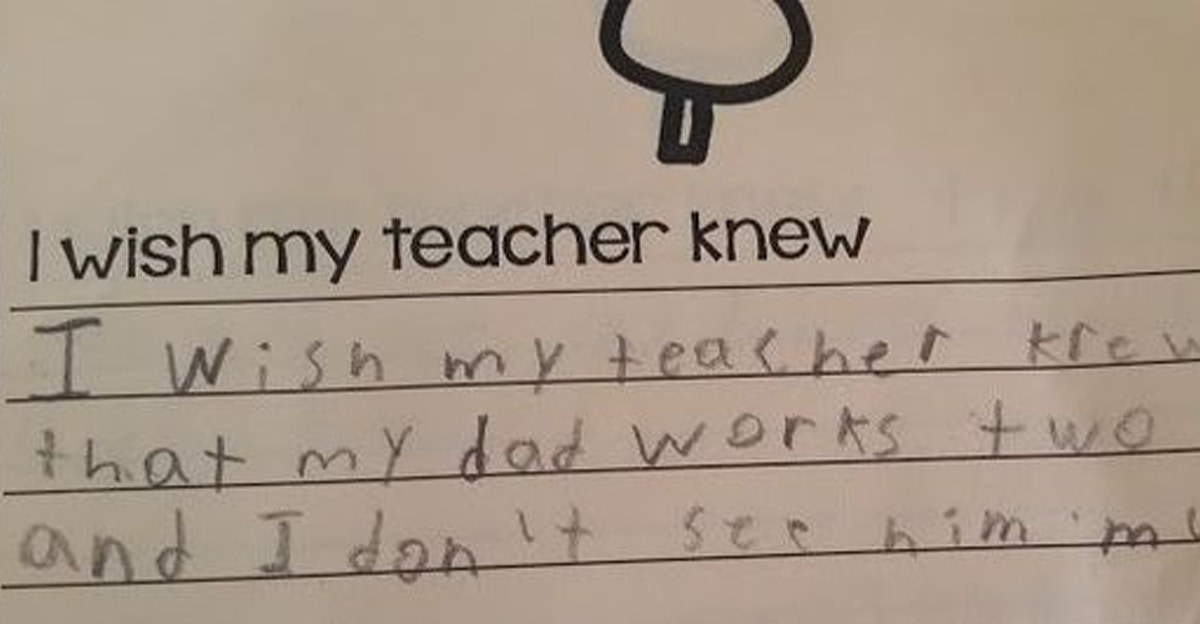
Five years ago, Kyle Schwartz asked her Doull Elementary class to fill in the blank: “I wish my teacher knew ______.”
Her students’ answers shocked her, and she shared some of the notes on Twitter.
One read: “I wish my teacher knew how much I miss my dad because he got deported to Mexico when I was 3 years old and I haven’t seen him in 6 years.”
Another read: “I wish my teacher knew sometimes my reading log is not signed because my mom is not around a lot.”
Other students talked about having no friends, being bullied and lacking school supplies at home. Here are nine of the notes:
1. The kids shared thoughts about parents who were rarely home.
“I wish my teacher knew that my dad works two jobs and I don’t see him much.” All photos via Kyle Schwartz.
2. They explained that their parents were divorced.
“I wish my teacher knew that my mom got divorce 3 times.”
3. They told her they were living in shelters.
“I wish my teacher knew that my mom and I live in a shelter.”
4. They said they worried about their siblings every night.
“I wish my teacher knew that my little brother gets scared and I get worried about getting up every night.”
5. They talked about feeling disconnected from their peers.
“I wish my teacher knew that my dad died this year, and I feel more alone and disconnected from my peers than ever before.”
6. They shared secret family struggles.
“I wish my teacher knew that my mom and dad are divorced and that I am the middle child of 7 kids. 5 out of that 7 or (are) boys.”
7. They revealed what they love most in the world.
“3 things I wish my teacher knew about me: 7 kids in my family, me being the second to youngest. I play basketball. I think I’m really good at writing.”
8. They explained worries about having a place to sleep at night.
“I wish my teacher knew that my mom might get diagnosed with cancer this week and I have been without a home 3 different times this year alone.”
9. They even shared intimate details about their relationships with their parents.
“I wish my teacher knew that I got kicked out of the house because of my mom’s girlfriend, and now I don’t have a relationship with my mom because of it.”
“When students feel like they have a voice, that they’re heard, they’re really more open,” Schwartz told local station KUSA last year. “They’re more able to take risks in school.”
The majority of Schwartz’s students live close to or below the poverty line, and 50% are learning English at school, she said. About 44% of children in America live in low-income families, according to the National Center for Children in Poverty.
Schwartz started sharing the notes two years ago, and people responded — teachers, parents, child advocates, and more.
Instructors, even one working with Syrian refugees in Greece, began implementing the exercise in their own classrooms. Many share responses using the hashtag #IWishMyTeacherKnew.
“In my classroom, I can impact 30 students,” Schwartz said. “When I share, I can impact classrooms around the world.”
So in July, Schwartz published “I Wish My Teacher Knew,” a teacher’s guide to address poverty, grief, and home life in the classroom.
The book is full of student notes and stories like these as well as Schwartz’s experiences and research on child poverty.
The cover of Schwartz’s book.
Each chapter includes “teacher tools, too — actionable steps that teachers can take in their classrooms to make change,” Schwartz said. The tips include having a food drawer with granola bars available to students who might be hungry and creating a memory book with students grieving a loss.