Whether you’re typing out a text, drafting an email, or even handwriting a sentence with good old-fashioned pen and paper, switching between uppercase and lowercase letters is probably second nature. Unless, of course, you’re Gen Z with an aversion to any and all grammatical rules holding this fragile world together…but that’s a different conversation.
Point being, while most of us know the names of these two basic fixtures of writing, we don’t know the surprising history behind how they got their names.
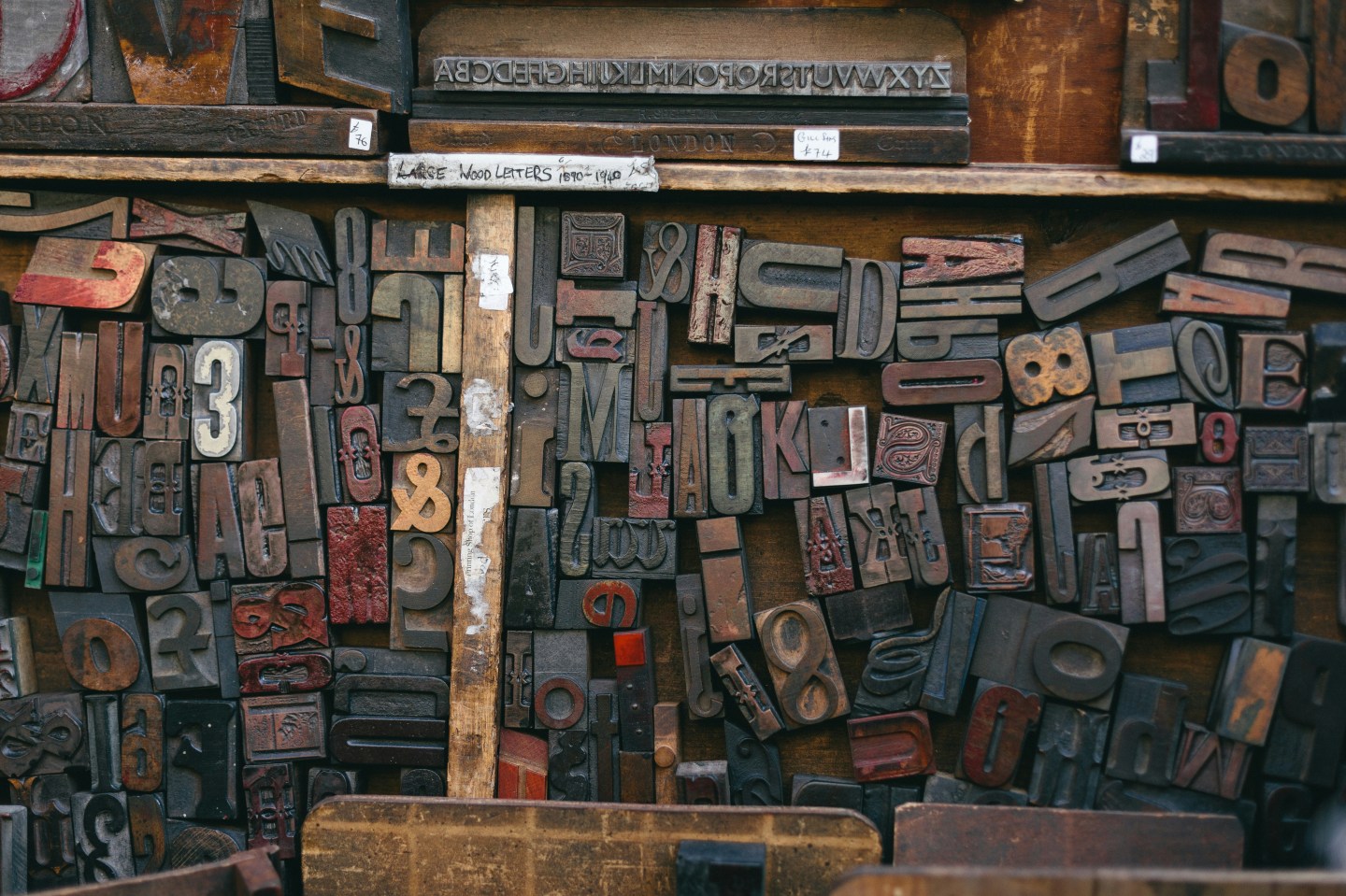
Our story begins in Europe, with the invention of movable type. Which, as we know, transformed how books were produced. These giant machines assembled words by arranging individual letters, each one encased in a reusable block. Getting those letters into the right order required meticulous organization, and that’s where the terminology we still use today began to take shape.
Cases. Actual, literal cases.
Printers store their metal type in wooden trays called, you guessed it, cases. Capital letters were in the upper tray, while smaller letters stayed in the lower one, conveniently positioned for frequent use.
According to the Oxford Dictionary (paywall), one of the earliest documents referencing “uppercase” and “lowercase” appeared in 1683, in Joseph Moxon’s printing manual, Mechanick Exercises, or the Doctrine of Handy-Works Applied to the Art of Printing.
In short, the names originally described the physical storage system. Over time, that became the standard terms for the letters altogether.
As linguist and language expert Noel Wolf explained to HuffPost, “The terms are more literal than people tend to assume.”
Capital and small letters have an even older history, though
Printing might have given us “upper” and “lower” case, but the distinction between capital and small letters developed much, much earlier.
Ancient Greek and Roman writing commonly used majuscule, a handwriting style featuring relatively large formal letterforms. Smaller letters, known as minuscule, emerged as handwriting evolved and people found more efficient ways to write.
The smaller forms were often easier to produce quickly, with rounded shapes that flowed together (probably the psychology behind the Gen Z habit of texting without any caps). Some letters developed ascenders, which extend above the main body of a letter, and descenders, which stretch below it. The stem of a “b” and the tail of a”p” are familiar examples.
But in the late eighth century, the ruler Charlemagne pushed education reform that standardized written Latin. The resulting Carolingian minuscule helped establish a recognizable system wherein small letters appeared alongside capitals to symbolize beginnings, titles, and place emphasis where needed.
Printers would then hold onto this organizing principle.
Other languages use different approaches
The two-case system is so natural to native English speakers that it can be easy to assume that it is universal. But in reality, many writing systems, including Arabic, Hebrew, Korean, Thai and Chinese, don’t distinguish between uppercase and lowercase letters. Instead, they use spacing, punctuation, and other conventions to convey capitalization.
Even other languages that do use tw cases sometimes play by their own rules. German, for instance, capitalizes all nouns, while English uses them almost exclusively for proper names and the beginning of sentences.
You probably don’t think about the fact that something as seemingly meaningless as pressing a Shift key on your laptop contains centuries’ worth of human history. But then again, every aspect of our lives does. And that’s the really cool part about learning stuff like this: not just having a weird fun fact, but actually connecting with the people who made our lives today possible.