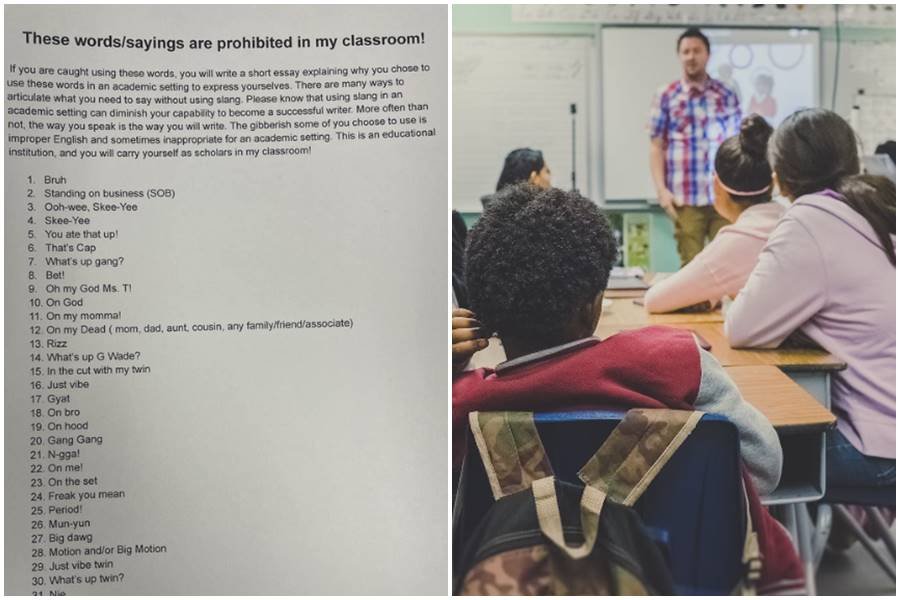
A teacher has sparked a passionate debate on X after a letter they wrote banning 32 words from being spoken in the classroom was made public. The discussion is centered around whether a teacher has the right to control how their students talk in class.
The letter has been seen nearly 44 million times on X.
“The gibberish some of you choose to use is improper English,” the teacher declared. “There are many ways to articulate what you need to say without using slang. Please know that using slang in an academic setting can diminish your capability to become a successful writer. More often than not the way you speak is the way you will write.”
“This is an academic institution, and you will carry yourself as scholars in my classroom,” the teacher added.
According to the letter, if students are caught using any of the 32 banned words in their classroom, they will be assigned to write a short essay explaining why they chose “to use these words in an academic setting.”
Words on the list include bruh, standing on business, on my momma, big motion, gyat, gang gang, on hood and rizz (short for charisma). The teacher also banned the use of the n-word.
Given that much of the slang on the list derives from African American Vernacular English (AAVE), many believed that the word ban was racially motivated. However, the teacher’s race has never been disclosed.
Seems anti black to me— Saint (@__lamar) January 7, 2024
There isn’t a Black child in the public school system who doesn’t know how to code switch. This is targeted.— RandomWhiteGuy? Heretic & Disheveled Misfit (@TheReelRandom) January 10, 2024
The list caused a lively debate on X, and many people joked in the comments that they didn’t think they would last a day in the teacher’s class.
First 5 minutes ??— ?????????????★ (@hearts4zaniyahh) January 7, 2024
Many people supported the teacher and believed slang is inappropriate in an academic setting, especially in an English class. They appreciated the teacher challenging them to change their word choice based on the setting.
1. Accurate and correct.
2. Sounds like a black teacher trying to help black kids elevate.— Dre Baldwin | #WorkOnYourGame (@DreAllDay) January 7, 2024
Good teacher. Not an easy stand to take. This will benefit the kids' education, lives, and careers.— Town Square Man ☕️ (@TownSquareMan) January 8, 2024
It appears this is a class full of inspiring writers and it also appears this lecturer is rightfully setting standards to improve their chances of success in the real world.
Imagine how people have found a way to demonize standards. SMH— Tuoyo (@JustTuoyo) January 7, 2024
I like this. Challenging students to articulate themselves without slang is good. They need to know how to write and speak properly.— Chi. (@ByEzenwanyi) January 8, 2024
i never thought i would see the day that teaching kids how to be functional adults would be frowned upon pic.twitter.com/Yb7rPAYXzt— jonxlewis ?? (@jonxlewis) January 7, 2024
Being able to talk with and without slang and adapt to whatever room or surroundings you’re in is important.
Just ask yourself this, how would feel if you were in court, with your life in the hands of a judge and jury and your lawyer used all of these words and phrases? ? pic.twitter.com/bKTOjTkRDZ— Agonaldinho?? (@Agonaldinho) January 11, 2024
The list also bothered many people who thought the teacher should be able to distinguish between the student’s speech and the work they do in class. For most people, there is a big difference between how they casually speak with peers and how they write in an academic or professional setting.
Many also thought the teacher was overstepping their bounds by trying to control how the students spoke.
She’s on a power trip & and doesn’t value the language of her students. She is more concerned with compliance than learning about her students, because she does not value her students’ identities.— Alyssa Rose (@AH_Belonging) January 7, 2024
So you as a teacher want to take away the right of speech to students? Why not let them talk how they talk? Dont you as a teacher know how people talk?
You can’t just police their words, slang and lingo and expect them to talk a different way, that isn’t realistic and that’s…— Mike Hanning (@Mikenaniyoka246) January 8, 2024
Let me write the essay on how the way I choose to speak isn’t the way I’ll write. This teacher needs to vibe out for real.— streaming on kick (@dabbunny710) January 8, 2024
I get where they're trying to go with that but I don't agree with cutting out slang. Language is always evolving and there's more than one way to speak English. This just seems like power tripping and respectability politics to me ?— Brindille (@twig_lalaland) January 7, 2024
One person had a practical solution the teacher could use instead of banning certain words. Instead, they could teach them to dig deeper into their meaning and find words and phrases that have a similar meaning.
As a middle school teacher, I relate to banning bruh. Instead of this draconian response, the teacher is making the words more popular. Instead, she could assign them as vocabulary words, then challenge the students to find synonyms, especially curse words from Shakespeare.— RobinRadlauer-Cramer (@robradreads) January 21, 2024
Pritay Washington, an expert on childhood education at the Education Development Center, told Newsweek that she believes the students should be allowed to use slang in the classroom because it has an essential function: it helps them feel like they belong in school.
“So much happens in middle and high school beyond the learning of classroom content. Students are developing cognitively, mentally, socially, emotionally and physically,” she told Newsweek. “They are honing their critical thinking skills and learning how to navigate the world around them. The importance of student engagement is critical, and this includes representation. Students’ sense of belonging matters.”