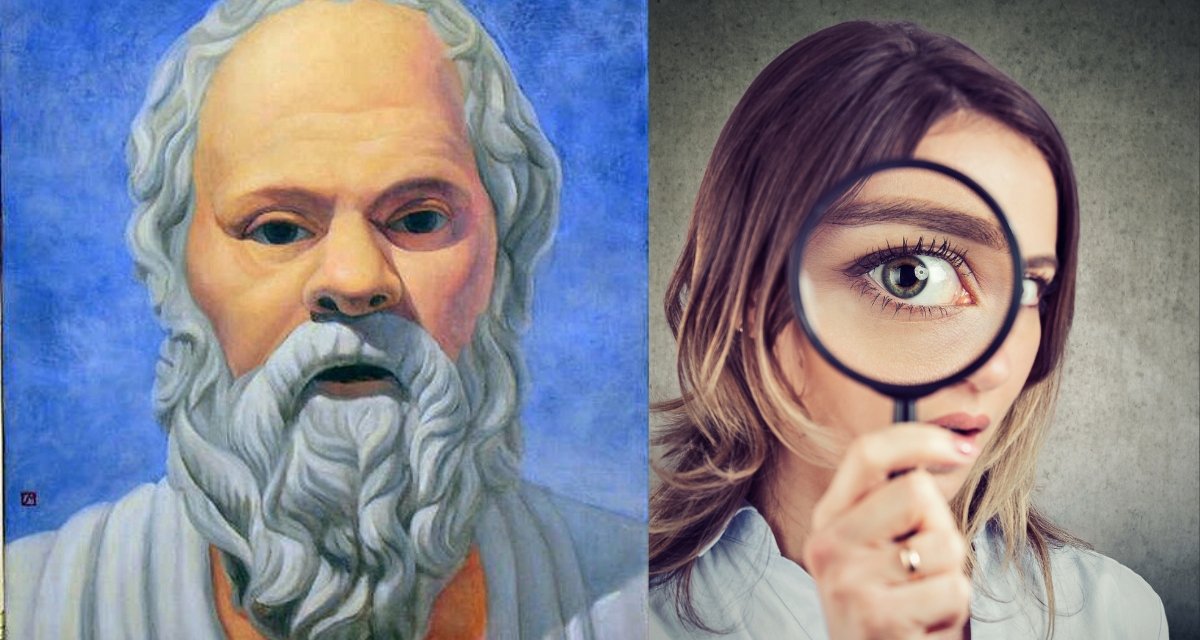
For someone who didn’t personally write down his thoughts, Greek philosopher Socrates sure does have a great influence over modern-day thinking. Luckily, one of his protégés, Plato, kept track and shared many of his mentor’s views, which have stood the test of time. This all happened between 300-400 B.C.E., so the fact that we’re still discussing it speaks volumes.
One particular idea from Socrates gets to the root of what makes a person intelligent. According to him, it’s not the elasticity of your mind or the way you were raised, nor how far you’ve traveled or your spatial awareness. Plain and simple, it’s your sheer intrigue and willingness to read and learn. This willingness actually supports the very thing Socrates believed was the biggest indicator of intelligence: curiosity.
‘I know that I know nothing’
Socrates, like his philosopher colleagues, spoke in Ancient Greek, so his ideas and words were often translated slightly differently. But the gist of his theory is this: “I’m intelligent because I know that I know nothing.”
If one starts with the premise that the world is vast with infinite amounts of ideas and lessons, they’re intelligent despite their so-called standardized IQ. In other words, it’s not what you already “know” that shows you’re smart. It’s knowing you have so much to learn.
In a recent YourTango article, writer Marielisa Reyes shares a similar idea that “curiosity is linked to intelligence,” along with ten examples of how curiosity might look. A few of them include: listening to podcasts or watching videos as you fall asleep, actively researching topics and discussing them with others, and a willingness to try new things.
Curiosity and fluid intelligence
In her article, Reyes cites a study posted on the American Psychological Association’s site. Co-authored by researchers Freda-Marie Hartung, Pia Thieme, Nele Wild-Wall, and Benedikt Hell, the study explores the link between “curiosity, fluid intelligence, and knowledge.” The study’s conclusion? “Epistemic curiosity not only fosters the search for new information in the environment and/or the creation of enriched environments but also that it stimulates and trains the ability to identify and infer relations, thus, enhance reasoning ability.”
Just recently, author and modern-day philosopher Eckhart Tolle posted a video where he talked about this very idea. He comments, “Socrates wasn’t the wisest for what he knew. He was wisest for what he stopped pretending to know.” (There were quite a few people in the comments who failed to listen to Tolle’s entire message, which begins, “The reason they call me the wisest of all men,” assuming he’s being egomaniacal.)
What Tolle said in actuality is: “The reason why they call me the wisest of all men is that I’m the only one who knows that he knows nothing.’ That’s what Socrates said, and even that statement is not understood by people who teach philosophy in universities.” He adds, “What he’s actually saying is, ‘I’m the only one who is comfortable with not knowing. That’s why I’m the wisest of all men.’” (Okay, it was still a bit egomaniacal.)
Asking questions
Upworthy spoke with psychotherapist Mary McLaughlin, LCSW, who has an interesting take on the matter: “Curious people tend to notice things, ask questions, and consider possibilities that stretch beyond the limits of their own understanding. Over time, that can help them gather knowledge from a wider range of sources, notice patterns, and make connections that other people may not see.”
She adds that this curiosity can come in handy when a problem needs to be solved. “Intelligence also involves knowing how to apply the information you’ve learned. Because curious people are always gathering information and looking at things from different angles, they may have more to draw from when they need to problem solve.”
And this can also help interpersonally. “In relationships, curious people process information differently. They are interested in a different perspective, can be influenced by new information, and tend to be more thoughtful in how they interact,” she concludes.